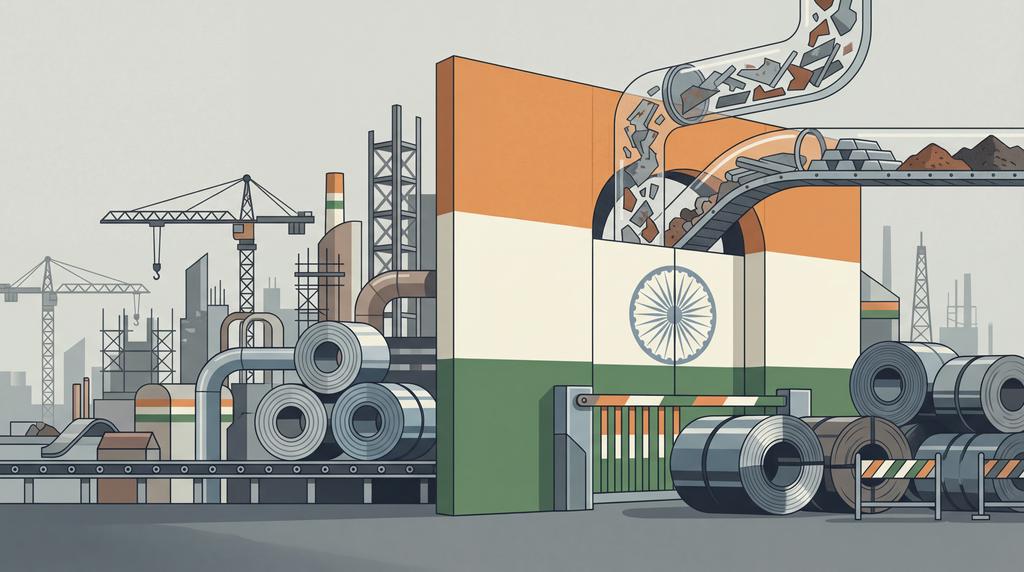
The Indian Stainless Steel Development Association (ISSDA) has recently urged the government to permanently remove customs duties on imported scrap and ferroalloys, and to classify chromium as a critical mineral, in order to support the country’s planned expansion of stainless steel capacity from 7 million mt to 11 million mt. At the same time, ISSDA has also called for stronger measures to address the impact of low-priced Chinese products, warning that some Chinese material may be entering India through third countries such as Vietnam, thereby bypassing existing trade protection measures. These statements suggest that the Indian stainless steel industry is no longer simply asking for “growth support.” Instead, it has entered a more complex phase, where it wants to accelerate capacity expansion while also defending itself against external competition.
Capacity Expansion Is Clear, and India’s Stainless Steel Industry Has Entered a Critical Phase
At first glance, these may look like two conflicting policy demands. On the one hand, the industry wants lower import duties on raw materials to reduce production costs. On the other hand, it is asking the government to tighten import restrictions and strengthen trade protection. But when viewed within the broader industry cycle that India’s stainless steel sector is currently going through, these two demands are not contradictory. They are simply two sides of the same expansion cycle.
For domestic stainless steel producers in India, the most important goal over the next few years is to build up local supply capacity while domestic demand is still growing. ISSDA has previously estimated that stainless steel demand in India will continue to grow by 7%–8% annually over the next two to three years. Against this backdrop, the industry wants to keep raw material costs as low as possible during the expansion phase, while also preventing low-priced imported finished products from eroding returns before local capacity expansion is complete.
In other words, what worries India’s stainless steel industry most right now is not the absence of market demand, but the possibility that demand exists while the gains from expansion are undermined by imports. That is why ISSDA is simultaneously calling for the permanent removal of duties on scrap and ferroalloy imports, while also highlighting the threat posed by low-priced Chinese products. In the industry’s view, lower tariffs on raw materials would improve the competitiveness of domestic manufacturing, while stronger protection on finished products would buy time for local investment, expansion, and capacity ramp-up. This policy logic of “opening the upstream while defending the downstream” is, in essence, a typical industrial development strategy.
Raw Material Security Has Become the Core Condition Behind Expansion
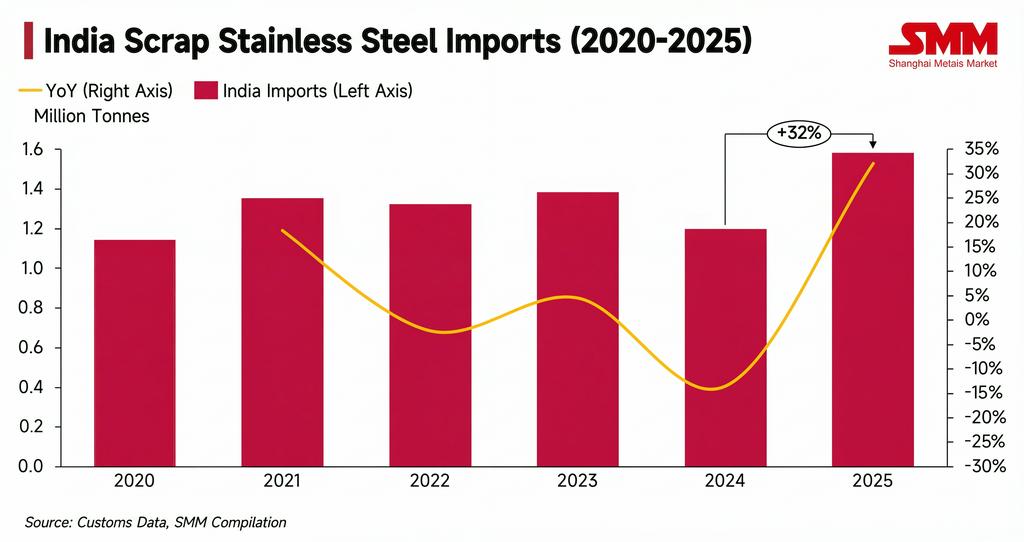
This also reflects the industry’s growing concern over raw material supply. Scrap and ferroalloys are key inputs for stainless steel production, while chromium is a critical element in the stainless alloy system. ISSDA’s specific call to classify chromium as a critical mineral shows that its focus is no longer limited to short-term price issues, but has shifted toward medium- to long-term resource security. India has long been the world’s largest importer of stainless steel scrap. Data shows that its stainless scrap imports rose to 1.58 million mt in 2025, up significantly from 2024, further underscoring India’s continued reliance on overseas scrap supply.
For a country aiming to expand stainless steel capacity from 7 million mt to 11 million mt, whether the raw material supply system can scale up in parallel will directly determine whether that expansion can actually be delivered. If import costs for scrap and ferroalloys remain high, or if chromium supply security proves insufficient, then even the most ambitious capacity plans could face rising costs, margin pressure, or slower project execution in practice.
From the industry’s perspective, therefore, removing duties on imported raw materials and strengthening critical mineral management are not isolated policy demands. They are essential supporting measures for the broader expansion target. India’s stainless steel industry wants to secure the raw material base first before further releasing capacity, reflecting a deeper concern for supply chain completeness and long-term sustainability.
Demand Continues to Grow, but Cheap External Supply Creates Real Pressure
On the demand side, India is still seen as one of the most important growth markets for stainless steel consumption globally. With the development of manufacturing, continued infrastructure investment, and upgrading in end-use consumption, India’s stainless steel demand is expected to maintain relatively strong growth, providing a solid foundation for capacity expansion.
The challenge, however, is that demand growth does not automatically mean domestic producers will benefit. If most of the incremental demand is captured by imported material, India may see consumption expand without domestic industry benefiting to the same extent. In this context, ISSDA’s concerns over Chinese oversupply spilling into India become particularly sensitive.
According to media reports, ISSDA believes China has more than 8 million mt of excess stainless steel melting capacity, and that this material is seeking overseas outlets, with India standing out as one of the most attractive target markets. The reason is straightforward. On the one hand, India is itself a growth market. On the other hand, its domestic supply system is still in the process of expanding and has not yet built an unshakable market barrier, making it more exposed to external supply pressure.
For Indian mills, this pressure is not only reflected in price competition, but also in investment expectations. When an industry is in the middle of an expansion phase, companies need a relatively predictable margin environment to support new investments, depreciation costs, and capacity ramp-up. If large volumes of low-priced imports continue to flow in during this period, domestic producers may struggle to convert rising demand into actual returns.
The Risk of Rerouted Trade Is One of India’s Bigger Concerns
Another important point in ISSDA’s latest statement is the issue of rerouted trade. The association warned that some Chinese steel products may be entering India through third countries such as Vietnam, thereby bypassing existing trade protection measures.
This concern is easy to understand. In recent years, amid ongoing global trade friction and stricter origin management, practices such as third-country rerouting, supply chain detours, and origin restructuring have come under increasing scrutiny. For India, this means that even if trade protection measures exist on paper, actual import pressure may not disappear in practice.
In other words, what truly concerns the industry is not simply whether tariffs or barriers exist, but whether these measures can actually work as intended. If external supply can continue entering India through more complex trade routes, then the competitive pressure facing domestic producers will not ease in any meaningful way, weakening the real impact of policy protection.
India’s Core Objective Is to Turn Demand Advantage Into Industrial Advantage
At a deeper level, India’s stainless steel industry is moving from a stage of demand-driven growth to one of broader industrial competition.
In the past, discussion of India’s stainless steel market often focused on its consumption growth potential, including its large population base, urbanization, and manufacturing upgrade. But as consumption continues to expand, the question is no longer simply whether demand will grow, but who will ultimately capture that growth.
If domestic demand keeps rising while most of the incremental market is filled by imports, India may become a major consumption market without necessarily becoming a true manufacturing powerhouse. What ISSDA is now pushing for is, in effect, the key step needed to turn India’s demand advantage into industrial advantage.
That is why the industry is asking the government to lower upstream raw material costs while at the same time strengthening trade defense at the finished-product end. The underlying logic is not simply to reject imports, but to create a more supportive environment for domestic manufacturing to grow and attract investment.
The Direction of Future Policy Is Worth Watching
Viewed within the broader competitive landscape of the Asian stainless steel market, India’s position is actually becoming quite clear. It does not want to remain merely a consumption market. It wants to become a more complete domestic manufacturing center. That means its policy stance is likely to continue along a dual-track approach: more openness toward key raw materials, and greater caution toward finished-product imports.
For the market, there are several developments worth watching. First, whether India will further reduce import duties on scrap and ferroalloys on a long-term basis, or even establish a more stable policy framework for raw material support. Second, whether chromium will be formally included in the country’s critical mineral system, thereby strengthening resource security. Third, whether India will step up anti-dumping, anti-circumvention, and origin-related scrutiny, especially against third-country rerouting paths.
If these directions gradually materialize, they could reshape competition in India’s stainless steel market, alter its import structure, and even change broader resource flows across Asia.
Conclusion
Overall, ISSDA’s latest public stance does not simply signal another trade friction issue. It reflects the broader priorities of India’s stainless steel industry as it enters a new stage: securing raw material supply and cost competitiveness for expansion, while also preventing low-priced external supply from undermining domestic industry during a critical window.
Whether India’s stainless steel story can evolve from one of consumption growth into one of manufacturing rise may depend not only on the pace of demand growth itself, but also on whether the government can build a policy mix that effectively balances resources, tariffs, and trade protection in a way that genuinely supports domestic industrial upgrading.
Written by: Bruce Chew | bruce.chew@metal.com +601167087088
![[SMM Analysis] Weak End-User Demand but Firm Costs, High-Grade NPI Prices Rose Steadily](https://imgqn.smm.cn/usercenter/GmHLU20251217171733.jpg)
![[SMM Analysis] Inventories Fall Below 1 Million mt, Costs and Geopolitical Risks Keep Stainless Futures Elevated](https://imgqn.smm.cn/production/admin/votes/imagesFURVz20260313180700.jpeg)