With the rapid development of the sodium-ion battery industry, the industrialisation and scale effect of localised hard carbon anodes have become core issues of industry concern. Progress in 2023 indicates that the industrialisation of hard carbon anode materials is a decisive factor for the large-scale application of sodium-ion batteries. This not only promotes the localisation of other raw and auxiliary materials for sodium-ion batteries but also significantly enhances the overall scale effect of sodium-ion batteries.
The key to hard carbon anode materials lies in raw materials and production technology. Production technology directly impacts the choice of raw materials. Once the issues of hard carbon and its production technology are resolved, the market is expected to see opportunities worth billions. According to calculations, the shipment volume of sodium-ion battery anodes in 2024 is estimated to be around 5,000 mt, and the demand in 2025 is expected to far exceed 20,000 mt.
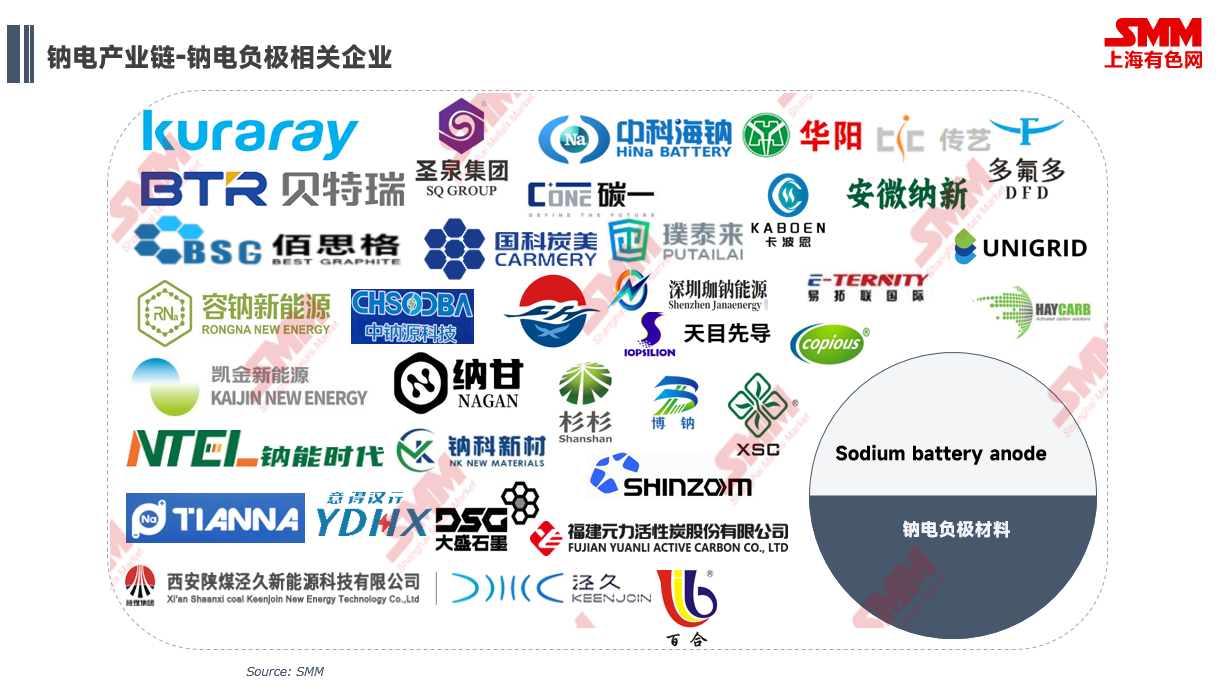
In the industry, dozens of companies have jointly formulated hard carbon standards, categorising them into four types: resin, plastic, bio-based, and fossil-based. Traditional hard carbon types include resin, bio-based, and fossil-based, while plastic-based hard carbon, mainly using plastic and waste plastic as raw materials, was newly classified this year. Compared to other types, plastic-based hard carbon shows significant differences in standards and specifications.
Currently, bio-based hard carbon is the most invested field, but its large-scale production is difficult, and its capacity is insufficient. Although resin-based hard carbon is costly, it is also an option. Plastic-based hard carbon holds an advantage due to its low cost.
Domestically, the planned production capacity in the hard carbon field has exceeded 600,000 mt/year. The consistency of single-variety hard carbon at the 10,000 mt level plays a crucial role in the scale and cost reduction of the sodium-ion battery industry. Consistency in hard carbon is one of the key factors affecting the scale of sodium-ion battery cells. Good consistency in hard carbon results in small performance differences in battery cells, high grouping efficiency, and long cycling life after grouping. Good consistency in hard carbon also leads to a high yield rate of battery cells, lower investment and usage costs after grouping. The consistency of hard carbon impacts the economic benefits of sodium-ion battery cell manufacturers and the cost of large-scale production and use of sodium-ion batteries. Therefore, the consistency of single-variety hard carbon at the 10,000 mt level is a decisive factor for the large-scale production of sodium-ion batteries.
Localisation and Industrialisation Direction and Focus of Sodium-ion Battery Anodes
The key to technological iteration in the sodium-ion battery industry lies in the hard carbon anode. Currently, domestic sodium-ion battery anode companies are developing more rapidly. By 2025, when sodium-ion batteries start to scale up, the market share of imported sodium-ion battery hard carbon anodes will be greatly diluted. Applying the logic of lithium batteries, the scaling up of sodium-ion batteries refers to the shipment of 10,000 mt of sodium-ion anodes and 8 GWh of sodium-ion battery cells.
In the development prospects of hard carbon, in the short term, it mainly relies on bio-based materials, whose mature process can be quickly applied and reduce costs. In the long run, the goal is to mass-produce resin-based hard carbon (e.g., phenolic and plastic precursors), with coal-based and asphalt as supplementary materials. In the future market, resin-based, bio-based, and fossil-based hard carbon may form a tripartite structure, each showing advantages in different market segments.
In the next stage, the entire sodium-ion battery anode industry needs to solve the consistency issue of single-variety hard carbon at the 10,000 mt level. Consistency determines whether sodium-ion batteries can be scaled up, whether they can reduce production costs through scaling up, and whether sodium-ion batteries will be a niche market or a heavyweight market comparable to lithium batteries.
Overall, the logic of China's sodium-ion battery industrialisation is: the first step is to survive, the second step is to reduce costs and achieve profitability, and the third step is to innovate for technological leaps and achieve long-term development.
The first step is to survive. First, manufacture low-cost battery cells and form a complete industrial chain. Leverage the advantages of sodium-ion batteries in specific differentiated markets, such as superior low-temperature performance, excellent rate performance, and high safety, to promote sales and thus launch the entire industrial chain. Each link of the industrial chain undergoes running-in and verification to ensure smooth overall operation, enabling the sustainable development of the industrial chain.
The second step is to reduce costs and achieve profitability. After a period of running-in, the sodium-ion battery industrial chain preliminarily verifies key links and identifies core obstacles to the growth of the industrial chain. Currently, the main bottlenecks of the industrial chain are solving the consistency issue of hard carbon and the cost issue of large-scale production. After multiple teams' various attempts in the early stages of hard carbon industrialisation, a feasible solution has begun to take shape: ensuring consistency through small molecule synthesis precursors, using mature petrochemical low-cost small molecule polymers to reduce raw material costs and expand raw material supply. Additionally, innovative simplification of the hard carbon production process can reduce investment and production consumption, focusing on producing balanced performance low-cost products, thereby accelerating large-scale production and rapidly reducing costs, promoting the industrial chain to achieve profitability as soon as possible.
The third step is innovation for technological leaps and long-term development. After the industrial chain becomes profitable, the R&D, production, and sales links achieve a virtuous cycle, further increasing technological investment, improving sodium-ion battery material and battery technology, achieving rapid technological iteration on the basis of further cost reduction, enhancing the performance of sodium-ion batteries, expanding the application fields and market of sodium-ion batteries, thereby achieving leapfrog development, and ultimately forming an industry comparable to lithium batteries.
![[SMM Tóm tắt cuộc họp buổi sáng về Cobalt] Kỳ vọng phục hồi nhu cầu tăng lên, giá chuỗi ngành vẫn trong giai đoạn thương lượng yếu](https://imgqn.smm.cn/usercenter/hSSxt20251217171722.jpeg)
![[Biên bản cuộc họp sáng SMM Cobalt-Lithium] Nguyên liệu thô củng cố ở vùng đỉnh nhưng phân hóa; kỳ vọng về mùa cao điểm vật liệu dần nóng lên](https://imgqn.smm.cn/usercenter/WgbTp20251217171727.jpg)
![[Biên bản cuộc họp sáng SMM về coban] Giá chuỗi ngành coban chịu áp lực trong mùa cao điểm; tín hiệu phục hồi nhu cầu vẫn chưa được xác nhận](https://imgqn.smm.cn/usercenter/CkvAg20251217171724.jpg)