Lithium is the most active metal among the known elements, and is also the metal with the smallest density and lightest mass. It has a series of excellent properties such as soft texture, high specific heat, large ionization potential and polarization coefficient. Lithium-ion batteries supported by lithium compounds have the characteristics of high open circuit voltage, high specific energy, wide operating temperature range, discharge balance, and self-discharge of electrons. It has long-term rigid demand and demand prospects in the field of new energy vehicle power batteries and energy storage, and is also called "battery metal". At the same time, lithium has important strategic value. Especially in recent years, its application scope in the battery industry, special engineering plastics and other fields has been continuously expanding. Therefore, lithium is known as the "new energy of the 21st century."
Since lithium only exists widely in nature in the form of compounds, there are many natural lithium-rich minerals on Earth. These minerals are categorized into salt lake brine type, pegmatite type (including related granite and greisen types), clay type, lithium zeolite type, other brine types (currently including two subtypes: oilfield brine and geothermal brine), and ion adsorption type. Among them, the salt lake brine type is singled out from brine lithium mines due to its vast resources and convenient development methods. Pegmatite lithium mines are categorized separately due to their widespread distribution, large resource volume, and high development degree. Other types of lithium mines are also distinguished from each other due to their unique causes or occurrence states.
Among these resources, due to environmental protection requirements, production costs, and mining technology issues, lithium resource supply is mainly divided into two types: salt lake brine and pegmatite.
II. Lithium Industry Development Policies
In recent years, China has introduced a series of policies to support and regulate the development of lithium resources, aiming to promote the sustainable development and utilization of lithium resources. The table below shows the policies:
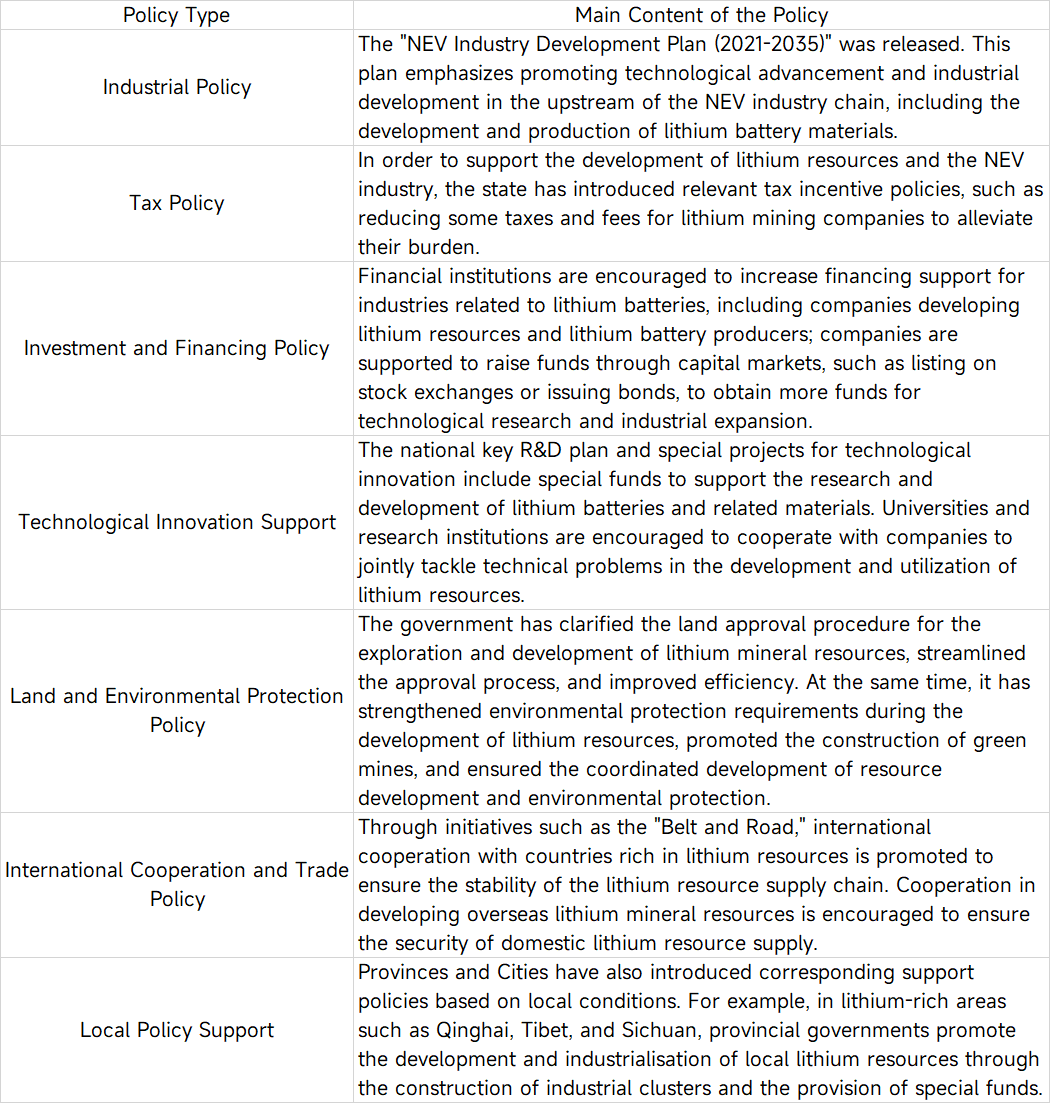
The introduction of these policies has greatly promoted the development of lithium resource development and related industries in China, providing a solid resource guarantee for the new energy sector, especially NEVs.
III. Current Status of Lithium Resource Distribution
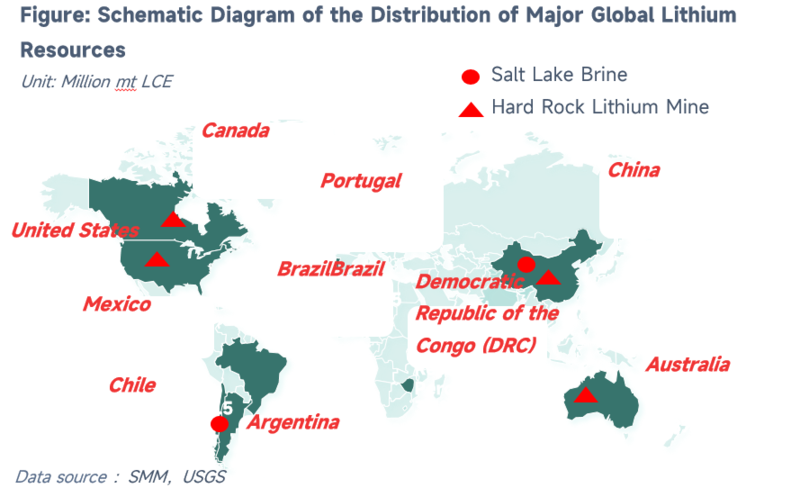
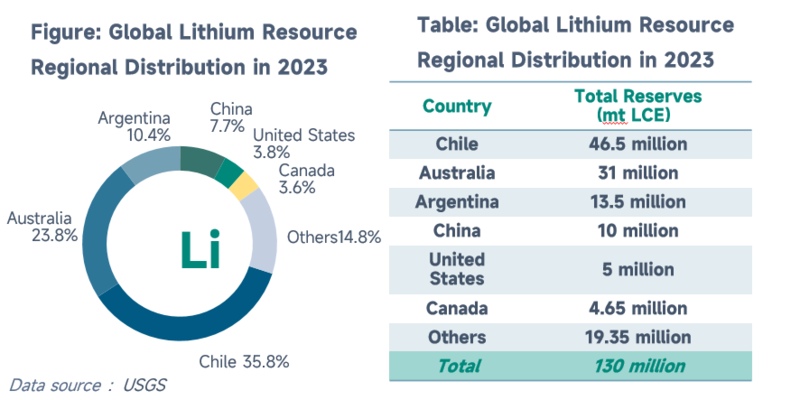
As shown in the figure above, global lithium resources are abundant but unevenly distributed. According to the US Geological Survey 2023 data, global lithium resource reserves total 26 million mt in metal content, equivalent to about 130 million mt LCE. The top five countries in the world in terms of lithium resources are Chile, Australia, Argentina, China, and the US, together accounting for 85% of the total.
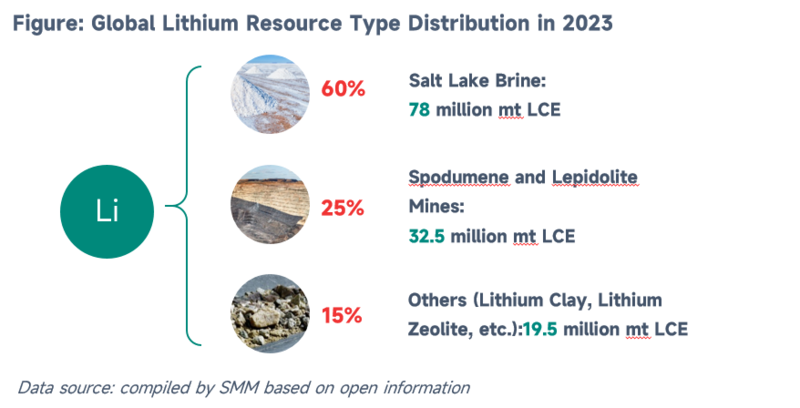
Global lithium resources can be roughly divided into ore lithium and brine lithium, as shown in the figure below. Lithium resources are mainly found in salt lake brine, spodumene, and lepidolite, with a combined proven reserve of about 85%. Among them, salt lake brine lithium accounts for 60% of the world's lithium reserves and is currently the main source of global lithium resources.
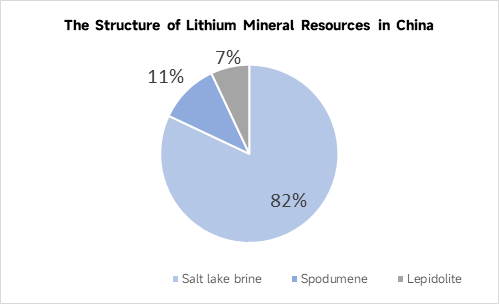
China's lithium resources are mainly from salt lakes, and it is the largest lithium salt producer through imports. According to the China Geological Survey, in China's lithium resources, salt lake brine, spodumene, and lepidolite account for 82%, 11%, and 7% of the total, respectively. Salt lake brine resources are mainly distributed in Qinghai and Tibet, spodumene is mainly distributed in Sichuan and Xinjiang, and lepidolite is mainly concentrated in Jiangxi.
IV. Lithium Industry Chain Structure
The lithium resource industry chain is mainly divided into three aspects: upstream mining, midstream smelting, and downstream applications. In the upstream sector, lithium resources are mainly divided into lithium ore and salt lake. In the midstream smelting sector, the main products are lithium carbonate, lithium hydroxide, and lithium chloride. Among them, as spodumene concentrate (average 6%) has a higher lithium oxide content than lepidolite concentrate (average 2.2%), spodumene concentrate has higher lithium extraction efficiency and better product quality, mainly used for producing battery-grade lithium carbonate and battery-grade lithium hydroxide. Lepidolite concentrates are mainly used for producing quasi-battery-grade lithium carbonate and industrial-grade lithium carbonate. Due to the high content of impurities such as potassium and magnesium in salt lake lithium extraction, most products cannot reach battery grade, so industrial-grade lithium carbonate is mainly produced.
In the midstream materials and application end, battery-grade lithium hydroxide is mainly used to produce high-nickel ternary materials, which are used in NEVs with higher mileage and energy density. Battery-grade lithium carbonate is mainly used to prepare mid-to-low-end and low-end ternary materials which are applied in some mid-end NEVs and two-wheelers, and also to prepare LCO cathode materials that are applied in high-rate demand 3C digital products such as mobile phones, tablets, laptops, and drones. Industrial-grade lithium hydroxide is mainly used to prepare traditional industrial lubricants and catalysts, and industrial-grade lithium carbonate is mainly used to prepare low-cost LFP and LMO materials which are used in most low-end NEVs and two-wheelers. Industrial-grade lithium carbonate is also used to prepare electrolyte raw material LiPF6 which is mainly used in glass ceramics, pharmaceuticals, primary batteries and other traditional industries.
V. Current Status and Outlook of the Lithium Industry
1. Current Status of the Lithium Industry
Looking at China's lithium industry development, it is mainly divided into the nascent period, overheating period, rational period, recovery period, and maturity period. At this stage, all sectors of the lithium industry chain are gradually evolving from the overheating period to the rational period to varying degrees, with companies increasingly focusing on reducing transaction costs. Looking ahead, improving competitive barriers, reducing production costs to enhance economic benefits, and stabilizing production and operations are the directions for enterprise development. For upstream lithium mines, lithium resources dominated by spodumene and salt lake are expected to maintain significant growth in the future, with steadily increasing lithium mine supply and the release of recycling volumes, further supporting the healthy development of the lithium industry. For lithium salt companies, lithium salts have rapidly developed from the nascent period to the overheating period and rational period. Since 2022, the supply-demand mismatch has caused significant price fluctuations, but in 2023, due to the gradual release of supply and the impact of subsidy reductions, lithium salt prices rapidly declined. From 2024 onwards, cost reduction and efficiency improvement while ensuring stable and healthy production is one of the main goals for lithium salt producers.
2. Outlook for the Lithium Industry
In the lithium mine sector: Strengthen geological exploration and resource evaluation, comprehensively assess potential lithium mine resources to accurately grasp the distribution and reserves of deposits, and establish geological data sharing platforms between regions and countries to promote international cooperation. Adopt modern, automated mining and production equipment to improve production efficiency and safety. Conduct detailed environmental impact assessments before mine development and properly handle mine waste to reduce pollution and damage to the surrounding environment, and ensure environmental protection and sustainable development. Conduct in-depth market analysis, study market demand, and formulate reasonable development strategies.
In the lithium salt sector: Based on China's lithium resource characteristics, increase research and application of salt lake lithium extraction technology, establish a stable and reliable raw material supply chain to ensure the continuity and value of production materials, optimize the supply chain, and strengthen cooperation with downstream customers to establish long-term stable cooperative relationships and ensure smooth product sales channels.
For cathode material manufacturers, in addition to strengthening technology research and development and ensuring quality control, managing the supply chain well, whether with upstream lithium salt plants or downstream application end-users, strengthening connections or even expanding the industry chain are effective measures to maintain competitiveness and sustainable development.
For end-users, improving market insight, optimizing product design, and timely adjusting and complying with energy and environmental protection policies of various countries are fundamental to staying invincible.
In addition, for the overall industry, actively participating in the formulation of international trade rules and conventions, improving bargaining power, strengthening the construction of the financial system, and enhancing financing capabilities and international competitiveness are all good aids for healthy and stable development.

![Phân tích sản lượng lithium sulfide cấp pin tháng 8: Quý 4 có bùng nổ không? [Phân tích SMM]](https://imgqn.smm.cn/usercenter/mpqgn20251217171727.jpg)