SHANGHAI, Sep 2 (SMM) - Not long after the stringent power rationing policy in Sichuan, Yunnan, another aluminium production hub, has also suffered from hydropower shortages recently, triggering concerns over potential output reduction in the province. SMM’s latest survey showed that most of the aluminium smelters in Yunnan are currently in normal operations, but they have expressed concerns over the future power supply. Many aluminium smelters in Yunnan have recently undertaken orderly electricity consumption and practice of power load interruptions. As a major aluminium producing province that relies heavily on hydropower, the operations of aluminium smelters in Yunnan will have a significant impact on the entire aluminium industry.
Aluminium capacity distribution in Yunnan
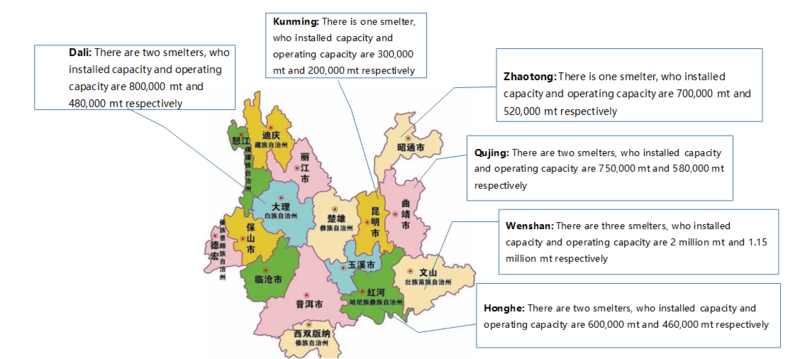
Driven by multiple favourable policies and low-carbon initiative, a tremendous amount of aluminium capacity has been relocated to Yunnan in recent years. In 2021, Yunnan cancelled the preferential power tariff policy to the aluminium industry that it had previously promised, under the requirement of the National Development and Reform Commission (NDRC) in its Notice on Tiered Power Tariffs in Aluminium Industry. Nevertheless, under the push to achieve carbon peak and carbon neutrality goals, Yunnan attracted smelters from other regions to transfer their aluminium capacity to the province by virtue of its abundance of cheaper green hydropower.
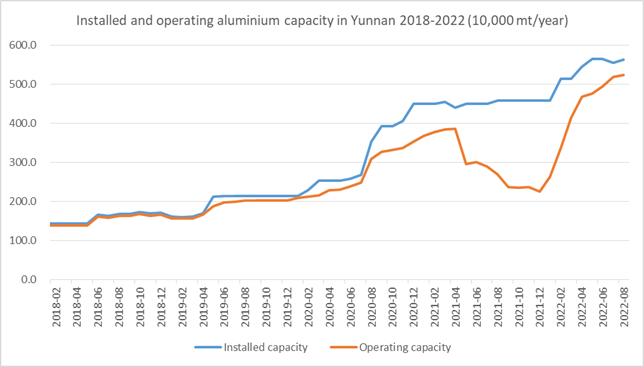
According to the latest statistics of SMM, the installed aluminium capacity in Yunnan currently stands at approximately 5.63 million mt, up 23% year on year and accounting for 12.7% of China's total installed aluminium capacity. As of the end of August, the operating aluminium capacity in Yunnan stood at 5.25 million mt, up 94.4% year on year. As more smelters, such as Weiqiao Group, will transfer their capacity to Yunnan, the installed aluminium capacity in the province looks set to exceed 9 million mt in the future, ranking first in the country.
According to data from the Energy administration of Yunnan, with the 12 big hydropower stations, such as Wudongde, Baihetan, Xiluodu, Nuozhadu, Huangdeng, Guanyinyan and Ludila, being put into operation successively, Yunnan's installed hydropower capacity has surged from 34.99 million kW to 78.2 million kW, ranking second in China. 7 out of the top ten hydropower stations in China are located in Yunnan, which also has 3 power stations of 10 million kW and 14 power stations of 1 million kW. Yunnan's installed power capacity has jumped to 100 million kW, with green energy power generating capacity accounting for about 90%, 60 percentage points higher than the national average. From January to July, Yunnan's industrial power generation above designated size reached 213.11 billion KWH, up 16.1% year on year. Specifically, its hydropower generation stood at 171.03 billion KWH, up 26.8%, and thermal power generation at 25.47 billion KWH, down 17.1%. Clean electricity accounted for 88.1%, 4.2 percentage points higher than the same period last year.
According to the feedback from aluminium smelters in Yunnan, the electricity supply in the province was normal from January to August, and hydropower was abundant in the first half of this year, encouraging local smelters to resume their production or put their new capacity into operation at a faster pace. The operating aluminium capacity in the province constantly refreshed new highs, intensifying the local supply pressure.
Nevertheless, local hydropower companies said that nearly half of the main power stations reported insufficient water supply in August, and the water storage of main reservoirs decreased when compared with last year, which could threaten the power supply in Yunnan this winter and next spring. Based on the current water level and rainfalls, the market is increasingly concerned about the operations of aluminium smelters in Yunnan. Smelters may be subject to power rationing and production curtailment after the dry season arrives.
According to SMM's preliminary estimates, the domestic installed aluminium capacity totalled 44.47 million mt at the end of August, while the operating capacity decreased 800,000 mt from the end of July to 40.6 million mt. If 20-30% of aluminium capacity in Yunnan is reduced due to the power rationing, the domestic operating capacity may fall below 40 million mt, and domestic aluminium supply pressure will be significantly alleviated in 2022. The uncertainty over future power supply will have an impact on the transfer of aluminium capacity from other regions to Yunnan, and SMM will keep a close eye on the operations of local smelters.
![Tỷ lệ gia công nhôm ổn định ở mức 61,7% khi mùa cao điểm kết thúc [Khảo sát hàng tuần của SMM]](https://imgqn.smm.cn/usercenter/tkWbz20251217171654.jpg)
![Chi phí cận biên suy yếu hỗ trợ; bổ sung công suất làm gia tăng cạnh tranh ngành [Đánh giá tuần Anode nung sơ bộ SMM]](https://imgqn.smm.cn/usercenter/bHIPd20251217171651.jpg)