

At the recent annual shareholders' meeting of Ningde Times, Ningde Times Chairman Zeng Yuqun revealed that Ningde Times will release sodium batteries around July 2021. "when cobalt is fired, everyone goes to be cobalt-free; if nickel is fried, no one wants nickel, but lithium is still there. If anyone goes all out to raise prices here, we will exclude them. Our technology is also developing, our sodium battery has matured, sodium chloride can not stir-fry, (because) there is a lot of salt. "
Sodium battery emerging power battery route will change?
The so-called sodium ion battery is a kind of secondary battery (rechargeable battery), which mainly depends on the movement of sodium ions between the positive and negative electrodes. According to the Zhongtai Securities Research report, sodium and lithium belong to the main group of alkali metals and have similar physical and chemical properties to lithium. Similar to lithium-ion batteries, sodium-ion batteries rely on the reversible migration of sodium ions between positive and negative electrodes to realize charge and discharge. both positive and negative electrodes are composed of intercalated materials that allow sodium ions to be inserted and removed reversibly.
The launch of heavy information in Ningde era has made the market discuss the market prospect of sodium ion, especially whether it will have an impact on the existing lithium-ion battery market. Northeast Securities believes that it is impossible for sodium to replace lithium to become the mainstream technology direction in the field of power. The energy density of sodium battery (generally less than 120Wh/kg) is significantly lower than that of lithium iron phosphate battery (160Wh/kg) and ternary battery and new energy vehicle battery, so there is no possibility to replace lithium battery to become the mainstream technology in power domain. At present, there is no significant advantage in the actual production cost of sodium battery. Although the use of relatively cheap metals can reduce raw material costs, low energy density means more auxiliary materials and manufacturing costs.
Zhongtai Securities also pointed out that compared with lithium-ion batteries, sodium-ion batteries have lower energy density, and future applications may mainly focus on energy storage, low-speed new energy vehicles and small power fields. Lithium-ion batteries are still the mainstream technology route of new energy vehicle batteries. Assuming that the energy storage demand reaches 90 GWH in 2025, and the permeability of sodium ion battery reaches 30% Mel 80%, the demand for lithium carbonate will be reduced by about 170-45400 tons, while the total demand for lithium carbonate will reach more than 1 million tons. the application of sodium ion battery does not change the medium-and long-term high business cycle of lithium carbonate.
Will the nickel-cobalt-lithium craze wheel metal Na also become popular?
After the market learned that Ningde Times will release sodium batteries around July this year, the sodium ion plate rose sharply in the early trading of the first trading day of this week, in which individual stocks, China Salt Chemical, Shengyang shares, and Nanfeng Chemical opened by the daily limit. Huachuang Securities pointed out that 70% of China's lithium resources need to be imported, and sodium-ion batteries are the support and guarantee of lithium-ion batteries. The main scenarios for the development of sodium ion batteries are base stations, electric bicycles and other areas that do not require high energy density, which is expected to have the advantages of low cost and good safety in the future, which is a good supplement to the ternary high nickel technology.
In terms of production capacity, domestic metal Na enterprises account for a large share. According to the annual report of salt and chemical industry in the domestic metal Na leader, the global metal Na production capacity is about 160500 tons in 2020. Of these, 28000 tons are abroad and 132500 tons are domestic. The average operating rate of the metal Na industry for the whole year was 79 per cent, down 9 per cent from the same period in 2019. Among them, salt and chemical metal Na has a production capacity of 65000 tons, accounting for 40.5% of the global production capacity, and its scale and technical advantages are in the leading position in the industry.
At present, benefiting from the growing demand for new energy vehicles, lithium prices continue to rise. As of May 24, SMM lithium carbonate (99.5% battery grade / domestic) has reached 89000 yuan / ton, which has doubled from the price level of less than 40, 000 yuan / ton in August last year. The high price of lithium means a great increase in cost for manufacturers. in the face of the two advantages of low cost of ownership and high safety, the substitution effect of sodium ion battery is considerable.
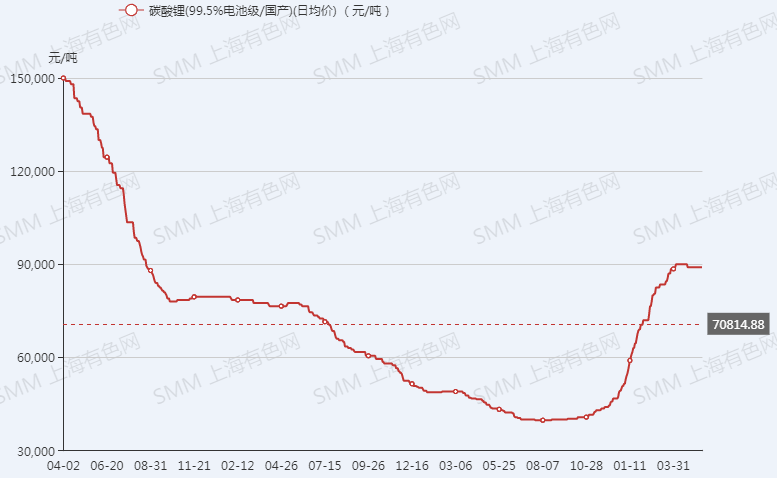
"Click to view the historical price of SMM Metals.
China International Capital Corporation pointed out that sodium battery is expected to become an important supplementary technology in addition to lithium battery, and if there is a shortage of lithium resources in the future, it can be used to achieve large-scale application. In addition, Huajin Securities also believes that sodium power is still in the early stage of industrialization, and it is expected to replace part of the low energy density power lithium battery market and energy storage market after industrialization.
![[Tóm tắt cuộc họp buổi sáng SMM Cobalt-Lithium] Hóa chất lithium củng cố và phân hóa, cuộc chiến cung-cầu chuỗi ngành gia tăng](https://imgqn.smm.cn/usercenter/tKgKv20251217171725.png)
![[SMM Tóm tắt Cuộc họp Buổi sáng về Coban] Nhu cầu mùa cao điểm thấp hơn kỳ vọng, cạnh tranh trong chuỗi ngành tiếp tục gia tăng](https://imgqn.smm.cn/usercenter/eGQFu20251217171723.jpeg)
![[Pin thể rắn: Tianneng Co., Ltd. đạt quy mô giao hàng pin bán thể rắn 314Ah, với các đột phá theo từng cấp độ trên nhiều hệ thống công nghệ]](https://imgqn.smm.cn/usercenter/JmyWy20251217171729.png)