Operating rates at silicon metal plants peaked in December

Đã xuất bản: Jan 14, 2021 14:04
Operating rates at silicon metal producers in China gained 4.8 percentage points on the month to 55% in December, according to an SMM survey. This was 16.1% higher than the same period last year. Higher operating rates in Xinjiang, Fujian, Guangxi, Shaanxi and Hunan offset declined supply from south-west China amid a dry season.
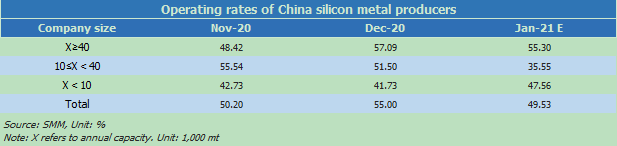
SHANGHAI, Jan 14 (SMM)—Operating rates at silicon metal producers in China gained 4.8 percentage points on the month to 55% in December, according to an SMM survey. This was 16.1% higher than the same period last year. Higher operating rates in Xinjiang, Fujian, Guangxi, Shaanxi and Hunan offset declined supply from south-west China amid a dry season.

High silicon prices also boosted operating rates. In addition, plants in Yunnan Dehong and Nujiang and Sichuan Ya’an, Shimian and Liangshan Mianning maintained operating rates after adjusting to power tariffs in a dry season. Some of them gradually suspended production during end December-early January, while a few planned to operate till the end of January. Operating rates stood at 45.96% and 34.4% in Yunnan and Sichuan respectively in December, up 25.1% and 9.7 percentage points year on year.

Operating rates in Xinjian gained 12.9 percentage points from November to 62.9% in December. Hoshine and East Hope continued to raise their operating rates, with output rising by 15,000 mt compared with November. Hoshine’s 400,000 mt of organosilicon monomer capacity is expected to be brought online in February, and by then its consumption of silicon metal is likely to increase by nearly 10,000 mt per month.

SMM expects operating rates to fall to about 49% in January 2021.

China produced 2.2 million mt of silicon metal in 2020, down 1.6% on the year.

For more information on the silicon metal sector, please subscribe to China Silicon Database.

Tuyên bố về Nguồn Dữ liệu: Ngoại trừ thông tin công khai, tất cả dữ liệu khác được SMM xử lý dựa trên thông tin công khai, giao tiếp thị trường và dựa trên mô hình cơ sở dữ liệu nội bộ của SMM. Chúng chỉ mang tính chất tham khảo và không cấu thành khuyến nghị ra quyết định.

Để biết thêm thông tin hoặc có thắc mắc gì, vui lòng liên hệ: lemonzhao@smm.cn
Để biết thêm thông tin về cách truy cập báo cáo nghiên cứu, vui lòng liên hệ:service.en@smm.cn
Tin Liên Quan
[SMM Chromium Flash] South Africa's July Chrome Ore Exports Hit 2026 High of 2.65 Mt as Buyer Base Broadens
37 phút trước
[SMM Chromium Flash] South Africa's July Chrome Ore Exports Hit 2026 High of 2.65 Mt as Buyer Base Broadens
Đọc thêm
[SMM Chromium Flash] South Africa's July Chrome Ore Exports Hit 2026 High of 2.65 Mt as Buyer Base Broadens
[SMM Chromium Flash] South Africa's July Chrome Ore Exports Hit 2026 High of 2.65 Mt as Buyer Base Broadens
South Africa's chrome ore exports rose to approximately 2.65 million tonnes in July 2026, up 10.3% month-on-month from June's 2.40 million tonnes and the highest monthly total recorded so far this year, surpassing April's previous high. China remained the dominant destination at 1.784 million tonnes, though its share of total exports eased slightly from 67.6% to 67.3% as growth broadened across smaller buyers. The clearest shift came among secondary destinations: Indonesia's imports nearly doubled month-on-month to 150,000 tonnes, overtaking the UAE, whose volumes fell 38.3% to 116,100 tonnes. Indonesia's gain tracks its expanding domestic ferrochrome and stainless steel capacity, while the UAE's decline is consistent with its role as a re-export trading hub rather than an end-use market. South Africa's proposed ITAC export-permit system and export tax remain unimplemented as of July.
37 phút trước
Mỏ Lithium Gwanda đầu tư 5 triệu USD vào tuyển quặng tantal-niobi
57 phút trước
Mỏ Lithium Gwanda đầu tư 5 triệu USD vào tuyển quặng tantal-niobi
Đọc thêm
Mỏ Lithium Gwanda đầu tư 5 triệu USD vào tuyển quặng tantal-niobi
[SMM Flash] Mỏ Lithium Gwanda của Zimbabwe đã đầu tư 5 triệu USD vào nhà máy tuyển quặng tantalum và niobium, được thiết kế để thu hồi lithium, tantalum và niobium từ cùng một dòng quặng. Theo công ty, dây chuyền chế biến mới dự kiến sẽ sản xuất khoảng 300 tấn tinh quặng tantalite và niobium mỗi năm, tạo ra nguồn doanh thu khoáng sản bổ sung từ vật liệu trước đây chỉ được chế biến nội địa ở mức hạn chế. Khoản đầu tư này phù hợp với chiến lược rộng lớn hơn của Zimbabwe nhằm tăng cường chế biến khoáng sản trong nước và giảm sự phụ thuộc vào xuất khẩu các sản phẩm khoáng sản thô. Đối với thị trường tantalum, diễn biến này đáng chú ý vì nó có thể đưa thêm vật liệu chứa tantalum đã qua tuyển chế từ châu Phi vào chuỗi cung ứng, đồng thời cho thấy tiềm năng thu hồi tantalum như một sản phẩm phụ từ các hoạt động khai thác lithium. Tác động thực tế đến thị trường sẽ phụ thuộc vào sản lượng thực tế, hàm lượng tinh quặng và doanh số thương mại khi dây chuyền chế biến vận hành ở quy mô lớn.
57 phút trước
Phân tích SMM: Giá than tăng đẩy chi phí sản xuất canxi thô lên cao
2 giờ trước
Phân tích SMM: Giá than tăng đẩy chi phí sản xuất canxi thô lên cao
Đọc thêm
Phân tích SMM: Giá than tăng đẩy chi phí sản xuất canxi thô lên cao
2 giờ trước
Operating rates at silicon metal plants peaked in December - Shanghai Metals Market (SMM)