SMM News: recently, with the overseas economic recovery, international copper prices continue to strengthen, but domestic demand is flat, copper prices show a weak internal and external strong pattern.
Credit expansion peaked
The increase in social integration fell month-on-month in July, and the year-on-year expansion was also slowing. Historically, the inflection point of M2 growth in the money supply tends to be ahead of social integration. Comparing the growth difference of M2 and social finance with the copper price, there has been a negative correlation between the two since December 2015. Based on the author's judgment on the decline of social financial growth in the future, the probability of the difference between M2 and social financial growth is widening, which leads to the pressure on copper prices.
In mid-to-late August, the central bank launched a series of reverse repo to release liquidity in order to hedge the financial pressure caused by the issuance of special bonds, but both interbank lending rates and repo rates continue to rebound. As a result, liquidity in the copper market began to tighten.
It is difficult to realize the expectations in the peak season.
The growth rate of China's real estate investment is likely to slow down. In the case of increased real estate regulation, the transaction area of land in Baicheng fell sharply to 30, 000 square meters in the week of August 23, compared with 10.7102 million square meters in the same period in July, down from 7.8609 million square meters in the same period last year. The sharp decline in the area of land transactions means that the enthusiasm of developers to take land has declined, and the growth rate of new construction may slow down in the future. From January to July, the rebound in real estate investment has a stimulating effect on the rise in copper prices, and the decline in housing sales area and land transaction area in August may mean that the growth rate of real estate investment, construction and construction area will all decline in September, thus driving copper prices down.
The rebound in infrastructure investment is likely to be weaker than expected. Large electricity and 5G investment driven by copper consumption is likely to slow in the first half of the year. On the one hand, the source of funds is still uncertain. Although the fiscal revenue was repaired in July, it accounted for 63.6% of the budget progress from January to July, 1.7 percentage points behind 2019. With the slowdown of the slope of economic repair, the slope of some tax revenue repair has also begun to slow down, and there is still great uncertainty in the second half of the year. This year's general public budget deficit, in addition to issuing bonds, but also needs to use stock funds to make up for the gap of nearly 3 trillion yuan in revenue and expenditure, which is more difficult. The broad deficit for the whole year may be slightly lower than the budget by about 1 trillion yuan. On the other hand, infrastructure investment in the second half of the year focuses on making up for deficiencies and people's livelihood in "two things and one new", while traditional infrastructure investment may slow down compared with the first half of the year.
As of July, the cumulative amount of government special bonds issued was 3.76 trillion yuan, much higher than the 1.95 trillion yuan issued in the same period last year. From August to October, there are still about 1.5 trillion yuan of new special bonds to be issued, an increase of about 1.1 trillion yuan over the same period last year. However, with the resumption of the issuance of special bonds for shed reform, the funds of special bonds are expected to be diverted, making the growth rate of infrastructure investment face new variables.
Manufacturing investment is faced with destocking constraints in the terminal industry. From April to June, the recovery of output is faster than that of demand, resulting in a significant increase in the inventory of finished goods in industrial enterprises above scale. In the first half of the year, the inventory of finished goods of industrial enterprises above scale increased by 8.3% compared with the same period last year, returning to the level of the same At present, the industrial sector has not yet entered the stage of passive destocking or active replenishment of inventory. historically, the active destocking stage corresponds to the decline of industrial product prices. The combination of rising industrial product prices and active destocking of enterprises this year is mainly due to the loose market liquidity, investment demand to undertake consumer demand, liquidity easing in exchange for time and space for enterprise destocking.
Judging from the manufacturing PMI data, due to the gradual economic recovery in Europe and the United States, leading to a recovery in Chinese export demand, the recovery in the new orders index in August was mainly driven by new export orders, while domestic orders actually declined.
From the perspective of the terminal industry, the industries with better copper consumption performance are 5G investment and new energy vehicles, but the copper foil demand from new energy vehicles is likely to weaken at the end of the third quarter and the fourth quarter. Relevant data show that in the first and middle of August, the production and sales of cars in 11 key enterprises completed 1.111 million and 939000 respectively, down 15.8 per cent and 0.3 per cent respectively compared with the first and middle of July, with production up 46.4 per cent and sales down 4.2 per cent compared with the same period last year. Residents' income expectations are not optimistic, reduced willingness to travel and other factors will lead to another decline in the growth rate of car sales in the future. And the rebound in the growth rate of automobile production and sales is mainly driven by commercial vehicles, while the rebound in passenger vehicles is weak, while the rebound in commercial vehicles is mainly caused by the government encouraging municipal buses to purchase new cars.
In terms of home appliances, the growth rate of sales of major home appliances in July was significantly slower than that in June. The growth rate of sales of air conditioners, refrigerators and washing machines fell 40%, 6% and 1% in July from a year earlier, down 45.5%, 45.5% and 26.7% respectively from a month earlier.
Supply is gradually restored.
At present, copper production in Chile and Peru is gradually recovering. Data show that in mid-late August, spot processing fees for imported copper concentrates remained stable at US $45-US $49 / ton, which means that the most tense period for copper mines is over. OctavioAraneda, CEO of the company, said that the processing capacity of the Chuquicamata copper mine will increase rapidly, and the project is progressing faster than expected. It is hoped that the mineral processing capacity of the Chuquicamata copper mine will reach 140000 tons per day as soon as possible.
In short, the rebound in new export orders brought about by the overseas economic recovery, driven by peak-season consumption expectations and the Fed's revision of the monetary policy framework means that the formation of a long-term low interest rate environment for the dollar supports a short-term rebound in copper prices. However, in terms of the share of global copper consumption, Chinese demand is the key to determining the medium-term trend of copper prices. On the other hand, the marginal tightening of domestic liquidity, the strengthening of real estate regulation, the rebound of infrastructure investment and the destocking of the manufacturing industry all mean that domestic demand is flat and copper prices are weak inside and strong outside. In the future, there is a high probability that domestic copper will lead the decline of international copper prices.
"Click to sign up: 2020 Fifth China Electrotechnical Materials supply and demand Trade Summit
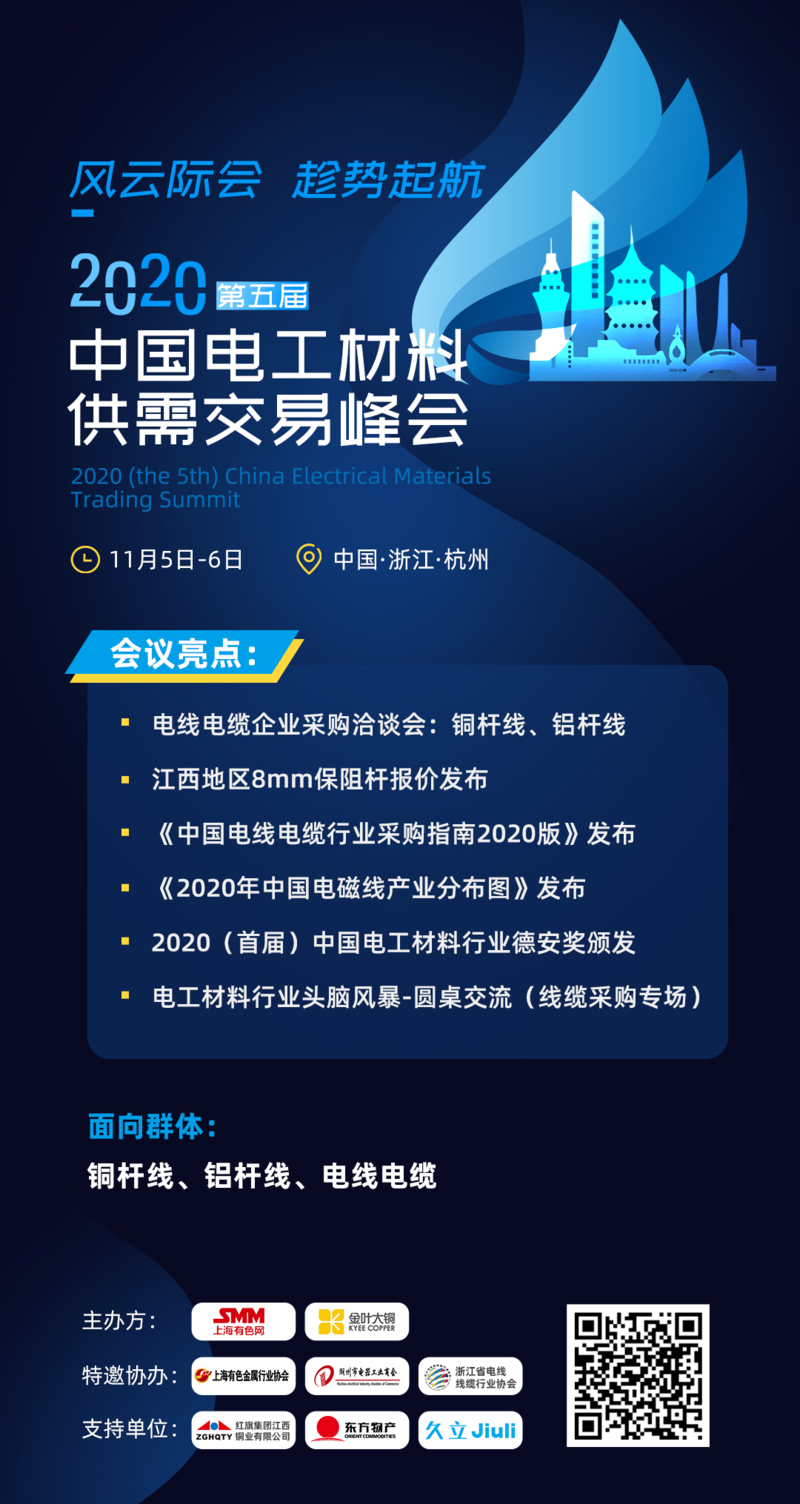

Scan the code to participate in the meeting or apply to join the SMM Electrical Industry Exchange Group