Hoshine Silicon to add 800,000 mt/year silicon metal capacity in Yunnan

Đã xuất bản: Dec 13, 2019 10:37 (GMT+8)
Sustainable availability of high-grade silicon ore has made Zhaotong in Yunnan province ideal for investment

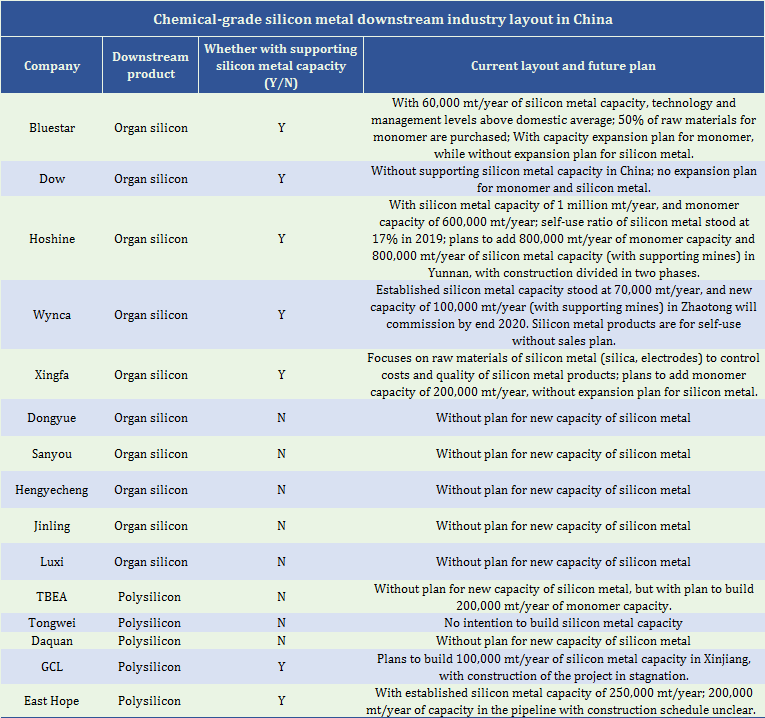
SHANGHAI, Dec 13 (SMM) –Hoshine Silicon, a Zhejiang-headquartered major silicon producer in China, will build 800,000 mt/year of silicon metal capacity in Zhaotong, Yunnan province. 

Although electrical power costs in Zhaotong are higher compared with other cities in Yunnan, sustainable availability of high-grade silicon ore has made Zhaotong ideal for investment, amid supply tightness of high-quality ore in China.

Yunnan currently has an annualised designed capacity of 1.3 million mt, located mostly in the western part of the province, including Dehong, Baoshan, Nujiang, and Lincang that boast rich hydro-power resources. 

The capacity utilisation rate, however, stands at low levels in Yunnan due to maintenance and dry season issues. The monthly average operating rate at silicon producers in the province stood at 46% in 2018. 

China’s silicon industry features low concentration ratios, as small and medium-scale producers with a capacity below 40,000 mt/year accounted for 89% in terms of number and 53% in terms of production capacity of the total silicon producers in China.

Silicon plants in Yunnan are mostly of medium-scale with an annualised capacity of 20,000 mt, invested by companies in Fujian and Zhejiang provinces before 2010. The past decade saw limited silicon capacity addition and expansion projects in Yunnan.

The opportunity of expansion/merger of Yunnan's existing small and medium-scale silicon companies came even smaller as the local implementation of desulfurisation methods over the past two years, ahead of other major silicon production areas in China, increased the cost of investment by around 10%.

Silicon metal can be categorised into metallurgical-grade and chemical-grade products based on downstream applications. Metallurgical-grade silicon, used to produce aluminum alloy, also sees limited chances of new investment due to demand bottleneck in the downstream car market, which is the main consumer of silicon-aluminium alloy. Besides, silicon accounts for only 3-7% of the feedstock to make silicon-aluminium alloy.

There will be more opportunities to invest in chemical-grade silicon on the back of the domestic shortage of high-quality ore and the trend in demand growth. Chemical-grade silicon is used mostly in organ silicon monomer and polysilicon, which have higher requirements for the stability and composition element of raw materials. 

For instance, chemical-grade silicon metal has to reach certain standards of content regarding not only main impurities such as iron, aluminium, and calcium, but also trace elements like phosphorus, boron, titanium, and carbon. 

On the policy front, major production areas such as Yunnan and Xinjiang have imposed controls on the total silicon capacity, but a national-level production quota scheme has not been introduced.  Yunnan aims to control silicon metal capacity within the province below 1.3 million mt/year by 2020, while boosting production and capacity of the top five producers to above half of the market share. 

New silicon projects in Yunnan should be equipped with downstream facilities to obtain government approval.

Xinjiang enjoys the advantages of lower electricity prices and thermal power plants that could guarantee production all year round without the impact of seasonality.  In terms of production capacity, Xinjiang has surpassed Yunnan to become the top silicon metal producer in China in 2015.

Addition of silicon capacity and construction of new self-owned power plants in Xinjiang face greater restrictions since 2018 as Xinjiang shifted its focus to high-level development. 

As a total 2 million mt silicon metal capacity quotas were all issued in Xinjiang, large companies are mulling acquisition or replacement of unrealised quotas for their further expansion. 

Besides capacity quotas, limitations on carbon emissions in each province will also be closely monitored.

Some silicon producers in Xinjiang were forced to cut or halt production due to depletion of carbon emissions quotas, a SMM survey showed. Some silicon mills in Fujian even purchased emissions quotas to extend production. 

A severe mismatch between the production capacity and carbon emission quotas has been seen across silicon production areas in China.
Tuyên bố về Nguồn Dữ liệu: Ngoại trừ thông tin công khai, tất cả dữ liệu khác được SMM xử lý dựa trên thông tin công khai, giao tiếp thị trường và dựa trên mô hình cơ sở dữ liệu nội bộ của SMM. Chúng chỉ mang tính chất tham khảo và không cấu thành khuyến nghị ra quyết định.

Để biết thêm thông tin hoặc có thắc mắc gì, vui lòng liên hệ: lemonzhao@smm.cn
Để biết thêm thông tin về cách truy cập báo cáo nghiên cứu, vui lòng liên hệ:service.en@smm.cn
Tin Liên Quan
Chi phí hỗ trợ suy yếu đối với silicone; giá DMC giảm nhẹ [Đánh giá hàng tuần về silicone của SMM]
53 phút trước
Chi phí hỗ trợ suy yếu đối với silicone; giá DMC giảm nhẹ [Đánh giá hàng tuần về silicone của SMM]
Đọc thêm
Chi phí hỗ trợ suy yếu đối với silicone; giá DMC giảm nhẹ [Đánh giá hàng tuần về silicone của SMM]
[SMM Báo cáo tuần về Silicone: Hỗ trợ chi phí cho Silicone suy yếu, giá DMC giảm nhẹ] Tuần này, chi phí tổng thể của silicone giảm trở lại, kéo theo chi phí sản xuất tổng hợp của ngành giảm theo. Tính đến ngày 22 tháng 10, giá trung bình của silicon kim loại #421 dùng cho silicone tại miền Đông Trung Quốc ở mức 9.750 nhân dân tệ/tấn, về cơ bản ổn định; giá giao dịch chủ đạo của silicon #421 tại miền Đông Trung Quốc trung bình 9.550 nhân dân tệ/tấn, giảm 0,52% so với tuần trước, giá silicon kim loại có xu hướng giảm trong tuần này. Trong khi đó, giá thị trường methanol giảm trở lại, kéo chi phí methyl chloride giảm theo. Tuần này, giá thị trường trung bình của methyl chloride là 3.450 nhân dân tệ/tấn, giảm 6,76% so với tuần trước.
53 phút trước
【Flash | Dòng chảy molypden của Hàn Quốc phân kỳ khi nhập khẩu tinh quặng giảm 26%】
1 giờ trước
【Flash | Dòng chảy molypden của Hàn Quốc phân kỳ khi nhập khẩu tinh quặng giảm 26%】
Đọc thêm
【Flash | Dòng chảy molypden của Hàn Quốc phân kỳ khi nhập khẩu tinh quặng giảm 26%】
Hàn Quốc đã nhập khẩu 2.707,3 tấn tinh quặng molypden rang và các loại khác trong tháng 9/2026, giảm 25,9% so với cùng kỳ năm trước, theo tính toán của SMM dựa trên dữ liệu hải quan. Nhập khẩu tinh quặng rang giảm 28,8% xuống còn 1.740,0 tấn, trong đó có 500,0 tấn từ Chile so với 1.410,7 tấn một năm trước đó. Xuất khẩu tinh quặng rang tăng 6,5% lên 516,6 tấn, chủ yếu sang Nhật Bản, Ấn Độ và Việt Nam. Xuất khẩu feromolypden giảm 29,2% xuống còn 1.121,1 tấn, với lượng xuất sang Trung Quốc giảm từ 580,0 xuống 70,5 tấn. Nhập khẩu oxit và hydroxit molypden tăng 311,0% so với tháng trước lên 97,2 tấn, mặc dù khối lượng từ tháng 1 đến tháng 9 giảm 39,2% so với cùng kỳ năm trước. Số liệu hải quan quốc gia không thể đo lường lưu lượng qua cảng Busan hay tồn kho giao ngay tại kho.
1 giờ trước
Giá khâu thượng nguồn PV đa phân khúc giữ ổn định trong bế tắc, giá module tiếp tục giảm [Bản tin tuần SMM]
1 giờ trước
Giá khâu thượng nguồn PV đa phân khúc giữ ổn định trong bế tắc, giá module tiếp tục giảm [Bản tin tuần SMM]
Đọc thêm
Giá khâu thượng nguồn PV đa phân khúc giữ ổn định trong bế tắc, giá module tiếp tục giảm [Bản tin tuần SMM]
[SMM Điểm tin tuần: Các khâu thượng nguồn PV giữ ổn định trong thế giằng co, giá module tiếp tục trượt dốc] Tuần này, giá thị trường pin mặt trời nhìn chung ổn định, với báo giá ở mọi kích thước không đổi so với tuần trước. Nguồn cung duy trì ở mức thấp và tồn kho tiếp tục giảm. Thị trường duy trì sự cân bằng giữa hỗ trợ chi phí và phân hóa nhu cầu, với sự giằng co giữa thượng nguồn và hạ nguồn vẫn tiếp diễn. Giá dự kiến sẽ ổn định trong ngắn hạn. Về mặt giá cả, mọi kích thước đều giữ ổn định. Dải giá 183 duy trì ở mức 0,29-0,301 NDT/W. Dải giá 210R giữ ở mức 0,305-0,314 NDT/W, vẫn chủ yếu dành cho xuất khẩu sang các thị trường ngoài Trung Quốc. Cửa sổ xuất khẩu dự kiến kéo dài đến đầu tháng 11, với nguồn cung ưu tiên cho các đơn hàng xuất khẩu. Nguồn cung nội địa khả dụng hạn chế, không có cơ sở để điều chỉnh giá. Dải giá 210N giữ ở mức 0,295-0,3 NDT/W, ổn định sau đợt tăng tuần trước. Mặc dù các nhà sản xuất wafer có ý định giữ giá vững, nhưng đà giảm liên tục gần đây của giá bạc đã bù trừ hỗ trợ từ phía chi phí, hạn chế đà tăng của giá. Ở giai đoạn này, người mua hạ nguồn đang bổ sung hàng theo nhu cầu thực tế, với các cuộc đàm phán đơn hàng thực tế bị khóa trong thế giằng co ổn định. Trong ngắn hạn, thế giằng co giữa thượng nguồn và hạ nguồn có thể kéo dài đến đầu tháng 11, và giá ở mọi kích thước dự kiến sẽ duy trì ổn định hoặc đi ngang.
1 giờ trước