Bloomberg New Energy Finance (BNEF) predicts that the world will cross another important milestone in the popularity of electric vehicles: 20 million electric vehicles (pure electric vehicles and hybrids) will be on the road in June 2022, a significant increase from 1 million in 2016. In the second half of 2022, the world will add nearly 1 million electric vehicles almost every month, about one every three seconds. By the end of 2022, BNEF estimates that there will be more than 26 million electric vehicles on the road worldwide.
The growth rate is much faster than many car and oil companies expected a few years ago. In its 2016 outlook, for example, BP expects 71 million electric vehicles to be on the road by 2035. Based on the latest sales figures, BNEF expects this goal to be achieved by 2025, a full 10 years ahead of schedule.
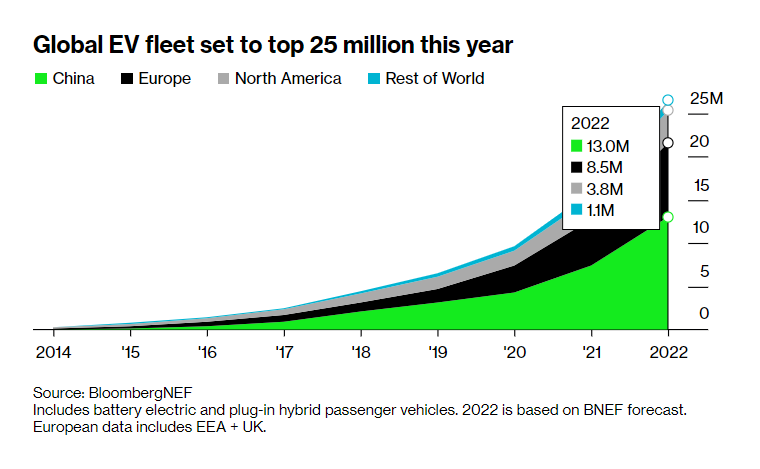
From a regional point of view, only a few regions in the world are promoting the popularity of electric vehicles. So far, China accounts for 46 per cent of global electric vehicle sales, followed by Europe and North America, accounting for 34 per cent and 15 per cent, respectively, and electric vehicle sales in all remaining countries together account for 5 per cent.
Although North America ranks third, the new policy should boost the region's electric car market this year and next.
There are about 5.3 million plug-in hybrid cars in the world, with Europe accounting for the majority. Plug-in hybrids have helped carmakers meet increasingly stringent targets in Europe to reduce car carbon emissions. BNEF predicts that there will be fewer plug-in hybrids on the market in the coming years as government subsidies for plug-in hybrids are cut and carmakers introduce the latest all-electric models.
Japan is the fourth largest car market in the world after China, the United States and Europe, but the popularity of electric vehicles in Japan has been very slow. As Japanese carmakers introduce new all-electric models in the popular minicar market, that should start to change soon. It is reported that mini-car sales account for about 1/3 of Japan's total car sales. Nissan and Mitsubishi Motors plan to launch miniature all-electric models this year, while Honda and Toyota subsidiary Dafa plan to launch miniature all-electric models in 2024 and 2025, respectively. South Korea has been active in the popularity of electric vehicles, with its market share reaching nearly 15 per cent by the end of 2021, driven by Hyundai and Kia electric models.
The popularity of electric vehicles has only just begun in the world's large emerging car markets, such as India, Brazil, Mexico and Southeast Asia, but once larger markets become saturated, they will be the key to the continued growth of global electric vehicle popularity. In the Indian tricycle market, more than 50% of sales are electric tricycles. The popularity of electric two-wheelers in Southeast Asian markets such as Vietnam is also relatively high. Parts of Latin America take the lead in electric buses and begin to focus on the electrification of taxis.
Most importantly, the best-selling electric car in China in the first quarter of this year was the Hongguang Mini EV, with a retail price of just $4700, suggesting that mini electric vehicles may be very attractive to middle-and lower-class consumers in emerging markets. As Japanese carmakers vigorously promote mini-electric vehicles and more electric motorcycle models, the popularity of electric vehicles in other parts of the world will increase sharply. The Hongguang Mini EV weighs only 560kg, while the recently launched GMC electric Hummer weighs more than 4000 kg. With the soaring cost of battery raw materials, electric compact cars and minicars seem to be more like sustainable mobile travel solutions needed around the world.
The popularity of electric vehicles will make remarkable progress in the next few years, but it will be an arduous task. BNEF estimates that there are about 1.2 billion light passenger vehicles in the world, and by the end of 2022, only slightly more than 2 per cent of light passenger vehicles will be electric. Although we still have a long way to go, the momentum of the transition to electric vehicles has been formed.