China nickel manufacturing returned to expansion in March after contracted for 11 months

เผยแพร่แล้ว: Apr 1, 2020 17:25
Manufacturing activities across nickel downstream sectors in China expanded in March after contracting for eleven consecutive months, as factories get back to business amid the easing of movement restrictions from COVID-19.

SHANGHAI, Apr 1 (SMM) – Manufacturing activities across nickel downstream sectors in China expanded in March after contracting for eleven consecutive months, as factories get back to business amid the easing of movement restrictions from COVID-19.


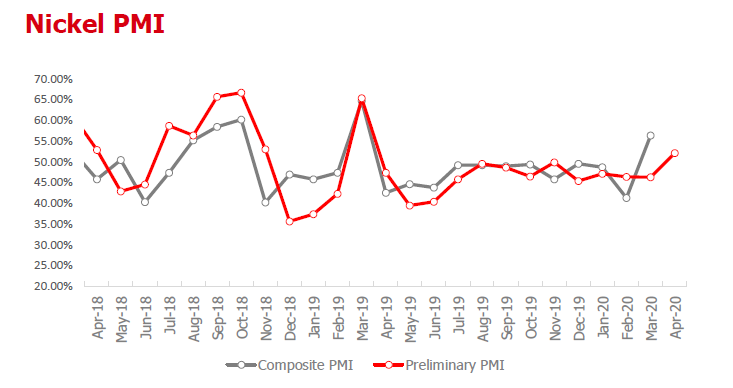
SMM data showed that the purchasing managers index (PMI) for downstream nickel industries, including stainless steel, electroplating, alloy and battery, stood at 56.31 in March, up 15.07 points from February. A reading above 50 indicates expansion.


Production sub-index rose significantly

The composite sub-index for production in March rose a significant 25.45 percentage points from February to 62.87, on the back of ramped-up operations at stainless steel mills after output cut in February as trades improved and raw materials prices weakened. The sub-index for production in the stainless steel sector advanced 24.67 percentage points on the month to 63.14. Profits margins for stainless steel remained limited, but were not as low as to trigger large-scale output curtailment. Gradual resumption of logistics also facilitated the recovery of stainless steel production. The sub-index for production in the electroplating sector performed better than expected, standing at 58.95 in March, as electroplating factories returned from February’s holidays to fulfil orders received before the Chinese New Year. Some large-scale electroplating plants resumed 80% of their capacity.


New orders sub-index rebounded in March

According to SMM data, the overall sub-index for new orders across downstream nickel sectors rallied 26.42 percentage points from February, to 61.15 in March. The recovery of logistics services revived trades of stainless steel and lifted orders at stainless steel producers, which led to an increase of 27.9 percentage points in the new orders sub-index of the sector to 62.19 for March. The new orders sub-index for the alloy sector stood at 62.18, beating expectations, as alloy casting plants maintained stable operations with most of them running at full capacity. Orders for military and nuclear power use as well as orders from civil-use products for domestic sales were sable last month. The delay of some export orders caused limited impact on the alloy sector. In the battery sector, new orders sub-index continued to recover to 60.91 in March. However, the rapid widespread of COVID-19 overseas raised some concerns about a decline in export orders. 


Raw materials inventory sub-index remained in contraction

The overall sub-index for raw materials inventories extended its decline in March, falling 3.25 percentage points from February to 42.82, as ample supply of nickel pig iron (NPI) and pessimistic outlook for its prices kept stainless steel producers from drastically stockpiling the raw material. Producers in other downstream sectors resumed restocking, with the raw materials inventory sub-index for the alloy sector at 63.19 for March. Most factories arranged restocking last month as prices of base metals retreated. 


Finished goods inventory sub-index edged higher, failed to surpass 50 

The overall sub-index for finished products stocks failed to enter the expansion territory as it climbed 4.65 percentage points from February to 45.85, indicating that sluggish consumption continued to drove up inventories, which is especially the case in the stainless steel sector. Less flexibility to cut production saw stainless steel mills relinquishing profits to destock amid weaker-than-expected consumption. The situation could sustain in the months ahead.  


คำชี้แจงแหล่งที่มาของข้อมูล: นอกจากข้อมูลที่เปิดเผยต่อสาธารณะแล้ว ข้อมูลอื่นๆ ทั้งหมดได้รับการประมวลผลโดย SMM จากข้อมูลสาธารณะ การสื่อสารกับตลาด และการพึ่งพาแบบจำลองฐานข้อมูลภายในของ SMMข้อมูลเหล่านี้มีไว้เพื่ออ้างอิงเท่านั้น ไม่ถือเป็นข้อเสนอแนะในการตัดสินใจ

หากมีข้อสงสัยหรือต้องการทราบข้อมูลเพิ่มเติม กรุณาติดต่อ: lemonzhao@smm.cn
หากต้องการข้อมูลเพิ่มเติมเกี่ยวกับวิธีการเข้าถึงรายงานการวิจัยของเรา โปรดติดต่อ:service.en@smm.cn
ข่าวที่เกี่ยวข้อง
[SMM นิกเกิลแฟลชนิวส์] อัปเดตรายวัน — 2 กันยายน 2569
9 นาทีที่แล้ว
[SMM นิกเกิลแฟลชนิวส์] อัปเดตรายวัน — 2 กันยายน 2569
อ่านเพิ่มเติม
[SMM นิกเกิลแฟลชนิวส์] อัปเดตรายวัน — 2 กันยายน 2569
[SMM นิกเกิลแฟลชนิวส์] อัปเดตรายวัน — 2 กันยายน 2569
ด้านราคา สัปดาห์นี้เป็นสัปดาห์แรกของรอบการกำหนดราคา HMA สำหรับครึ่งแรกของเดือนกันยายน โดย HMA อยู่ที่ 16,733.33 ดอลลาร์สหรัฐต่อตัน ราคาเฉลี่ย CIF แร่นิกเกิลอินโดนีเซียปรับตัวในทั้งสามเกรด: • Ni 1.3%: ราคาเฉลี่ย CIF ที่ 30 ดอลลาร์สหรัฐต่อเวตเมตริกตัน • Ni 1.4%: ราคาเฉลี่ย CIF ที่ 52.8 ดอลลาร์สหรัฐต่อเวตเมตริกตัน • Ni 1.5%: ราคาเฉลี่ย CIF ที่ 59.2 ดอลลาร์สหรัฐต่อเวตเมตริกตัน ________________________________________ อัปเดตนโยบายอินโดนีเซียและ DSI ICOMEX — 2 กันยายน 2026 ตลาดแร่นิกเกิลอินโดนีเซียยังคงอยู่ในช่วงรอดูสถานการณ์ โดยตลาดจับตาการอนุมัติ RKAB เพิ่มเติมและการปรับโควตาที่อาจเกิดขึ้นอย่างใกล้ชิด ขณะเดียวกัน DSI กำลังเดินหน้าพัฒนา ICOMEX ซึ่งเป็นแพลตฟอร์มดิจิทัลสำหรับติดตามและกำกับดูแลการส่งออกแร่และสินค้าโภคภัณฑ์เชิงยุทธศาสตร์ โดยคาดว่าแพลตฟอร์มจะทยอยบูรณาการข้อมูลสำคัญที่เกี่ยวข้องกับการส่งออก ได้แก่ สัญญา ราคา เกรดแร่ รหัส HS เรือ ปลายทาง และข้อมูลการชำระเงิน การพัฒนา ICOMEX คาดว่าจะช่วยเพิ่มความโปร่งใสของข้อมูลการส่งออก การกำกับดูแลด้านกฎระเบียบ และการติดตามราคา พร้อมทั้งช่วยให้ภาครัฐมีภาพรวมของกระแสการส่งออกแร่ที่ครอบคลุมมากขึ้น สภาพอากาศในพื้นที่ผลิตนิกเกิลหลักโดยรวมยังคงอยู่ในระดับที่บริหารจัดการได้ แม้ว่าฝนตกหนักในบางพื้นที่อาจยังก่อให้เกิดการหยุดชะงักชั่วคราวต่อการทำเหมืองและโลจิสติกส์ ตลาดยังรอการปรับปรุงสูตร HPM สำหรับแร่ลิโมไนต์ที่อาจเกิดขึ้น การเปลี่ยนแปลงใด ๆ ในกลไกการกำหนดราคา โดยเฉพาะการปฏิบัติต่อโลหะร่วมและปัจจัยปรับแก้ อาจส่งผลต่อราคาลิโมไนต์และเศรษฐศาสตร์ของวัตถุดิบสำหรับ HPAL โดยรวมแล้ว ตลาดยังคงระมัดระวัง โดยการอนุมัติ RKAB การพัฒนา ICOMEX สภาพอากาศ และการปรับปรุง HPM สำหรับลิโมไนต์ที่อาจเกิดขึ้น เป็นปัจจัยสำคัญที่ต้องจับตาในระยะสั้น
9 นาทีที่แล้ว
[SMM Analysis] กฎ Melt-and-Pour ของสหภาพยุโรปมาถึงในวันเส้นตาย — ปรับโฉมต้นทุนการเข้าถึงตลาดยุโรป
43 นาทีที่แล้ว
[SMM Analysis] กฎ Melt-and-Pour ของสหภาพยุโรปมาถึงในวันเส้นตาย — ปรับโฉมต้นทุนการเข้าถึงตลาดยุโรป
อ่านเพิ่มเติม
[SMM Analysis] กฎ Melt-and-Pour ของสหภาพยุโรปมาถึงในวันเส้นตาย — ปรับโฉมต้นทุนการเข้าถึงตลาดยุโรป
[SMM Analysis] กฎ Melt-and-Pour ของสหภาพยุโรปมาถึงในวันเส้นตาย — ปรับโฉมต้นทุนการเข้าถึงตลาดยุโรป
บรัสเซลส์ออกกฎหมายบังคับใช้ความยาวสามหน้าเมื่อวันที่ 31 สิงหาคม เหลือเวลาอีกสี่สัปดาห์ก่อนเริ่มการยื่นสำแดง และอีกหนึ่งปีก่อนที่ใบรับรองการทดสอบโรงงานจะกลายเป็นข้อบังคับ บทวิเคราะห์จาก SMM — ติดตามต่อจาก “EU Melt-and-Pour: ใกล้เส้นตาย แต่ยังไร้กฎเกณฑ์”
43 นาทีที่แล้ว
ตลาด NPI เกรดสูงอ่อนตัวลงอีก หลังอุปสงค์เหล็กกล้าไร้สนิมทรุด
52 นาทีที่แล้ว
ตลาด NPI เกรดสูงอ่อนตัวลงอีก หลังอุปสงค์เหล็กกล้าไร้สนิมทรุด
อ่านเพิ่มเติม
ตลาด NPI เกรดสูงอ่อนตัวลงอีก หลังอุปสงค์เหล็กกล้าไร้สนิมทรุด
[SMM นิกเกิลแฟลช] วันที่ 2 กันยายน ตลาด NPI เกรดสูงยังคงมีแนวโน้มอ่อนตัว ความตึงเครียดในตลาดทวีความรุนแรงขึ้นอีก ความอ่อนแอต่อเนื่องของตลาดสแตนเลสส่งผ่านไปยังฝั่งวัตถุดิบ เนื่องจากโรงงานเหล็กปลายน้ำเพิ่มแรงกดดันให้ราคาลดลง โรงงานเหล็กส่วนใหญ่ใช้ท่าทีรอดูสถานการณ์และเลื่อนการซื้อออกไป ทำให้ธุรกรรมจริงในตลาดมีจำกัดมาก
52 นาทีที่แล้ว
China nickel manufacturing returned to expansion in March after contracted for 11 months - Shanghai Metals Market (SMM)