As of May 13, SMM's weekly quotation for SMM CIF Indonesia Sulfur jumped from $990-1,050/mt last week to $1,100-1,250/mt, with some sellers quoting as high as $1,250-1,300. SMM Sulfur (Solid) price have risen for two consecutive weeks, with today's quotation at 7,080-7,400 yuan/mt, and the average price has increased by 715 yuan/mt within a month. Can sulphur prices continue to rise?
Note: SMM sulphur (CIF Indonesia) is currently a weekly quotation, and will be adjusted to daily release starting May 18.
I. Domestic "Dual-Track Market" Under Supply Guarantee: Coexistence of Low-Priced Direct Supply and High-Priced Scramble for Goods
China is the world's largest importer of sulphur (with imports of 9.61 million mt in 2025, dependence around 45%, of which 56% comes from the Middle East), and is also the largest exporter of sulphuric acid (with exports of 4.64 million mt in 2025). The blockade of the Strait of Hormuz has obstructed the logistics of more than half of the imported sulphur.
Starting May 1, 2026, China suspended sulphuric acid exports (provisionally until year-end), intending to retain resources to ensure the domestic self-circulation. However, sulphur prices have risen rather than fallen, with the root cause being that the hard shortage caused by import disruption cannot be filled through internal circulation.
How does national supply guarantee operate? In its notices on fertiliser supply guarantee for the 2026 spring ploughing season and the entire year, the NDRC explicitly placed the stable supply of key raw materials such as sulphur and phosphate ore as the top priority, requiring domestic sulphur to prioritise direct supply to phosphate fertiliser enterprises. Central state-owned enterprises such as Sinopec and PetroChina supply sulphur to their long-term partner large phosphate fertiliser enterprises at prices significantly below market levels. According to public reports, Puguang Gas Field alone supplied 290,000 mt of sulphur to the market at low prices in Q1 2026, with concessions reaching 570 million yuan, helping downstream enterprises produce 590,000 mt of fertiliser.
But supply guarantee does not equal full coverage. Enterprises receiving allocations at parity prices are mainly limited to the listed large phosphate fertiliser plants. Shortfalls beyond their guaranteed volumes, as well as the large number of downstream enterprises not on the supply guarantee list (small and medium fertiliser plants, titanium dioxide, caprolactam, etc.), can only purchase at high prices through market channels such as ports. Port inventories have already been at low levels due to sharply reduced arrivals from the Middle East, with port sulphur inventories down significantly YoY, leading to exceptionally fierce competition for market-based supplies. Currently, the domestic sulphur market has formed dual-track prices: parity prices through supply guarantee channels (actual prices not disclosed but significantly below market prices), and market channels as high as approximately 7,300 yuan/mt.
Demand-side pace: Although the spring fertiliser peak season has passed, August and September will see the autumn fertiliser stockpiling cycle. There is still some time before large-scale autumn fertiliser stockpiling, but some enterprises have already begun to lock in raw materials in advance, and the early start of just-in-time procurement provides support for prices.
Domestic market summary: Although restricting exports is conducive to the self-circulation of domestic sulphur resources, import disruption is an irreversible hard shortage. Parity supply guarantee by central state-owned enterprises has instead exacerbated the scarcity of market-based supplies, and structural tightness under dual-track operation is difficult to alleviate. As long as Middle Eastern supplies do not recover, high domestic prices will persist.
II. International Supply "Major Reshuffle": How Much of the Gap Can Alternative Channels Fill?
The core driver of the international sulphur price jump remains the large-scale stranding of Middle Eastern supplies caused by the Strait of Hormuz blockade. The market estimates that the volume of sulphur already loaded but unable to depart is as high as 800,000-1 million mt. Middle East FOB prices hit multi-year highs, with Kuwait KPC quoting $765/mt and Qatar at $740/mt.
The world is forced to seek alternative supplies, forming three major supplementary routes.
Route 1: Central Asian land route (Turkmenistan/Kazakhstan → Alashankou/Khorgos)
Although UN trade data shows that Kazakhstan's sulphur exports exceeded 5 million mt in 2025, these mainly serve Morocco's OCP long-term contract supply, with limited market-based sulphur supplies. Central Asia can export approximately 500,000-600,000 mt of sulphur to China annually, arriving in China by rail in 10-15 days. However, sulphur is a Class 4.1 dangerous good, requiring dedicated wagons for rail transport, and port customs clearance capacity is limited. This channel is small in scale and high in cost, serving only as additional supplementation.
Route 2: Vancouver Port, Canada
Vancouver Port is not constrained by the strait. Canadian customs data shows exports reached 1.24 million mt in January-March 2026, with full-year volumes likely approaching 4 million mt. FOB Vancouver prices rose from $492/mt at the beginning of the year to $680-720/mt. Canada is actively filling gaps in South America, North Africa and elsewhere, but its rail capacity is saturated, and there is limited room for production expansion.
Route 3: Safe export channels in the Middle East — Duqm Port in Oman and Saudi Red Sea ports
- Duqm Port in Oman is located outside the strait. The Duqm refinery project produces approximately 400,000-500,000 mt of sulphur annually and exported approximately 120,000 mt in Q1 2026. Market rumours suggest that some Iranian sulphur may be transported by small vessels to Oman, transhipped, and exported with Omani certificates of origin (so-called "renaming" operations). Although compliance thresholds are high, sanction risks exist, and no public data confirms large-scale transhipment, the existence of such grey channels does increase supply elasticity to a certain extent.
- Saudi Red Sea ports (Yanbu, Jizan, etc.) transport Persian Gulf sulphur overland to Red Sea exports via the East-West crude oil pipeline. Several batches have been successfully shipped since the strait blockade. However, the Red Sea route faces risks of Houthi attacks, with some shipowners detouring via the Cape of Good Hope, significantly increasing freight costs; overland transport costs are nearly double those of direct loading in the Persian Gulf; and annual transport capacity is limited.
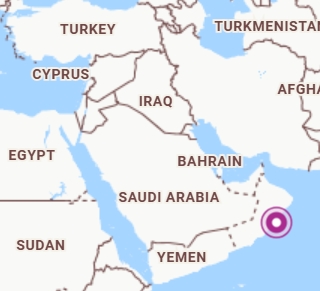
Location of Duqm Port, Oman
Image source: Internet
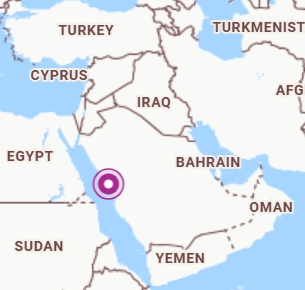
Location of Yanbu Port
Image source: Internet
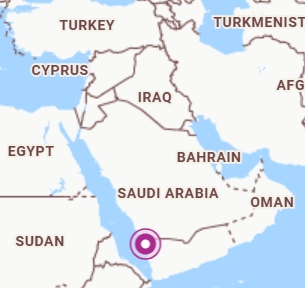
Location of Jazan Port
Image source: Internet
Overall assessment: The total supplementary capacity of the three alternative routes is optimistically estimated at approximately 3-4 million mt/year, while the global shortfall caused by the Middle East supply disruption is at least 8-10 million mt/year. Alternative sources cannot fundamentally reverse the supply-demand imbalance.
India Tender: A Barometer for Market Acceptance
Indian Potash Limited (IPL), on behalf of eight local enterprises, issued a sulphur tender for a total procurement volume of 593,500 mt, with delivery from June to August. Sellers have already submitted offers at $1,300/mt CFR, but whether the Indian side can accept this remains controversial. The Indian government has already raised spring-summer phosphate and potash fertiliser subsidies in advance, with the sulphur subsidy rate raised from 2.87 rupees/kg to 3.16 rupees/kg, providing fiscal cushion for high-priced imports. The final transaction price of this tender will become the price anchor for subsequent negotiations in East Asia and Southeast Asia.
High Costs Have Begun to Erode Demand
China's phosphate fertiliser enterprises have proactively reduced their operating rates to 50%-55% due to the export suspension; Indonesian hydrometallurgy enterprises (Huafei, Lygend, etc.) have cut production or reduced load, with sulphuric acid costs already accounting for 50% of MHP full costs; copper strip buyers in Southern Africa have begun to resist high prices, with some enterprises already reducing production loads. Marginal contraction on the demand side may constrain unlimited price increases.
III. Market Outlook: Three Variables Determine Whether Sulphur Can Reach New Highs
Current sulphur prices are already at historically extreme levels. Whether prices can continue to rise depends on the trajectory of three core variables.
Variable 1: Timeline for Resumption of Navigation Through the Strait of Hormuz
This is the decisive factor. If transit is partially restored within the next 1-2 months, the 800,000-1 million mt of stranded Middle East supplies will be gradually released, and CFR prices are expected to pull back to $800-900/mt. If the blockade persists through the end of Q3, global inventories will be further depleted, and prices could challenge $1,500/mt. If the blockade extends to the end of the year, the global sulphur trade system will be forced to undergo a complete restructuring, and prices will depart from historical ranges.
Variable 2: Actual Transaction Price of India's IPL Tender
If IPL concludes transactions near $1,300/mt, it would mean global buyers have accepted this price level as the new anchor, and subsequent East Asian and Southeast Asian negotiations will proceed above this baseline, with prices still having upside room. If the Indian side successfully pushes for lower prices (e.g., transaction price below $1,100), then current seller quotes are inflated, and the market may experience a brief correction. Given that India has already raised subsidies, the probability of a high-price transaction is relatively large.
Variable 3: China's Export Policy and Autumn Fertiliser Stockpiling Pace
The sulphuric acid export suspension is tentatively set through year-end. If international supply has not recovered by then, the policy may be extended; if conditions ease, it may be relaxed ahead of schedule. Autumn fertiliser stockpiling (August-October) will bring a new round of rigid demand, but if China's phosphate fertiliser enterprises continue to suppress operating rates due to excessively high overall costs, the demand side will form a negative feedback loop.
Overall Assessment
- Short-term (next 1-2 months): No substantive improvement on the supply side; the probability of India's tender concluding at high prices is large. Prices will stay high and hold up well, with the possibility of further surges (challenging $1,300-1,400).
- Medium-term (Q3): If easing signals emerge from the Strait of Hormuz, prices may retreat from highs, but the pullback will be limited by insufficient alternative supplies and rigid autumn fertiliser demand; if the blockade persists, prices will reach new highs.
- Long-term: The structural contraction on the sulphur supply side is evolving into a medium and long-term driving factor. Even if the geopolitical conflict ends, the restructuring of global sulphur trade will take time, and the price center has been systematically elevated.
Disclaimer: This article is based on publicly available information and does not constitute investment advice. Market fluctuation risks are extremely high; please exercise independent judgment.