The China rhenium market in H1 2026 generally saw an initial rise and stabilization, followed by a mild pullback and consolidation at highs, driven by four core factors: rigid raw material supply, supply-demand tug-of-war in the industry chain, structural divergence between investment and industrial demand, and price divergence between domestic and overseas markets. In H1, rhenium prices remained supported at high levels by structural supply deficits, yet trading stayed persistently sluggish with strong industry-wide wait-and-see sentiment; there was no clear unilateral trend, and a tug-of-war between longs and shorts ran throughout the period.
I. Early February: Cooling Trading, Counter-Trend Price Rise
In early February, the rhenium market showed a typical split: market activity fell MoM, but prices climbed steadily. On the sentiment side, gold and silver price fluctuations triggered a cautious mood across precious metals, which spilled over into the minor metals segment—there were many inquiries but few actual deals, with only small amounts of rigid demand supporting transactions, and cautious selling by retail investors led to a significant cooling in trading.
On the price side, the core support came from tightening raw material supply. Ammonium rhenate supply remained tight and prices rose, sharply lifting smelting costs for midstream processors and pushing up finished product prices like rhenium pellets. Meanwhile, raw material prices rose faster than the pace of finished product price adjustments, squeezing midstream margins; the industry widely increased scrap recovery ratios to offset cost pressure. At that time, Sinopec’s tender for ammonium rhenate failed, confirming upstream producers’ inclination to hold back from selling and hold prices firm, bullish on the outlook. In the medium and long term, incremental rhenium recovery from copper-molybdenum smelting is limited by raw ore grades and technical barriers, making it difficult to fully close the supply gap, which provides sustained high-level support for rhenium prices.
II. Post-Chinese New Year to Early Q2: High-Level Stalemate, Intensified Supply-Demand Tug-of-War
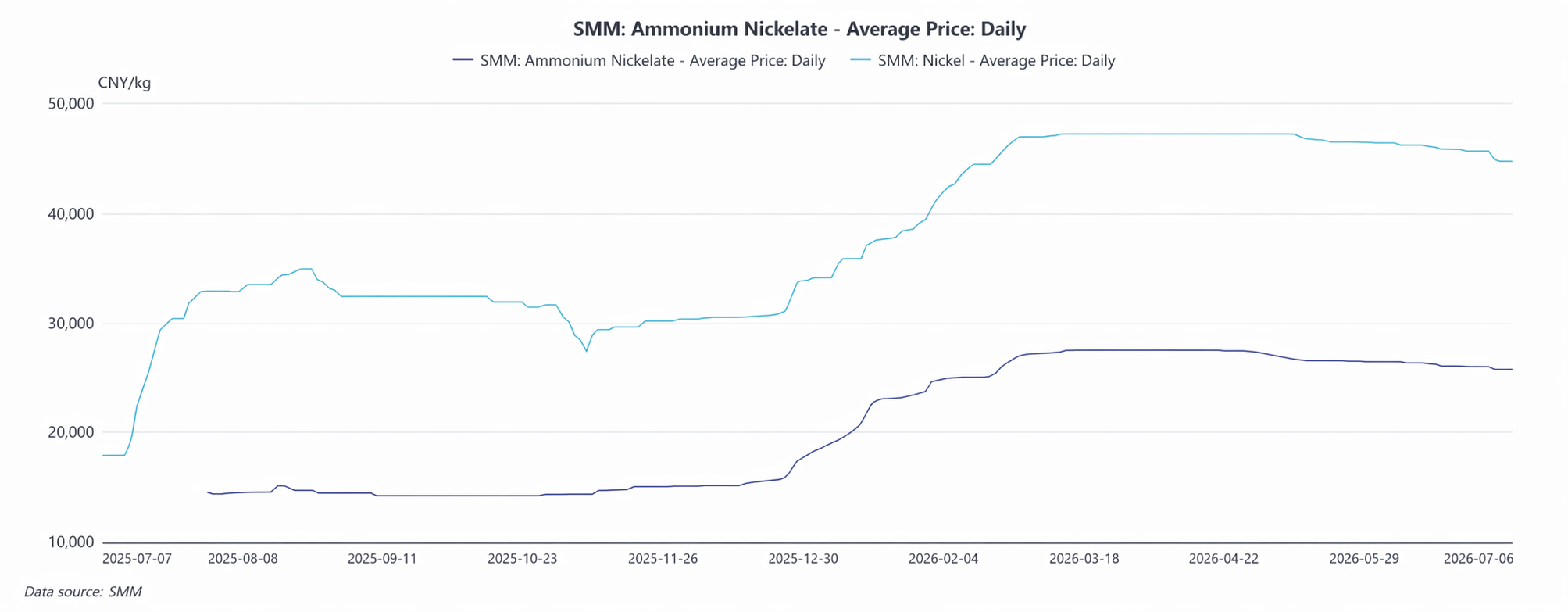
After the Chinese New Year holiday, the rhenium market entered a prolonged consolidation phase at highs. Mainstream quotations for raw materials stabilized at 27,000–28,000 yuan/kg, with a few high-priced sources touching 30,000 yuan/kg; the price range was firm with minimal fluctuations. Upstream hold-back-from-selling attitudes gradually softened, with small-scale selling to test market acceptance, but without concentrated dumping, supply increments were manageable and the rigid supply structure remained intact.
Midstream processors focused on delivering pre-holiday orders, with production schedules full from March to April. However, their acceptance of high-priced ammonium rhenate was low, and they generally negotiated rationally, refusing to rush to buy amid the continuous price rise. Downstream demand showed structural divergence: investment appetite continued to cool—retail investors exited and low-price selling increased, weighing on market sentiment; meanwhile, steady recovery in industrial demand from aviation, catalysts, and other sectors provided fundamental support, offsetting some bearish factors. At the same time, capital rotated into the energy sector, and speculative interest in minor metals waned, leaving rhenium prices lacking strong upward momentum. Overseas critical mineral competition intensified, raising import supply chain uncertainty and providing long-term bottom support for the market.
III. Late Q2: China Pulls Back Weakly, Overseas Strengthens Against Trend
In late H1, China’s rhenium market weakened slightly, with raw material and finished product prices pulling back simultaneously, while overseas markets rose independently, resulting in a significant divergence between domestic and overseas trends. In China, the mainstream transaction range for ammonium perrhenate pulled back to 26,000-27,000 yuan/kg, and small and medium-sized producers offered low-priced goods to recoup funds, with spot order prices dropping to 24,000-25,000 yuan/kg, dragging down the overall price center. The mainstream transaction price for rhenium pellets pulled back to around 46,000 yuan/kg.
The tug-of-war in the industry chain further intensified. After concentrated restocking at the beginning of the year, downstream inventories were sufficient. Entering the traditional off-season, purchasing sentiment was cautious, with a strong willingness to push for lower prices and probe the bottom, mostly making purchases based on rigid demand in small lots. Upstream still held expectations for the future market, controlling volumes and selling cautiously, which capped the downside room and prevented a sharp decline. Overseas markets saw strong demand resilience and tight supply, with prices of ammonium perrhenate and rhenium pellets continuing to rise. However, the rise in overseas markets had limited boosting effect on the domestic market, and the price spread between Chinese and overseas markets continued to diverge.
IV. Summary of Key Bullish and Bearish Factors in H1
(I) Key Bullish Factors
First, as a rare and dispersed metal by-product of copper and molybdenum, rhenium has strong primary supply rigidity, while recovery capacity release is slow, leading to a long-standing structural supply-demand gap. Second, intensified exclusivity in the critical minerals supply chain outside China has raised import risks, and expectations of tightening supply in the long term underpin the market. Third, industrial rigid demand has been recovering steadily, providing continuous fundamental support. Fourth, upstream producers’ willingness to hold prices firm is solid, with no concentrated sell-offs, limiting downside room for the market.
(II) Key Bearish Factors
First, the ebb of speculative capital and repeated retail selling disturbed spot prices, with sluggish trading activity. Second, raw material cost transmission was sluggish, squeezing midstream profits, increasing the substitution ratio of scrap, and contracting demand for primary ammonium perrhenate. Third, after completing phased restocking, downstream purchasing willingness was weak in the off-season, making it difficult to spur a market rebound. Fourth, the decoupling of domestic and overseas market trends prevented the bullish benefit of overseas price increases from transmitting to the domestic market.
V. Overall Summary of H1
In H1 2026, the rhenium market overall showed features of consolidating at highs, mixed bullish and bearish factors, and weak transactions. The market underwent three stages: price increases, sideways consolidation, and a weak pullback. The core contradiction has always been the two-way balance between rigid upstream supply underpinning prices and weak downstream demand, coupled with capital outflows capping gains. Industry chain profits diverged significantly: the upstream resource segment had stable earnings, while midstream processing enterprises remained under pressure, and the industry accelerated the pace of scrap recovery and recycling. Overall, there was no one-sided trend in H1. The tug-of-war between suppliers and buyers dominated market movements. The structural supply-demand gap supported high-level operation and laid the fundamental foundation for the rhenium market’s consolidating pattern in H2.
![[SMM Analysis] South Africa's Chrome Ore and High-Carbon Ferrochrome Exports](https://imgqn.smm.cn/usercenter/FHiZE20251217171722.jpeg)
![Short-term Bull Momentum Repair, Aluminum Alloy Drifting Higher; Cautious Price Adjustments in Spot Market, Sluggish Transactions [ADC12 Daily Price Review]](https://imgqn.smm.cn/usercenter/ZsMtd20251217171723.jpeg)
![Low Willingness to Sell among Manufacturers, Weak Futures and Spot Prices [SMM SiMn Weekly Review]](https://imgqn.smm.cn/usercenter/TdoSs20251217171724.jpeg)