SMM June 10 news:
Metal markets:
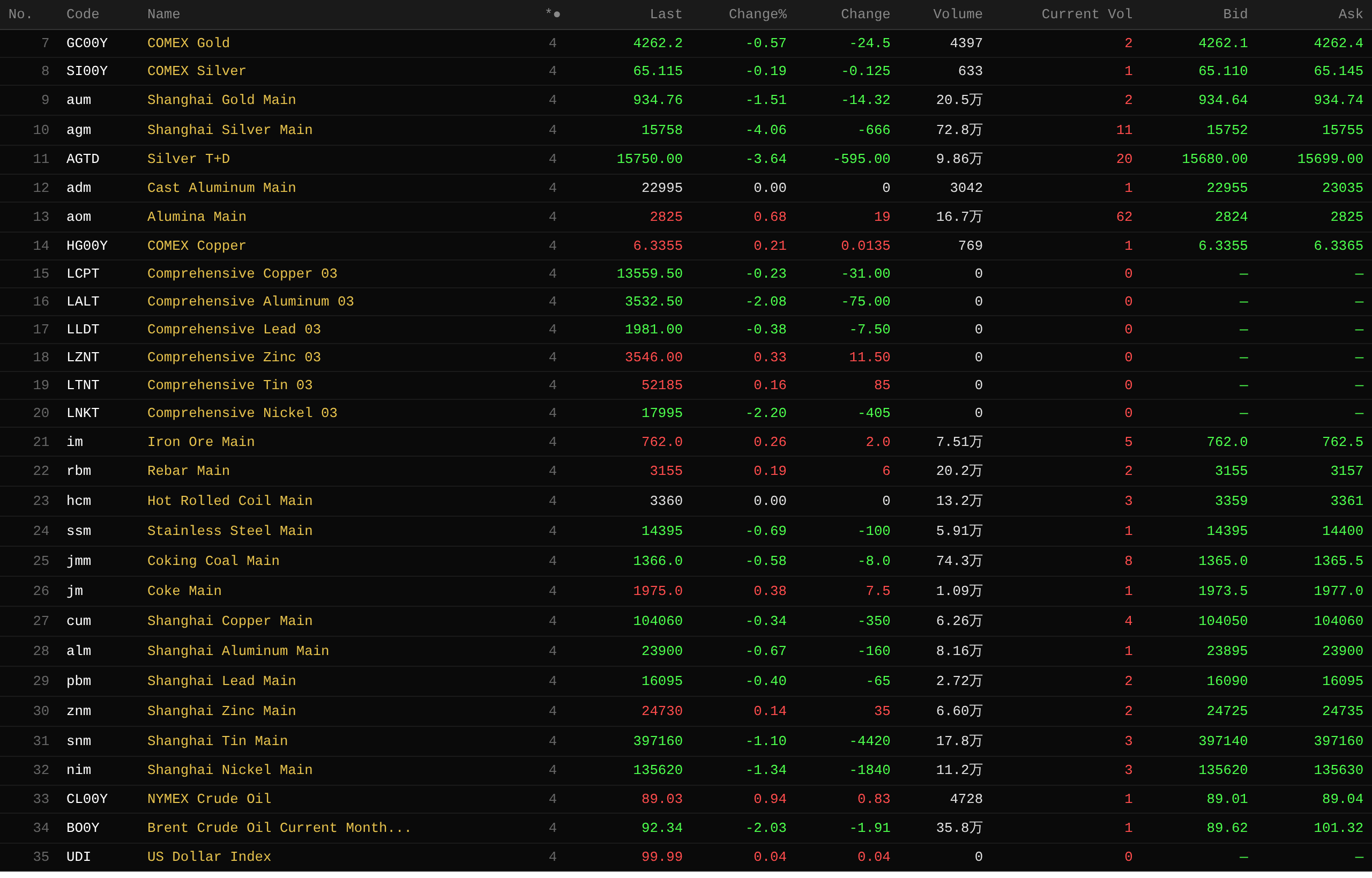
The domestic base metals market mostly fell overnight. SHFE copper fell 0.34%. SHFE aluminum fell 0.67%, and SHFE lead fell 0.4%. SHFE zinc rose 0.14%. SHFE tin fell 1.1%. SHFE nickel fell 1.34%. In addition, the most-traded alumina futures contract rose 0.68%, and the most-traded cast aluminum contract closed flat at 22,995 yuan/mt.
Overnight, ferrous metals showed mixed performance, with iron ore up 0.26%, HRC flat at 3,360 yuan/mt, stainless steel down 0.69%, and rebar up 0.19%. Coking coal and coke: The most-traded coking coal futures contract fell 0.58%, and the most-traded coke futures contract rose 0.38%.
On the overseas metals market overnight, LME base metals mostly fell. LME copper fell 0.23%. LME aluminum fell 2.08%, and LME lead fell 0.38%. LME zinc rose 0.33%. LME tin rose 0.16%. LME nickel fell 2.2%.
Overnight precious metals market: Overnight COMEX gold fell 1.8%, and COMEX silver fell 4.56%. Overnight, the most-traded SHFE gold futures contract fell 1.51%, and the most-traded SHFE silver futures contract fell 4.06%.
Bob Haberkorn, Senior Market Strategist at RJO Futures, stated: "Traders are slightly uneasy about the current market situation... A broad risk-off mode has taken hold across all markets. I believe this risk-off sentiment is what drove gold prices down." Haberkorn added: "Until the US Fed provides clearer guidance, gold and silver prices remain under downward pressure." (Jinshi Data APP)
Analysts at Saxo Bank stated that gold futures prices closed below their 200-day moving average for the first time since October 2023, following last Friday's non-farm payrolls report and a broad deterioration in risk sentiment that also weighed on stock markets. The combination of a resilient US economy and rising inflation expectations is creating a challenging environment for gold, overshadowing long-term supportive factors such as central bank purchases, fiscal concerns, and reserve diversification. (Jinshi Data APP)
As of 7:19 on June 10, overnight closing prices:
Macro front
China:
[Guangdong: Over 3 million charging facilities to be built province-wide by the end of 2027, meeting the charging demand of more than 8 million NEVs] The Guangdong Provincial Development and Reform Commission and other departments recently issued the "Guangdong Province EV Charging Facility High-Quality Development Action Plan." The plan proposes to build a high-quality charging facility system where super-charging, fast charging, and slow charging complement each other by continuously innovating application scenarios, improving charging networks, enhancing charging efficiency, optimizing service quality, and innovating the industrial ecosystem. This aims to promote the balanced development of charging facilities in eastern, western, and northern Guangdong alongside the Pearl River Delta region, and facilitate the wider purchase and use of EVs. By the end of 2027, the province will have cumulatively built over 3 million charging facilities to meet the charging demand of more than 8 million NEVs; the province will achieve "super-charging coverage in every county," with the number of super-charging stations no fewer than the number of gas stations. (Jinshi Data APP)
[CPCA: Retail sales in China's domestic narrow PV market reached 1.51 million units in May 2026] According to the latest retail sales statistics from the China Passenger Car Association (CPCA), retail sales in China's domestic narrow passenger vehicle (PV) market reached 1.51 million units in May 2026, down 22.1% YoY, but up 9.2% MoM. Cumulative sales from January to May totaled 7.099 million units, down 19.5% YoY.
US Dollar:
The overnight US dollar index fell 0.07% to 99.95. Data: The weekly change in US ADP employment for the week ending May 23 was 29,000, compared to the previous figure of 35,750. Jay Woods, Chief Global Strategist at Freedom Capital Markets, stated that the US May headline CPI YoY rate is expected to jump from 3.8% to 4.2%, which would be the highest level since March 2023. But the real concern isn't the headline number; it's the potentially entrenched "sticky" items like housing, insurance, and services. These categories could keep inflation persistently above the US Fed's comfort zone, as they may remain elevated for longer. Woods noted that high inflation driven by gasoline is typically less worrying, whereas sustained price increases in housing and services could be a trend that takes time to reverse. According to CME "FedWatch": The probability that the US Fed will keep interest rates unchanged through June is 98.2%, with a cumulative probability of a 25 basis point cut at 1.8%. The probability that the Fed will keep rates unchanged through July is 85.8%, with a cumulative probability of a 25 basis point hike at 12.6% and a cumulative 25 basis point cut at 1.6%. (Jinshi Data APP)
China Securities pointed out that in the short term, the probability of a US Fed interest rate hike remains low, and market concerns about Fed tightening are mainly at the expectations level, based on assumptions of sticky domestic US inflation and a persistently hot job market. CME FedWatch data indicates that the most likely timing for a Fed rate hike expected by markets outside China begins in late October 2026. The current tightening of global liquidity and market adjustments represent a front-running reaction to expectations of a Q4 Fed rate hike. Regarding the domestic bond market, increased expectations for Fed tightening are not bearish. China's bond market is relatively independent and has a small correlation with US Treasuries. Furthermore, given ample domestic liquidity, the anticipated tightening of overseas liquidity and adjustments in equity markets could potentially drive capital flows into the bond market, supporting the current level of long-term bonds. Subsequently, China's 10-year government bond yield is expected to continue oscillating around the 1.70% level; a break below 1.70% still requires the emergence of new incremental information from domestic sources.
Data:
Today will see the release of China's May CPI YoY, the US May unadjusted CPI YoY, the US May seasonally adjusted CPI MoM, the US May seasonally adjusted core CPI MoM, the US May unadjusted core CPI YoY, the Bank of Canada interest rate decision as of June 10, and China's May M2 money supply YoY (date TBD), among other data points. Also, attention should be paid to: the Bank of Canada's announcement of its interest rate decision; and the monetary policy press conference held by Bank of Canada Governor Macklem and Senior Deputy Governor Rogers.
Crude Oil:
Overnight, both oil futures fell, with US crude oil down 2.85% and Brent crude oil down 2.03%. Oil prices were volatile on Tuesday. Trump stated earlier in the day that negotiations with Iran were "in the final stages of a very, very good deal," pushing Brent crude lower. However, Trump subsequently posted on social media stating that Iran had shot down a US Apache helicopter patrolling the Strait of Hormuz and declared "the US must respond," causing oil prices to jump immediately. Iranian officials further warned afterward that "foreign military forces near Iran face risks," briefly lifting oil prices further. Despite this, crude oil closed lower. (Wall Street CN)
Data: The US API crude oil inventory for the week ending June 5 fell by 9.119 million barrels, compared to an expected draw of 3.421 million barrels, with the prior figure showing a draw of 6.757 million barrels. The US API gasoline inventory for the week ending June 5 fell by 1.191 million barrels, compared to an expected draw of 614,000 barrels, with the prior figure showing a build of 3.454 million barrels. (Jinshi Data APP)
The US Energy Information Administration (EIA) stated on Tuesday local time that due to crude oil production losses exceeding 11 million barrels per day in the Middle East caused by the Iran war, major consumer nations are drawing down inventories to bridge supply shortfalls at an unprecedented rate. Consequently, oil inventories among OECD members are heading toward their lowest levels since at least 2003. The EIA stated that under its current assumptions, where maritime shipping activity through the Strait of Hormuz is unlikely to return to pre-conflict levels before the beginning of 2027, total oil inventories held by OECD member nations will fall to just under 2.3 billion barrels by December. (Jinshi Data APP)
![Metals Broadly Declined, Alumina Surged over 3%, SHFE Nickel, SHFE Tin, and Coking Coal Led Declines, COMEX Gold Intraday Fell Below 4,200[SMM Midday Review]](https://imgqn.smm.cn/usercenter/LVqfJ20251217171736.jpg)
![Inventory neared a new low for the year, suppliers held prices firm significantly. Overall trading was moderate. [SMM South China spot copper]](https://imgqn.smm.cn/usercenter/CJXfS20251217171710.jpg)
![As delivery date approaches, market supply decreases and premiums rebound [SMM North China Spot Copper]](https://imgqn.smm.cn/usercenter/OpmKJ20251217171712.jpg)