SMM April 18 News:
Metals market:
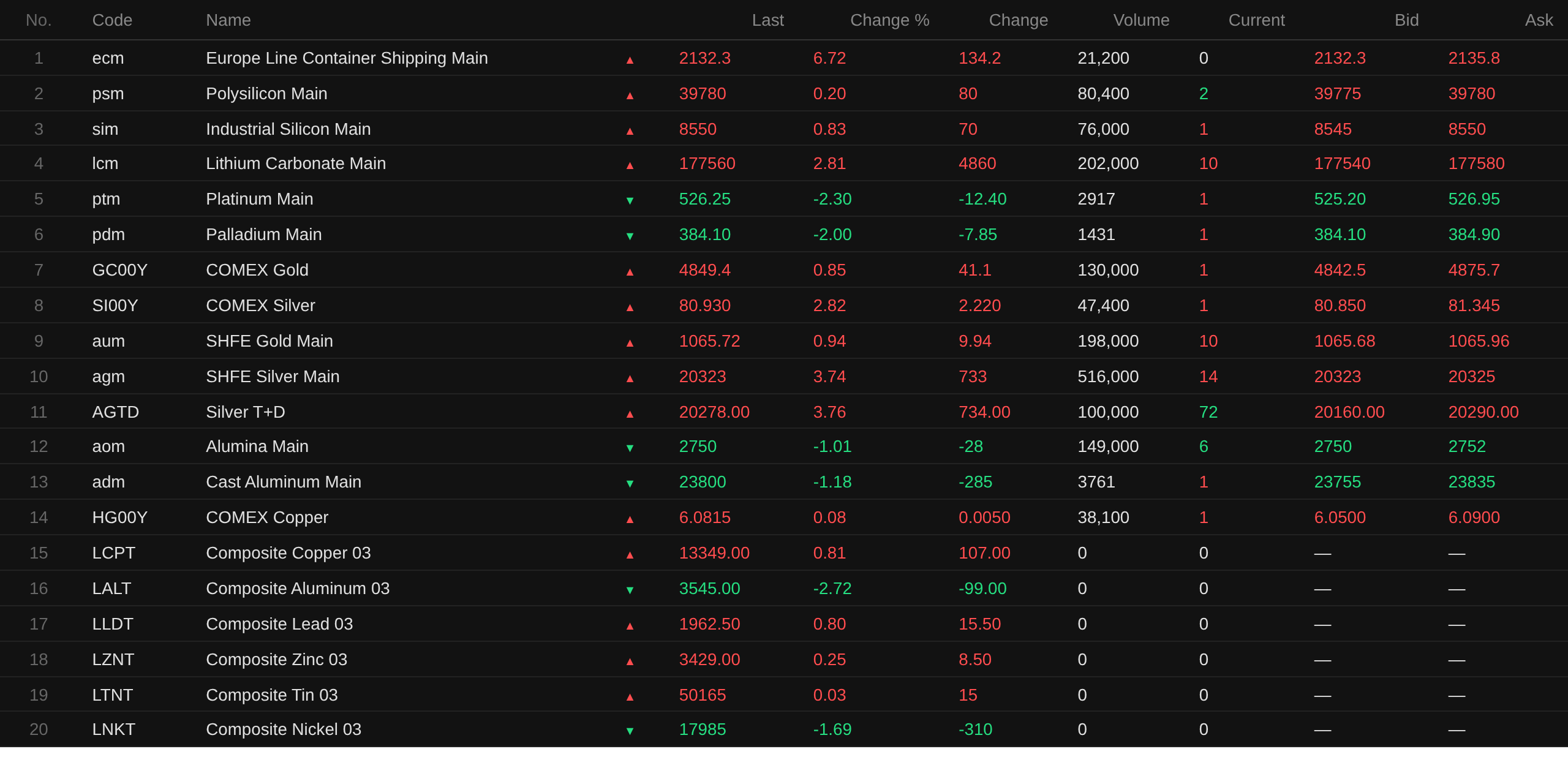
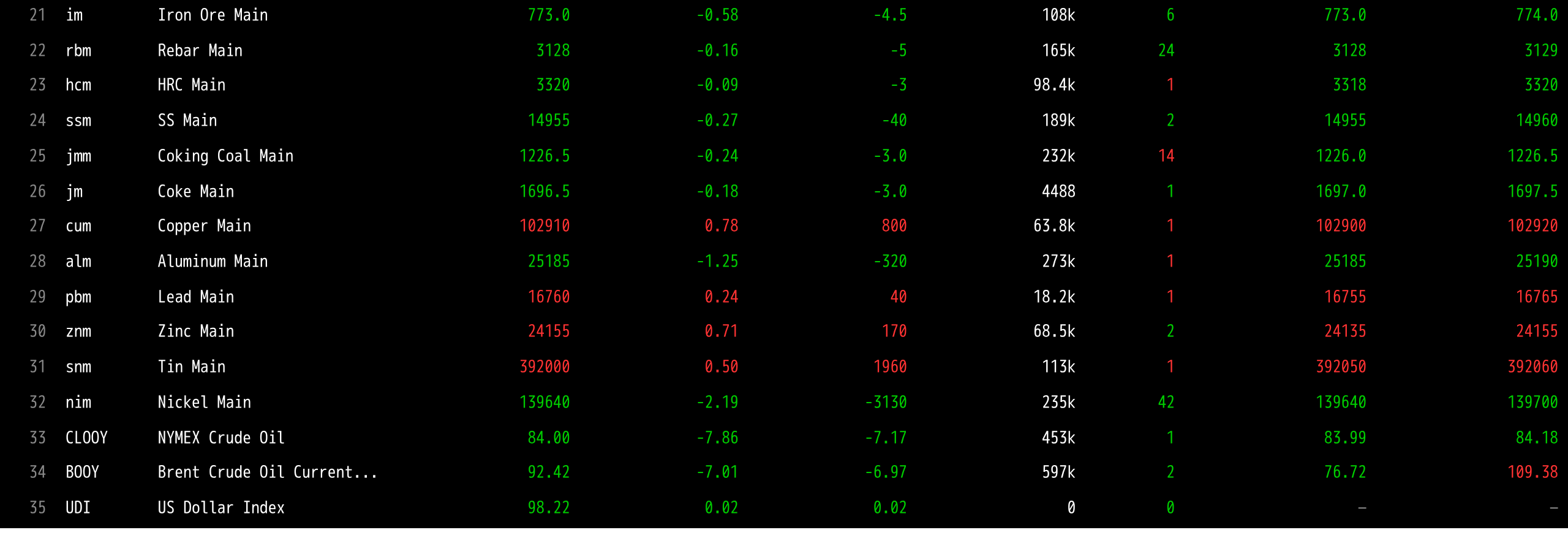
Overnight, domestic market base metals mostly rose. SHFE copper gained 0.78%; on a weekly basis, SHFE copper posted a four-week winning streak, up 4.07% for the week. SHFE aluminum fell 1.25%, SHFE lead rose 0.24%. SHFE zinc gained 0.71%. SHFE tin rose 0.03%. SHFE nickel fell 2.19%. In addition, the most-traded alumina futures contract fell 1.01%, and the most-traded foundry aluminum futures contract fell 1.18%.
Overnight, ferrous metals all fell, with iron ore down 0.58%, stainless steel down 0.27%, rebar down 0.16%, and hot-rolled coil up 0.09%. Coking coal and coke: coking coal fell 0.24%, coke fell 0.18%.
Overnight, overseas market metals: LME base metals mostly rose. LME copper gained 0.81%; on a weekly basis, LME copper posted a four-day winning streak, up 3.83% for the week. LME aluminum fell 2.72%, LME lead rose 0.8%. LME zinc gained 0.25%. LME tin rose 0.03%. LME nickel gained 1.69%.
Overnight precious metals:COMEX gold rose 0.85%, posting a three-week winning streak, up 1.3% for the week; COMEX silver rose 2.82%, posting a four-week winning streak, up 5.82% for the week. Overnight, SHFE gold rose 0.94%, posting a three-week winning streak, up 0.12% for the week; SHFE silver rose 3.74%, posting a four-week winning streak, up 5.18% for the week.
Amid optimistic sentiment over US-Iran negotiations, gold prices rebounded, but further gains may be limited until the geopolitical situation becomes clearer. Commerzbank analysts said: "Gold prices also rebounded on hopes of an end to the war, as this eased concerns that central banks would have to respond to higher inflation risks with tighter monetary policy, thereby increasing the opportunity cost of holding gold. However, as long as uncertainty remains elevated, the underlying recovery in the gold market may be temporarily exhausted."
As of 7:45 AM on April 18, overnight closing prices:
Macro Front
China:
[State Council Executive Meeting: Deeply Implement the Strategy to Upgrade Free Trade Zones and Promote High-Quality Development of FTZs]Li Qiang chaired a State Council executive meeting to hear reports on the development of free trade zones (FTZs). The meeting noted that since the 18th CPC National Congress, FTZs across the country had actively explored deepening reform, expanding opening-up, and promoting development, achieving a series of breakthrough and pioneering results and effectively serving as comprehensive pilot platforms. Facing new circumstances and new tasks, the strategy to upgrade FTZs should be deeply implemented, institutional mechanisms should be reformed and improved, the layout should be further optimized and capacity enhanced, to better serve the overall national development agenda. It is important to adapt measures to local conditions, proceed steadily and in an orderly manner, and pursue practical results. On the basis of scientific assessment and evaluation, tailored plans should be formulated for each zone according to local conditions and actual needs, relevant work should be solidly advanced, and high-quality development of pilot free trade zones should be promoted. Support should be given to pilot free trade zones such as Shanghai to leverage their functional positioning, proactively align with high-standard international economic and trade rules, steadily expand institutional opening-up in terms of rules, regulations, management, and standards, explore and develop more replicable and scalable experiences and practices, and better play a demonstrative, leading, and radiating role. (CCTV News)
[MOF and Another Department: Adjusting the Scope of VAT and Consumption Tax Refund Goods for Pingtan Comprehensive Experimental Zone]The Ministry of Finance and the State Taxation Administration announced the adjustment of the scope of VAT and consumption tax refund goods for Pingtan Comprehensive Experimental Zone. Goods related to production sold from the mainland to Pingtan via the "second line" shall be treated as exports, and VAT and consumption tax refunds shall be implemented in accordance with current tax policy provisions. However, the following goods are excluded: 1 Exported goods to which the Ministry of Finance and the State Taxation Administration have stipulated that VAT refund (exemption) and tax exemption policies do not apply. 2 Goods procured for commercial real estate development projects in Pingtan. Commercial real estate development projects refer to the construction (including renovation and expansion) of hotels, office buildings, villas, apartments, residential buildings, commercial shopping venues, entertainment and service facilities, catering establishments, and other commercial real estate projects. 3 Other goods sold from the mainland to Pingtan that are not eligible for tax refunds. The specific scope is detailed in the appendix. 4 Goods purchased by enterprises whose tax refund or exemption eligibility has been revoked in accordance with relevant regulations. (Ministry of Finance) (Jin10 Data APP)
[General Administration of Customs: Supporting Local Governments in Building Bulk Commodity Collection, Distribution, Storage, and Transportation Bases Leveraging Comprehensive Bonded Zones to Conduct Storage and Distribution of Bulk Commodities Such as Energy and Mineral Products]On April 17, the General Office of the State Council forwarded the notice of the General Administration of Customs on Several Measures for Promoting the Capacity Expansion and Quality Improvement of Comprehensive Bonded Zones. Among the measures proposed, serving national strategic needs was highlighted. Support is given to local governments to build bulk commodity collection, distribution, storage, and transportation bases leveraging comprehensive bonded zones, and to conduct storage and distribution of bulk commodities such as energy and mineral products. Enterprises within the zones are allowed to conduct physical blending of metal ore products through bonded logistics. Differentiated conformity assessment shall be implemented. Enterprises within the zones are supported in conducting key core technology research in areas such as artificial intelligence, integrated circuits, industrial master machines, medical equipment, instruments and meters, advanced materials, basic software, and industrial software. Differentiated conformity assessment shall be implemented for relevant equipment, reagents, and consumables imported by enterprises in accordance with national statutory inspection requirements.
[CSRC Publicly Solicits Comments on the Measures for the Supervision and Administration of Futures Companies (Draft for Comments) and Supporting Implementation Provisions]Building on the public consultation conducted in March 2023, the CSRC, in light of new circumstances and issues encountered in futures industry regulatory practice, conducted further research and evaluation on the relevant institutional arrangements of the Measures for the Supervision and Administration of Futures Companies, and formulated the new Measures for the Supervision and Administration of Futures Companies (Draft for Comments). Concurrently, the Announcement on Matters Concerning the Implementation of the <Measures for the Supervision and Administration of Futures Companies> (Draft for Comments) was drafted as supporting implementation provisions. Public comments are now being solicited. The new *Measures for the Supervision and Administration of Futures Companies (Draft for Comments)* shifted futures market-making and derivatives trading businesses—previously operated by risk management subsidiaries with filing-based access and self-regulatory management by the Futures Industry Association—to be operated by futures companies themselves, subject to licensing access and administrative supervision, strengthening the regulation of futures companies' subsidiaries and branches.
US dollar:
The overnight US dollar index rose 0.02% to 98.22. On a weekly basis, the US dollar index fell for a third consecutive week, down 0.48% for the week. After Iran announced that the Strait of Hormuz was now "fully open" to commercial shipping, the US dollar erased all gains since the outbreak of the US-Iran conflict, further weakening demand for safe-haven assets. The index declined consecutively as investors focused on ceasefire and negotiations for a potentially broader agreement. Jayati Bharadwaj, head of FX strategy at TD Securities, said: "Safe-haven buying has started to fade. That's why the dollar is moving lower." (Jin10 Data)
US Fed Governor Waller said he was cautious about whether an interest rate cut was needed in the near term due to the energy shock triggered by the Iran war, and warned that the conflict could have a lasting impact on inflation. Waller outlined two main scenarios in his remarks. In the first scenario, if the Strait of Hormuz reopens and trade flows normalize, officials would be able to look through the surge in energy prices and shift their focus to the weakening labour market later this year. He said that if this were the case, "I think there is a prospect that underlying inflation will continue to pull back toward the 2% target, which would make me cautious about cutting interest rates now and more inclined to support the labour market through interest rate cuts later this year when the outlook is more stable." However, he warned that oil prices and the broader market were underestimating the risk of a prolonged conflict. "On the inflation front, the risk is that the longer the conflict lasts and the longer energy prices stay high, the greater the likelihood that these elevated prices seep into other prices, as enterprises factor high energy input costs into their pricing." He said that if this occurred against a backdrop of a weak labour market, it would constrain the policy response space. In such a scenario, he would weigh the risks of higher inflation against a weaker labour market, "and if inflation risks outweigh labour market risks, that could mean keeping the policy rate at the current target range." (Jin10 Data)
Other currencies:
ECB Governing Council member De Marco: June is a more natural time to assess; there is not much additional information in April; the situation appears to be heading toward an adverse scenario; and the rate decision in April or June is not yet set in stone. (Jin10 Data)
Analysts at Berenberg Bank said in a report that once the worst of the Middle East conflict passes, Europe's positive fundamentals should reassert themselves. Economic growth is likely to be led by Germany, which, in addition to fiscal stimulus, should accelerate pro-growth reforms. They said: "We expect most eurozone member states to return to their 2025 growth rates by 2027." By 2028, eurozone growth is expected to be around 1.5%. The UK should experience a greater upside. By contrast, US growth is expected to slow down in the coming years. Analysts said: "Capital misallocation caused by tariffs, pervasive Trump policy uncertainty, and most importantly, the harsh crackdown on immigration will all take a toll." (Jin10 Data)
On the macro front:
Data to be released next week include China's 1-year Loan Prime Rate as of April 20, Germany's March PPI MoM, Canada's March CPI MoM, Switzerland's March trade balance, UK February three-month ILO unemployment rate, UK March unemployment rate, UK March claimant count, Germany's April ZEW Economic Sentiment Index, eurozone April ZEW Economic Sentiment Index, US March retail sales MoM, US February business inventory MoM, US March pending home sales index MoM, UK March CPI MoM, UK March Retail Price Index MoM, eurozone April consumer confidence index preliminary reading, China's March SWIFT RMB share in global payments, France's April manufacturing PMI preliminary reading, Germany's April manufacturing PMI preliminary reading, eurozone April manufacturing PMI preliminary reading, UK April manufacturing PMI preliminary reading, UK April services PMI preliminary reading, UK April CBI industrial orders balance, US initial jobless claims for the week ending April 18, US April S&P Global manufacturing PMI preliminary reading, US April S&P Global services PMI preliminary reading, Japan's March core CPI YoY, UK March seasonally adjusted retail sales MoM, Germany's April IFO Business Climate Index, Canada's February retail sales MoM, US April University of Michigan consumer sentiment index final reading, and US April one-year inflation expectations final reading.
In addition, events to watch next week include: German Chancellor Merz and ECB President Lagarde delivering speeches; the US Senate Banking Committee holding a hearing on Kevin Warsh's nomination as Fed Chairman; China's refined oil products entering a new round of price adjustment window; ECB President Lagarde delivering a speech; and US President Trump hosting the early summer White House Correspondents' Dinner. (Jin10 Data)
On the crude oil front:
Both crude oil futures fell sharply overnight, with WTI down 7.86% and Brent down 7.01%. On the weekly chart: WTI crude oil futures fell more than 10% for two consecutive weeks, down 13.02% for the week; Brent crude oil declined for two straight weeks, down 2.92% for the week. US-Iran nuclear negotiations eased market sentiment, compounded by Iran's foreign minister stating that the Strait of Hormuz would be open to all commercial vessels during the Lebanon-Israel ceasefire, sending crude oil lower. Iran announced the opening of the Strait of Hormuz, confirmed by Trump. According to Xinhua News Agency, Iranian Foreign Minister Araghchi said on the 17th that, given the ceasefire between Lebanon and Israel, Iran would open the Strait of Hormuz to all commercial vessels during the ceasefire period. US President Trump subsequently confirmed this. (Wall Street Insights)
However, according to the latest report from Xinhua News Agency: Iranian Islamic Parliament Speaker Ghalibaf posted on social media in the early hours of the 18th, stating that the seven statements US President Trump had posted on social media within one hour were "all untrue." The US failed to win wars through lies and would gain nothing in negotiations either. Ghalibaf emphasized that if the US continued to blockade Iranian ports, the Strait of Hormuz could not remain open. (Xinhua News Agency)
According to Reuters, approximately 20 minutes before Iran's foreign minister announced the reopening of the Strait of Hormuz on Friday local time, investors placed approximately $760 million in short bets on oil prices — yet another large wager on the world's most actively traded commodity ahead of a major announcement during the Middle East war. According to LSEG data, between 20:24 and 20:25 Beijing time on Friday, investors sold a total of 7,990 lots of Brent crude oil futures. At prevailing prices, these trades were worth approximately $760 million. Then around 20:45, Iran's foreign minister posted that the Strait of Hormuz was fully open to all commercial vessels for the remainder of the ceasefire, and within minutes, intraday oil price declines briefly widened to 11%. In recent months, multiple precisely timed large trades have raised concerns among US lawmakers and legal experts that decisions surrounding war and diplomacy may give certain traders an advantage in volatile and opaque derivatives markets. It was previously reported that the US Commodity Futures Trading Commission was investigating a series of crude oil futures trades, including those on March 23 and April 7, all of which occurred shortly before Trump made major policy shifts regarding the war with Iran.
The US Department of Energy (DOE) said on Friday local time that it had lent 26.03 million barrels of crude oil from the Strategic Petroleum Reserve to nine oil companies, marking the third batch of loans by the Trump administration aimed at curbing fuel prices that had surged since the US and Israel went to war with Iran. The DOE said in a statement that companies receiving SPR loans included BP North America, ExxonMobil, and Marathon Petroleum. (Jin Shi Data)
As shipping through the Strait of Hormuz was disrupted for weeks, blocking Middle Eastern supply, Asian refiners turned to importing US crude oil, and US crude oil cargoes transiting the Panama Canal approached a four-year high. According to data compiled by shipping intelligence firm Kpler for the first half of April, US crude oil exports via this shortest route connecting the US Gulf Coast to Asia exceeded 200,000 barrels per day, approaching the highest level since July 2022. Sources said that waiting times to enter the Panama Canal extended significantly, prompting crude oil shippers to pay over $3 million for priority passage. Although the Panama Canal cannot accommodate the largest tankers, it provides a shortcut to the Far East. Traveling from the US Gulf Coast to Japan via the canal typically takes close to one month, while routing around the Cape of Good Hope in Africa could take nearly twice as long. Data showed that the vast majority of tankers heading to the Pacific in March and April carried US crude oil destined for Japan and South Korea. (Jin Shi Data)
In addition, four energy sources said that Iraq resumed southern oil exports after a disruption of over one month caused by disruptions in the Strait of Hormuz, with one tanker having begun loading. (Jin Shi Data)
Note: The NYMEX New York crude oil May futures contract is subject to contract rollover. The final pit trading session will be completed at 2:30 on April 22, and the final electronic trading session will be completed at 5:00 a.m. Please pay attention to the exchange's expiration and rollover announcements to manage risk. In addition, the expiration time for US crude oil contracts on some trading platforms is typically one day earlier than the official NYMEX schedule. Please take note accordingly.
Recommended reading:

![Metals Show Mixed Performance, LME and SHFE Nickel Rise Over 1%, Lithium Carbonate Up Nearly 3%, Europe Container Shipping Surges Over 6% [SMM Daily Review]](https://imgqn.smm.cn/usercenter/VphiQ20251217171736.jpg)
![Market Gradually Digested Bearish Sentiment, Steel Prices May Hold Up Well Following Costs [SMM Steel Industry Chain Weekly Report]](https://imgqn.smm.cn/usercenter/lIGxY20251217171747.jpg)