On Tuesday, local time, the US government unveiled the latest round of investment projects to mine important strategic minerals at home, aimed at reducing the heavy dependence of the domestic supply chain on key foreign raw materials.
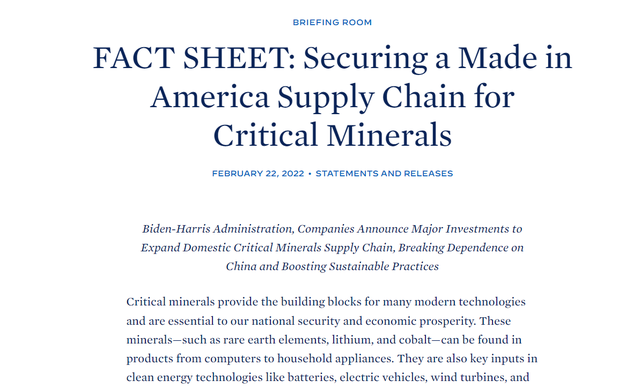
(source: White House)
According to the US definition of "key minerals", such as rare earths, lithium and cobalt fall into this category. These materials can not only be used in the production of computers, household appliances and other equipment, electric vehicle batteries, wind turbines, solar panels and other important carriers of clean energy transformation can not be separated from them.
In the coming decades, global demand for these key minerals will increase 4-6 times, while demand for battery materials such as lithium and graphite will increase as much as 40 times, the White House said in a statement.
In response to the White House, the US Geological Survey also released the final list of key Minerals 2022 on Tuesday, adding 15 items from the original 2018 version, mainly due to the meticulous separation of rare earth and platinum "mining groups" into individual elements. nickel and zinc were added, while helium, potash, rhenium and strontium were removed.
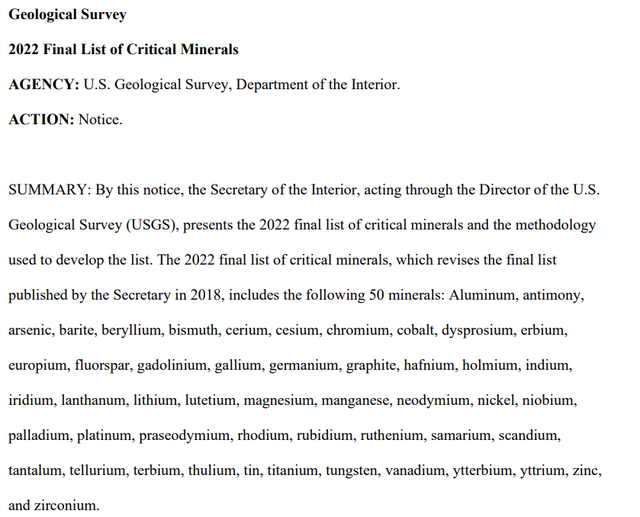
(source: United States Department of the Interior)
U.S. president Joe Biden also announced a batch of mining investments on Tuesday. Among them, rare earth miner MP Materials will receive a $35 million subsidy from the U.S. Department of Defense to separate and process heavy rare earth ores at California facilities and to establish a closed-loop supply chain of local rare earth magnets. The company will also announce an investment of $700 million by 2024 and add 350 jobs to the magnet supply chain.
In addition, Buffett and Berkshire Renewable Energy will also announce this spring that they will build a new display facility in California's Impiril Valley to verify the commercial feasibility of the company's renewable geothermal salt lake lithium extraction technology. It is also one of the projects Berkshire has invested billions of dollars in the production of renewable lithium resources. If successful, it will also pave the way for the company to commercialize mass production of lithium hydroxide and lithium carbonate by 2026.
In the field of recycling, Ford and Volvo will discuss with Redwood Materials a recycling project for waste lithium batteries to reuse lithium, cobalt, nickel, graphite and other materials.
The White House also announced on Tuesday that the U.S. Department of Energy will launch its first demonstration project, allocating $140 million to explore technologies for extracting key materials such as rare earths from coal mine residues and other tailings, thereby reducing demand for new mines. In addition, the Department of Energy will allocate $3 billion to support the construction of recycling facilities for battery materials.
The U.S. government also announced the launch of a revision of the Mining Act, which was written 150 years ago and is still used to regulate the mining of most key minerals on federal land.
It is worth mentioning that the White House will also release a series of policies related to supply chain issues this week. Investments related to the local supply chain, involving the food, energy, transportation and health care sectors, will be disclosed on Thursday, White House officials told the media. Matters related to the implementation of the bipartisan infrastructure bill will also be announced on Wednesday and Friday, but the official did not give details.
![[SMM Еженедельный обзор рынка аккумуляторных элементов для хранения энергии 9.3] Дефицит поставок медной фольги ограничивает сентябрьские производственные планы, цены на аккумуляторные элементы для хранения энергии остаются стабильными](https://imgqn.smm.cn/usercenter/tKgKv20251217171725.png)

![Lithium Carbonate Market Weekly Review: 8.31-9.3 spot lithium carbonate prices rose first then fell, overall downward trend [SMM Weekly Review]](https://imgqn.smm.cn/usercenter/PPLUj20251217171727.jpg)