From March 25 to 26, enterprises in the upper and lower reaches of the industrial chain, elites in the industry, the government and investment institutions will gather in Chongqing to participate in the 2021 China magnesium Industry chain Summit Forum to explore the way for the development of the industry! At the meeting, Zhou Jixue, deputy director of the Institute of New Materials, Shandong Academy of Sciences, explained the integral micro-arc oxidation treatment technology for magnesium-aluminum dissimilar alloy connectors.
Engineering Application of Surface Protection Technology of magnesium Alloy
With the support of the national key science and technology project of the 13th five-year Plan, the Institute of New Materials of Shandong Academy of Sciences has carried out a series of research work on surface protection of magnesium alloys. it mainly includes: (1) micro-arc oxidation surface protection technology; (2) green phosphating surface protection technology; (3) electrochemical deposition surface protection technology.
The related research on micro-arc oxidation focuses on engineering application, preparation of special functional film, performance characterization and improvement.
Engineering application case: magnesium alloy extruded profiles and casting parts are protected by micro-arc oxidation. The components of extruded profiles include AZ series, ZK series, ZM series and so on. After micro-arc oxidation, the surface of extruded profiles is smooth and smooth.
Study on the formulation of low-cost / ultra-low-cost micro-arc oxidation electrolyte
The cost of micro-arc oxidation is mainly divided into two parts: electricity and electrolyte, and low-cost micro-arc oxidation also saves costs.
Research progress: AZ31 low-cost-simple formula electrolyte research and related testing work have been carried out to prepare weakly alkaline or even neutral electrolyte, taking into account the requirements of environmental protection. The high conductivity electrolyte was prepared and combined with the study of high efficiency micro-arc oxidation process, the micro-arc oxidation time was shortened to 2-3min. The time of this process is 1 beat 4 times and 1 stroke 5 of the traditional process, and the current is twice as much as that of the traditional process.
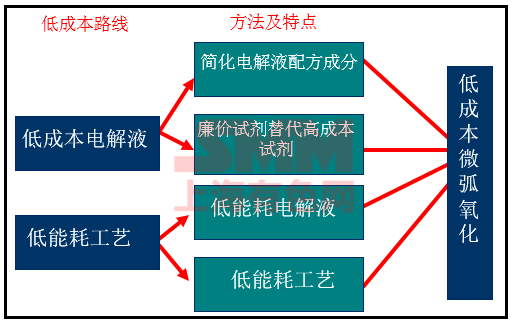
Low-cost electrolyte formulation and short-time micro-arc oxidation process: low-cost electrolyte reduces the formula ingredients to 3 (the cost of trace NaOH), is very low. Combined with high efficiency micro-arc oxidation process, rapid micro-arc oxidation (2min) of magnesium alloy according to AZ31 can be realized, and the performance of the film is better.
Efficient micro-arc oxidation treatment of AZ80 cast magnesium alloy: through high-efficiency micro-arc oxidation process, 1.5min prepared 3um ceramic film on the surface of AZ80 cast magnesium alloy, and the film increased to 6um when 3min. Main conclusions: 1. With the increase of treatment time, the surface tends to be flat (self-leveling) 2. With the increase of treatment time, the size of surface voids increases. 3. The composition of the film on the surface is basically the same in different treatment time.
Rapid micro-arc oxidation process can greatly improve the corrosion resistance of AZ80 magnesium alloy (including corrosion potential and long-period corrosion test). The law of improvement is as follows: before 1.5min, the corrosion resistance is greatly improved, but after 1.5min, the corrosion resistance is slowly improved. The main corrosion form of AZ80 magnesium alloy treated by micro-arc oxidation is pitting corrosion, and the corrosion area accounts for 12% of the total area after 180 hours of neutral salt spray test.
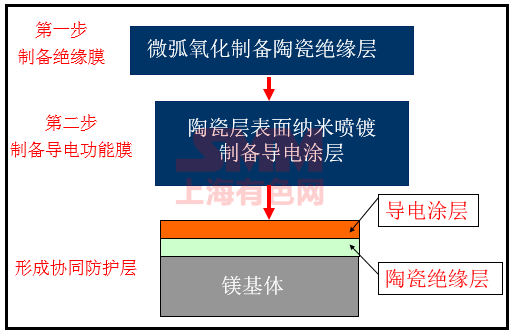
Preparation of insulating Ceramic-Conductive Composite functional Film
Objective: to meet the requirements of surface conductivity and electromagnetic shielding of the coating, and have good anti-corrosion performance.
Research route: ceramic layer + functional coating to prepare functional composite conductive coating.
Technical features: 1. The ceramic layer is used to cut off the electrochemical corrosion closed loop to form the anti-corrosion structure of anode-insulating layer-anode. two。 The coating cooperates with protection to realize the sealing of ceramic insulating layer and further enhance the anticorrosion performance of magnesium alloy.
Research progress: the research work of "ceramic-conductive layer" composite protective coating with low resistance and high conductivity was carried out. A silver film was chemically prepared on the surface of the ceramic layer, and the functional film with low resistance and high conductivity was prepared. The composite coating has good electromagnetic shielding, electrical conductivity and beautiful and smooth appearance.
Integral surface protection technology of magnesium-aluminum heterogeneous metal
Technical difficulty: how to overcome the reaction non-equilibrium caused by the differences in physical, chemical / electrochemical properties of heterogeneous metals. Technical features:
Avoid damage to the film in the process of split assembly. The high impedance and insulating ceramic layer wraps the magnesium-aluminum heterogeneous metal connector as a whole to cut off the corrosion circuit. Improve the overall corrosion resistance of magnesium-aluminum heterogeneous metals and reduce the corrosion potential difference between magnesium and aluminum.
Application field: lightweight structure overall surface protection. The method of high efficiency micro-arc oxidation was used.
The cross section analysis of the ceramic film shows that the thickness of the film on the surface of aluminum and magnesium is the same, and the preparation of the whole ceramic film is more balanced. The main oxidation film has been formed on the surface of 1.5min aluminum and magnesium, and the film becomes denser with the increase of treatment time. After 1.5min, the thickness of the film remains basically the same, and the thickness of the film is about the same as that of 6um.
According to the analysis of the surface morphology of ceramic film, it is found that the smoothness of ceramic film is effectively improved with the increase of treatment time. (self-leveling ability) with the increase of treatment time, the pore diameter of the surface film increases. The EDS/XRD results show that the composition of the film on the surface of aluminum alloy is basically the same, and that of Al2O3, magnesium alloy on the surface of aluminum alloy is MgO. The film on the surface of magnesium alloy grows earlier than that of aluminum alloy.
Through the electrochemical test, it can be found that the whole micro-arc oxidation improves the corrosion resistance of magnesium and aluminum. Reduce the corrosion potential difference between magnesium and aluminum. The corrosion resistance of AZ31 magnesium alloy is better than that of 6061 aluminum alloy, and 3min magnesium has considerable corrosion resistance, while aluminum needs longer time to improve its corrosion resistance. It shows that there is a time sequence in the whole micro-arc oxidation of magnesium-aluminum heterogeneous metals.
Through the electrochemical test, it can be found that the thickness of ceramic film in different treatment time shows that the growth of AZ31 magnesium is earlier than that of 6061 aluminum, and the priority time is about 3min. About 10min, the growth of magnesium and aluminum ceramic film is basically stable, and the film is no longer thickened.
Integral surface protection technology of heterogeneous metals
Through the surface morphology and EDS, it can be found that the ceramic film morphology is different in different areas of 6061-7075 friction stir weldment, especially in the weld zone. The island-shaped porous ceramic layer is distributed on the dense layer. EDS line scan shows that the surface of porous ceramic layer contains Si. With the transition from the base metal area to the weld zone, the number of island porous ceramic layers decreases. The EDS results show that the composition of the dense base layer is Al2O3.. The elements of the island porous ceramic layer are consistent with those of the base metal surface film.
The results of EDS and XRD show that the composition of the ceramic film on the surface of 6061 and 7075 is similar, mainly y-Al2O3 and a small amount of a-Al2O3 and mullite, and the composition of the dense base layer in the weld zone is y-Al2O3. The composition of the island porous ceramic layer on the surface of the weld zone is not consistent with that of the dense base layer. There are a large number of diffusion peaks in the film layer on the surface of 6061 and 7075, and it is inferred that there may be amorphous matter. EDS results show that there is P element, but XRD does not find crystalline P-containing matter. As a result, the formation mechanism of amorphous is inferred: the oxide melt formed under the action of arc high temperature, the surface of the oxide melt is cooled by the electrolyte, and the shell of the high temperature melt forms amorphous.
Verification of timing and selectivity of whole micro-arc oxidation of heterogeneous metals: samples were taken from 6061-7075 connectors after treatment, and the breakdown voltage of the film was measured. 6061, 7075, weld monomer micro-arc oxidation, the breakdown voltage of the film was measured.
It is found that the breakdown voltage of monomer micro-arc oxidation film is similar, and among the films sampled from weldments, the breakdown voltage of 6061 is the highest, followed by 7075. The results showed that the overall treatment of 6061-7075 had reaction sequence and selectivity, 6061 gave priority to covering the film, 7075 was the second, and the weld zone was the last, but the reaction was carried out by Synchronize.
![[SMM еженедельный обзор рынка магния: рост цен на магний, обусловленный издержками, неустойчив из-за слабого спроса]](https://imgqn.smm.cn/usercenter/rUQIB20251217171723.jpeg)
![[SMM отчет по спотовому рынку магниевых чушек: поддержка издержек не может компенсировать слабый спрос, рынок магниевых чушек слабеет под давлением]](https://imgqn.smm.cn/usercenter/XUnxM20251217171723.jpeg)