【SMM Analysis】Falling Chrome Ore Imports, Supported by Demand and Costs, Drive Strong Price Performance

Published: Mar 23, 2026 14:15
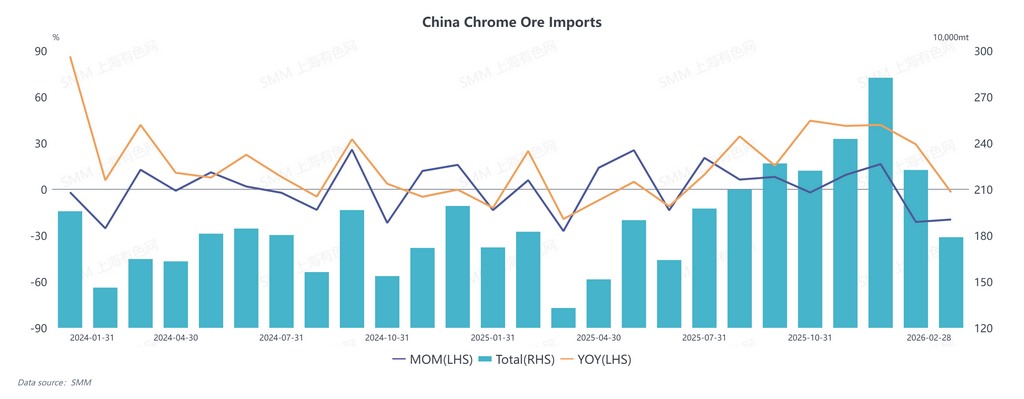
Combined for January and February 2026, China’s cumulative chrome ore imports reached 4.0144 million tons, up 13.2% year-on-year. Breakdown by origin: imports from South Africa were 3.2422 million tons (up 6.2% year-on-year), imports from Turkey were 184,700 tons (up 55.8% year-on-year), and imports from Zimbabwe were 400,000 tons (up 70.3% year-on-year).
News release: March 23, 2026

In January 2026, China's total chrome ore imports amounted to 2.2256 million tons, down 21.2% month-on-month and up 29.2% year-on-year. Specifically, imports from South Africa reached 1.8050 million tons, a month-on-month decrease of 19.4% and a year-on-year increase of 24.0%; imports from Turkey stood at 77,500 tons, dropping 35.0% month-on-month; and imports from Zimbabwe were 224,500 tons, declining 20.2% month-on-month.

In February 2026, China imported 1.7888 million tons of chrome ore in total, falling 19.6% month-on-month and 2.0% year-on-year. Among this volume, imports from South Africa were 1.4372 million tons, down 20.4% month-on-month and 10.1% year-on-year; imports from Turkey hit 107,100 tons, rising 38.1% month-on-month; and imports from Zimbabwe totaled 175,400 tons, a month-on-month drop of 21.9%.

Combined for January and February 2026, China’s cumulative chrome ore imports reached 4.0144 million tons, up 13.2% year-on-year. Breakdown by origin: imports from South Africa were 3.2422 million tons (up 6.2% year-on-year), imports from Turkey were 184,700 tons (up 55.8% year-on-year), and imports from Zimbabwe were 400,000 tons (up 70.3% year-on-year).

Affected by the rainy season, chrome ore mining and shipments in South Africa and Zimbabwe have been relatively constrained. According to South African customs data, South Africa’s total chrome ore exports in January 2026 were 2.1261 million tons, down 5.3% month-on-month and up 54.4% year-on-year, including 1.3831 million tons exported to China, a month-on-month decrease of 5.7% and a year-on-year surge of 138.3%. In addition, Zimbabwe has imposed additional export tariffs on chrome ore. Coupled with unresolved port congestion issues at the Port of Beira, chrome ore shipments have decreased accordingly. Escalating geopolitical conflicts worldwide have pushed up fuel prices and ocean freight rates, lifting the cost of overseas chrome ore and driving chrome ore prices to a relatively high level of 60 yuan per metric ton unit. On the downstream demand side, raw materials purchased for pre-holiday inventory have been consumed, while high ferrosilicon chromium production schedules have sustained steady and growing purchasing demand for chrome ore. Overall, buoyed by rising costs and robust demand, chrome ore prices are expected to maintain a strong trend in the short term.

Data Source Statement: Except for publicly available information, all other data are processed by SMM based on publicly available information, market communication, and relying on SMM‘s internal database model. They are for reference only and do not constitute decision-making recommendations.

For any inquiries or to learn more information, please contact: lemonzhao@smm.cn
For more information on how to access our research reports, please contact:service.en@smm.cn
Related News
[SMM Analysis] Magnesium Exports Surge in Early 2026, Geopolitical Turmoil Threatens Q2 Outlook
9 hours ago
[SMM Analysis] Magnesium Exports Surge in Early 2026, Geopolitical Turmoil Threatens Q2 Outlook
Read More
[SMM Analysis] Magnesium Exports Surge in Early 2026, Geopolitical Turmoil Threatens Q2 Outlook
[SMM Analysis] Magnesium Exports Surge in Early 2026, Geopolitical Turmoil Threatens Q2 Outlook
Jan-Feb 2026 China magnesium exports reached 72.7kt, up 3.4kt YoY. Magnesium alloy led with +33.1% YoY, orders booked through April. Magnesium ingot fell 6.8% due to weak European demand, while powder grew 10.3%. However, US-Israel conflict disrupted Middle East aluminum plants, halting regional magnesium orders and pressuring Q2 outlook despite the strong start.
9 hours ago
Scrap Tungsten Market Saw a Slight Price Collapse, While Ore and Upstream Smelting Products Consolidated Sideways [SMM Tungsten Daily Review]
9 hours ago
Scrap Tungsten Market Saw a Slight Price Collapse, While Ore and Upstream Smelting Products Consolidated Sideways [SMM Tungsten Daily Review]
Read More
Scrap Tungsten Market Saw a Slight Price Collapse, While Ore and Upstream Smelting Products Consolidated Sideways [SMM Tungsten Daily Review]
[SMM Tungsten Daily Review: Slight Price Collapse in the Scrap Tungsten Market, Ore and Upstream Smelting Products Consolidated Sideways] SMM News, March 23 In the short term, prices across the tungsten industry chain still showed divergence between primary and recycled materials. China was currently in a transition period marked by tightening supply on the raw ore side and a rising utilization rate of recycled materials. Smelters still needed some time to adjust their restocking practices and complete the adaptation and transition from a long-term contract pricing model led by the ore side to a scrap tungsten market procurement model featuring higher-frequency transactions and greater sensitivity to sentiment.
9 hours ago
【SMM Analysis】Limited Overseas Production Recovery; Ferrochrome Imports Remain Low
16 hours ago
【SMM Analysis】Limited Overseas Production Recovery; Ferrochrome Imports Remain Low
Read More
【SMM Analysis】Limited Overseas Production Recovery; Ferrochrome Imports Remain Low
According to data from China Customs: Combined for January–February 2026, China imported 265,100 metric tons of high-carbon ferrochrome in total, a year-on-year decline of 51.6%. Breakdown by origin: imports from South Africa were 40,700 metric tons, down 83.3% year-on-year; imports from Kazakhstan were 158,400 metric tons, down 19.7% year-on-year.
16 hours ago