On the evening of January 6, CMOC announced its preliminary estimates for the production of major products in 2024 as follows:
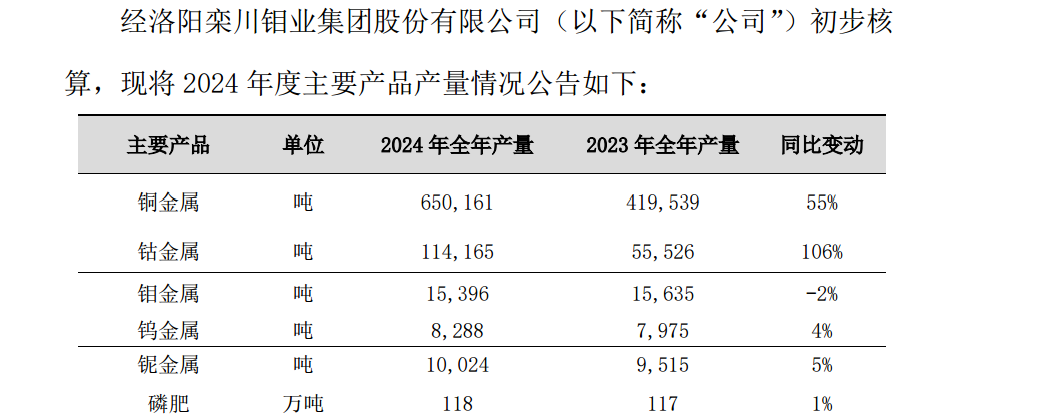
The announcement from CMOC revealed: In 2024, the company's refined copper production is expected to reach 650,000 mt, up 55% YoY; refined cobalt production is expected to reach 110,000 mt, up 106% YoY; molybdenum production is expected to reach 20,000 mt, down 2% YoY; tungsten production is expected to reach 8,288 mt, up 4% YoY; niobium production is expected to reach 10,000 mt, up 5% YoY; and phosphate fertiliser production is expected to reach 1.18 million mt, up 1% YoY.
CMOC stated that the production data mentioned in this announcement are only preliminary estimates, and the final figures will be subject to the audited 2024 annual report officially disclosed by the company.
An investor asked on the interactive platform: "Which regions are the company's products sold to? Are the risks controllable? Are the company's inventory and market share stable?" On November 28, CMOC responded on the interactive platform, stating that the company's products are sold globally, sales are normal, and inventory levels are basically stable.
Previously, when asked, "What are the company's main businesses? How does the company address future risks and challenges?" CMOC responded on November 28 via the interactive platform, stating that the company operates in the non-ferrous metal mining and processing industry, primarily engaged in the mining, selection, smelting, and processing of base and rare metals, as well as mineral trading. Currently, the company's main operations are distributed across Asia, Africa, South America, Oceania, and Europe. It is a global leader in the production of copper, cobalt, molybdenum, tungsten, and niobium, and a leading phosphate fertiliser producer in Brazil. Additionally, its base metal trading business ranks among the top globally. For more detailed business-related information, please refer to the company's annual report. The company continues to consolidate its low-cost competitive advantage through cost reduction and efficiency improvement, technological breakthroughs, and enhancing the capacity, production, and efficiency of ongoing projects. It also strengthens market research, uses financial derivatives prudently and reasonably to mitigate price fluctuation risks, identifies macro environments and mining regulations in the countries or regions where its mines operate, adheres to lawful and compliant operations, maintains positive and constructive relationships with stakeholders, and ensures orderly production and operations. The company formulates and improves safety systems, reinforces safety and environmental protection responsibilities, increases investment in safety and environmental protection, and strongly promotes standardised safety management to prevent and control safety risks.
CMOC's previously released Q3 report showed that from January to September, the company achieved an operating income of 154.755 billion yuan, up 17.52% YoY; net profit attributable to shareholders of publicly listed firms was 8.773 billion yuan, up 238.62% YoY; and net cash flow from operating activities was 17.28 billion yuan, up 71.1% YoY.
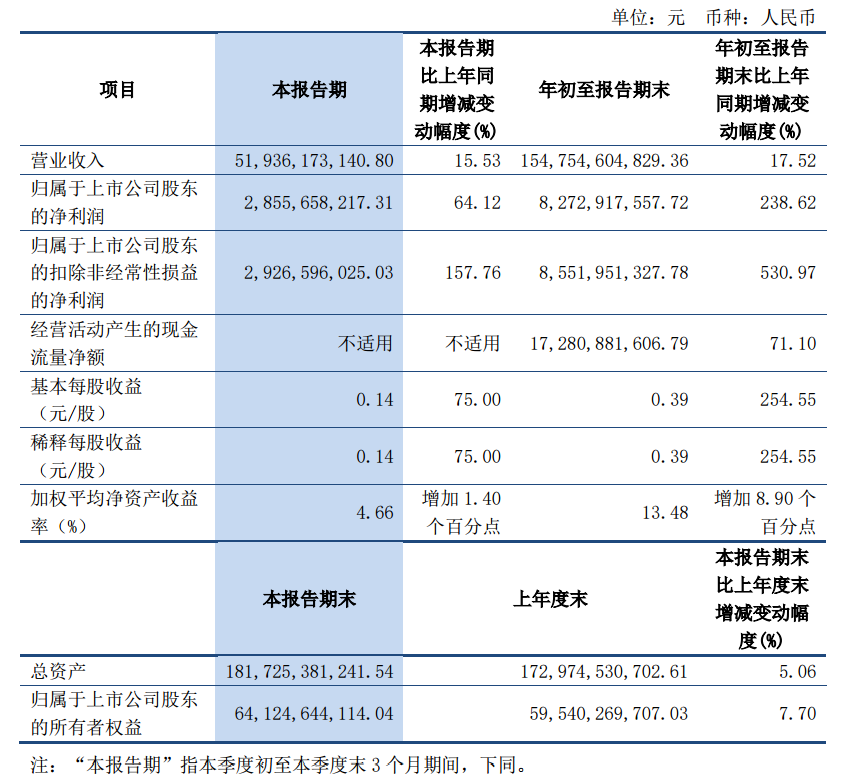
The Q3 report stated that during the period, the company's copper and cobalt product production and sales volumes increased, while lean management continued to improve, overall costs decreased compared to the same period last year, and profits rose YoY.
Guolian Securities released its 2025 annual investment strategy for the non-ferrous metal industry, analyzing that from early 2024 to December 30, 2024, the Shenwan Non-Ferrous Metal Industry Index rose by 6.10%, ranking 15th among the 31 Shenwan primary industry indices. Among these, the industrial metals, new metal materials, and minor metal sectors saw the highest increases, with gains of 15.27%, 10.71%, and 9.84%, respectively, while the energy metals sector experienced the largest decline, falling by 18.48%. Regarding fund holdings, the allocation ratio of the non-ferrous metal sector in funds was 6.04%, 6.11%, and 5.41% in Q1, Q2, and Q3 of 2024, respectively, remaining at historically high levels. Among these, the copper, aluminum, and gold sectors saw significant increases in institutional allocations, with Q3 2024 holdings valued at 38.455 billion yuan, 17.885 billion yuan, and 17.34 billion yuan, respectively. Guolian Securities remains optimistic about investment opportunities in the non-ferrous metal sector and maintains an "outperform" rating for the industry. Recommended stocks include: 1) Industrial metals: in the aluminum sector, Chalco, China Hongqiao, Yunnan Aluminum, and Shenhuo Group; in the copper sector, Zijin Mining, CMOC, Jiangxi Copper Corporation (JCC), Minmetals Resources, JCHX Mining, and Tongling Nonferrous Metals; 2) Precious metals: in the gold sector, China Gold International, Chifeng Jilong Gold Mining, and Shandong Gold International; in the silver sector, Yinxing Silver & Tin.
A research report by Minsheng Securities pointed out: 1) Aluminum: Focus on the resource attributes of bauxite. Supply side, domestic capacity has reached its ceiling, with limited effective capacity growth. Aluminum production growth is slow, European aluminum production recovery is sluggish, and Indonesia's planned capacity is constrained by power supply, making rapid release difficult. Demand side, the expanding base of NEVs and PVs is increasingly important in boosting aluminum consumption. Real estate completions, driven by continuously strengthened property policies, are not a major concern. Raw material side, focus on the resource attributes of bauxite. Domestic bauxite production recovery is slow, Guinea's overseas supply stability is suboptimal, and bauxite supply tightness is unlikely to ease. Regarding alumina, the backwardation structure persists. In the long term, as new domestic and overseas capacities come online and ore supply disruptions ease, production will gradually increase. Coupled with the approaching ceiling of aluminum capacity on the demand side, alumina demand growth will be limited, leading to a gradual surplus in alumina. Recommended stocks include Chalco, Tianshan Aluminum, etc. 2) Copper: The time is ripe. Financial attributes: The US Fed has entered an interest rate cut cycle, improving financial attributes marginally. Supply side, ore supply remains tight, long-term contract smelting processing fees have hit historic lows, and ore supply tightness is being transmitted to the smelting side. In the long term, insufficient long-term capital expenditure by copper miners, combined with declining ore grades weakening resource endowments, is steepening the supply curve. In the short term, long-term contract smelting processing fees (TC/RC) have dropped significantly, accelerating the transmission of copper ore tightness to copper cathode tightness. Demand side, domestic policies provide support, and overseas supply chain restructuring ensures stable demand growth. In 2025, domestic policies of fiscal and monetary easing will strengthen domestic demand, while emerging sector demand will continue to grow. Additionally, overseas demand will remain significant due to supply chain restructuring, potentially driving copper prices higher. Recommended stocks include CMOC, Zijin Mining, etc.