Recently, the second phase of the National Integrated Circuit Industry Investment Fund (hereinafter referred to as "the second phase of the fund") has made new moves. Ningbo Nanda Optoelectronics, the holding subsidiary of 300346.SZ, plans to introduce the second phase of the fund as a strategic investor by means of capital increase and share expansion. At this point, Nanda Optoelectronics has become the first semiconductor material company to be invested in the second phase of the big fund.
A number of industry insiders and analysts told the Financial Associated Press that the next investment focus of the second phase of the big fund will be the leader in the field of semiconductor materials and equipment, and the injection of capital is expected to promote the rapid development of the domestic semiconductor industry.
Affected by the above news, NTU Optoelectronics shares rose from 50.60 yuan on July 27 to 82.28 yuan on July 30, up 62.6% in three trading days, and hit the 20% limit on July 29, closing at 70.60 yuan on Friday. Its own stock price shot up all the way up at the same time, it also led the whole plate of photoresist to rise sharply in recent days.
Why Nanjing University Optoelectronics?
The reporter combed the relevant information and found that so far, the second phase of the large fund has announced 13 investment projects, with a total investment of more than 30 billion yuan. From the point of view of the number of projects and the amount of investment, the main destination is still in the field of semiconductor manufacturing and IC design.
However, the two recent investments, the second phase of the big fund respectively focused on the equipment and materials in the upper reaches of the integrated circuit industry chain.
Before becoming the battle investment of Nanda Optoelectronics, the second phase of the big fund was allocated 24.44 million shares issued by 688012.SH for nearly 2.5 billion yuan at the beginning of this month. After the fixed increase is completed, the second phase of the big fund will become the fifth largest shareholder of the latter. China Micro Corporation specializes in ion etching equipment, has entered TSMC 7nm, 10nm production line, 5nm is in the certification stage.
Analysts believe that the reason why Nanjing University Optoelectronics has become the first semiconductor material company to be invested in the second phase of the big fund may be related to the special status of semiconductor photoresist and the company's own technical strength.
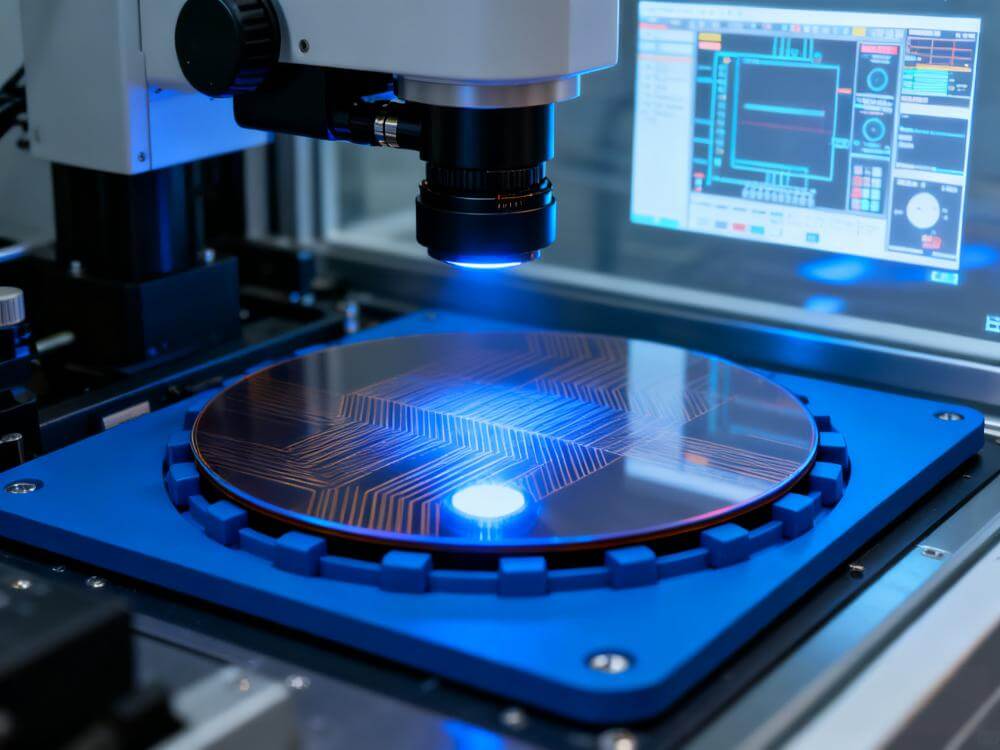
Photoresist is the core material of semiconductor lithography. At present, there is an obvious gap between domestic and foreign manufacturers. The self-sufficient rate of gzag I line photoresist is 20%. The self-sufficient rate of Magneto KRF photoresist is less than 5%, while the more technically difficult ArF and EUV photoresist have not yet been mass produced, and the market share of middle and high-end photoresist is almost monopolized by overseas leaders.
Earlier, under the influence of Fukushima Earthquake, Japan's Shinyue chemical production capacity was limited and the export of KRF photoresist to China was restricted, which made some domestic wafer factories "without glue available".
In the field of semiconductor photoresist, the main players on the domestic track are Tongcheng New material (603650.SH), Jingrui Electric material (300655.SZ), Nanda Optoelectronics and Shanghai Xinyang (300236.SZ) and so on.
Potential target: skilled equipment and material leader
With regard to the focus of investment, Ding Wenwu, general manager of the big fund, said at the Semiconductor Integrated Circuit parts Industry Summit that the second phase of the fund mainly focuses on three aspects: first, to speed up the investment layout of core equipment such as lithography machines, chemical and mechanical grinding, as well as key components; second, to form a group to go to sea to cultivate Miaozi of "applied materials" or "Tokyo Electronics" enterprises in mainland China. The third is to speed up the process of equipment from verification to "batch procurement", so as to strive for more market opportunities for local equipment and material enterprises.
"next, there are two factors for reference in the investment direction of (big funds). One is the leading technology, such as being able to supply materials and equipment from domestic and even international mainstream wafer factories, and the other is that there is an urgent need for a breakthrough. a leader in a subdivided field with a low localization rate." A private equity person analyzed it to a reporter from the Financial Associated Press.
With reference to market space, self-sufficiency rate and technical difficulty, a reporter from the Financial Associated Press combed the listed companies of materials and equipment in the upstream of semiconductors and found that in some segments of the market, there is a huge space for the domestic market at present. leading companies with technology leadership are expected to usher in breakthroughs under policy and capital support, while benefiting from the capacity expansion of domestic wafer factories. Previously, China Micro Corporation, Changchuan Technology (300604.SZ), Bauhinia Technology, North China Chuang Chuang (002371.SZ) and ACMR.O Semiconductor have been supported by large funds.
Under the background of the imminent demand for chip localization, the National Integrated Circuit Industry Investment Fund (the first phase of the large fund) was officially launched in September 2014, with a registered capital of 98.72 billion yuan. At present, all investment has been completed, with a total investment of 138.7 billion yuan. There are 23 public investment companies, with a total of about 70 effective investment projects. The investment direction of the first phase of the large fund is focused on memory and advanced process production lines, and the proportion of the top three enterprises in the industrial chain reaches 70%.
Compared with the continuous increase in the second phase, the first phase of the large Fund has entered the payback period in 2019-2023 as planned, and began to opt out of previous investment projects in stages. In addition to Jingfang Technology (603005.SH) and Zhaoyi Innovation (603986.SH), which have been continuously reduced recently, Ruixin Micro (603893.SH), Taiji Industry (600667.SH), long-term Power Technology (600584.SH), Tonfu Micro Power (002156.SZ) and so on are also on the reduction list.
![[SMM Flash de Cromo] Aumento do diesel na África do Sul eleva custos de transporte de minério de cromo](https://imgqn.smm.cn/usercenter/tjmLW20251217171722.jpeg)
![[SMM Flash de Cromo] Nova Bolsa de Minerais da Índia Pode Remodelar a Descoberta de Preços Domésticos de Cromita](https://imgqn.smm.cn/usercenter/wUnEn20251217171722.jpeg)