SMM7: at the 2020 (Fifth) China International Nickel-Cobalt-Lithium Summit Forum and China International Conference on New Energy Lithium Materials held by SMM, Hu Guorong of Central South University explained the present situation and future development of high-nickel ternary cathode materials for lithium-ion batteries.
Application Market of Lithium Ion Battery and cathode Materials
New energy vehicle
Plug-in hybrid and pure electric vehicles in the global market have begun to enter the development stage of popular application. It is estimated that by 2050, most of the world's 44 million pure electric vehicles and internal combustion engine vehicles will be replaced by new energy vehicles.
Energy storage lithium battery
Energy storage lithium battery is still in its infancy. Thanks to the energy storage demand of household energy storage, telecommunications base stations, wind energy, solar energy and other emerging energy storage, the energy storage market will reach 114 billion yuan in 2020.
Consumer electronics
Due to the continuous innovation and integration of big data, cloud computing, Internet of things and other information technology and industry, the global intelligent equipment industry will continue to maintain rapid growth, of which industrial robots will maintain 11%CAGR growth in the next five years; by 2020, the overall market size of China's intelligent equipment will exceed 1 trillion yuan.
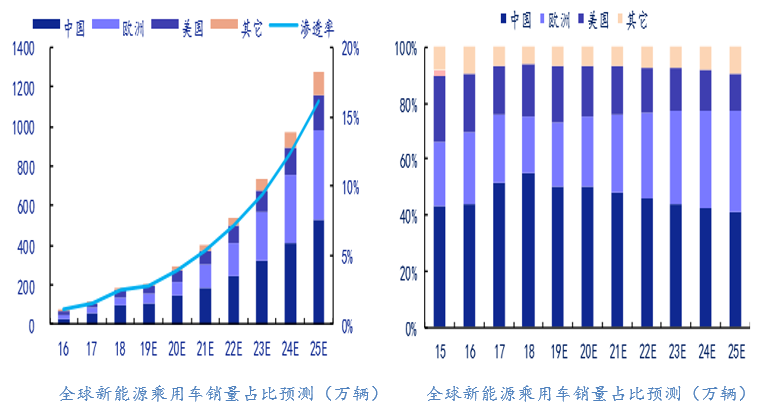
The cathode materials of lithium batteries keep growing at a high speed, and gradually develop to ternary materials and other high energy density materials.
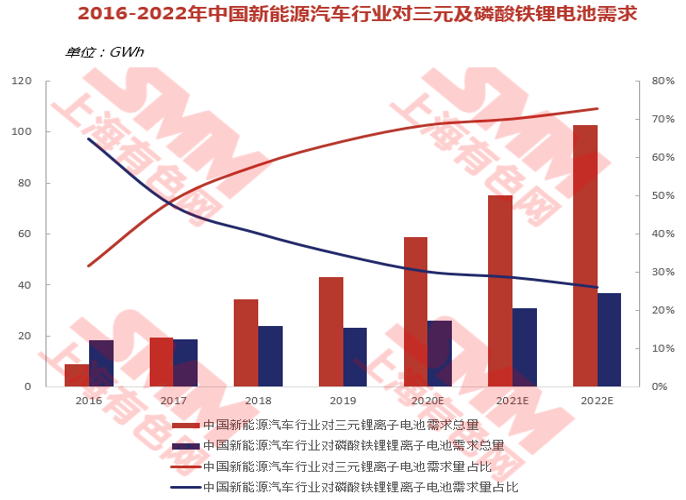
Characteristics of cathode materials for commercial lithium-ion batteries
High nickel ternary materials have high energy density and long range, but the increase of nickel content encounters other problems, such as safety problems.
At present, the commercialized ternary series materials:
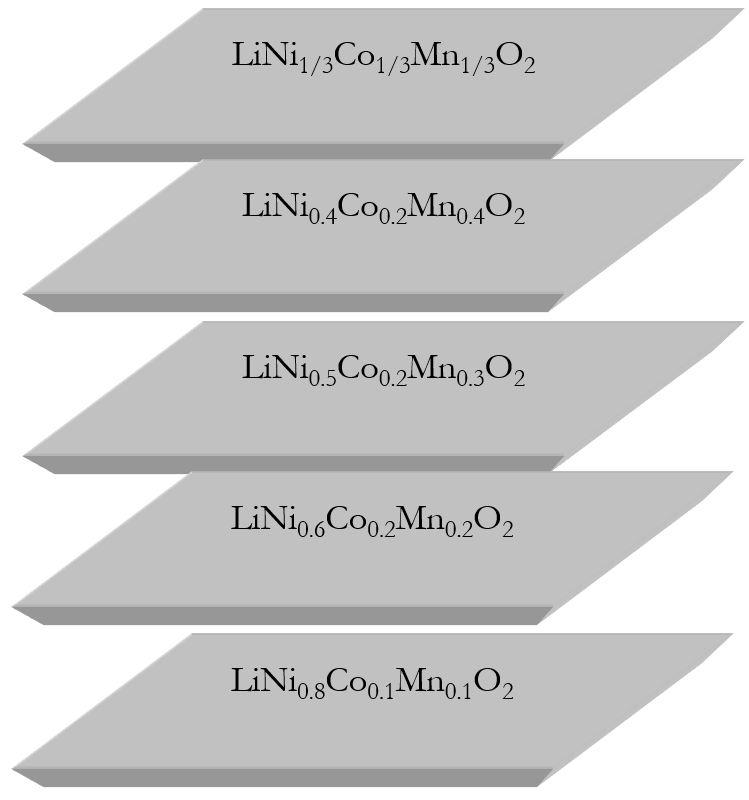
Present situation of industrialization of Ternary Materials
Competition pattern of Ternary Materials at Home and abroad
At present, the domestic competition in ternary material technology is fierce, and the speed of product upgrading is relatively fast.
In the past, more digital NCM111 and NCM532 ternary materials are facing the awkward situation of elimination, manufacturers began to promote nickel NCM622, 721,811, 900505 and other ternary materials, as well as NCA (851005) ternary materials, because the precursor is a technically difficult and customized intermediates, precursor research and development and cathode materials research and development need a good collaborative mechanism in order to achieve efficient development. Therefore, the self-prenatal drive mode of cathode material manufacturers has better technical development efficiency, which is advantageous to occupy the first-mover advantage in the field of high-end ternary materials and has higher investment value.
Suppliers of ternary materials and their precursors
At present, the competition pattern in the field of ternary materials abroad has basically taken shape, forming a pattern of oligopoly competition, mainly for Japanese and Korean ternary material suppliers such as Umicore, Tanaka Chemical, Sumitomo Metals, Nichia, Laff, Toda Kogyo and so on. There is still a certain gap between domestic ternary material manufacturers and Yumeike and other Japanese and South Korean manufacturers in terms of technology and production capacity.
Precursors occupy an important position in the ternary material industry chain, have high technical barriers, and have an important impact on the quality of ternary materials, and are non-standard customized products. Therefore, manufacturers of prenatal drivers have more advantages in the competition of technological upgrading. At present, most of the leading suppliers of ternary materials are from prenatal drive, including Dangsheng Technology, Xiamen Tungsten Industry, Bamo-Huayou, Ningbo Rongbai, Ruixiang New Materials, Green Mei, Henan Cologne and other manufacturers.
Among the enterprises that produce precursors separately, Greenmei, Bangpu, Guizhou Zhongwei, Zhejiang Pawa, Jinchuan Science and Technology are the leading enterprises, and their precursors supply first-line ternary material customers at home and abroad.
Development trend of NCM
High nickel and low cobalt ternary materials: cobalt is an expensive scarce resource, reducing the content of cobalt can save the cost of materials. At present, materials with cobalt content reduced to 3% have been used. At present, the cost of 811 material is lower than that of 523, but the energy density is higher!
High voltage ternary materials, NCM523, 622 materials can achieve high voltage. The structure of NCM523 and 622 materials is more stable than that of 811 materials, so they can synthesize high voltage NCM; similar to high voltage lithium cobalt.
The compaction density of high pressure single crystal NCM material can reach 3.8.
Surface modification of high nickel ternary materials, including washing to reduce the content of residual alkali on the surface, and surface coating, including coating of non-metallic oxides and organic conductive polymers, to reduce the sensitivity of materials to humidity.
Current debate on the technical route of cathode materials for power batteries
At present, there are three schools in the technical route of cathode materials for power batteries: lithium iron phosphate school, ternary (NCA,NCM) school, and lithium manganate school.
1. Lithium iron phosphate line
Led by BYD, Chinese battery manufacturers take the lead in the development and manufacture of lithium iron phosphate batteries. BYD's e6 electric car has a range of 300 in the early stage and more than 400km in the medium term. BYD's latest "Han" pure electric vehicle with lithium iron phosphate blade battery has a range of more than 600km. Lithium iron phosphate battery due to good safety, low cost, the future price of lithium iron phosphate material will be less than 30,000 yuan / ton, lithium iron phosphate battery less than 0.5 yuan / WH, BYD lithium iron phosphate blade battery and CATL CTP lithium iron phosphate battery volume energy density significantly increased, the mileage has exceeded 600km, the future impact on ternary battery can not be ignored. The Tesla Shanghai plant, in cooperation with Ningde Times, may use lithium iron phosphate batteries to reduce costs.
2. Ternary (NCA,NCM) route
Represented by Tesla, using Japanese Panasonic NCA battery, South Korea LG Sanyuan 811 battery and China CATL Sanyuan 811 battery, the mileage can reach 700km, and in the future it may reach 800,000km. Tesla has built a plant in Lingang New City, Shanghai, China, using NCA batteries. The power battery invested by South Korean Samsung in Xi'an also uses NCA. Chinese CATL, BYD, Bic, Funeng Technology, Lishen, Guoxuan and other enterprises have also put into production ternary NCM power batteries.
3. Lithium manganate route
NISSAN adopts lithium manganate route and launched LEAF pure electric vehicles with cruising mileage of 160km in Japan, the United States and European markets as early as 2010. at present, lithium manganate is widely used in low-speed electric vehicles, logistics vehicles and electric bicycles, mainly lithium manganate power battery manufacturers such as Suzhou Xingheng and Beijing CITIC Guoan. Because of its high voltage platform and high compaction density, lithium manganate has the same bulk energy density as lithium iron phosphate. Due to the good safety of lithium manganate, the future lithium manganate can also be designed as a blade battery or CTP battery (that is, directly from the battery cell to pack), the range of the future lithium manganate battery can also reach more than 600km.
Current debate on the technical route of cathode materials for power batteries
Ternary NCM/ lithium titanate negative electrode
Due to the possible safety problems and cycle life problems caused by the formation of lithium dendrite in carbon negative electrode, some power battery manufacturers adopt ternary NCM/ lithium titanate negative electrode combination, which has good safety, high charge and discharge rate and long cycle life (up to 5000ml 10000 times). Although the energy density of ternary NCM/ lithium titanate power battery is low (even lower than that of lithium iron phosphate battery) due to the high voltage of lithium titanate, it still has a good application prospect in electric buses, because the electric bus does not require high mileage, but it has high requirements for safety, charging speed and cycle life, so ternary NCM/ lithium titanate power battery can meet these requirements very well.
At present, Zhejiang Huzhou Weihong Power and Zhuhai Yinlong adopt ternary NCM/ lithium titanate power battery, which is widely concerned and praised by the industry. However, this technical route is non-mainstream, affected by the low energy density, and has been abandoned in the field of passenger cars. In the field of buses, it has also been abandoned because of its high cost.
Dong Mingzhu, president of Gree Electric Appliances, and real estate giant Wang Jianlin invest in Zhuhai Yinlong and are optimistic about NCM/ lithium titanate power batteries. But this kind of technical route is not mainstream, the industry is not optimistic!
Resource Analysis of Ternary Materials
At present, the mainstream international technology adopts ternary NCA or NCM cathode materials, in which nickel and cobalt belong to rare metals. The following is an example of NCA adopted by Tesla:
Tesla's NCA battery is an 18650 cylindrical battery with a capacity of about 3000mAh, and each car needs about 7000 batteries.
It is calculated that each battery needs 17 grams of NCA, and consumes about 8.33g of nickel and 1.56g of cobalt.
Each car needs 58.3 kilograms of nickel and 10.95 kilograms of cobalt.
According to the global 2020 electric vehicles will reach 5 million, if all use ternary materials, the annual need for nickel is 292000 tons, cobalt is 55000 tons.
At present, major developed countries, such as the seven industrial countries in the world, as well as China have begun to formulate a timetable for banning the sale of fuel vehicles.
If the global annual production of electric vehicles reaches 25 million, the global demand for nickel and cobalt is 1.46 million tons and 275000 tons respectively.
At present, the global annual output of nickel is about 2 million tons and cobalt is 100000 tons.
Therefore, if NCA or NCM is used as the cathode material, the nickel and cobalt resources are difficult to bear. Even if the method of recovery of nickel and cobalt is adopted, the cost is still a problem.
With the increase of the consumption of nickel and cobalt resources, the price of nickel and cobalt will soar. In history, the price of nickel is as high as 400000 yuan / ton, and the price of cobalt is as high as 700000 yuan / ton. The price of ternary materials will soar accordingly.
Resource Analysis of Lithium Iron Phosphate cathode material
The global iron output is more than 1 billion tons, the iron resources are not limited, the global phosphorus production is more than 100 million tons, and the resources are not limited.
In addition, the lithium content in lithium iron phosphate is about 4%, while the lithium content of ternary materials is about 7%.
As a result, lithium iron phosphate consumes more than 40% less lithium resources than ternary systems.
In 2020, with the further increase of lithium iron phosphate production capacity and the substantial decrease in the price of iron phosphate and lithium carbonate in China, the cost of lithium iron phosphate will be greatly reduced. At present, the price of lithium iron phosphate has dropped to 32000 yuan / ton, and may be as low as 28000 yuan / ton in the future.
If lithium iron phosphate / graphene composite is used, the lithium iron phosphate battery will be filled with 80% of the battery in 10 minutes. Capl is developing and solving the problem of fast charging of lithium iron phosphate battery. Combined with blade battery and CTP battery, the battery mileage of lithium iron phosphate battery is not a problem. Considering the advantages of cost, cycle and safety performance of lithium iron phosphate, the technical route of electric vehicles in the future will be that ternary materials and lithium iron phosphate will go hand in hand.
Some suggestions on the future development of high nickel ternary materials
Solve safety problems and further improve mileage
Further increase in industrial concentration
Large-scale and intelligent equipment
Site selection is prudent
Upstream and downstream extension
Co-production of high nickel ternary materials and lithium iron phosphate materials
Conclusion
The main results are as follows: 1. High nickel MCN and NCA materials have high energy density, so they are the preferred cathode materials for electric vehicle power lithium batteries.
2. At present, high nickel MCN and NCA materials still have some problems, such as safety, cycle life, high surface residual alkali content and so on, which need to be further studied and improved.
3. Considering the advantages of cost, cycle and safety performance of lithium iron phosphate, combined with lithium iron phosphate blade battery and CTP battery, the future technical route of electric vehicles will be that ternary materials and lithium iron phosphate will keep abreast of each other.
4. Some suggestions for the future development of high nickel ternary materials: solve safety problems, further improve mileage, further improve industrial concentration, large-scale and intelligent equipment, select dry areas and areas with cheap electricity, extend upstream and downstream to enhance industrial competitiveness, do a good job in battery recycling, co-production of high nickel ternary and lithium iron phosphate, reduce costs, industrial mergers and acquisitions, and promote the healthy development of the industry!

Scan the QR code and join the SMM metal communication group.
![[Análise de SMM] Portugal cancela a construção de uma indústria integrada de mineração e processamento de lítio](https://imgqn.smm.cn/usercenter/WBREf20251217171728.png)
![[SMM Flash] SADC instada a passar das exportações de minerais brutos para o processamento, proibição do lítio no Zimbábue citada como modelo](https://imgqn.smm.cn/usercenter/mpqgn20251217171727.jpg)