On November 2, South Korean research firm SNE Research released its latest installation data, showing that global power battery installations reached 994.5 GWh in the first three quarters of 2026, up 19.7% from 830.7 GWh in the same period last year.
September alone saw installations hit 145.1 GWh, a record monthly high, up 15.8% YoY. Amid continued global market expansion, the competitive landscape of the power battery industry is undergoing sharp divergence, with Chinese battery companies continuing to climb while Japanese and South Korean giants collectively face pressure.
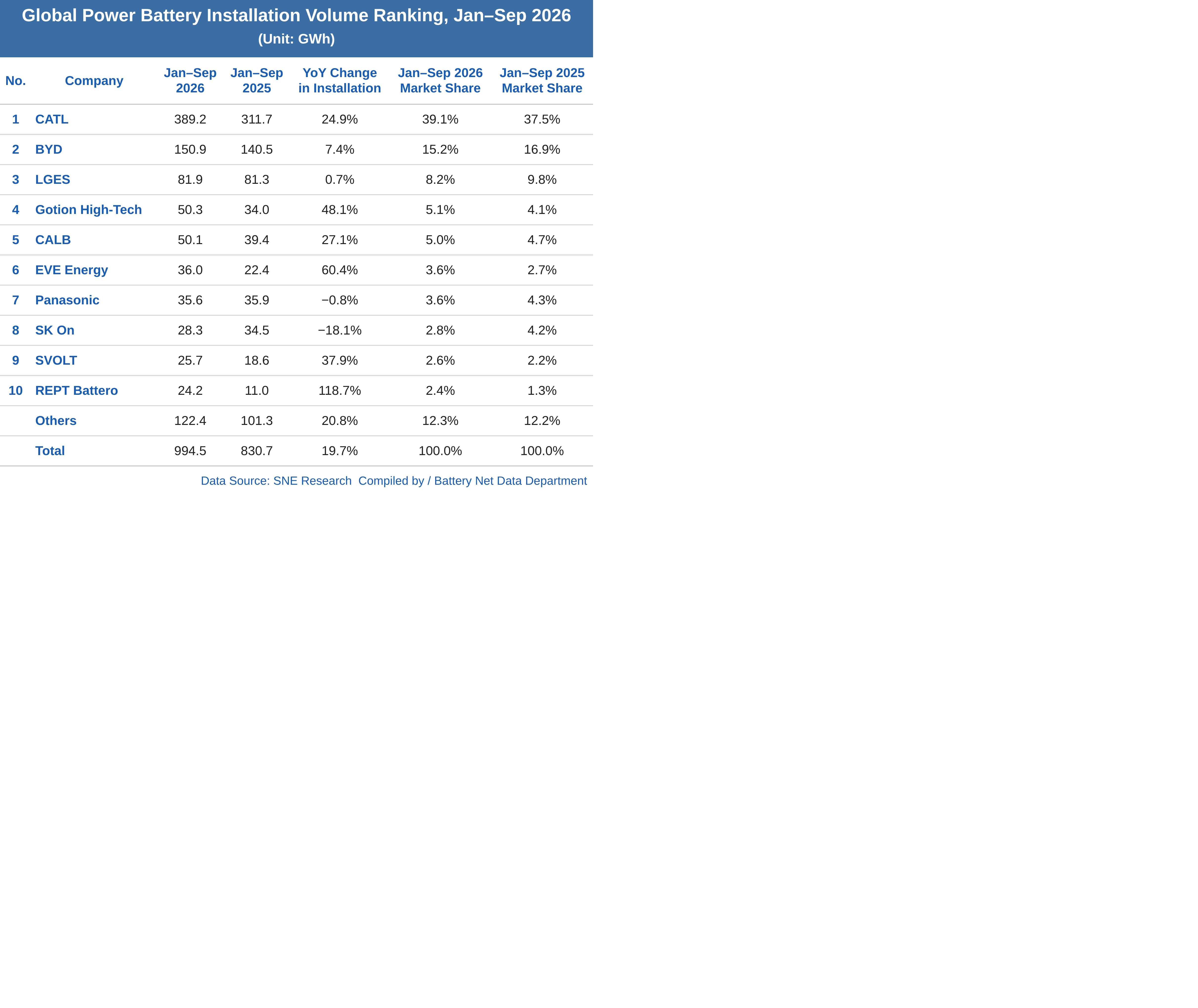
In terms of YoY changes in installations, among the global top 10 power battery installation companies in the first three quarters of 2026, SK On and Panasonic posted YoY declines of 18.1% and 0.8%, respectively, while the remaining eight companies all achieved YoY growth. REPT Battero maintained triple-digit growth of 118.7% in the first three quarters, making it the only company in the top 10 to more than double its growth rate.
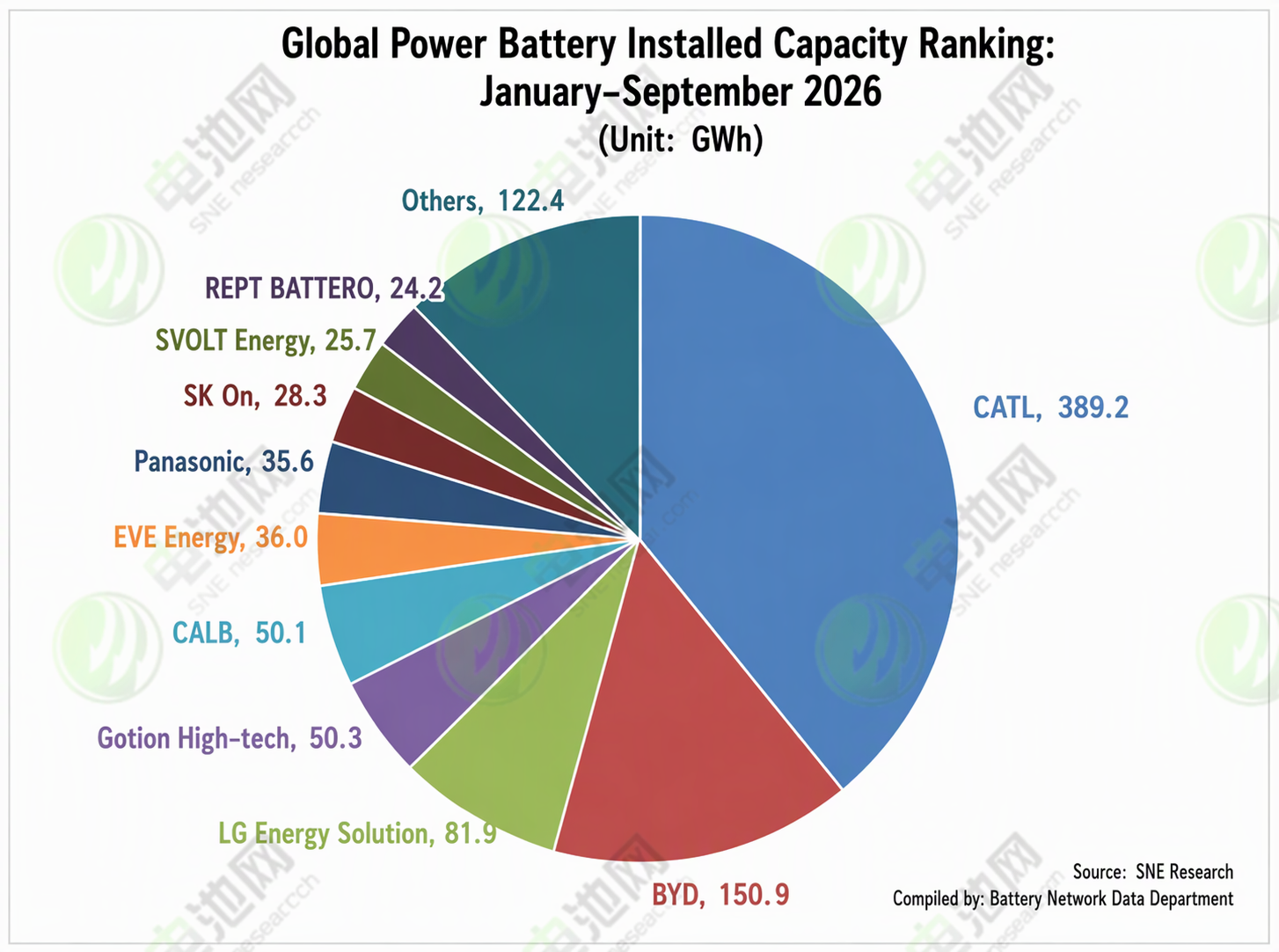
In terms of market share, compared with the same period in 2025, among the global top 10 power battery installation companies in the first three quarters of 2026, CATL, Gotion High-tech, CALB, EVE, SVOLT, and REPT Battero achieved positive YoY growth, while BYD, LG Energy Solution, Panasonic, and SK On saw declines of varying degrees.
In terms of ranking changes, compared with January-August 2026, among the global top 10 power battery installation companies in the first three quarters, Gotion High-tech and CALB swapped positions, as did EVE and Panasonic, ranking 4th through 7th; the rankings of the other six battery companies remained unchanged.
Compared with the same period last year, among the global top 10 power battery installation companies in the first three quarters of 2026, aside from the top 3 remaining unchanged—still CATL, BYD, and LG Energy Solution—other companies saw notable changes:
Driven by the dual engines of the NEV and energy storage markets, some Chinese companies demonstrated remarkable explosive growth. REPT Battero and EVE led the growth rankings, each rising three places, with Gotion High-tech climbing from 7th last year to 4th, and EVE rising from 9th to 6th.
CALB and Panasonic each dropped one place to 5th and 7th, respectively; SK On fell from 5th to 8th; SVOLT rose one place from 10th to 9th.
In addition, compared with the same period last year, REPT Battero newly entered the list at 10th place, while 11th-ranked Sunwoda recorded installations of 23 GWh, with the gap between the two at 1.2 GWh. Samsung SDI, previously ranked 8th, dropped out of the top 10.
In terms of the competitive landscape, the global power battery market remains in expansion overall, but competition among companies is further diverging, with Chinese battery companies performing particularly well.
On the Chinese company side, among the global top 10 power battery installation companies in the first three quarters of 2026, seven Chinese companies (CATL, BYD, Gotion High-tech, CALB, EVE, SVOLT, and REPT Battero) captured a combined 73% market share, up 3.6 percentage points YoY.
Specifically, as the undisputed leader of the global power battery industry, CATL remained strong in the first three quarters of 2026: its market share reached 39.1%, up 1.6 percentage points YoY, maintaining its global No.1 position with installations of 389.2 GWh, up 24.9% YoY.
BYD's market share slipped to 15.2%, but it remained firmly in 2nd place with installations of 150.9 GWh, up 7.4% YoY. Together with CATL, the two companies accounted for over 54% of the global market, further consolidating China's power battery industry's bargaining power in the global supply chain.
Gotion High-tech ranked 4th with installations of 50.3 GWh, up 48.1% YoY, for a market share of 5.1%.
CALB ranked 5th with installations of 50.1 GWh, up 27.1% YoY, for a market share of 5.0%.
EVE ranked 6th with installations of 36.0 GWh, up 60.4% YoY, for a market share of 3.6%.
SVOLT ranked 9th with installations of 25.7 GWh, up 37.9% YoY, for a market share of 2.6%.
REPT Battero ranked 10th with installations of 24.2 GWh, up 118.7% YoY, emerging as the fastest-growing dark horse on the list with a market share of 2.4%.
Unlike most Chinese companies, which maintained double-digit or even triple-digit explosive growth, leading Japanese and South Korean battery companies showed notably weak market performance in the first three quarters of 2026. Facing growth bottlenecks in the power battery segment, Japanese and South Korean companies are being forced to seek a second growth curve.
On the South Korean company side, Samsung SDI has dropped out of the top 10, while the remaining two Korean battery companies, LG Energy Solution and SK On, recorded combined installations of 110.2 GWh, with their global market share shrinking from 14% in the same period last year to 11%.
Among them, LG Energy Solution ranked 3rd with installations of 81.9 GWh, but its YoY growth rate was only 0.7%. The company continues to supply major automakers including Tesla, General Motors, Hyundai Motor Group, and Volkswagen, but its market growth has slowed sharply. LG Energy Solution has begun aggressively expanding into the energy storage market. In North America, on top of the more than 50 GWh of capacity planned by the end of this year, it is adding a new prismatic line to ensure ESS capacity exceeds 70 GWh by the end of next year. In Europe, its Polish plant converted part of its EV production lines to ESS last year.
SK On ranked 8th with installations of only 28.3 GWh, down 18.1% YoY, with its market share further declining to 2.8%. SK On is actively exploring growth markets beyond power batteries, with part of its Georgia plant converted to an LFP production line for ESS, and it has partnered with a US ESS company to build a 9 GWh plant.
Japan's Panasonicsaw installations fall 0.8% YoY to 35.6 GWh, dropping one place to 7th, with its market share also down 0.7 percentage points from 4.3% to 3.6%. As Panasonic's customer base is concentrated mainly in Tesla, with North American sales determining its performance, the company is formulating plans to stabilize production at its Kansas plant and shifting part of its power battery production lines to produce batteries for AI data centers.
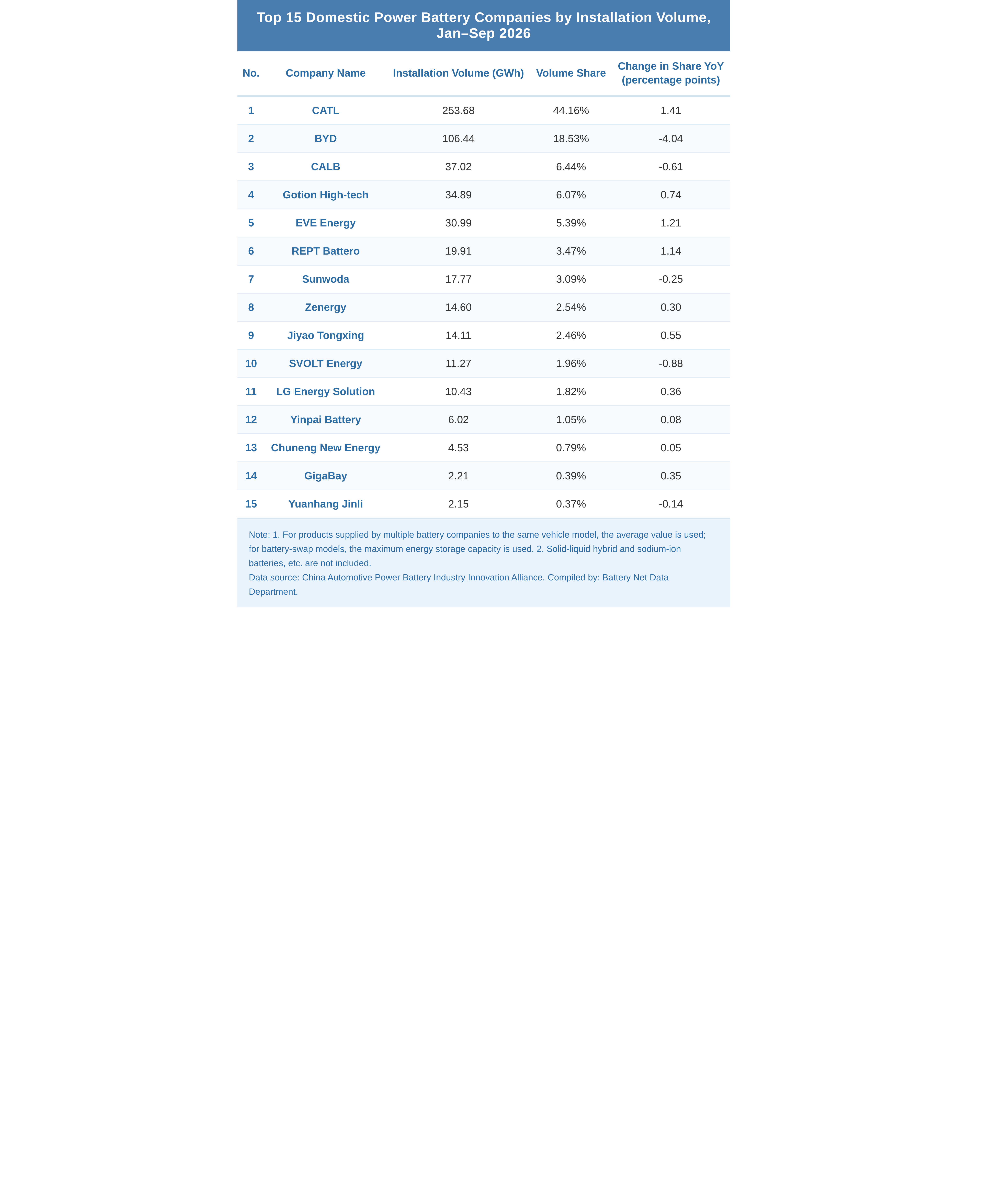
Turning back to the domestic market. Data from the China Automotive Power Battery Industry Innovation Alliance shows that in the first three quarters of 2026, China's cumulative power battery installations reached 576.3 GWh, up 16.7% YoY. A total of 41 power battery companies in China's NEV market achieved installation support, nine fewer than the same period last year. The top 2, top 5, and top 10 power battery companies recorded installations of 360.1 GWh, 463.0 GWh, and 540.7 GWh, respectively, accounting for 62.5%, 80.3%, and 93.8% of total installations, with the top 10 share down 0.5 percentage points from the same period last year.
In the domestic rankings, compared with the same period in 2025, the top 5 companies in the first three quarters of this year—CATL, BYD, CALB, Gotion High-tech, and EVE—saw no change in their rankings; REPT Battero rose from 8th to 6th; Sunwoda dropped one place to 7th; Zenergy rose one place to 8th; Jiyue Tongxing rose one place to 9th; SVOLT fell from 7th to 10th; LG Energy Solution, Yinpai Battery, and CORNEX New Energy ranked 11th through 13th, unchanged; Yuanhang Genlead remained unchanged at 15th; and Juwan Technology replaced DFD as a new entrant at 14th.