On October 21, talk spread through the market of coordinated output cuts across Indonesia’s nickel intermediates: 50% for mixed hydroxide precipitate (MHP), 50% for high-grade nickel matte and 20% for Nickel Pig Iron (NPI). Reports that leading Chinese-owned nickel producers had discussed joint curtailments added to the momentum, and the most-traded nickel contract on the Shanghai Futures Exchange (SHFE) closed 3.05% higher on the day. None of the cuts has been confirmed by producers or officials.
SMM’s view is that the logic behind a cut differs sharply by product. MHP producers are losing money on a cash basis and have the strongest reason to cut. Matte output has already shrunk, leaving little left to remove. NPI smelters still earn cash margins, so large voluntary cuts are unlikely. SMM’s assessment of each segment follows.
MHP: A Cut Was Expected
Recent reports suggest some Indonesian high-pressure acid leach (HPAL) producers may jointly cut MHP output by 50%, which briefly triggered a sharp rebound in nickel prices. No announcement has yet clarified the baseline for the cut or how long it would last.
SMM notes that the industry already broadly expected some reduction in hydrometallurgical intermediate output this month, so a cut in itself is no surprise. A cut of 50% of current output, however, would be.
Why cuts were coming: the market flipped from deficit to surplus
From the third quarter, Indonesian sulphur supply improved markedly versus Q2, helped by better shipping access through the Strait of Hormuz and supplementary imports from Canada and other sources. Sulphur is burned to make the sulphuric acid used in HPAL, so MHP production schedules recovered accordingly.
On the demand side, new-energy demand kept nickel sulphate consumption near its highest level of the year in Q3, but output of electrowon nickel (refined nickel produced by electrowinning, a key outlet for MHP) was gradually reduced. SMM data show Indonesia’s MHP balance swung from deficit in Q2 to surplus, and MHP payables (MHP prices expressed as a percentage of the LME nickel price) began to soften. Because nickel prices had not yet fallen significantly, MHP prices at the start of Q3 still covered theoretical cash production costs.
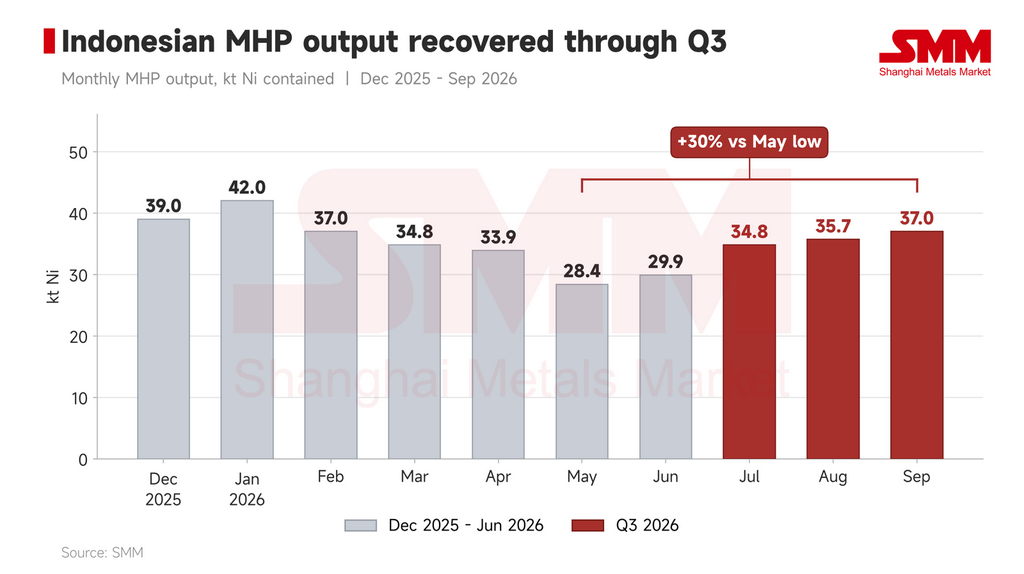
Figure 1: Indonesian MHP monthly output (kt Ni). Source: SMM
From late Q3 into early Q4, the MHP market weakened further. Order changes at some leading companies reduced domestic nickel sulphate consumption by the ternary (NCM) cathode sector, pulling MHP demand lower. With no meaningful supply reduction expected at that point, MHP gradually became a buyer’s market and payables fell sharply.
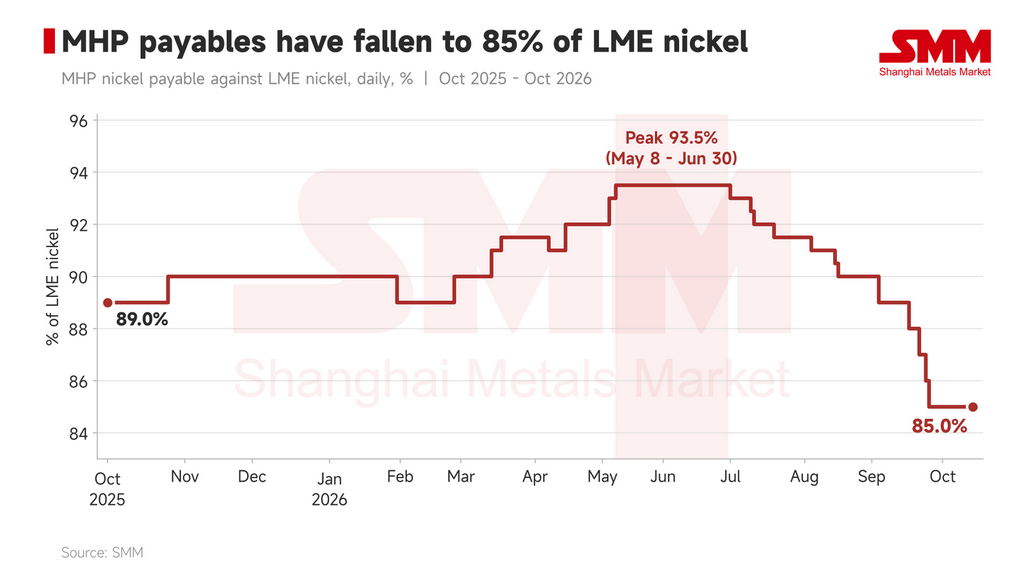
Figure 2: MHP nickel payable against LME nickel, daily (%). Source: SMM
Costs: spot production is underwater
Nickel ore and sulphur prices have eased slightly but remain high compared with the start of the year. SMM data put the theoretical cash cost of MHP production, net of cobalt credits, at around $14,500/mt Ni in mid-October. Cobalt is also hard to monetise at present, so the theoretical cobalt credit does not translate directly into cash flow.
With spot MHP selling below $13,000/mt Ni on an FOB basis, according to SMM, producers are under heavy pressure from negative margins on current production. In an oversupplied market where spot costs exceed selling prices, cuts were a logical outcome.
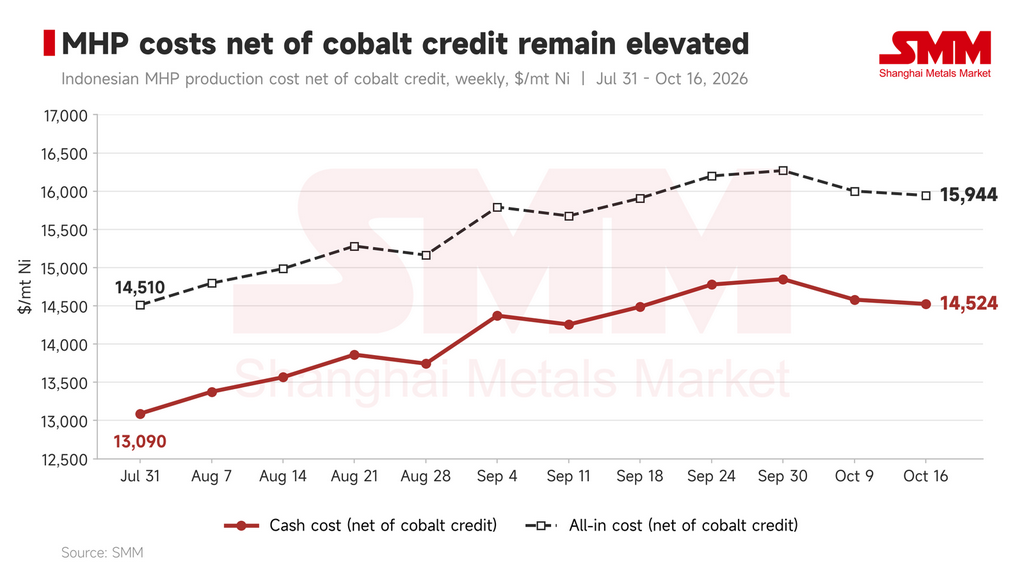
Figure 3: Indonesian MHP cash cost and all-in cost, net of cobalt credit, weekly ($/mt Ni). Source: SMM
Impact: a floor under payables, but a rebound needs destocking
Before the cut talk emerged, SMM saw MHP payables as already bottoming, with limited further downside. On the supply side, negative margins leave producers little room for further discounts. On the demand side, a further 1–2 percentage-point drop in the payable would make it economic to buy MHP for electrowon nickel production, so electrowinning could act as a backstop for MHP demand.
The one obstacle is cobalt. There is no hedging instrument for the cobalt contained in MHP, so buyers carry unhedged (“naked long”) exposure to falling cobalt prices.
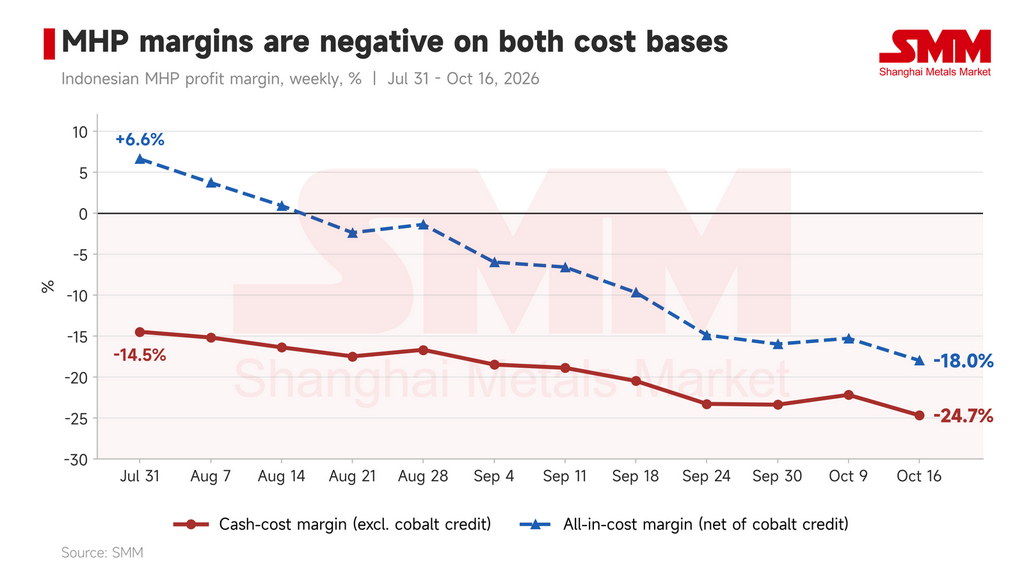
Figure 4: Indonesian MHP profit margins, weekly (%): cash-cost basis excluding cobalt credit; all-in-cost basis net of cobalt credit. Source: SMM
Since the actual arrangements remain unsettled, SMM has run two illustrative scenarios based solely on market reports. They are not intended as guidance:
- Scenario 1: a 50% cut from current output would remove 15,000–18,000 mt Ni of MHP per month.
- Scenario 2: a fall in industry operating rates to 50% would remove around 12,000 mt Ni per month.
Cuts on this scale would markedly tighten a loosely supplied MHP market and, with cost support underneath, should put a definitive end to the slide in payables. A rebound, however, will require meaningful destocking across the upstream and downstream chain, or a clear recovery in downstream demand.
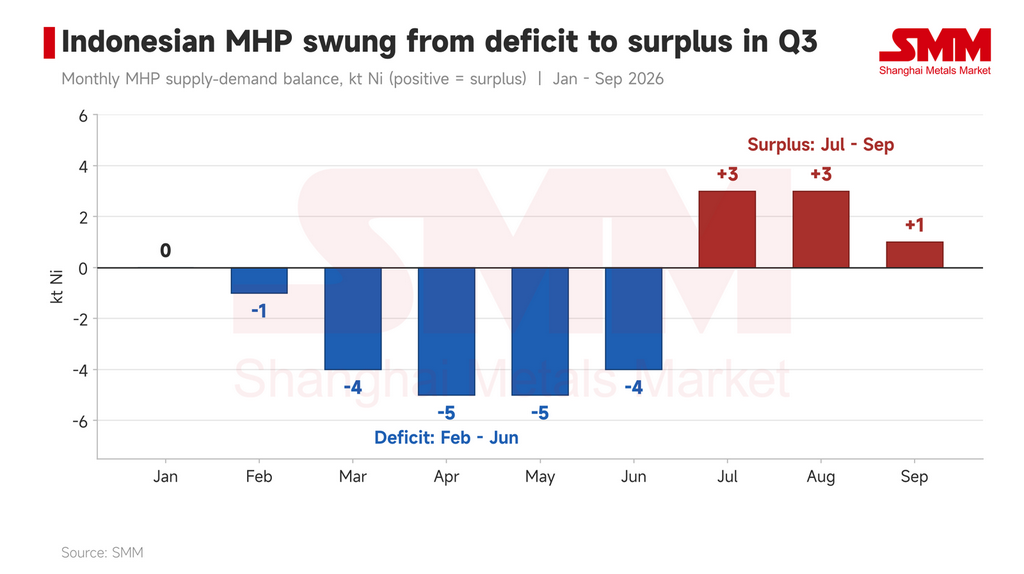
Figure 5: Indonesian MHP monthly supply-demand balance (kt Ni; positive = surplus). Source: SMM
Takeaway: an extreme preview of next year’s capacity wave
Forced cuts in Q4 are an extreme dress rehearsal for next year, when large amounts of new capacity are due to come online. Upstream smelting capacity is set to grow sharply while downstream consumption shows no sign of a comparable increase. This year producers are squeezed by high costs; next year the squeeze may come from low selling prices.
Electrowon nickel may look like a long-term last resort for surplus MHP. But until solid-state batteries or stainless steel generate enough incremental demand, producers will need to plan output carefully to avoid pushing their own prices ever lower.
Risks
To reiterate, the cut volumes in this section are hypothetical estimates based on market information and should not be treated as guidance. Confirmation must await the companies’ actual production schedules and official announcements. In addition, if nickel prices become overbought, doubts over how long the cuts last, together with producer hedging, could weigh on prices.
Nickel Matte: Output Has Already Shrunk, Limiting the Impact of Any Cut
The October 21 talk of a 50% cut to Indonesian high-grade nickel matte output, alongside foreign media reports that leading Chinese-owned producers were discussing coordinated HPAL cuts, helped lift the most-traded SHFE nickel contract 3.05% that day. Neither report has been confirmed by companies or officials.
SMM data show matte output had already contracted sharply before the rumour surfaced. Even if a cut materialises, its marginal effect on supply is likely to be limited.
Output fell sharply in August–September while payables held flat
Indonesian matte output was 21,100 mt Ni in August and fell 21.3% month on month to 16,600 mt Ni in September; SMM expects 15,800 mt Ni in October. Against monthly capacity of 70,900 mt Ni, operating rates dropped from about 30% in August to about 23% in September, with October expected at about 22%.
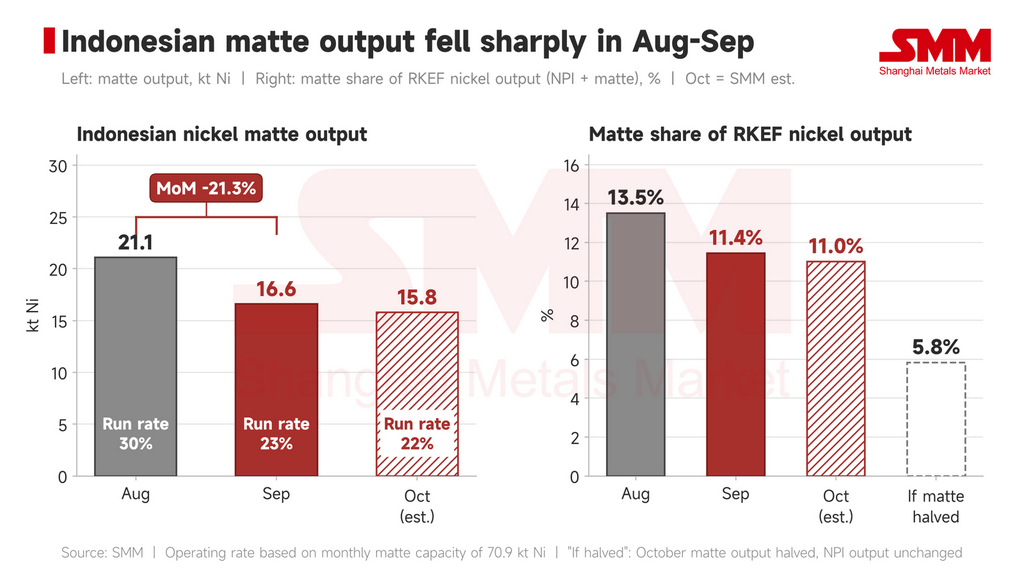
Figure 6: Indonesian nickel matte output and operating rates (left) and matte share of Indonesia’s RKEF nickel output (right); October is an SMM estimate. Source: SMM
The decline reflects weaker conversion economics. One route to matte in Indonesia takes NPI produced on rotary kiln-electric furnace (RKEF) lines and blows it into matte in converters. SMM calculates that the margin from converting to matte versus selling the NPI directly averaged –$522/mt Ni in August, –$377/mt Ni in September and –$467/mt Ni in the first half of October. It has been negative on all 48 trading days since August 3.
On an all-in cost basis, Indonesian matte swung from a profit of about $300/mt Ni in early August to a loss of about $857/mt Ni by mid-October. As a result, most RKEF-based matte lines have switched back to producing NPI.
On prices, Indonesian matte was assessed at $14,145/mt Ni FOB on October 22, down 9.5% from end-August, mainly tracking the fall in nickel. Its payable against LME nickel has held around 93.5% since mid-May.
The spot market is weak on both sides. Major suppliers have finished signing long-term contracts, leaving little spot tonnage, which supports the payable. Buyers that source feed externally prefer MHP: on October 21, the margin for producing nickel sulphate from MHP was 5.8%, against 2.9% from matte, which caps the upside for matte payables.
If a cut does happen, the marginal impact is limited
The rumour did not specify what the 50% is measured against. Halving October’s estimated output would remove about 7,900 mt Ni per month and cut operating rates to about 11%. In the context of Indonesia’s total RKEF nickel output, that is a small share.
7,900 mt Ni is equal to about 6.2% of Indonesia’s monthly NPI output. With most RKEF lines already back on NPI, there is limited room for further cuts on this route. Notably, Indonesian NPI output did not rise in August–September as lines switched: combined NPI and matte output fell from 156,200 mt Ni to 145,100 mt Ni, as lower overall RKEF run rates offset the extra NPI from converted lines.
Most matte still in production is sold under long-term contracts with relatively fixed delivery schedules, leaving limited scope for sharp near-term cuts. Overall, SMM sees an industry-wide 50% matte cut as relatively unlikely; any reduction is more likely to be a temporary adjustment at individual producers.
Outlook: treat the rumour with caution; output likely to stay low
Until the cut is confirmed, SMM advises a cautious reading of its impact on matte. Output was already low before the rumour, and even halving current production would remove less than 8,000 mt Ni per month, a limited marginal effect on overall nickel supply. In the near term, SMM expects matte payables to hold in a 93–93.5% range and output to stay around 15,000–16,000 mt Ni per month.
Two things are worth watching. First, whether the cuts materialise, and at what scale and on what baseline. Second, conversion margins: if nickel prices rebound and hold while NPI prices lag, NPI’s discount to refined nickel will widen and conversion margins could recover. Idle converters could then restart, lifting matte output.
NPI: Cut Talk Lifts Sentiment, but Smelters Still Earn Cash Margins
A one-way slide in prices through October
Indonesian NPI output is expected at 128,000 mt Ni in October, with the high-grade NPI market broadly in tight balance. Prices nonetheless fell steadily through September and October. Spot trading was weak, downstream buyers were cautious and largely stayed on the sidelines, and most deals were restocking for immediate needs rather than active buying.
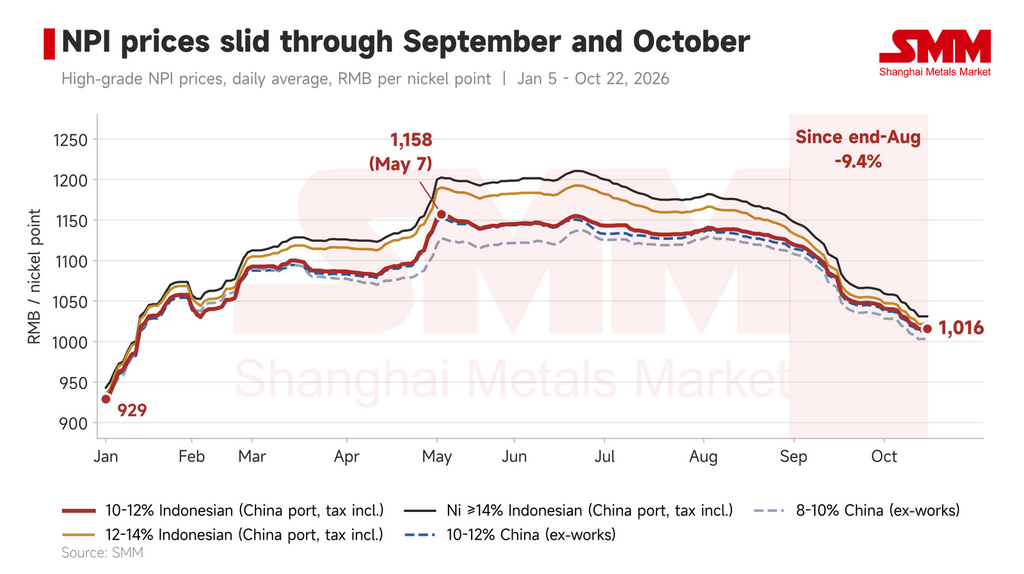
Figure 7: High-grade NPI prices by grade, Indonesian (delivered to China port, tax included) and Chinese (ex-works), in RMB per nickel point, i.e. per 1% Ni content per mt. Source: SMM
Cut talk raises supply expectations, but the baseline is still disputed
On October 21, the market heard talk of a 20% NPI cut. On that basis, supply would fall by more than 20,000 mt Ni per month.
Market feedback suggests output at the Indonesia Morowali Industrial Park (IMIP) in Central Sulawesi, the country’s largest nickel processing hub, is already down by more than 20% because of El Niño-related drought. Operating rates at other industrial parks are broadly 70–80%.
Industry discussions indicate the baseline for the 20% cut is still being negotiated and actual volumes have not been settled; the market expects real reductions to take effect in November. NPI prices showed signs of stabilising and rebounding after the news.
Ample stocks and weak appetite for higher prices cap the upside
Cut expectations are underpinning the market, but NPI inventories are ample and stainless steel mills are reluctant to accept higher-priced feedstock. Wait-and-see sentiment persists, and until the cuts actually change the supply-demand picture, they are unlikely to give prices strong support.
SMM expects high-grade NPI prices to most likely stabilise with a firmer bias in November, with the pace of any gains following shifts in supply and demand and downstream buying.
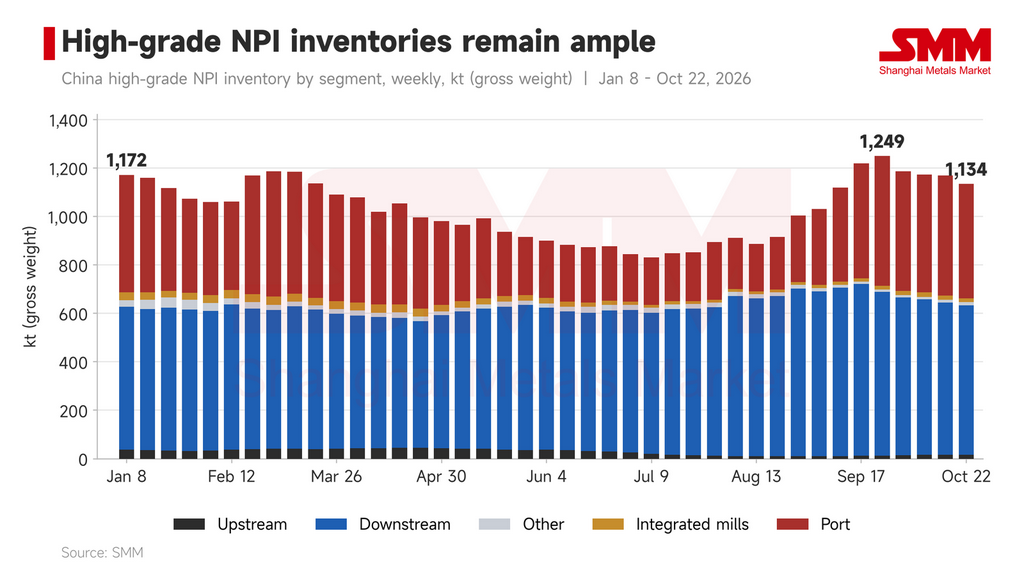
Figure 8: China high-grade NPI inventory by segment, weekly (kt, gross weight). Source: SMM
Cash margins remain, making large voluntary cuts difficult
NPI smelting still generates cash profits, so producers have little intrinsic incentive to cut together. SMM does not expect large-scale, industry-wide voluntary cuts in November. Actual reductions will depend on the plans producers agree among themselves, and the overall volume is expected to be manageable.
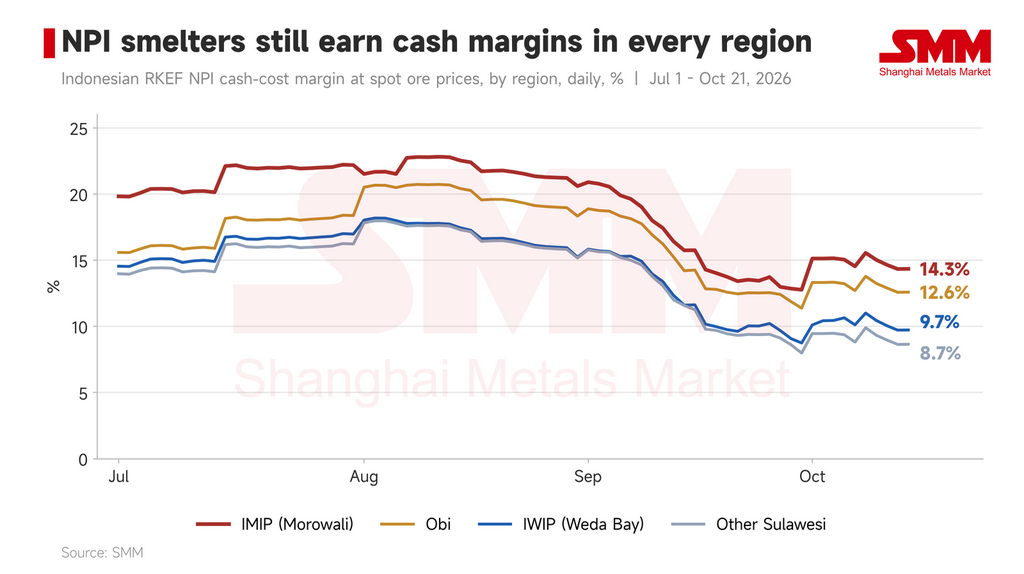
Figure 9: Indonesian RKEF NPI cash-cost margins at spot ore prices by region, daily (%). Source: SMM
Outlook: Prices Are Trading the Cut Narrative; Delivery Will Decide the Rebound
Across the three nickel intermediates, the logic behind cuts diverges markedly. MHP smelters are deep in negative margins and have the strongest incentive to cut; if the rumoured plan materialises, it would effectively ease MHP oversupply. Matte output has already been contracting and operating rates are low, so further changes depend mainly on conversion economics.
For NPI, spot prices fell steadily in September–October, and IMIP has already lost about 20% of output involuntarily because of drought. But NPI smelters still earn cash margins, which makes large voluntary cuts hard to achieve, and the baseline for coordinated cuts is still under discussion.
Overall, nickel prices are currently trading expectations of coordinated cuts across the chain, and sentiment is providing support, but several factors cap the upside. How far nickel rebounds will depend on how much of each product’s cut actually materialises. If final cuts fall short of the rumours, nickel prices risk a pullback.