Recently, market reports emerged that some Indonesian hydrometallurgy smelters may jointly cut MHP production by 50%, which briefly drove a sharp rebound in nickel prices. However, as of now, there has been no official announcement regarding the baseline for the production cuts (whether based on current production or nominal capacity) or their duration, and the actual implementation remains to be seen. SMM believes that the industry already had some consensus this month on production cuts for hydrometallurgy intermediate products, making such moves "within expectations." However, if the cuts are implemented at 50% of current production, that would clearly exceed prior market expectations and would be "beyond expectations."
I. Supply-Demand Drivers Behind the Production Cuts
Supply side, starting in Q3, with improved shipping capacity through the Strait of Hormuz and the arrival of supplementary imports such as Canadian sulphur, Indonesia's sulphur supply improved significantly compared with Q2, and MHP production schedules recovered overall.
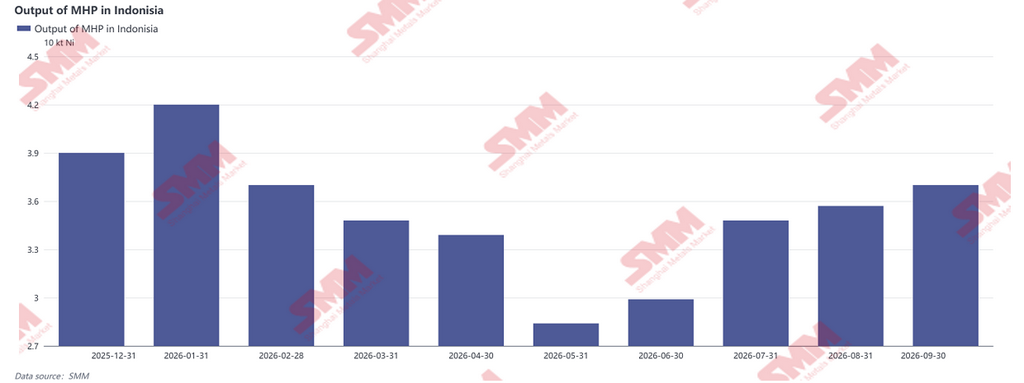
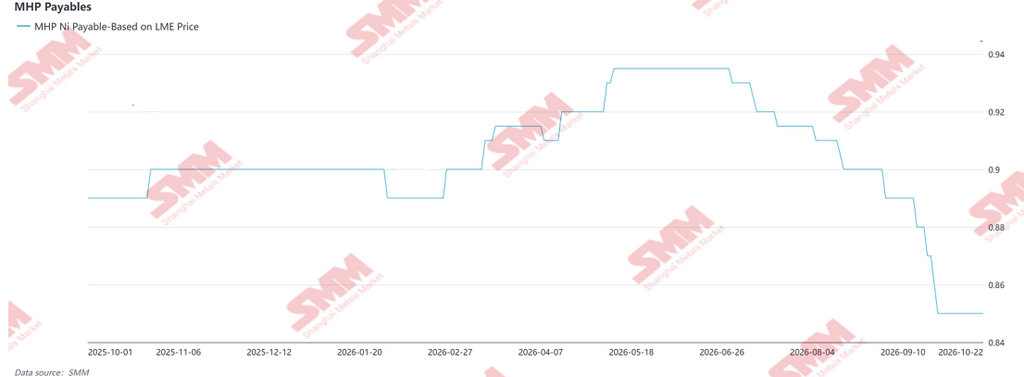
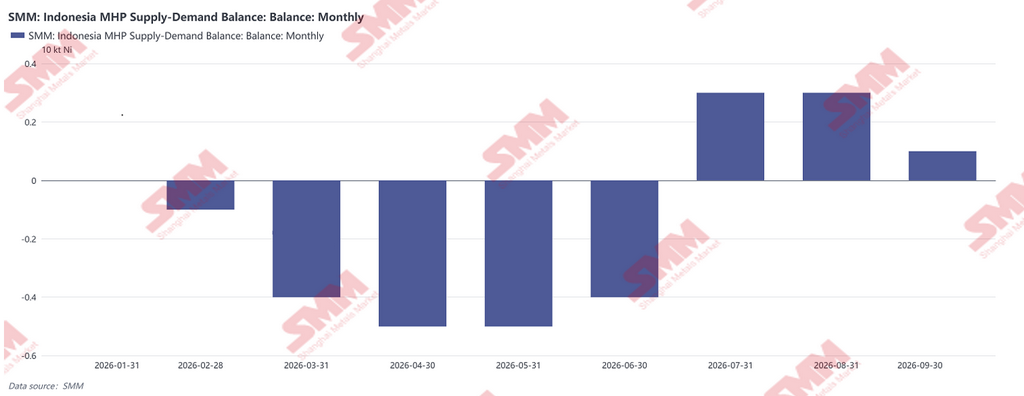
Demand side, although new energy demand in Q3 continued to support nickel sulphate consumption at high levels for the year, the electrodeposited nickel segment had already begun gradual production cuts. According to SMM data, Indonesia's MHP supply-demand balance shifted from a shortage in Q2 to a surplus, and MHP payables subsequently loosened. However, since nickel prices had not yet pulled back significantly at that time, MHP prices could still barely cover theoretical production cash costs, though pressure was gradually emerging.
From late Q3 to early Q4, the MHP market weakened further.
Demand side, affected by orders from some top-tier players, China's ternary nickel sulphate consumption weakened, dragging down MHP demand. Meanwhile, cobalt salt prices had yet to stop falling, and salt producers' purchase willingness remained weak. Supply side, with no clear expectations of production cuts previously, MHP gradually shifted to a buyer's market, and payables loosened noticeably.
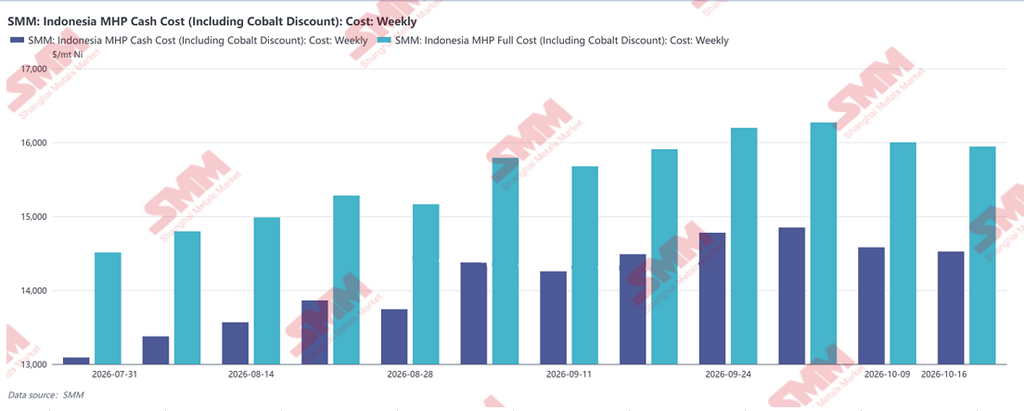
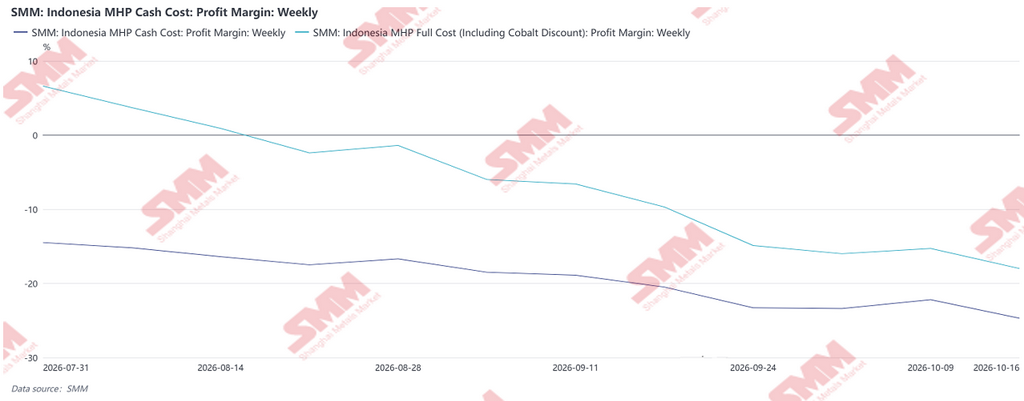
Cost side, although nickel ore and sulphur prices pulled back slightly, they remained at high levels compared with the start of the year. According to SMM data, in mid-October, the theoretical production cash cost of MHP (after cobalt credits) remained at a high level of around $14,200/mt (metal content). It should be noted that cobalt monetization pressure is currently significant, and the theoretical cobalt credit cannot be directly converted into cash flow support. Meanwhile, spot nickel MHP FOB selling prices have fallen below $13,000/mt (metal content) (also on a post-cobalt-credit basis), putting significant pressure on enterprises' immediate production costs, which are now loss-making.
Under the dual pressure of oversupply and immediate losses, production cuts are "within reason."
II. Impact of Production Cuts and Market Outlook
Before the production cut news was confirmed, SMM believed that MHP payables were already consolidating at lows, with relatively small downside. From the supply side, losses have compressed the room for enterprises to make further concessions, which is support that has "already materialized." From the demand side, if MHP payables were lowered by another 1–2 percentage points, externally purchased MHP for electrodeposited nickel production would become somewhat economical, and the entry of electrodeposited nickel operations could provide a "floor" for MHP demand—but this is "potential" support that has yet to materialize, and the only obstacle is the lack of hedging tools for the cobalt component of MHP, meaning enterprises must bear the price decline risk of unhedged long positions.
After the production cut news was confirmed, since actual production schedules remain undecided, SMM has only conducted two scenario calculations based on market rumors, for directional reference only and without practical guidance:
Scenario 1: Production cuts of 50% based on current production, with a monthly impact of approximately 15,000–18,000 mt in metal content.
Scenario 2: Industry operating rate reduced to 50%, with a monthly impact of approximately 12,000 mt in metal content.
In terms of impact magnitude, if the production cuts are implemented as reported, they would significantly improve the relatively loose MHP supply situation. Combined with cost support, this is expected to push MHP payables to confirm a bottom and stop falling completely. However, a price rebound still requires one of two conditions to be met: destocking across upstream and downstream segments reaching a certain level, or a significant recovery in downstream demand.
III. Summary
The "predicament" of forced MHP production cuts in Q4 is, in fact, an extreme preview of the market landscape after new capacity comes online in a concentrated manner next year. Under the premise that downstream consumption does not see substantial growth, upstream smelting capacity still has significant growth expectations. The difference lies in the form of pressure: in Q4 this year, enterprises are bearing high-cost pressure and can still hold prices firm through voluntary production cuts; next year, the entities bringing new capacity online will be more dispersed and have lower cost curves, making production cut coordination more difficult, and enterprises will bear more pressure from low selling prices.
The electrodeposited nickel segment may appear to be the "last straw" for surplus MHP, but it functions more as a short-term buffer than a long-term solution. Until solid-state batteries or externally purchased refined nickel for stainless steel generate sufficient demand growth, how to reasonably arrange production schedules and avoid product prices falling into a negative cycle of "selling lower and lower" remains a persistent challenge for enterprises. Adopting a sales-based production strategy, as seen in nickel salts, may point the way forward for hydrometallurgy intermediate products.
IV. Risk Warning
Once again, the production cut estimates in this article are merely hypothetical projections based on market information and carry no practical guidance value. It remains necessary to await actual production schedule arrangements and official announcements from relevant enterprises. Additionally, if nickel prices experience a short-term overbought condition, the sustainability of production cuts may come into question, and the entry of industrial hedging positions could both exert downward pressure on nickel prices.