Since October, the Asian molybdenum oxide market has experienced a holiday consolidation, a rapid rise after the holiday, and a subsequent sustained pullback. The SMM Busan warehouse 57% molybdenum oxide average assessed price rose from $33.15/lb Mo on October 1 to $33.35/lb Mo on October 8-9, then gradually moved lower. The market widely believed that $33/lb Mo would be key support in the short term, with a break below unlikely unless driven by multiple market factors, and those conditions were generally considered difficult to achieve. However, by October 21, the assessed price range ultimately broke below support, with the low end quoted at $32.95/lb Mo, and the overall range fell to $32.95-33.05/lb Mo, averaging $33/lb Mo, down $0.1/lb Mo from the previous day. The low end of the assessment fell below the $33/lb Mo threshold for the first time this month.
This round of price movement was not driven by a single factor. During China's National Day holiday, Chinese buyers left the market in phases, and trading was relatively thin. As the market approached reopening, some sellers expected a recovery in purchasing, and combined with labor and weather events in South America that raised market attention on supply stability, offers moved higher. However, after the holiday, downstream acceptance of high-priced raw materials was limited. The cost-bearing capacity of the raw material side in China's ferromolybdenum segment declined, producers became more cautious in purchasing, and the earlier rally was not supported by sustained transactions.
With two recent failed auctions on the domestic ore side, market expectations for subsequent prices weakened further. As of today, another auction by a Chinese mine failed again, pushing market sentiment into a new low. Prices fell again, officially breaking below the $33/lb Mo support. SMM market surveys indicate that buyers are not entirely without purchase willingness, but they continue to wait for lower buying opportunities. During this period, some suppliers, concerned that prices will continue to pull back, increased their willingness to sell, and a cargo was recently sold at a low price. Overall, demand has not disappeared, but there is still a gap between the prices buyers and sellers can accept. This tug-of-war over costs, inventory, and the subsequent market trend has officially shattered the $33/lb Mo support. During midday trading, inquiries in the Busan market even appeared at 32.7-32.8, and a transaction was reported at around $32.75/lb Mo.
1. Price: Busan molybdenum oxide shot up after the holiday, but the rally was not supported by sustained transactions
Since October, the Asian molybdenum oxide market first stabilized, then rose, and then quickly pulled back. During the National Day holiday, Chinese buyers left the market in phases, and Busan molybdenum oxide prices generally moved sideways. After the holiday, as expectations for the reopening of the Chinese market heated up, and combined with labor and weather disruptions in South America that raised supply concerns, some sellers reduced low-price shipments, and the SMM Busan warehouse 57% molybdenum oxide average assessed price once rose to $33.35/lb Mo.
However, actual purchases after the market reopened did not follow through. China's molybdenum raw material market continued to weaken, ferromolybdenum tender prices pulled back, and processing enterprises' acceptance of high-priced molybdenum oxide declined accordingly. The gains previously driven by purchasing expectations and supply news lacked support from continuous transactions, and Busan molybdenum oxide prices gradually gave back those gains. On October 21, the SMM assessment fell to $32.95–33.05/lb Mo, with an average price of $33.00/lb Mo, and the low end of the assessed range officially broke below $33.
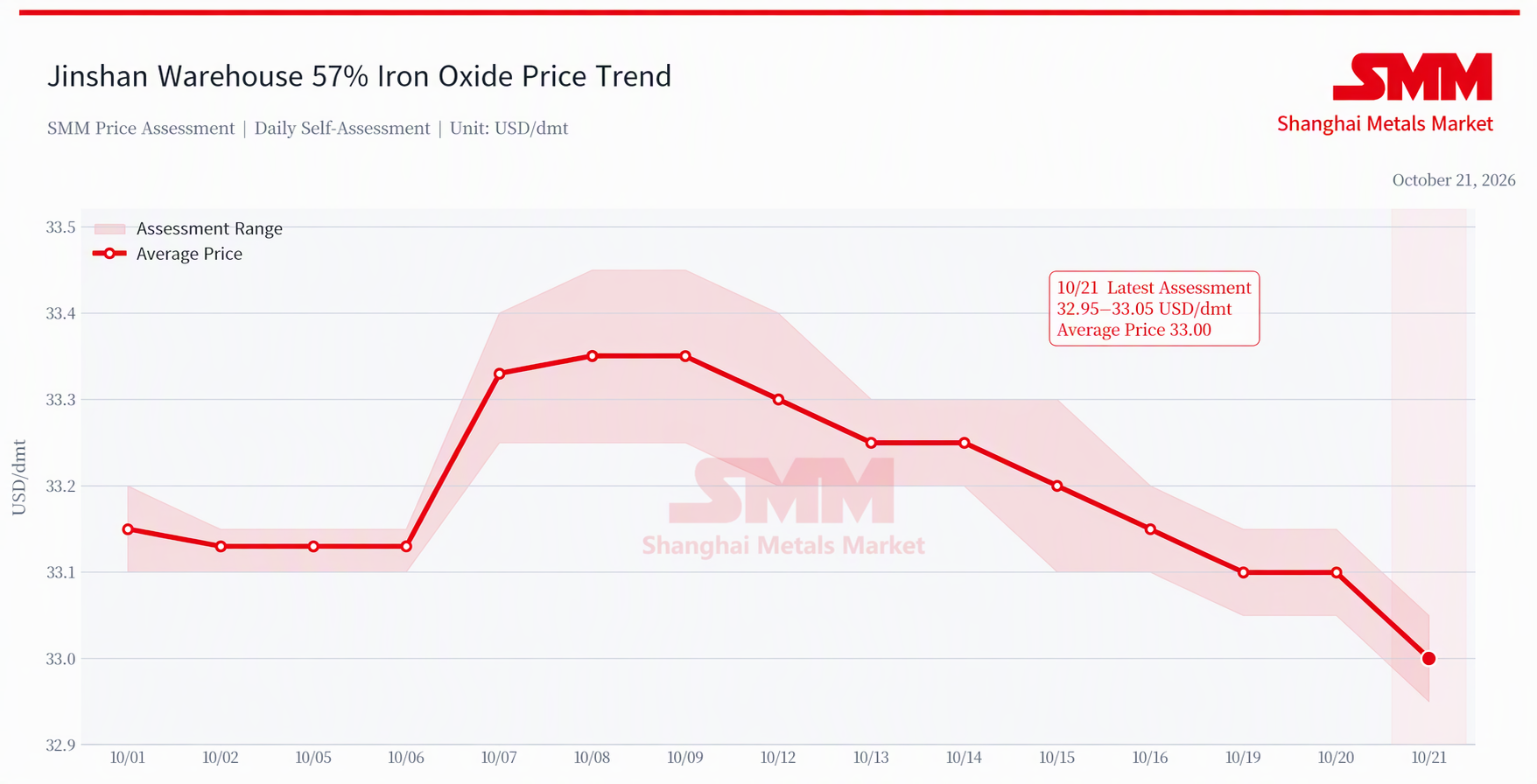
Figure 1. Price trend of 57% molybdenum oxide at Busan warehouses, October 1–20, 2026
Note: Ex-warehouse Busan bonded warehouse, uncleared and duty unpaid; source: SMM market research.
However, after midday on the 21st, the market showed further signs of loosening. Public quotes and reference ranges remained mainly concentrated around $32.95–33.05/lb Mo, but inquiries and price feedback at $32.70–32.80/lb Mo had already emerged, with the $32.75/lb Mo inquiry considered by some market participants to have a relatively high likelihood of being transacted. Meanwhile, multiple channels reported that transactions at $32.75/lb Mo had already taken place in the Busan market.
Nevertheless, as of now, the above transactions have not yet been confirmed with complete trade terms such as trading volume, delivery method, and buyers and sellers. Therefore, $32.75/lb Mo can only be defined at this stage as a market rumor with relatively high credibility, and cannot be directly regarded as a confirmed new transaction level, nor included in the official price series in the chart. The information around $32.70–32.80/lb Mo includes inquiries, market feedback, and transaction rumors, and the three need to be strictly distinguished.
Compared with the price itself, the more noteworthy change after midday came from market sentiment. Previously, sellers were generally unwilling to release supply below $33, hoping that Chinese buying could provide support near the round-number level. However, as domestic raw material prices continued to pull back, an important mine tender failed for the third time today, and off-market molybdenum concentrate transactions were reportedly about 50–100 yuan/mtu below the open market, buyers' expectations for subsequent prices declined further. The failure to quickly attract purchases near $33 led some sellers to begin worrying about the risk of price declines from continuing to hold inventory, and the earlier sentiment of holding back from selling began to loosen, with willingness to sell strengthening accordingly.
Therefore, the market is currently shifting from "whether $33 can form support" to "whether the high $32 range can attract buying again." Demand has not disappeared; steel mill orders and processing enterprises' rigid restocking demand still exist. However, with raw material prices continuing to decline and ferromolybdenum processing margins under pressure, buyers lack the motivation to build inventory in advance and are more inclined to wait for further price adjustments.
Whether prices can stabilize near $33 subsequently depends not only on public quotes, but also on whether low-price inquiries actually translate into representative transactions. If a deal at $32.75/lb Mo is confirmed and the market continues to see trades below $33, the spot price center for Busan molybdenum oxide may shift further downward. Conversely, if the high end of $32 can attract concentrated restocking by Chinese and other Asian buyers, the pace of price declines may slow somewhat.
In the short term, the focus should be on actual transaction volumes below $33 and delivery terms, buyer responses to procurement at the high end of $32, as well as upcoming tenders at major domestic mines and changes in off-market raw material transactions. Before a new effective trading range is established, market sentiment may remain weak, and price fluctuations could widen noticeably compared with earlier periods.
II. Supply side: Mine-side risks persist, but ex-China supply has not yet contracted across the board
Recently, major overseas mines have successively released financial reports and quarterly production reports. Based on the nine major overseas mines and tailings recovery projects with disclosed data shown in the chart, total molybdenum output in Q2 2026 was approximately 7,410 mt, and approximately 6,880 mt in Q3, down about 530 mt QoQ, a decline of about 7%. This change indicates that supply from the sample projects declined in Q3, but performance varied across mines, so it cannot yet be concluded that ex-China molybdenum supply has contracted across the board.
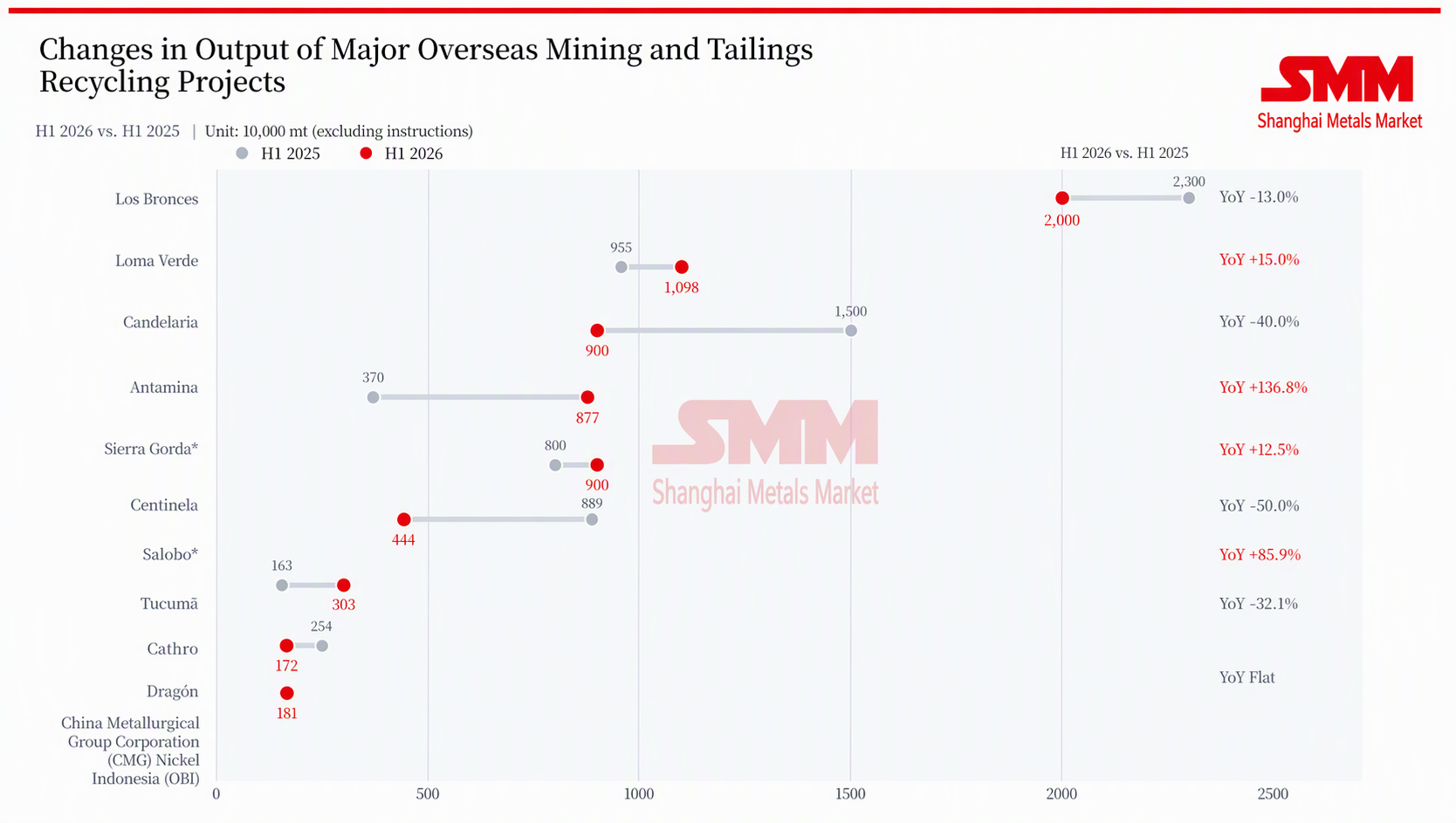
Figure 2: Q3 2025 vs. Q3 2026 production comparison for major overseas molybdenum producers and mines
Note: Unified to company-disclosed molybdenum content; MVC and Gibraltar converted from pounds; source: relevant corporate financial reports and production reports, compiled by SMM.
Based on the disclosed mine production data, no severe impact has been found on the supply side overall, and subsequent uncertainty is mainly concentrated in a few mines. Kennecott/Bingham Canyon is expected to see molybdenum output remain affected as mining areas shift toward lower-grade ore. Whether molybdenum grades and recovery rates at Los Pelambres can recover still needs to be observed in the next quarter's data. Sierra Gorda's Q3 production declined noticeably, but the company has not separately explained the specific reasons for the molybdenum output pullback, and its subsequent changes still need to be further verified through ore grades, mining sequence, and recovery rate data.
On the growth side, Las Bambas is advancing adjustments to its molybdenum flotation facilities, but whether the equipment can steadily improve recovery rates after commissioning still needs to be confirmed by actual production results. Antamina and Spence saw clear production rebounds in Q3, and more quarterly data are needed to determine whether this growth can be sustained. The labor dispute at Centinela has ended, and no clear molybdenum production loss caused by it has been disclosed by the company so far.
Overall, total Q3 production of the disclosed sample declined from Q2, but increases and decreases were distributed across different mines. In the short term, attention should still be paid to production changes at Kennecott/Bingham Canyon, Los Pelambres, and Sierra Gorda, as well as the sustainability of new facilities at Las Bambas and growth at Antamina and Spence. Whether these changes can affect spot supply of molybdenum oxide still needs to be assessed in combination with concentrate shipments, roasting arrangements, and long-term contract deliveries.
III. Trade and demand side: South Korea plays a regional distribution role, and Asian demand exists but procurement paces differ
South Korea is both an import market for Asian molybdenum raw materials and an important processing, warehousing, and re-export hub. According to South Korean customs data for January-September 2026, the main sources of roasted molybdenum ores and concentrates include Chile, Mexico, and China; other molybdenum ores and concentrates also come from Peru, the US, Canada, and Australia. After goods enter South Korea, part of them supply the local production and trading system, while another part is re-exported in the form of roasted concentrates, ferromolybdenum, or other molybdenum products.
It should be emphasized that South Korea's national customs data cannot be directly equated with Busan port throughput, nor can they represent the available inventory at Busan warehouses on a given day. Customs data reflect declared cross-border cargo movements, while Busan warehouse price assessments focus on spot cargo that meets corresponding specifications and delivery conditions. The two can corroborate market direction, but cannot be directly converted into each other.
In terms of market size and cargo flows, China's capacity to directly absorb molybdenum raw materials is generally higher than South Korea's. China has a relatively complete production system for molybdenum concentrates, molybdenum oxide, and ferromolybdenum, and is also the main molybdenum consumer market in Asia. South Korea, by contrast, relies more on imported raw materials and plays a role in roasting and processing, warehousing and distribution, and regional distribution. Therefore, mine sales, ferromolybdenum tenders, and processing margin changes in the Chinese market usually affect the procurement pace across Asia, while the South Korean market more directly reflects import costs, Busan warehouse cargo availability, and changes in buying from Japan, India, and Southeast Asia.
The delivery methods for China port molybdenum oxide CIF prices, Busan Ex-warehouse prices, and China export FOB prices are not the same, so they cannot be directly compared as identical spot prices, but they still have some reference value for trade economics. China port CIF prices can reflect the landed cost of overseas cargo entering China, while export FOB prices reflect the cost level of Chinese goods before departure. If the FOB price of Chinese goods is already above overseas buyers' procurement expectations, the export competitiveness of such goods will decline further once shipping, financing, and related costs are added for shipment to South Korea or other markets.
Recently, prices of Chinese molybdenum concentrates, molybdenum oxide, and ferromolybdenum have generally been at relatively high levels, lacking a clear export price advantage compared with markets outside China. Even if there are overseas inquiries for some products, it is difficult to form effective exports after adding freight and other trade costs. China's current influence on the Asian market is transmitted more through import procurement pace, domestic mine transactions, ferromolybdenum tenders, and processing margins, rather than through large-scale exports of low-priced products to South Korea and other markets.
After the National Day holiday, Chinese steel mills still have ferromolybdenum tender demand, but after tender prices pulled back, ferromolybdenum producers began to lower raw material procurement costs. The weakening domestic raw material market further reduced buyers' acceptance of overseas molybdenum oxide, and Chinese buyers' overseas procurement pace slowed accordingly, putting pressure on the Busan market. However, high prices in the Chinese market also mean that Chinese goods are temporarily unlikely to become a low-priced supplementary source for Busan and other Asian markets.
India remains one of the important export destinations for South Korean roasted molybdenum concentrates. Indian buyers typically compare landed costs from South Korea, China, and other sources, and their procurement is relatively price-sensitive. Recently, the Indian market still has inquiries and restocking demand, but with downstream orders and processing margins constrained, buyers are mainly purchasing based on actual orders, and sustained large-scale restocking has not yet emerged.
Japan mainly plays the role of a mature consumer market in South Korea's molybdenum product export flows, with its stainless steel, special steel, tool steel, and high-performance materials industries providing a foundation for molybdenum demand. Procurement in such markets usually places more emphasis on product quality, delivery stability, and long-term supply arrangements, so short-term price pullbacks may not immediately bring significant incremental spot purchases.
In Southeast Asia, Vietnam, Thailand, Malaysia, and Indonesia all appear among the export destinations for South Korea's relevant molybdenum products, but the imported products, processing stages, and end uses vary by country. Some cargo may supply stainless steel, special steel, casting, or trade distribution, and may also be resold through regional traders. Therefore, export destinations alone cannot confirm that the relevant cargo has already formed end-use consumption locally.
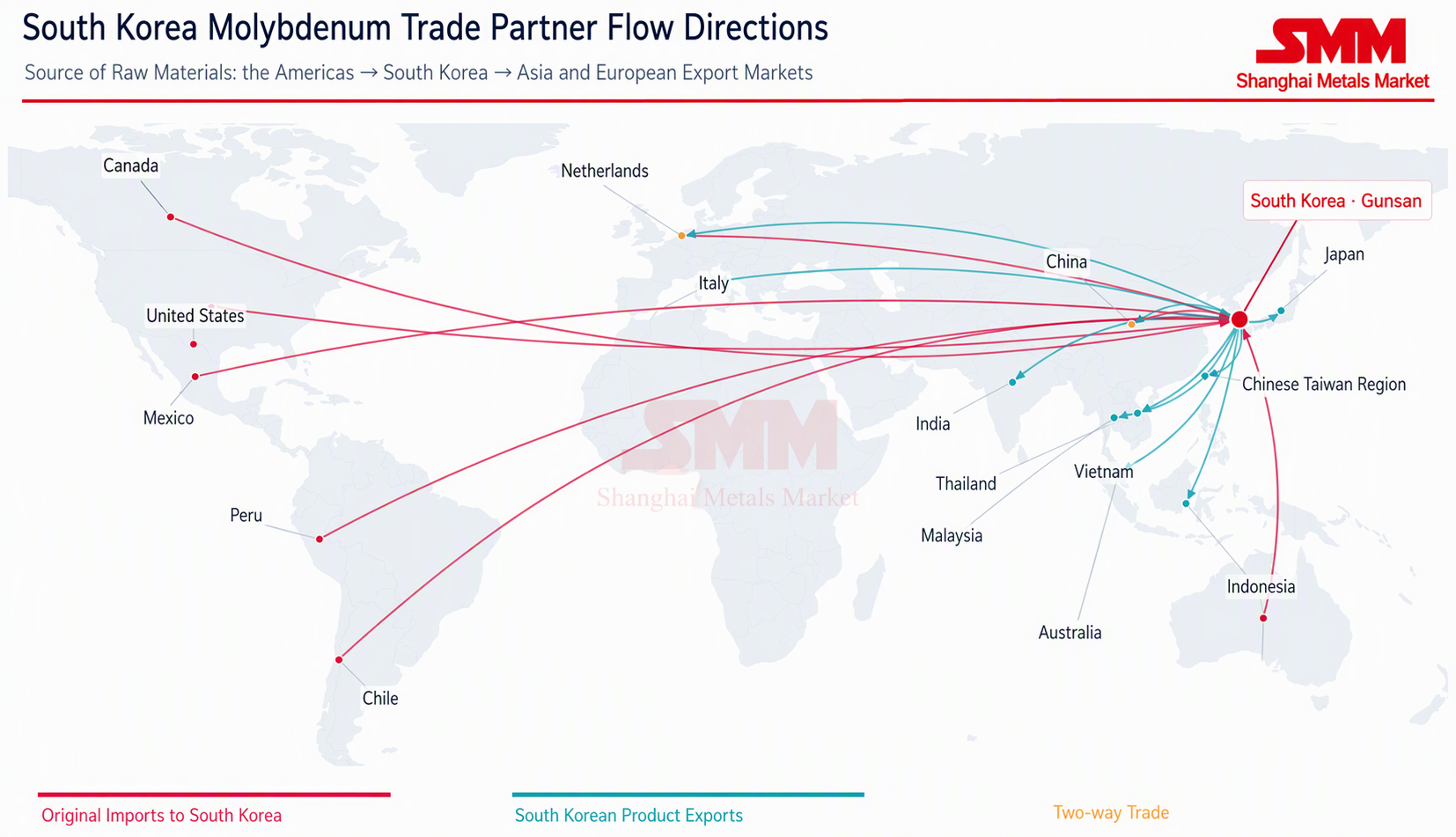
Figure 3: January-September 2026South Koreamolybdenum product flows by major trading partner
Source: South Korean import and export data, compiled by SMM.
Overall, the Chinese market is larger in scale and has a more direct influence on Asian prices and procurement sentiment, while South Korea mainly plays a role in raw material imports, warehousing and processing, and regional distribution. Asian demand has not disappeared recently, but Chinese buyers lowering raw material procurement prices and markets such as India maintaining need-based restocking have made it difficult for Busan spot cargo to move quickly in large volumes. Going forward, attention should still be paid to whether the Chinese raw material market can stabilize, whether ferromolybdenum processing margins recover, and whether buying from India, Japan, and Southeast Asia can absorb the available cargo in the South Korean market.
IV. Cost transmission and market outlook: Demand remains, but the raw material costs buyers can bear have declined
Overall, the ex-China supply side has not yet seen a full contraction, and production changes at mines point in different directions. Localized incidents, weather, and labor disputes mainly affect short-term expectations, and their actual impact on spot supply still needs to be confirmed through production losses and shipment conditions. South Korea and other Asian markets still have inquiries and restocking demand, but buyers generally arrange procurement based on ferromolybdenum orders and processing margins, and demand has not yet translated into continuous large-volume transactions. At the same time, inventory and funding conditions vary among suppliers, and sellers' willingness to concede on price is not uniform, while buyers are still waiting for lower procurement opportunities. As a result, market prices have repeatedly adjusted amid limited transactions. However, in midday trading on October 21, the Busan market saw further inquiries and price feedback at $32.7-32.8/lb Mo, and multiple channels mentioned a deal at $32.75/lb Mo, though the relevant transaction terms have not yet been fully confirmed. SMM expects that if this deal is confirmed and representative trades below $33 continue to emerge, the Busan molybdenum oxide price center may shift further downward. Conversely, if the high end of $32 can again attract restocking by Chinese, Indian, and other Asian buyers, the pace of market declines may slow somewhat.
Entering Q4, some downstream procurement tends to become more cautious, and with negotiations for new-year long-term contracts gradually getting underway, the spot market will also be affected by forward supply expectations and contracting willingness. In the short term, if trades below $33 are confirmed one after another while new orders and actual procurement do not increase significantly, ex-China molybdenum oxide prices may continue to be in the doldrums and search for new transaction support at lower levels. If the price pullback again attracts concentrated restocking, or if the mine side shows confirmed actual output reductions, market sentiment could also change quickly. In the medium and long term, the focus should be on actual production and shipments at major mines, the Chinese raw material market and ferromolybdenum processing margins, available inventory in South Korea, procurement intensity in Asian markets such as India, and the degree of supply tightness ultimately reflected in annual long-term contracts.