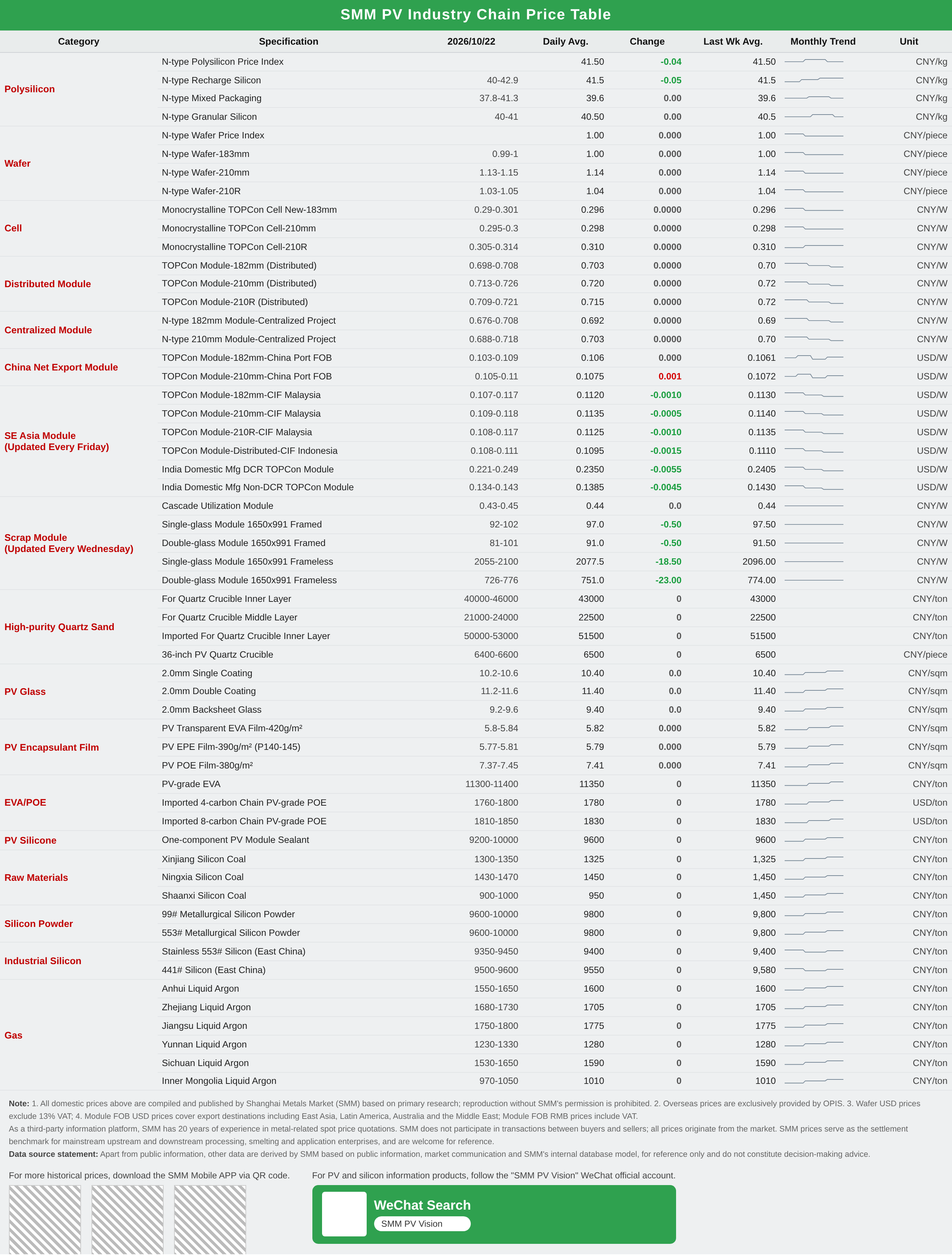
Polysilicon: This week, the polysilicon price index stood at 41.5 yuan/kg, with N-type recharging polysilicon quoted at 40-42.9 yuan/kg and granular polysilicon at 40-41 yuan/kg. Market quotes were relatively stable this week, with limited changes. The meeting had a limited impact on the market. Several sporadic transactions by small producers occurred this week, with converted prices basically around 40 yuan. Some enterprises indicated plans for capacity supervision in the future.
Wafer: Wafer prices were broadly stable this week. N-type 183 wafers were priced at 0.994-1.002 yuan/piece, 210R wafers at 1.031-1.05 yuan/piece, and 210mm wafers at 1.125-1.146 yuan/piece. Upstream polysilicon prices still provided some cost support for wafers, and wafer enterprises showed weak willingness to cut prices for sales, keeping overall market quotes stable. Downstream solar cell procurement remained primarily need-based, with additional support from overseas stockpiling demand, but upward momentum was insufficient. Wafer prices are expected to remain stable in the short term. Going forward, continued attention is needed on the pace of polysilicon production cuts and price trends, as well as changes in solar cell procurement pace and overseas demand.
Solar cell: Solar cell market prices were broadly stable this week, with quotes across all sizes unchanged WoW. Supply remained low and inventory continued to destock. The market maintained a balance between cost support and demand divergence, with the tug-of-war between upstream and downstream persisting. Prices are expected to remain stable in the short term. Prices held steady across all sizes. The 183 price range stayed at 0.290-0.301 yuan/W. The 210R price range stayed at 0.305-0.314 yuan/W, still dominated by exports, with the export window expected to last until early November. Supply prioritized export orders, leaving limited available domestic cargo and no basis for price adjustments. The 210N price range stayed at 0.295-0.300 yuan/W, stabilizing after last week's increase. Although wafer producers showed willingness to hold prices firm, the recent continued decline in silver prices offset cost-side support, limiting upward momentum. At this stage, downstream procurement is need-based, and actual order negotiations remain in a stalemate. The short-term tug-of-war between upstream and downstream may persist until early November, with prices across all sizes expected to remain stable or move sideways. October supply stayed low, with the production cut trend continuing. Ongoing technological transformation of production lines, phased production halts at some capacity, and holiday maintenance contributed to a further MoM contraction in industry output. The extent of production cuts will be confirmed after resumption plans following technological transformation are finalized. Industry inventory continued to destock this week. 210N spot supply was tight due to centralized project demand, 210R exports moved smoothly with low inventory, and 183 demand was sluggish with slower destocking. The combination of inventory destocking and supply contraction formed bottom support for prices. Going forward, focus should be on price changes for 210R after the export window ends and the continuity of new orders.
China modules: This week, China module prices continued their downward trend, with the market currently in a phase of divergence, as enterprises facing greater shipment pressure intensified their price concessions to boost sales. On the distributed side, producer guidance prices remained unchanged, but the transaction center moved lower overall, with 182mm and 210mm falling by 0.002 yuan/W and 0.0018 yuan/W, respectively. 210R, high-power 210R, and BC modules held their previous prices, while HJT modules edged down 0.001 yuan/W. Cost support remains in place, but demand absorption has weakened, making stabilization unlikely in the short term. On the centralized side, the decline was relatively mild, with all three specifications down 0.001 yuan/W. Delivery pace was steady, and the realization of demand improvement still needs time. For the short-term price outlook, SMM believes the market remains in a downtrend, with the primary factor being the competitive pricing landscape driven by low-efficiency modules, followed by demand in China and ex-China still falling short of earlier expectations. Module enterprises, amid divergent selling strategies, continue to show price declines. As of now, the average price of China Topcon modules-182mm (distributed) is 0.703 yuan/W; Topcon modules-210mm (distributed) average 0.7195 yuan/W; Topcon modules-210R (distributed) average 0.715 yuan/W; high-power Topcon modules-210R (distributed) average 0.755 yuan/W; BC modules-210R (distributed) average 0.7635 yuan/W; HJT modules-210mm (distributed) average 0.7235 yuan/W. On the centralized side, 182mm module prices were 0.692 yuan/W, 210mm module prices were 0.703 yuan/W, and 210R module prices were 0.698 yuan/W. On the inventory side, post-holiday backlog is being absorbed, and inventory is expected to decline again this week, though the pace of decline is expected to slow slightly. With mild production cuts on the supply side, enterprise inventory levels are expected to fall to around 25GW.
Module FOB exports:
This week, module FOB export prices continued to diverge, with conventional TOPCon prices generally moving sideways, while the price center for high-power TOPCon and large-format BC modules shifted lower. During the week, some producers moderately narrowed their earlier low-price ranges, with mainstream transaction prices for conventional TOPCon holding near $0.107/W. However, price competition in markets such as Asia-Pacific, Africa, and Latin America remained intense, with some second-tier producers continuing to offer lower quotes to secure orders. By technology route, transaction prices for 630-640W conventional TOPCon modules were mostly concentrated in the $0.104-0.107/W range, compressing the premium for high-power products. Some high-power TOPCon module quotes had fallen to around $0.11/W, gradually overlapping with the price range of conventional products. The BC module premium also narrowed, with some 670W products pulling back to $0.113-0.115/W, while conventional and destocking products saw quotes at $0.11/W and below. In the short term, exchange rate fluctuations and rising shipping costs will provide some support to prices, but weak end-use demand will continue to constrain cost pass-through, and the export market is expected to remain divergent. As of today, FOB prices for PV module exports are as follows: TOPCon 182mm modules at $0.103–0.109/W, 210mm modules at $0.105–0.110/W, and 210R modules at $0.104–0.110/W; TOPCon high-power 210R modules at $0.109–0.114/W; BC 210R (66/72-cell) modules at $0.111–0.122/W, and BC 54-cell modules at $0.129–0.140/W.
Module CIF Southeast Asia:
This week, module prices across Southeast Asian markets generally pulled back, with the decline gradually spreading from earlier low-power inventory products to mainstream 630W specifications. Regional demand performance was mixed: inquiries and project procurement in Malaysia and Vietnam gradually improved, but transaction prices have yet to find effective support amid inventory digestion and supply competition; demand in Indonesia and Thailand remained relatively flat. As of today, CIF prices for TOPCon modules in Southeast Asian markets are as follows:
In Malaysia, 182mm module CIF prices are $0.107–0.117/W, 210mm modules at $0.109–0.118/W, and 210R modules at $0.108–0.117/W;
In Indonesia, distributed TOPCon module CIF prices are $0.108–0.111/W;
In Thailand, 182mm module CIF prices are $0.107–0.115/W, 210mm modules at $0.108–0.116/W, and 210R modules at $0.107–0.116/W;
In Vietnam, 182mm module CIF prices are $0.105–0.113/W, 210mm modules at $0.106–0.114/W, and 210R modules at $0.105–0.114/W.
By market, China's module exports to Vietnam and Malaysia in September both grew notably from August, with Malaysia posting a more pronounced increase. Entering late October, both markets are expected to continue improving, with inquiry and procurement activity rebounding further. Malaysia's CRESS-related projects provide some support for medium-term PV+ESS demand, but rising effective grid connection costs may still affect the return calculations of some projects; Vietnam's commercial and industrial distributed PV and PV+ESS project demand continues to grow, but supply competition still pressures prices. Indonesia's first large-scale PV plan has yet to translate significantly into module orders, with the market continuing to await tender and delivery arrangements; in Thailand, after the gradual implementation of TISI certification requirements, the compliant supply structure has adjusted somewhat, but end-use demand has yet to show significant volume growth. In the short term, as ocean freight rates gradually rise from late October to early November, the landed cost of Southeast Asian modules will receive some support. If the freight rate uptrend continues, the earlier extremely low quotes may gradually diminish, and CIF prices in some markets could stop falling and rebound slightly, though the actual increase will still depend on end-user acceptance of cost pass-through.
India modules: This week, both DCR and non-DCR module prices in India moved lower. As of today, India-made DCR TOPCon module prices were $0.221–0.249/W, and non-DCR TOPCon module prices were $0.134–0.143/W. For DCR modules, although year-end local project deliveries still provided some demand support, market inventory remained elevated for an extended period, and destocking pressure at enterprises gradually transmitted to prices, pushing the transaction center further downward. As of today, India DCR module inventory was approximately 13.49 GW, and DCR cell inventory was approximately 3.81 GW. For non-DCR modules, affected by stricter centralized stockpiling restrictions under the US "Section 232," demand for stockpiling for the US cooled further, and external demand orders weakened notably. With demand support diminishing, non-DCR module prices also began to pull back, and some downward pressure remains in the short term.
Europe modules:
This week, trading activity in the European module market remained at a low level, with end-user procurement pace staying slow and no large-scale demand emerging to support prices. Before the formal implementation of module energy efficiency rating requirements, some distributors accelerated the clearing of low-power inventory, and low-priced supply entered the market in concentrated fashion, creating substitution effects and pushing for lower prices on mainstream conventional modules. Coupled with increased low-price transactions for conventional 630–640W TOPCon modules on the export side, as well as narrowing premiums for high-power TOPCon and BC modules, prices across all form factors at European warehouses pulled back to varying degrees, and the market transaction center moved further downward. In the short term, end-user acceptance of high-priced modules remains limited, and inventory digestion along with low-price competition will continue to pressure market prices. However, as ocean freight costs gradually rise from late October to early November, and exchange rate fluctuations push up import and restocking costs, the downside for module prices may be somewhat limited. The European market is expected to remain in a low-level tug-of-war pattern characterized by weak demand coexisting with cost support. As of now, ex-warehouse duty-paid TOPCon module prices at Rotterdam warehouse are as follows: distributed 210R (48-cell) modules at €0.1061–0.1149/W, distributed 210R (66/72-cell) modules at €0.1009–0.1113/W; centralized 210R (66/72-cell) modules at €0.0983–0.1085/W, and centralized 210mm (66/72-cell) modules at €0.0985–0.1089/W. Based on average prices by module type, warehouse prices in Portugal and Greece were both about 2.3%–2.4% higher than in Rotterdam.
End-user: This week, PV module prices fell while volumes rose. According to SMM statistics, from October 12 to October 18, 2026, Chinese enterprises won 34 PV module projects, with a single-week weighted average price of 0.7 yuan/W, down 0.06 yuan/W from the previous statistical period. Total awarded procurement capacity was 3,622.34 MW, an increase of 3,464.63 MW from the previous statistical period.
According to SMM analysis, the main awarded capacity in the current statistical period fell within the 2,000 MW–5,000 MW range, accounting for 75.42% of the total disclosed awarded capacity. The details by capacity range are as follows:
For the 0 MW–1 MW section, there were 5 projects, accounting for 0.04% of capacity, with an average price of 0.815 yuan/W.
For the 1 MW–6 MW section, there were 5 projects, accounting for 0.29% of capacity, with the average price undisclosed.
For the 6 MW–50 MW section, there were 4 projects, accounting for 2.82% of capacity, with an average price of 0.745 yuan/W.
For the 50 MW–100 MW section, there were 2 projects, accounting for 4.31% of capacity, with an average price of 0.691 yuan/W.
For the 200 MW–500 MW section, there were 2 projects, accounting for 17.13% of capacity, with the average price undisclosed.
For the 2,000 MW–5,000 MW section, there was 1 project, accounting for 75.42% of capacity, with the average price undisclosed.
According to SMM analysis, the weighted average price in the current statistical period was 0.7 yuan/W, down 0.06 yuan/W from the previous week. This change was due to the small number and low capacity of awarded projects in the previous statistical period, which did not reflect overall market conditions.
In terms of total awarded procurement capacity, the week's figure was 3,622.34 MW, an increase of 3,464.63 MW from the previous statistical period.
In terms of regional distribution, the province with the highest awarded capacity this week was Liaoning, accounting for 75.42% of the total capacity, followed by Shanxi and Jiangsu, accounting for 12.45% and 7.20% of the total, respectively.
Key awarded project information during the statistical period (October 12 to October 18):
In the "PowerChina Hydropower Bureau 6 East China Company Haicheng Yaofeng New Energy 2,732 MW PV Power Generation Project PV Modules," TrinaSolar Co., Ltd. won the award for 2,732 MW of PV modules.
In the "China Huadian Group Materials Co., Ltd. Huadian (Yuanping) New Energy Co., Ltd. Huadian Yuanping Energy Transition and Ecological Governance Wind and Solar Power Demonstration Base Phase II 300,000 kW PV Power Generation Project PV Modules," TCL Zhonghuan Renewable Energy Technology Co., Ltd. won the award for 360.07 MW of PV modules.
In the "China Huadian Corporation Ltd. Jiangsu Branch, Huadian Jiangsu Changzhou New Energy Co., Ltd., Jiangsu Huadian Changzhou Wujin Qianhuang Lingtai Fishery-PV Complementary PV Project PV Modules" project, Tongwei Co., Ltd. won the bid for 260.33 MW of PV modules.
PV glass: As of October 22, the average price of 3.2mm single-layer coating rose to 16.5 yuan/square meter, and the average price of 2mm single-layer coating rose to 10.4 yuan/square meter, up 0.2 yuan/square meter and 0.15 yuan/square meter respectively from before the holiday (September 30), with increases of 1.16% and 1.33%. The executed price was approximately 10.3-10.5 yuan/square meter. Supply side, top-tier players in China have recently started a new round of production cuts. Although the overall affected capacity has not yet expanded, the trend of supply-side production cuts has continued, thereby supporting the subsequent stability and even rise of glass prices. Inventory, this week's inventory is expected to decline again. The current industry inventory has dropped to just over 2 million mt, down by one-third from the year's high. In addition, cost side, this week's rise in domestic natural gas prices has already provided support for glass cost. Therefore, with rising costs and shrinking supply, there are strong signals for glass price increases next month. However, it should be noted that if module production schedules fall short of expectations, this will put pressure on glass prices from the demand side, and expectations of price bargaining still exist.
Film: This week, film package prices ranged from 28,600 to 28,800 yuan/mt, with film prices remaining stable for the time being. Currently, mainstream large producers are mainly executing monthly pricing, and spot order quotes have also been stable recently. Cost side, upstream EVA resin prices have stopped rising and stabilized temporarily, causing no significant disturbance to film costs. Meanwhile, downstream module producers' procurement demand has provided some bottom support for the film market. Film prices are expected to most likely remain stable in the short term.
EVA: This week, spot prices of PV-grade EVA resin were 11,300-11,400 yuan/mt, with resin prices stopping their rise and stabilizing temporarily. Cost side, recent raw material price fluctuations have been limited, providing no further cost push to resin prices for the time being. PV-grade EVA prices are expected to move sideways in the short term. Looking ahead, if geopolitical tensions gradually ease, the disturbance from raw material prices will weaken, and market pricing will return more to supply-demand fundamentals. Conversely, if the international situation becomes volatile again, driving raw material prices up or disrupting supply, the possibility of PV-grade EVA prices rising again cannot be ruled out.
POE: This week, domestic delivered prices of POE were 13,300-13,500 yuan/mt, with market prices temporarily stable. Currently, upstream raw material prices remain high, providing strong bottom support for POE. In addition, some mainstream producers have recently suspended quotes, increasing uncertainty in spot supply and price expectations. In the short term, POE prices still have some cost support, but variables such as raw materials and supply remain unclear, and prices are expected to mainly consolidate.
High-purity quartz sand: After consolidating for over a month, high-purity quartz sand prices showed signs of loosening. The upper end of inner-layer sand was lowered from 47,000 yuan/mt to 46,000 yuan/mt, with the quotation range narrowing to 40,000-46,000 yuan/mt, making it the only sand type to see an adjustment this week; middle-layer sand at 21,000-24,000 yuan/mt, outer-layer sand at 12,500-18,000 yuan/mt, and imported sand spot orders at 50,000-53,000 yuan/mt all remained unchanged from last week. For crucibles, 33-inch crucibles were at 5,400-5,700 yuan/piece and 36-inch crucibles at 6,400-6,600 yuan/piece, unchanged for two consecutive weeks. The trigger for this round of loosening lies on the demand side rather than the cost side—the oversupply situation at crucible makers has yet to ease, and some enterprises are matching purchases to orders, with the desire to bargain down prices being transmitted upstream to the sand side. In addition, the increase in market sand sources has also made it difficult for domestic sand prices to stay firm. However, considering that inner-layer sand is already close to the cost line, SMM believes there is relatively limited room for further declines, and it is more likely to manifest as fewer transactions for high-priced resources and a convergence of quotation ranges toward the middle. Supply-side adjustments are still ongoing.
Module recycling: Last week, domestic PV module recycling market prices pulled back slightly.
Early small-format framed modules fell by about 0.5-1 yuan/piece, with first-hand single-glass prices landing in the range of 96-112 yuan/piece, while frameless modules fell by 18-23 yuan/mt, with first-hand single-glass prices landing in the range of 2,055-2,100 yuan/piece. In addition to early small-size modules, large-size prices also showed a downward trend, with framed module prices falling by about 0.5-1 yuan/piece and frameless modules falling by about 19-23 yuan/mt.
This round of price pullback was affected by the pullback in spot prices of major recycled metals. Last week, spot silver drifted lower, while aluminum prices continued to consolidate at highs. According to SMM, the SMM 1# silver spot price fell from 14,555 yuan/kg on October 14 to 13,935 yuan/kg on October 21; A00 aluminum prices stayed high and consolidated, fluctuating from 23,710 yuan/mt on October 14 to 23,610 yuan/mt on October 21.