Magnesium Prices Continue Downward Trend Post-Holiday, Smelters Cut Output Amid Cost-Price Inversion

Published: Oct 21, 2026 17:52 (GMT+8)
Following the National Day holiday, magnesium prices kept falling amid ample spot supply from holiday inventory buildup and well-stocked downstream buyers, leaving supply-demand severely imbalanced. Smelters cut prices to spur transactions, deepening the downtrend; rapidly falling prices eroded margins and widened the cost-price inversion. When will magnesium prices stop falling?

Following the National Day holiday, magnesium prices extended the pre-holiday downtrend, continuing to drift lower. Magnesium ingot spot inventory accumulated during the holiday left the market well supplied, while downstream buyers had already stocked up sufficiently before the holiday and existing inventories had yet to be effectively consumed, resulting in a severely imbalanced supply-demand landscape. To stimulate transactions, primary magnesium smelters cut prices one after another, kicking off the post-holiday downtrend; the rapidly falling prices kept eroding smelter margins, and the cost-price inversion for primary magnesium production continued to widen. With prices running below cost, when will magnesium prices stop falling?
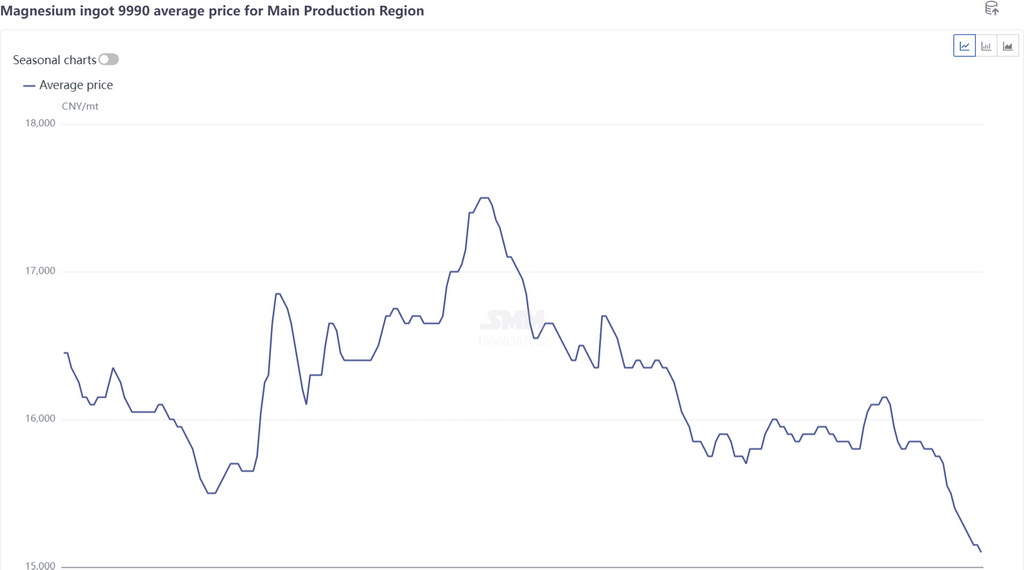
After the holiday, magnesium prices fell sharply, and the pace of decline moderated after prices approached 15,300 yuan/ton — yet the overall downtrend remained intact and the market stayed in a pattern of steady declines. During this period, primary magnesium smelters frequently signaled output cuts: according to SMM statistics, four primary magnesium smelters have halted production for maintenance and three have lowered operating rates, together affecting roughly 220 tpd (excluding changes made by smelters before the September production statistics were finalized). Given that some smelters that underwent maintenance in September have slightly raised operating rates in October, October primary magnesium output is expected to remain broadly flat versus September.

On the demand side, demand for magnesium alloy in both the automotive and two-wheeler segments has weakened, pushing up inventory pressure at magnesium alloy smelters, which have been forced to cut output — with total magnesium alloy production affected by nearly 3,000 tonnes. Although other end-use segments may see some increases, the overall supply-demand balance for magnesium metal remains difficult to fundamentally correct.

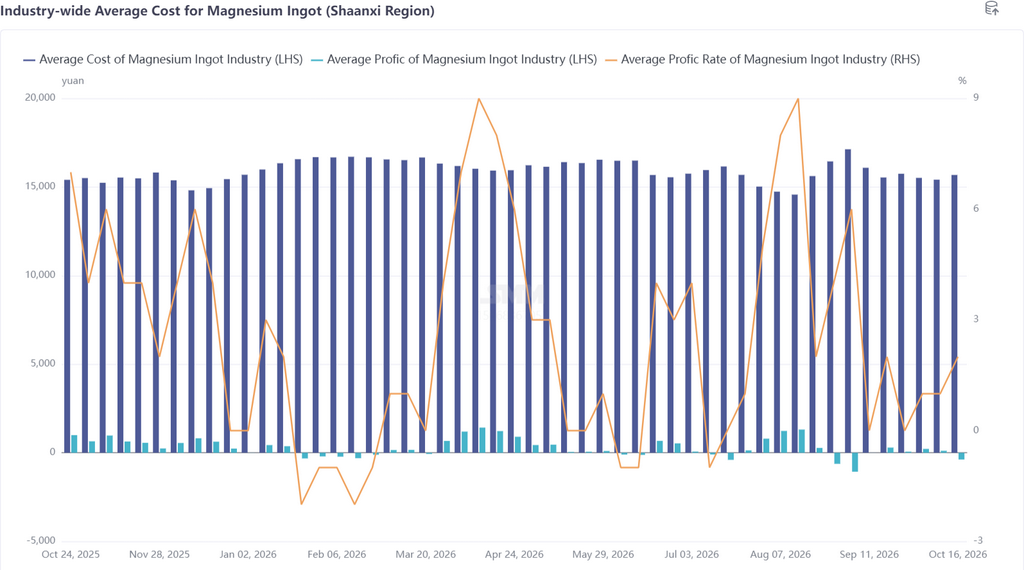
On costs, entering October, ferrosilicon and coal prices have partially retreated from earlier highs: 75# ferrosilicon prices have eased to 6,100 yuan/ton, and coal for semi-coke production has fallen back to around 900–950 yuan/ton. However, overall costs remain elevated, and cost disparities across provinces persist. Benefiting from its semi-coke cost advantage, Shaanxi's average production cost in October is around 15,500 yuan/ton, roughly in line with current magnesium prices; other provinces have seen costs retreat but still at high absolute levels. As magnesium prices weakened rapidly, regional loss disparities widened quickly, and with the recent sharp price declines, the cost-price inversion for primary magnesium smelters has kept deepening — losses in higher-cost provinces continue to mount, putting smelters under considerable operational pressure.
According to SMM, as of press time, primary magnesium smelters have raised quotations slightly, with overall market offers moving up to 15,200 yuan/ton. Magnesium prices have now stabilized and rebounded, with quotations awaiting transaction follow-through and market sentiment modestly improving. This rebound is largely the combined result of short-term factors — strengthened price-support sentiment among smelters following the rapid price decline, and restocking by end customers attracted by low prices. The foundation of price support remains fragile. Over the longer term, the market's supply-demand contradiction has yet to be resolved; for the magnesium market to truly stabilize, both meaningful supply-side reductions and a substantive demand recovery are still required.


Data Source Statement: Except for publicly available information, all other data are processed by SMM based on publicly available information, market communication, and relying on SMM's internal database model. They are for reference only and do not constitute decision-making recommendations.

For any inquiries or for more information, please contact: lemonzhao@smm.cn
For more information on how to access our research reports, please contact:service.en@smm.cn
Related News
Magnesium Prices Stabilize After Revisiting the 15,050 Mark for the First Time in a Year and a Half; Production Cuts and Firm Prices Provide Support—How Far Can the Rebound Go? [SMM Analysis]
2 hours ago
Magnesium Prices Stabilize After Revisiting the 15,050 Mark for the First Time in a Year and a Half; Production Cuts and Firm Prices Provide Support—How Far Can the Rebound Go? [SMM Analysis]
Read More
Magnesium Prices Stabilize After Revisiting the 15,050 Mark for the First Time in a Year and a Half; Production Cuts and Firm Prices Provide Support—How Far Can the Rebound Go? [SMM Analysis]
[SMM Magnesium Market Analysis: Magnesium Prices Stabilize After Revisiting the 15,050 Mark for the First Time in a Year and a Half, with Production Cuts and Price Support Providing a Floor—How Far Can the Rebound Go?] After the National Day holiday ended, magnesium prices continued their pre-holiday decline, drifting lower. The magnesium ingot spot inventory that accumulated during the holiday left the market well supplied, while downstream buyers had restocked fairly thoroughly before the holiday and their existing inventories had yet to be effectively absorbed, resulting in a severe supply-demand imbalance in the market. To stimulate transactions, primary magnesium smelters cut prices one after another, setting off the post-holiday downward cycle in magnesium prices. The rapidly falling prices kept eroding smelter profits, and losses on primary magnesium smelting continued to deepen. With costs inverted, when will magnesium prices stop falling?
2 hours ago
Magnesium smelters' willingness to hold prices firm rebounds, early signs of a rebound emerge in the magnesium market [SMM magnesium ingot spot report]
3 hours ago
Magnesium smelters' willingness to hold prices firm rebounds, early signs of a rebound emerge in the magnesium market [SMM magnesium ingot spot report]
Read More
Magnesium smelters' willingness to hold prices firm rebounds, early signs of a rebound emerge in the magnesium market [SMM magnesium ingot spot report]
[Magnesium plants' willingness to hold prices firm rebounds, signs of a magnesium market rebound emerge] The persistently sluggish market has continued to cause losses for magnesium plants, and signs of prices bottoming out are beginning to emerge, suggesting the market may be poised for a change.
3 hours ago
In September, the export of magnesium products showed differentiation, with the overall weak trend continuing unchanged
Oct 20, 2026 09:51 (GMT+8)
In September, the export of magnesium products showed differentiation, with the overall weak trend continuing unchanged
Read More
In September, the export of magnesium products showed differentiation, with the overall weak trend continuing unchanged
【SMM Magnesium Flash】According to statistics from the General Administration of Customs, China exported approximately 33,200 tons of various magnesium products in September 2026, marking a month-on-month decrease of 0.6% and a year-on-year decrease of 23.6%. From January to September 2026, China exported a total of approximately 340,200 tons of various magnesium products. Specifically, in September 2026, China exported 18,811 tons of magnesium ingots, marking a month-on-month increase of 0.3% an
Oct 20, 2026 09:51 (GMT+8)