Inventory clearance and competition for orders continued to dominate the solar module market in the Ex-China Region during the week of 12–16 October. Enquiries and discounted transactions increased in some markets, but end-user procurement showed no clear, sustained growth. Some manufacturers attempted to raise export offers, only to face limited orders and competition from cheaper stock. China FOB, Southeast Asian CIF and European warehouse markets remained under pressure. Prices of India-made modules, both compliant with domestic content requirements (DCR) and non-DCR, also fell.
Clearance activity is extending from stock rated at 625 W and below into standard 630 W TOPCon modules, while smaller-format back-contact (BC) modules are also being discounted. As clearance stock moves closer to mainstream power ratings, it is competing more directly with newly manufactured products. With new demand yet to provide sufficient support, inventory reduction and the flow of fresh orders remain central to pricing.
China FOB: limited support for price increases as standard TOPCon and smaller BC modules face pressure
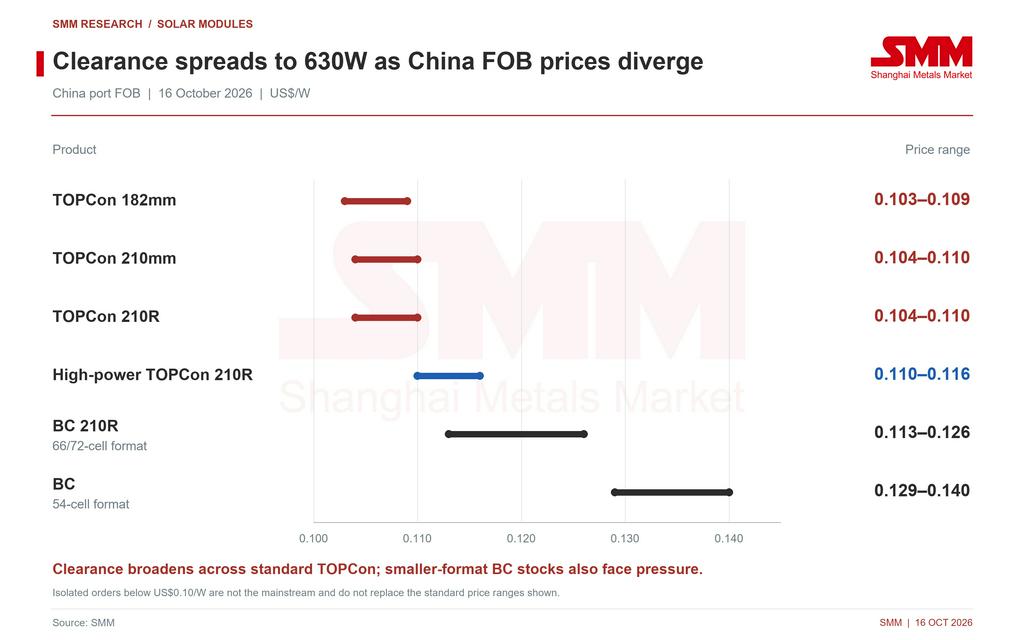
Some manufacturers raised export offers slightly during the week, encouraged by improved scheduling for European orders due in Q1 2027 and policy expectations. However, changes in forward delivery schedules have yet to generate a material increase in current procurement. Price competition across Asia, Africa, Latin America and Europe persisted, leaving FOB offers slightly lower overall after an initial rise. Some manufacturers continued to defend their cost floors, while transactions remained subject to individual negotiation and selective discounts.
Discounted standard TOPCon supply has gradually extended into 630 W products. Some exceptionally low offers approached US$0.102/W, with isolated orders even below US$0.10/W. These remain specific to particular inventories and trading terms and have not become mainstream transaction levels. Greater availability of low-priced stock is making broad price increases harder to sustain.
BC pricing also diverged by power rating. Some European and Asia-Pacific buyers received offers around US$0.002/W below previous levels. Inventory of smaller-format modules rated at roughly 475 W began selling at discounts, while offers for higher-power products rated at 490 W and above showed no clear change. Price pressure remains concentrated in stock clearance; the resilience of higher-power products will depend on actual order intake.
Southeast Asia: discounted stock supports transactions; policy expectations have yet to drive procurement
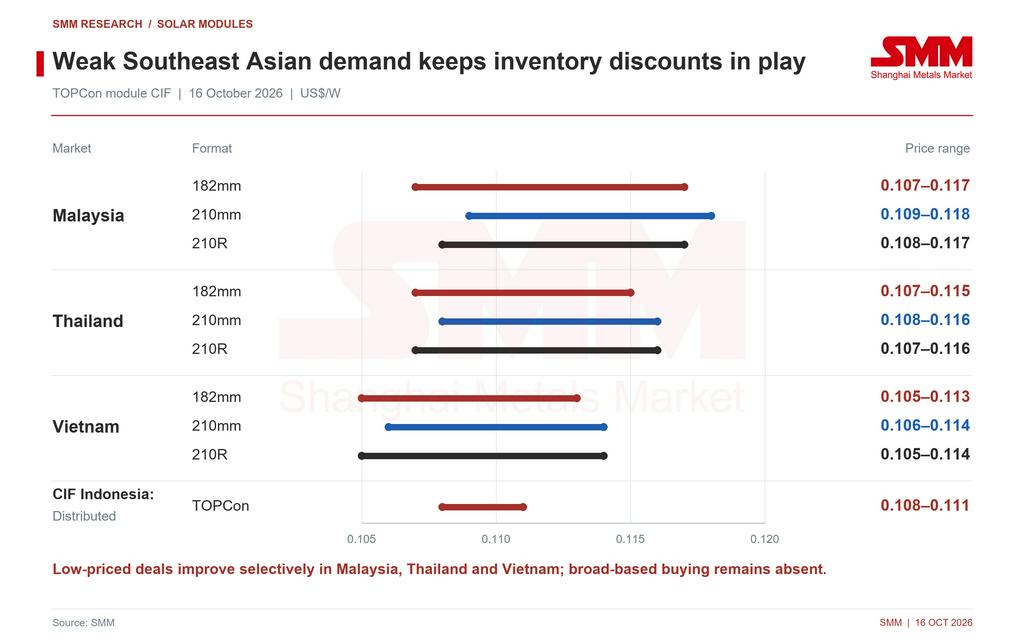
Module demand remained weak overall in Southeast Asia. Enquiries and discounted transactions increased in parts of Malaysia, Thailand and Vietnam, but buying continued to centre on immediate project requirements and available stock. As inventories of lower-power and non-mainstream grades declined, some standard 630 W modules also entered clearance sales, with isolated stock offers below US$0.10/W. Discounting lifted trading activity modestly, while demand for standard products at higher prices and for higher-power modules remained limited.
The localised improvement in transactions in Malaysia, Thailand and Vietnam has not translated into greater acceptance of higher-priced new supply. Indonesia continues to await further implementation of government quotas and related project procurement, with no significant near-term increase in buying volumes. The next question is whether distributors and developers will sustain purchases of new supply once discounted inventories have been absorbed.
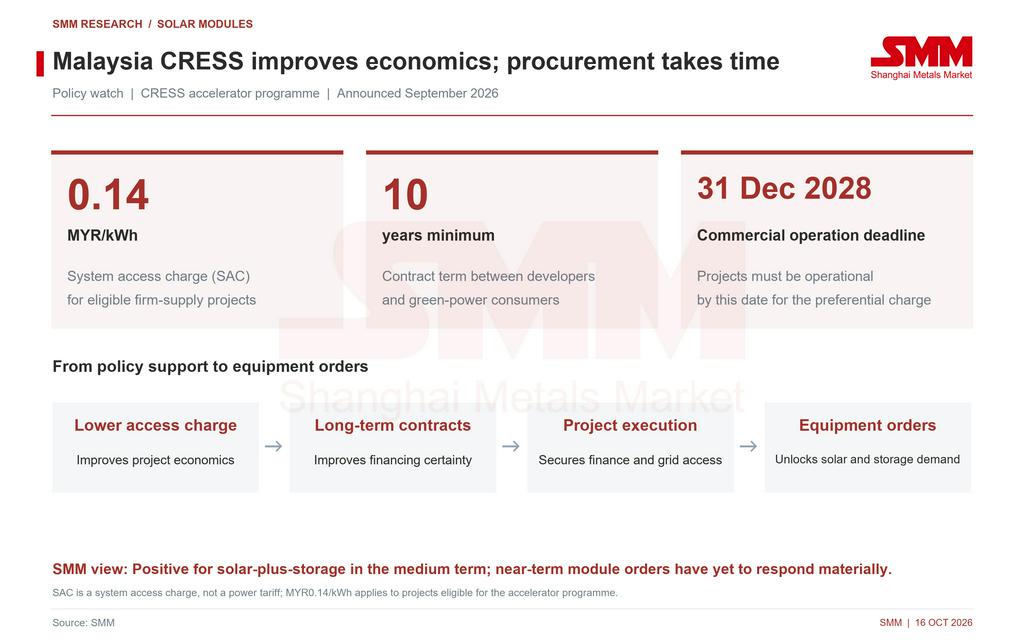
Malaysia's previously announced acceleration programme under the Corporate Renewable Energy Supply Scheme (CRESS) offers a system access charge of MYR0.14/kWh for eligible projects providing firm supply. Developers and green electricity consumers must sign contracts lasting at least 10 years, and qualifying projects must begin commercial operation by the end of 2028. Lower access costs and long-term contracts could improve project economics and financing certainty, encouraging developers to assess solar and storage configurations more closely.
Projects still need to complete contracting, financing, grid connection and construction arrangements. The policy's support for medium-term development has yet to produce a clear increase in module procurement during the review week. Equipment demand will depend on specific delivery schedules.
Europe: replenishment and small distributor orders dominate as weak project returns constrain pricing
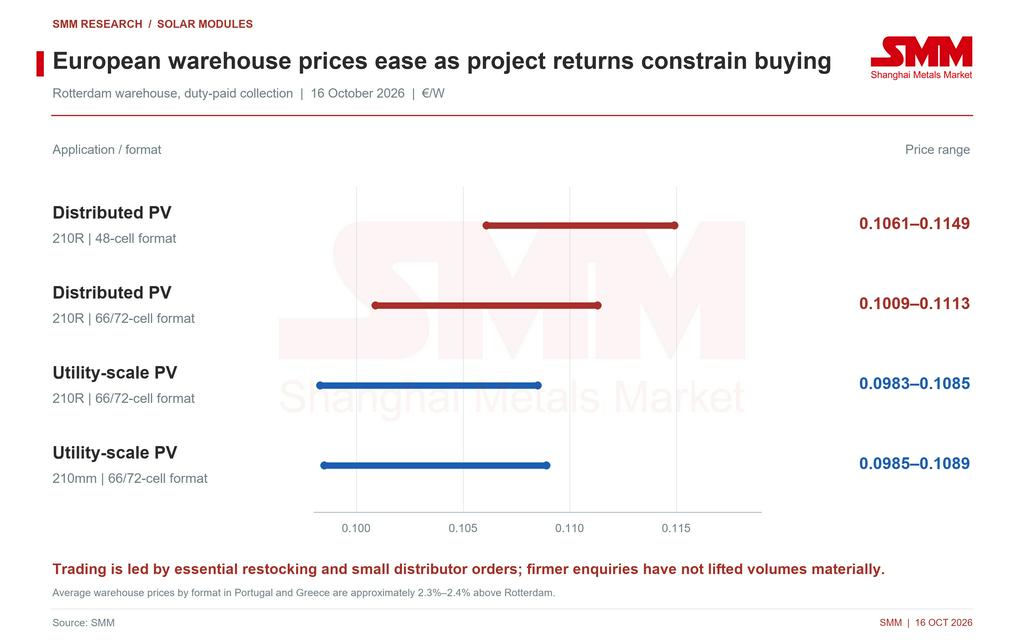
End-user enquiries in Europe recovered somewhat, but transactions remained concentrated in essential replenishment, small distributor purchases and deliveries under existing orders. New project procurement provided limited support. Continued clearance of 610–625 W stock, now joined by some 630 W products, strengthened buyers' negotiating position. Most leading manufacturers have not fully matched the lowest offers, leaving inventory discounts alongside attempts to defend cost-based prices.
Project returns remain the main demand constraint. Some awarded projects have locked in relatively low power purchase agreement (PPA) tariffs, so higher module costs would further squeeze investment returns. Earlier negative power prices have also affected investors' assessments of solar capture prices and long-term earnings. Storage deployment and grid connection progress have yet to relieve power integration constraints quickly enough, keeping developers cautious about equipment prices and procurement timing.
The latest Rotterdam warehouse offers declined for both distributed-generation and utility-scale modules, with smaller-format products facing greater pressure. Warehouses in Portugal and Greece retained average price premiums of around 2.3%–2.4% over Rotterdam, reflecting regional logistics and local delivery differences. Improved scheduling for some Q1 2027 orders lends support to forward demand expectations, but conversion into new contracts and firm deliveries remains the key test.
India: DCR and non-DCR prices decline amid inventory pressure and limited fresh orders
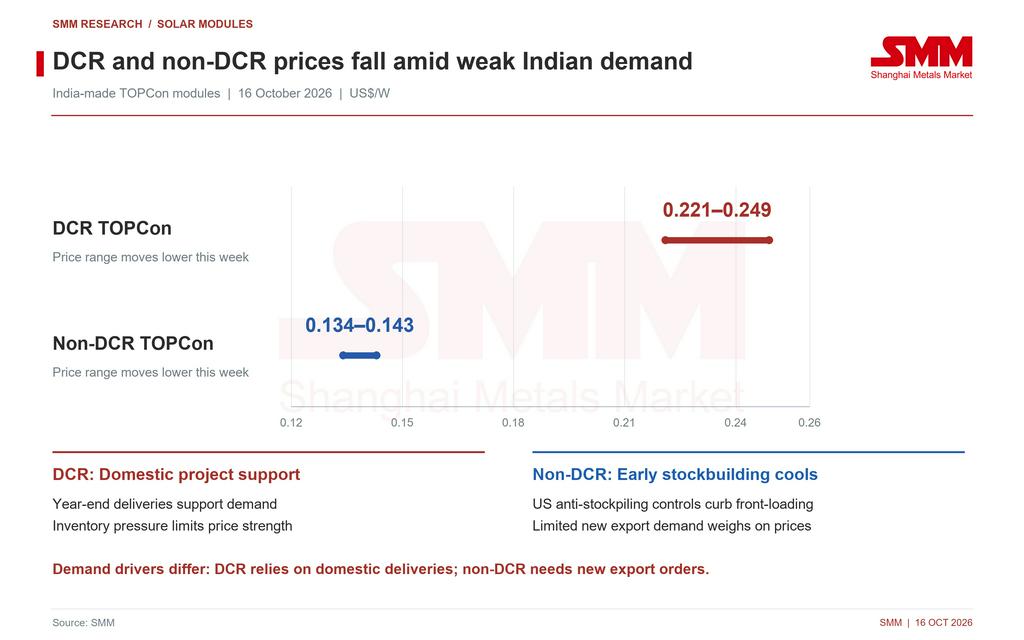
Both DCR and non-DCR module prices declined in India. DCR products rely primarily on Indian project demand, with year-end deliveries providing some support. However, additional transactions have been insufficient to materially ease supply and inventory pressure. Non-DCR products face softer advance stocking demand for the US market and limited new export orders, prompting previously elevated offers to ease.
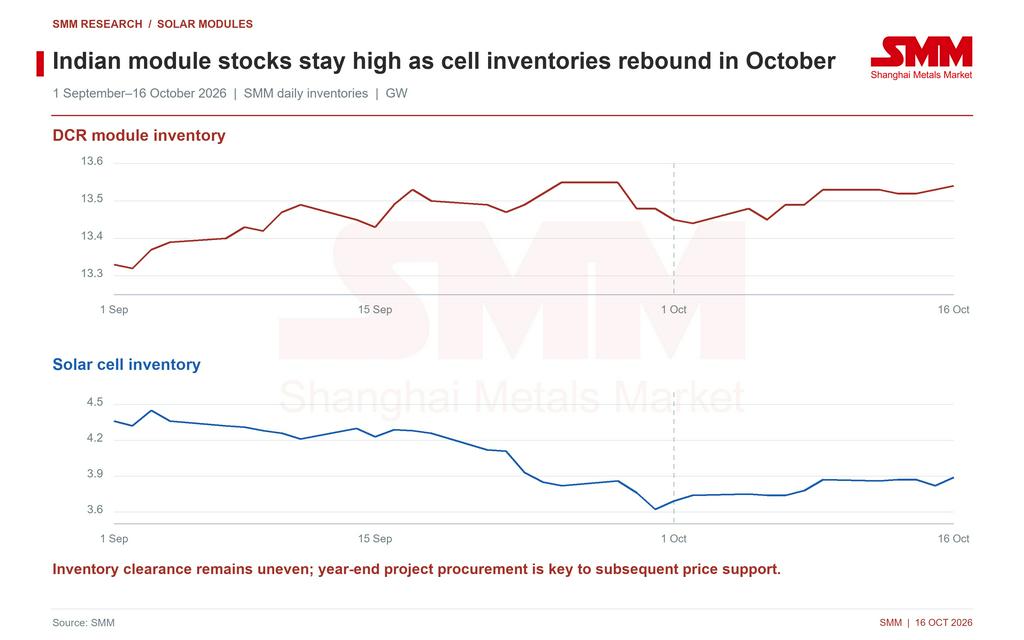
SMM daily data put India's DCR module inventory at 13.54 GW and cell inventory at 3.89 GW on 16 October, up 0.01 GW and 0.02 GW respectively from 9 October. Module stocks remained elevated, while cell inventories recovered in October after declining in September. A sustained drawdown has yet to emerge. Whether expected year-end project demand translates into actual module offtake will directly influence price support.
Tighter anti-stockpiling controls ahead of the implementation of US Section 232 measures have reduced the scope for concentrated shipments and advance stocking. For Indian non-DCR products, demand generated by earlier orders being brought forward is difficult to sustain, with falling prices coinciding with slower stocking activity. These products are likely to remain under pressure in the near term if fresh export orders fail to replace that demand.
SMM view: discounted sales offer limited evidence of recovery; watch inventory clearance and new orders
SMM sees localised transaction improvements in the Ex-China Region as driven mainly by inventory discounts and immediate purchasing requirements. Demand remains weak overall. European forward delivery schedules and policy-supported projects in Southeast Asia underpin expectations for later procurement, but competition for current orders will continue to constrain manufacturers' pricing power. Prices are expected to fluctuate at low levels, with differences across brands and power ratings persisting.
The main indicators to watch are clearance of standard 630 W TOPCon and smaller-format BC inventories, actual contracting for European Q1 2027 projects, and module offtake schedules for Southeast Asian projects and Indian domestic orders. If lower inventories lead to sustained purchases of newly manufactured products, mainstream prices could gradually gain support. If fresh orders remain insufficient to absorb supply, discounting may extend to a wider range of specifications.
Written by:
Ryan Tey Tze Yang | SMM PV Analyst
+60 127179370 | ryan.tey@metal.com