On 16 October, China's Ministry of Commerce (MOFCOM) and Ministry of Science and Technology announced proposed revisions to the Catalogue of Technologies Prohibited and Restricted from Export, alongside temporary pre-export registration requirements for the technologies concerned. The solar sector accounts for 12 technologies covering polysilicon, wafer and cell manufacturing. Certain key and core equipment incorporating these technologies also falls within the scope.
SMM sees the main implications for manufacturing plants in the Ex-China Region that rely on Chinese technology, equipment and continuing technical support: can they ramp up and upgrade on schedule? The issue is distinct from exporting finished products directly from China. It concerns polysilicon, wafer, cell and associated module factories in the Ex-China Region, rather than solar power projects buying equipment. Completing construction and starting production do not guarantee stable output at design capacity. The continuity of subsequent cross-border transfers of controlled technology could affect how quickly nameplate capacity becomes effective supply.
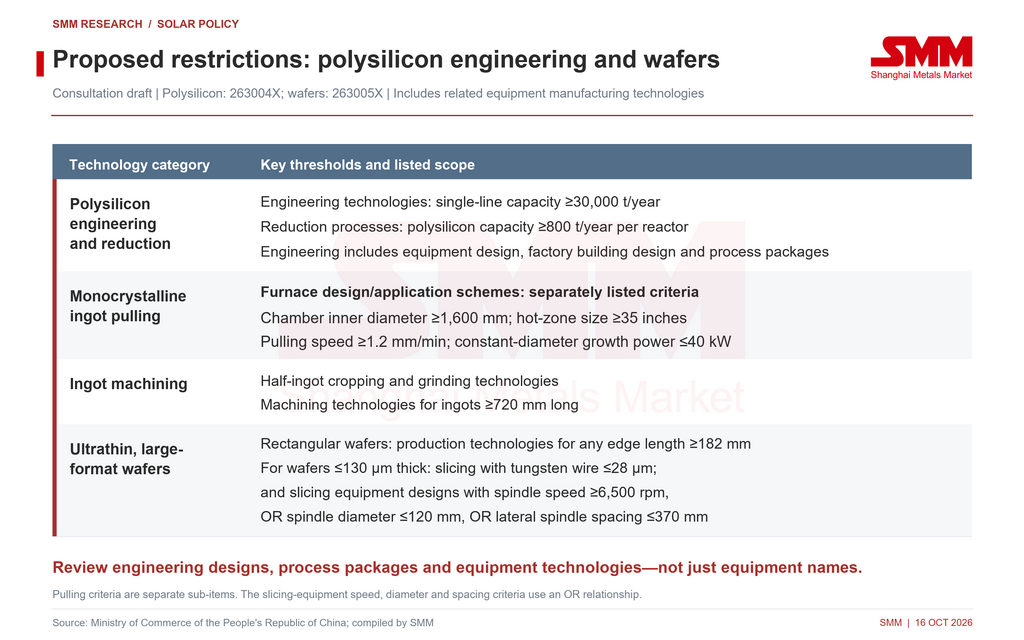
Registration has begun, but this is not an immediate ban on all solar technology exports
The policy has two separate timelines. Public consultation on the proposed additions runs from 16 October to 15 November 2026. Temporary pre-export registration, however, takes effect from the announcement date and continues until the revised catalogue enters into force. Relevant technology exports that have started but remain incomplete must also be registered. The consultation deadline of 15 November is not a confirmed implementation date for the final catalogue.
The consultation draft should therefore not be treated as a final, effective list of prohibited or restricted exports. Nor does registration automatically confer export authorisation. Whether a technology is ultimately prohibited or restricted, and which technical thresholds and procedures apply, will depend on the final catalogue and the applicable regulatory framework.
Technology and products must also be distinguished. The measures target technology transfers and specified equipment, not a blanket ban on exports of polysilicon, wafers, cells or modules manufactured using the technologies concerned. Technologies below the control thresholds and other unlisted solar manufacturing equipment cannot automatically be regarded as restricted by this announcement.
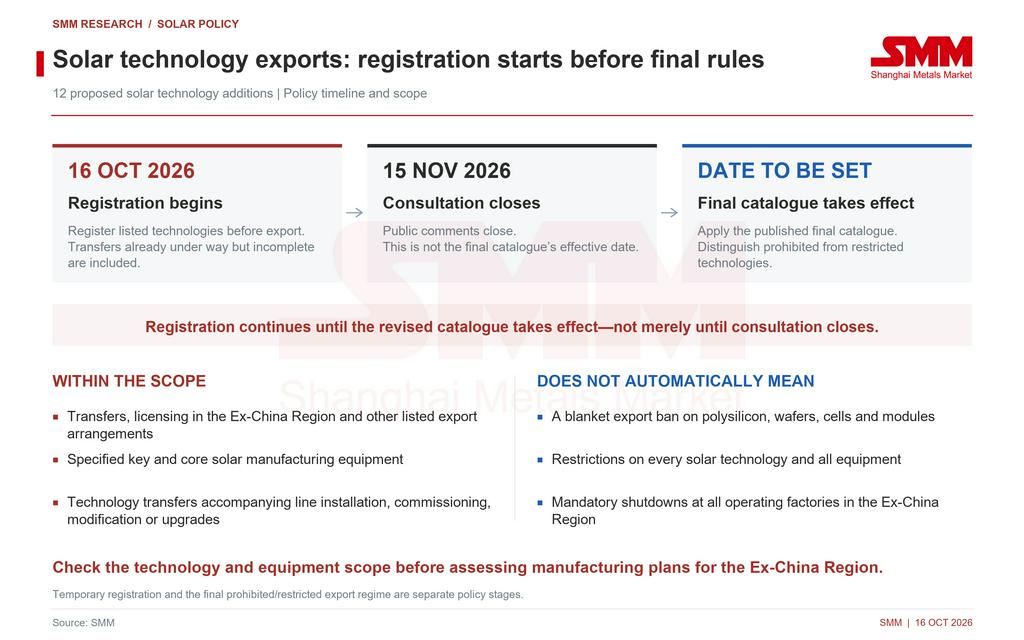
Proposed prohibitions cover selected polysilicon processes, ultrathin wafers and specific cell technologies
The proposed prohibited category includes cold-hydrogenation fluidised-bed processes with single-line trichlorosilane capacity of at least 250,000 t/year, silane fluidised-bed processes with single-line capacity of at least 20,000 t/year, and related equipment manufacturing technologies. For wafers, the proposal covers technologies for producing wafers 70 micrometres thick or less, together with related equipment manufacturing technologies. The entry explicitly includes program code, underlying algorithmic models and equipment drawings.
For cells, the proposal covers PV-specific edge-passivation technologies and related equipment manufacturing technologies meeting simultaneous conditions, including full-wafer edge lengths of 182–230 mm and thickness of no more than 140 micrometres. Perovskite and tandem technologies are also defined by specific thresholds. Examples include perovskite–crystalline silicon tandem cells with mass-production wafer sizes of at least 182 mm and efficiency of at least 30%; perovskite-specific slot-die coating with a working width of at least 1.1 m; and single-junction or tandem perovskite modules meeting the specified area and efficiency thresholds.
These entries concern qualifying manufacturing technologies and related equipment manufacturing technologies, rather than the finished wafers, cells or modules themselves. Companies planning to replicate these processes in the Ex-China Region, or introduce them through upgrades, would need to reassess implementation separately from ordinary product supply.
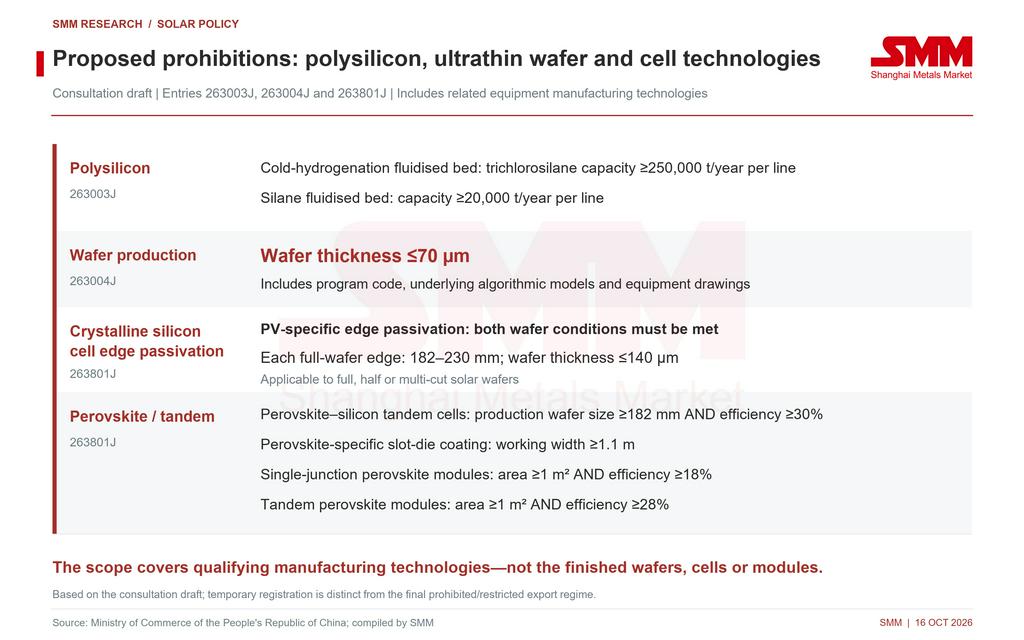
Proposed restrictions set thresholds for polysilicon engineering, ingot pulling and wafer slicing
Proposed restrictions on polysilicon include engineering technologies for single-line capacity of at least 30,000 t/year, as well as reduction processes and related equipment manufacturing technologies for reactors producing at least 800 t/year of polysilicon. Engineering technologies include equipment engineering design, factory building design and process packages. The scope therefore extends beyond the delivery of an individual machine.
For wafers, the proposal covers monocrystalline silicon ingot pulling, machining and ultrathin large-format wafer production. Separately listed monocrystalline furnace design criteria include a chamber inner diameter of at least 1,600 mm, a hot-zone size of at least 35 inches, a pulling speed of at least 1.2 mm/min, and power consumption during constant-diameter growth of no more than 40 kW. Machining entries cover half-ingot cropping and grinding, and technologies capable of producing ingots at least 720 mm long. Slicing entries cover large rectangular wafers, as well as fine tungsten wire and specified slicing equipment technologies for wafers no thicker than 130 micrometres. Each sub-item must be assessed against its own wording; the criteria should not be combined into a single set that must all be met simultaneously.
Process-specific controls on TOPCon, XBC and HJT could affect ramp-up and cost-reduction upgrades
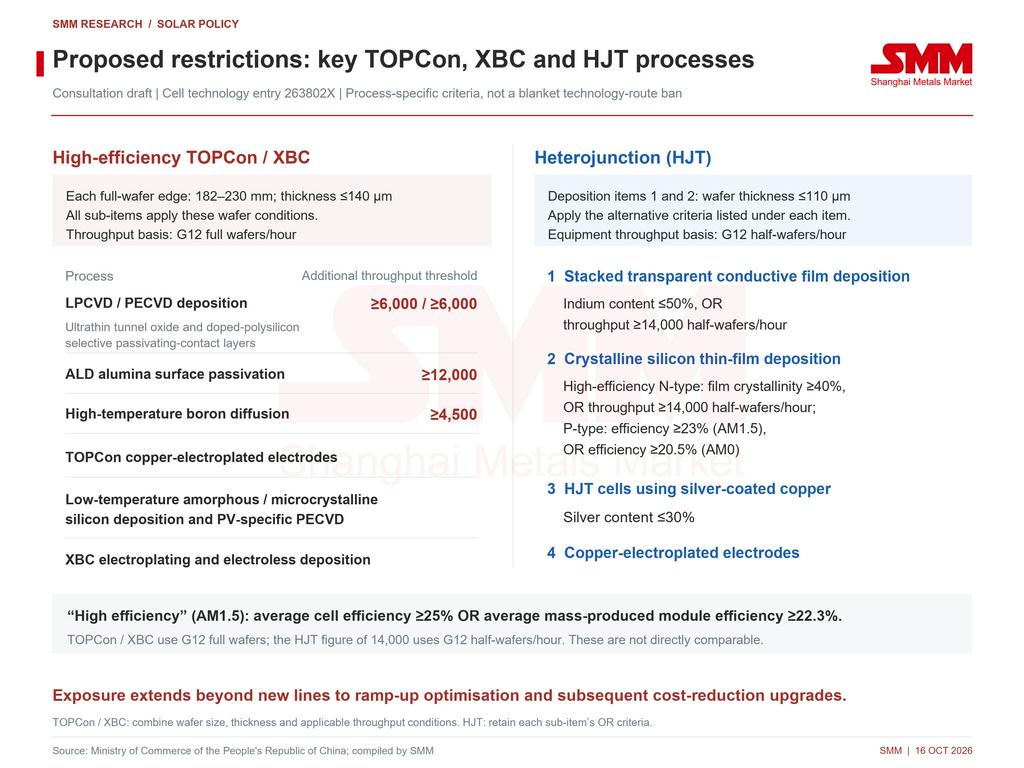
The proposed restricted category covers selected key processes for high-efficiency tunnel oxide passivated contact (TOPCon), back-contact (XBC) and heterojunction (HJT) cells. It does not prohibit these technology routes in their entirety. TOPCon and XBC entries include low-pressure chemical vapour deposition (LPCVD) and plasma-enhanced chemical vapour deposition (PECVD) for ultrathin tunnel oxides and doped-polysilicon selective passivating-contact layers; atomic layer deposition (ALD) for alumina surface passivation; high-temperature boron diffusion; copper electroplating; and low-temperature amorphous or microcrystalline silicon deposition. The entries specify wafer dimensions and thickness, with equipment throughput thresholds for some processes. These include 6,000 and 12,000 wafers/hour for the relevant deposition processes, and 4,500 wafers/hour for high-temperature boron diffusion, all on a G12 full-wafer basis. Each threshold must be read together with the other conditions in its sub-item.
The HJT entries cover stacked transparent conductive film deposition and crystalline silicon thin-film deposition for wafers no thicker than 110 micrometres. The relevant sub-items use criteria such as indium content, film crystallinity, equipment throughput or conversion efficiency. They also cover silver-coated copper HJT cell manufacturing with silver content of no more than 30%, and copper-electroplated electrode manufacturing. The stated throughput of 14,000 half-wafers/hour uses a G12 half-wafer basis and is not directly comparable with the G12 full-wafer figures above. For this cell technology entry, the annex defines high efficiency under AM1.5 conditions as average cell conversion efficiency of at least 25%, or average conversion efficiency of mass-produced modules of at least 22.3%.
SMM believes the implications extend beyond replicating new production lines in the Ex-China Region. They could also affect the technology arrangements supporting continued efficiency gains and lower costs per watt through thinner wafers, deposition optimisation, copper electroplating and reduced silver use after commissioning. For plants still dependent on relevant technology transfers from China, ramp-up, yield improvement and subsequent cost reduction need to be assessed together. The impact will depend on whether the technology falls within the listed scope and what is actually transferred across borders.
Finished-product exports and manufacturing in the Ex-China Region are different; construction does not complete a technology transfer
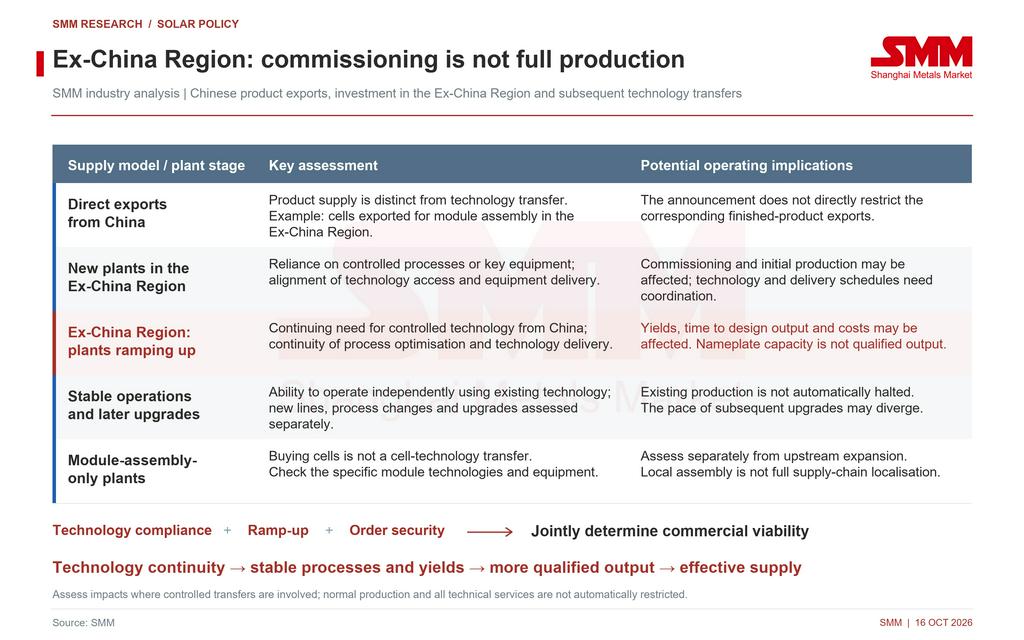
Markets in the Ex-China Region are supplied through two main routes: products manufactured in China and exported directly, or products manufactured and delivered by factories in the Ex-China Region. Exporting Chinese-made cells for module assembly in the Ex-China Region combines product supply with local processing; it does not automatically constitute an export of cell manufacturing technology. The relevant question is whether a transaction involves a cross-border transfer of controlled technology or specified equipment, not where the finished product is ultimately sold.
Local manufacturing and reliance on Chinese technology are not mutually exclusive. A Chinese-owned factory in the Ex-China Region, a joint venture or a local manufacturer adopting Chinese processes and equipment may all require subsequent installation, commissioning, process optimisation and upgrades. The official explanation states that transfers of key solar technologies can accompany production-line exports, installation, commissioning, modification and upgrading. Equipment delivery or the start of production therefore does not necessarily mark the completion of all technology transfers. Assessment must consider the actual content transferred and the control thresholds, rather than only a factory's location or ownership.
Incomplete technology exports require a check against the registration rules. Subsequent arrangements involving restricted technologies also need to align the applicable procedures with equipment delivery, commissioning and mass-production targets. Routine after-sales services and normal use of previously delivered technology in the Ex-China Region should not indiscriminately be treated as new restricted technology exports. Listed key and core equipment includes relevant fluidised beds, reduction reactors, monocrystalline furnaces, ingot-processing and slicing equipment, and certain edge-passivation, deposition, diffusion, electroplating and slot-die coating equipment. The key test remains whether the equipment incorporates technology meeting the control criteria.
Ramp-up is the central issue: starting production does not mean stable output at design capacity
Rather than asking broadly whether projects in the Ex-China Region can be built, SMM sees greater relevance in completed or newly commissioned manufacturing plants that still depend on further technology transfers from China. Moving from trial production to stable mass production requires better equipment integration, process stability and manufacturing yields. Cell plants must also improve conversion efficiency, product consistency and unit costs. If process introduction or optimisation during this stage involves controlled technology, changes to cross-border transfer arrangements could affect ramp-up schedules.
The result need not be a shutdown. It could instead be a later date for reaching design output, slower growth in qualified production, or delays to planned cost reductions. If actual output and yields fall short, fixed costs per unit, working-capital requirements and customer delivery pressure may rise. Assessing incremental supply from the Ex-China Region therefore requires more than the GW capacity announced or commissioned: qualified output, stable operation and actual delivery capability matter. These effects depend on whether subsequent technology transfers fall within the controls; temporary registration alone does not imply that ramp-up will necessarily be disrupted.
New plants still under construction also need to coordinate access to technology, equipment delivery and initial commissioning. Factories that buy cells solely for module assembly should be assessed separately from cell manufacturing investments, with requirements determined by their specific module technologies and equipment. Local module production does not demonstrate local upstream manufacturing or independent technological development. Full supply-chain localisation remains a separate question.
Existing plants need not shut down, but access to upgrades could widen performance gaps
The announcement does not require factories in the Ex-China Region to stop production if their technology transfers are complete and they are operating normally. The issues to assess are incomplete transfers and whether subsequent new lines, process improvements or equipment upgrades fall within the scope. Existing and new factories face different questions and should not all be labelled capacity-constrained.
Plants with established processes, engineering teams and independent operating capabilities may face less near-term exposure to changes in new technology transfers. However, those relying heavily on continued access to advanced processes or core equipment from China to improve efficiency and reduce costs may need to reassess their longer-term competitiveness. Having built a factory and being able to keep pace with technological change are different achievements.
Investment in the Ex-China Region will remain relevant, but technology access must align with production and orders
Manufacturing in the Ex-China Region may retain commercial value for orders requiring local production, supply-chain traceability or access to specific markets. The policy does not automatically remove these demand drivers. It does, however, place greater emphasis on three conditions being met together: compliant access to technology, the ability to establish effective supply on schedule, and sustainable orders and margins. Cheap land, policy incentives or favourable export geography alone are insufficient to justify a project.
SMM expects some manufacturing projects in the Ex-China Region still at the planning stage to proceed more cautiously until the final rules and implementation procedures become clearer. Developers may prioritise technology plans, equipment scope and order visibility before committing to an investment schedule. The pace at which effective capacity becomes available could diverge further between plants with independent technology, mature production systems and stable customers, and those still reliant on continuing technology transfers from China to complete their ramp-up.
For Chinese companies, the focus on technology transfers rather than the corresponding manufactured products could further differentiate strategies for advanced-product exports and local manufacturing in the Ex-China Region. The former draws on R&D and production capabilities in China. The latter requires a viable combination of target-market access, local supply-chain support and compliant technology options. This does not imply that all manufacturing in the Ex-China Region will return to China, or that moving a factory to another country resolves technology export requirements.
SMM view: track ramp-up and upgrades, not just nameplate capacity in the Ex-China Region
The main medium-term question is whether plants in the Ex-China Region built around Chinese technology can ramp up and keep upgrading, rather than whether China's finished-product export model itself changes. Where plants still require controlled technology from China, continuity of subsequent transfers could affect the time needed to reach design output, improve yields and reduce unit costs. For factories already producing reliably without additional controlled technology transfers, an impact on existing supply cannot simply be assumed.
If effective output from some factories in the Ex-China Region grows more slowly than planned while orders in their target markets continue to expand, reliable suppliers with compliant delivery capabilities could become more valuable. Conversely, weak demand and ample alternative supply could prevent slower ramp-up from improving incumbent factories' profitability. A rise in module prices is not an automatic consequence.
The next priorities are the final catalogue's technical thresholds and classifications, the procedures for technology and key-equipment exports, and actual progress from equipment commissioning and trial production to stable output at plants in the Ex-China Region. SMM believes assessments of expansion in the Ex-China Region should increasingly shift from how many GW have been built to how much qualified output can be produced consistently, and whether costs can keep falling as technology improves. Global manufacturing investment will continue, but technology compliance, ramp-up performance and order quality will jointly determine its commercial viability.
![[SMM Analysis] Silver Down Nearly 20% From Stage High: Why Are Solar Cell Prices Not Following?](https://imgqn.smm.cn/usercenter/FqtWa20251217171742.jpg)
![[SMM PV Flash] Sigenergy Named National-Level Specialized and Sophisticated "Little Giant" Enterprise!](https://imgqn.smm.cn/usercenter/JNxfy20251217171742.jpg)
![[SMM PV Flash] JA Solar Technology Receives EcoVadis Gold Rating](https://imgqn.smm.cn/usercenter/TygQH20251217171742.jpg)