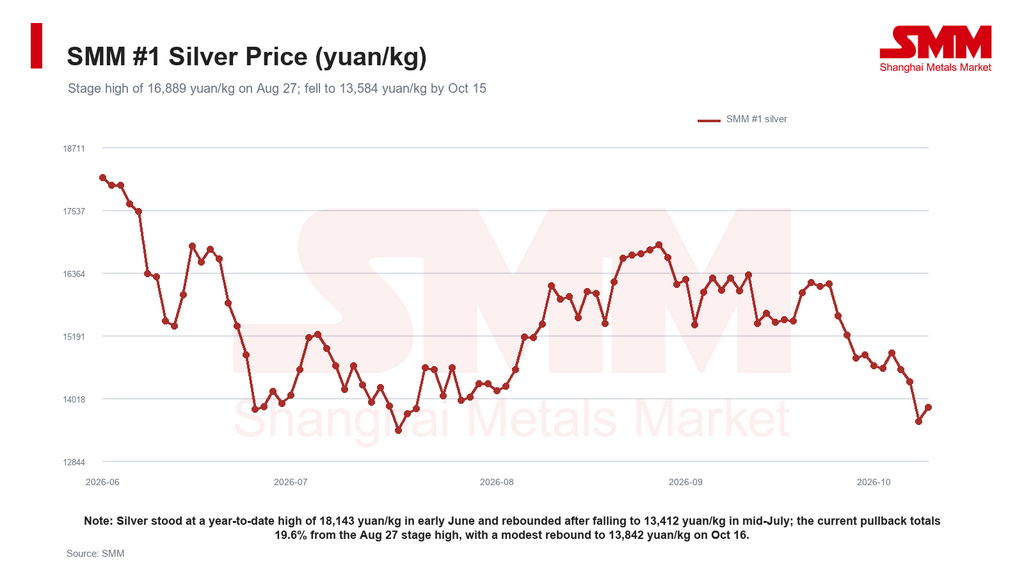
Since late August 2026, silver prices have entered a rapid pullback. According to SMM data, the SMM #1 silver price fell from its stage high of 16,889 yuan/kg ($2,513/kg) on August 27 to 13,584 yuan/kg ($2,021/kg) on October 15, a cumulative drop of 19.6%, before edging back to 13,842 yuan/kg ($2,059/kg) on October 16. Over the same period, the solar cell cost curve shifted lower across the board: taking the M10 (183 mm) cell as an example, total cost per watt fell from 0.348 yuan/W to 0.310 yuan/W, a decline of about 10.8%.
Unlike in February 2026, when a sharp silver drop was matched by a synchronous fall in cell quotations, the latest cost relief has not translated into lower cell prices. SMM price data showed that G12R (210R) cell prices have held steady since September 18, with no adjustment for nearly a month; G12 (210 mm) cell prices rose rather than fell in mid-October; and M10 cells only drifted lower within a narrow band.
Silver Price Correction: Macroeconomic Headwinds Weigh on Precious Metals Valuations
The latest silver price correction was primarily triggered by developments in the overseas macroeconomic environment. The minutes of the US Federal Reserve's September policy meeting struck a relatively hawkish tone, while the US Dollar Index climbed above 102 and US Treasury yields reached multi-year highs, putting pressure on precious metals valuations.
COMEX silver futures fell below the USD 60/oz threshold on October 8, touching an intraday low of USD 58.96/oz. Domestic silver prices followed the downward trend. Between October 12 and 15, the SMM 1# Silver price declined by a cumulative 8.6%, marking the steepest phase of the latest correction.
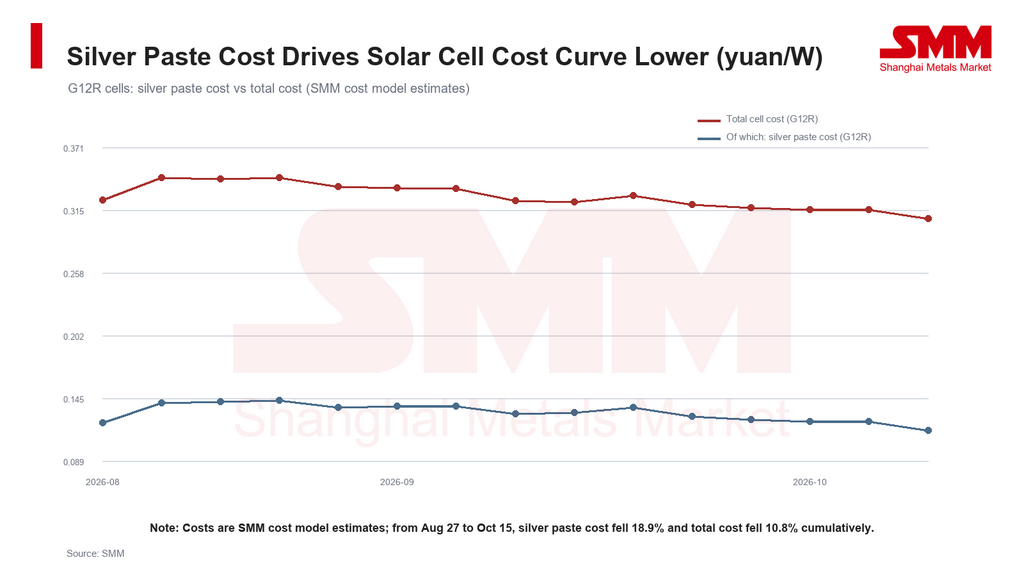
Cost Transmission: Lower Silver Paste Prices Drive Down Total Cell Production Costs
According to SMM data, the average price of TOPCon front-side fine-line silver paste fell from 15,976.5 yuan/kg ($2,377/kg) on August 27 to 12,991 yuan/kg ($1,933/kg) on October 15, down 18.7%. The silver paste cost of G12R cells fell from 0.143 yuan/W to 0.116 yuan/W, down 18.9%. Notably, in the three weeks from September 28 to October 15, the total cost of G12R cells fell by a cumulative 0.013 yuan/W, while the silver paste cost fell by the same 0.013 yuan/W — meaning the improvement in cell costs came essentially from the single variable of silver prices.
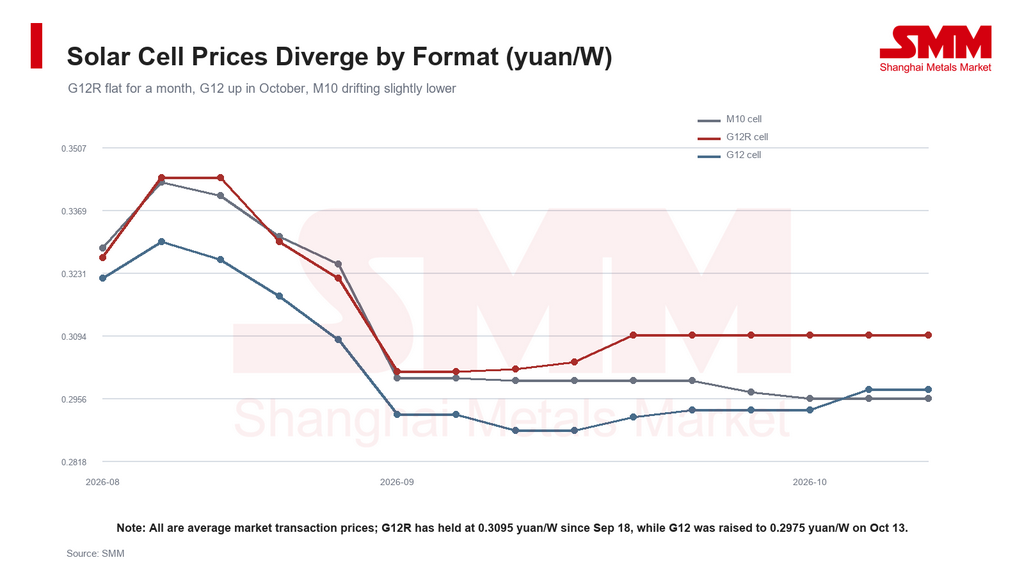
Market Performance: Price Stability, Selective Increases and Marginal Declines Coexist
While the cost curve moved lower, cell prices showed three distinct trajectories. SMM price data showed that since September 18, the average G12R cell price has held at 0.31 yuan/W, anchored by upstream and downstream psychological price levels, with no adjustment for nearly a month. G12 cells were largely stable in September after pulling back from late-August highs, before the average price was raised to 0.2975 yuan/W on October 13, within a range of 0.295-0.3 yuan/W, up 1.5% from the start of the month. M10 cells edged down from 0.2995 yuan/W to 0.2955 yuan/W, a move of less than 2% during the window of steepest silver declines. None of the three formats followed costs lower in tandem.
Why Have Cell Prices Remained Resilient? Production Line Upgrades and Output Cuts Tighten Supply
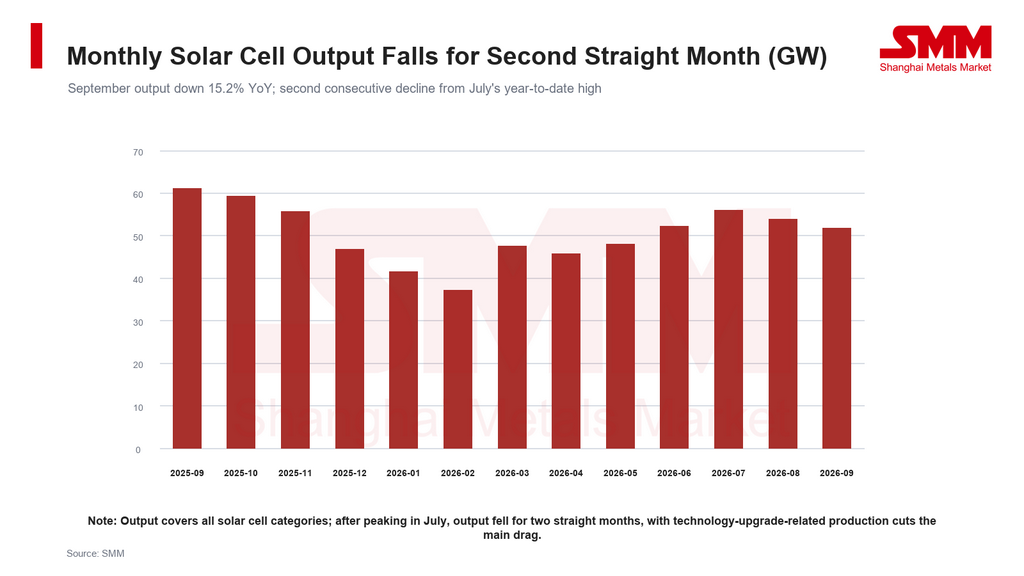
The first pillar of price resilience came from the supply side. SMM data showed that China's solar cell output fell 15.2% year on year in September, staying below the July year-to-date high for a second consecutive month, while the industry operating rate fell to 53.5%, down 23.04 percentage points from a year earlier. The reduction mainly came from ongoing production line technology upgrades at some cell makers; the resulting temporary shutdowns squeezed effective market supply and left fewer spot cargoes in circulation than before.
Three Cell Formats, Three Market Dynamics: Weak but Stable 183, Export-Supported 210R and Tight 210N Inventories
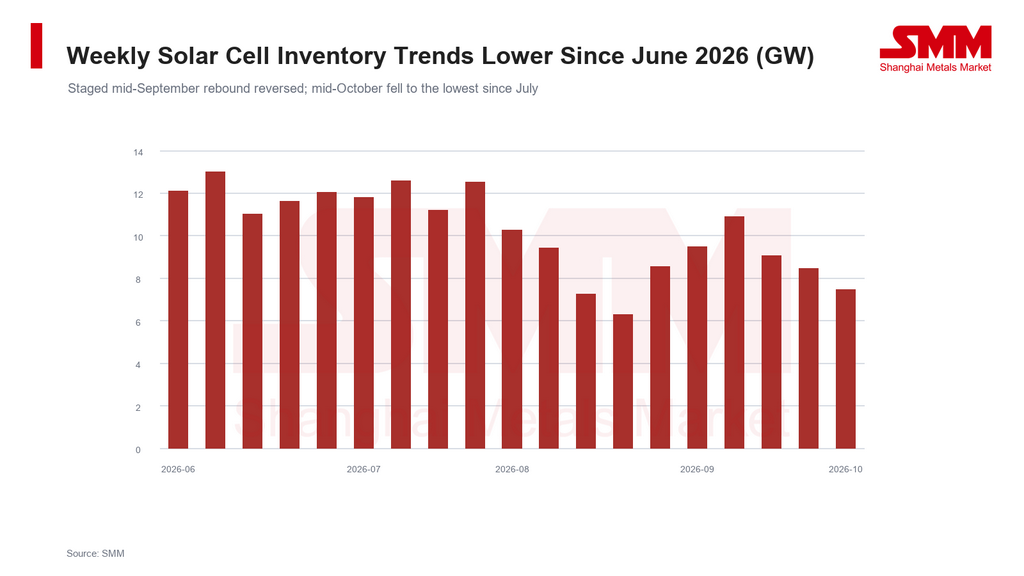
The second pillar is that the three formats are driven by different demand logics — there is no single price direction in the market right now. Inventory movements are a key clue to this divergence. Inventories staged a rebound in September, but then fell again as some producers cut output for technology upgrades, pre-holiday stockpiling kicked in and export orders were delivered. As of October 12, industry inventory was down about 31.68% from its mid-September high.
By format, domestic demand for M10 cells has been shrinking steadily, and export order volumes are relatively limited; with neither buyers nor sellers showing much initiative, prices have moved within a narrow band. G12R cells are mainly supported by export orders, with cell makers prioritising existing supply for export markets — even when domestic module makers tried to press for lower prices on the back of cheaper silver, they struggled to secure meaningfully cheaper cargoes. G12 cells, meanwhile, have benefited from the release of utility-scale project demand and module makers' restocking in October; spot supply has tightened, pushing prices up rather than down.
Outlook
In the near term, falling silver prices help improve cell makers' costs, but are not yet enough to trigger across-the-board cell price cuts. For M10, limited demand upside means little room for prices to rise, but prices will largely move within a narrow band until supply recovers. For G12R, order support should hold until the export window closes; watch for changes in the export pace and any backflow of cargoes into the domestic market after early November. Whether G12 can sustain its strength depends on the continuity of utility-scale project deliveries and module makers' restocking. Overall, this round of "silver down, cells flat" does not signal a failure of cost-based pricing — it reflects a temporary shift of pricing power from the cost side to structural supply and demand.
![China Proposes Tighter Solar Technology Export Controls: What Next for the Ex-China Region? [SMM Analysis]](https://imgqn.smm.cn/usercenter/lBNjs20251217171740.jpg)
![[SMM PV Flash] Sigenergy Named National-Level Specialized and Sophisticated "Little Giant" Enterprise!](https://imgqn.smm.cn/usercenter/JNxfy20251217171742.jpg)
![[SMM PV Flash] JA Solar Technology Receives EcoVadis Gold Rating](https://imgqn.smm.cn/usercenter/TygQH20251217171742.jpg)