[SMM Analysis] Hot Metal Production Hits Bottom in Stages, Ore Prices Expected to Stop Falling and Stabilize Next Week

Published: Oct 16, 2026 11:44 (GMT+8)

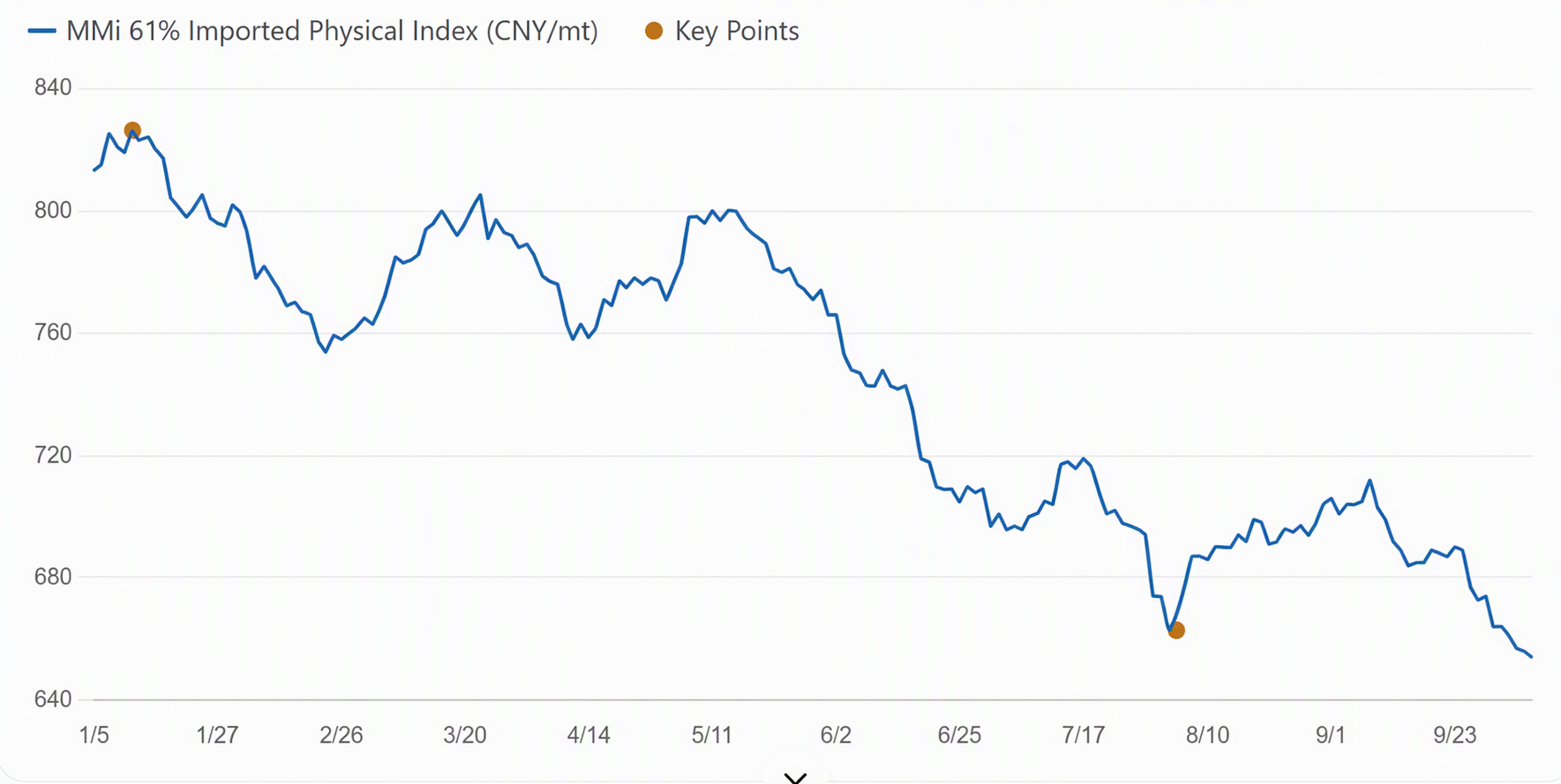
Iron ore remained in the doldrums this week, with the most-traded I2701 contract falling for four consecutive trading days to a low of 667 yuan/mt. It was down 31 yuan cumulatively from the pre-holiday level (September 30). Spot cargoes at Qingdao Port pulled back in tandem, with both futures and spot weakening together. Fundamentals showed a pattern of reduced supply and weak demand: on the supply side, although global shipments retreated from highs and China's port arrivals declined for three consecutive weeks, the first post-holiday port data showed SMM 35-port inventories increased to 148.3 million mt, an inventory buildup of 2.85 million mt from the pre-holiday level, driven mainly by coarse fines and lump ore, with the pace of inventory buildup clearly accelerating. On the demand side, the SMM survey of 242 steel mills showed daily average hot metal production fell to 2.352 million mt, down 36,200 mt from the pre-holiday level. This week, the impact from blast furnace maintenance expanded to 1.9011 million mt, rising for three consecutive weeks, leaving hot metal at a staged low. However, after two rounds of coke price cuts, the spot profit of integrated rebar improved from -179.79 yuan/mt before the holiday to -68.12 yuan/mt. Although steel mill profits have recovered, most mills remain loss-making, which is curbing raw material demand.

Chart: MMI 61% Port Spot Index
Source: SMM


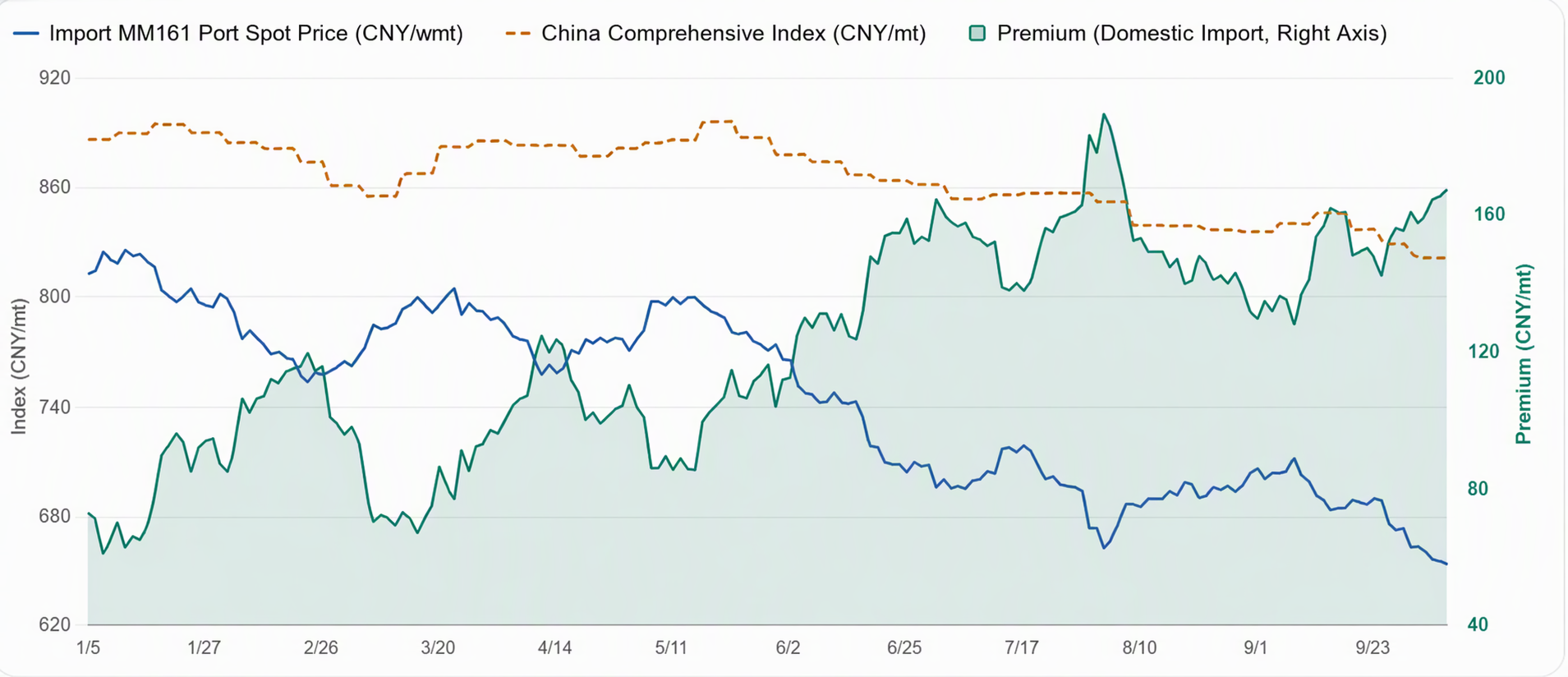
Chart: Imported ore fell more sharply, with the domestic-imported ore price spread continuing to widen
Outlook for next week

Outlook for next week, as steel mill profits recover and blast furnace maintenance winds down in stages, hot metal production is expected to hit bottom and rebound slightly, providing some support for ore prices. However, expectations for future supply growth remain strong, and mounting inventory pressure will continue to cap the upside, while falling ocean freight rates further weaken cost support. Overall, ore prices lack upward drivers and are expected to move sideways in the short term. In terms of trading, selling into rebounds is recommended as the main strategy, with close attention to steel demand and the sentiment impact from macro news.


Data Source Statement: Except for publicly available information, all other data are processed by SMM based on publicly available information, market communication, and relying on SMM's internal database model. They are for reference only and do not constitute decision-making recommendations.

Images in this article contain AI-translated captions for reference only.

For any inquiries or for more information, please contact: lemonzhao@smm.cn
For more information on how to access our research reports, please contact:service.en@smm.cn
Related News
[SMM Steel] Turkish Rebar: Sentiment Depressed as Exhausted Quotas and Shipping Risks Stagnate Exports
7 mins ago
[SMM Steel] Turkish Rebar: Sentiment Depressed as Exhausted Quotas and Shipping Risks Stagnate Exports
Read More
[SMM Steel] Turkish Rebar: Sentiment Depressed as Exhausted Quotas and Shipping Risks Stagnate Exports
[SMM Steel] Turkish Rebar: Sentiment Depressed as Exhausted Quotas and Shipping Risks Stagnate Exports
[Turkey] The Turkish rebar market remained sluggish this week, with several primary mills lowering their offer prices and overall trading activity staying extremely muted across both domestic and export sectors. In pricing, domestic rebar ex-works prices held steady at 610 USD/tonne EXW (excluding VAT), while export FOB prices edged down by 1 USD/tonne to 609 USD/tonne FOB. This minor drop reflected November shipment offers hovering around 610–620 USD/tonne FOB against a near-total absence of buying bids. Regionally, major Izmir mills lowered domestic quotes to 605–608 USD/tonne EXW; Iskenderun producers held firm near 605 USD/tonne EXW; and Marmara mills maintained offers in the 625–635 USD/tonne EXW range. On the trade and logistics front, export flows to Europe have ground to a virtual standstill. This freeze stems from European fourth-quarter tariff rate quotas (TRQs) being entirely exhausted—with EU buyers typically deferring fresh bookings until late in the first month of the new quarter—alongside heightened Black Sea shipping risks. Buyers clearing material through Romanian and Bulgarian ports are expressing severe concerns over shipment feasibility, as vessel owners refuse to operate in these waters following recent strikes on commercial vessels, with several Turkish shipowners explicitly declining calls to Romanian or Bulgarian ports.
7 mins ago
[SMM Steel] European HRC: CBAM Compliance Risks Disrupt Import Trade as Mills Push Q1 Forward Prices
12 mins ago
[SMM Steel] European HRC: CBAM Compliance Risks Disrupt Import Trade as Mills Push Q1 Forward Prices
Read More
[SMM Steel] European HRC: CBAM Compliance Risks Disrupt Import Trade as Mills Push Q1 Forward Prices
[SMM Steel] European HRC: CBAM Compliance Risks Disrupt Import Trade as Mills Push Q1 Forward Prices
[Europe] Obligations under the EU’s Carbon Border Adjustment Mechanism (CBAM) returned to the market spotlight today. Trading activity stalled as third-country suppliers struggle to obtain verified carbon emissions data—particularly for precursor raw materials like slabs and pig iron. Lacking primary documentation subjects shipments to punitive default benchmark values, sparking concerns over potential cancellations of Q1 import contracts by risk-averse buyers and traders. In pricing, the Northwest European HRC ex-works price held flat at 740 EUR/tonne EXW (831 USD/tonne), while the Italian domestic price edged up to 742 EUR/tonne EXW (833 USD/tonne). The combination of CBAM compliance challenges and tariff rate quota (TRQ) risks has severely constrained foreign steel inflows. Traders quoting Q1 and Q2 arrivals on DDP terms are offering prices above European domestic baselines at 780–800 EUR/tonne DDP. Specific offers today placed Japanese and Egyptian origins at 800 EUR/tonne DDP, Taiwanese material for March arrival at 790 EUR/tonne DDP, and Indian origin at 740–750 USD/tonne CFR. Turkish mills, despite nominal CFR price advantages, saw buying interest dampened by certification gaps and quota expiration risks. While mills remain cautious regarding broad Q1 volume allocations, selective forward pricing for 2027 delivery has already begun circulating among key accounts.
12 mins ago
[SMM Malaysia Weekly Review] Rebar Offer Extend Gains While HRC and Wire Rod Hold Steady; Import Price Advantage Narrows
45 mins ago
[SMM Malaysia Weekly Review] Rebar Offer Extend Gains While HRC and Wire Rod Hold Steady; Import Price Advantage Narrows
Read More
[SMM Malaysia Weekly Review] Rebar Offer Extend Gains While HRC and Wire Rod Hold Steady; Import Price Advantage Narrows
[SMM Malaysia Weekly Review] Rebar Offer Extend Gains While HRC and Wire Rod Hold Steady; Import Price Advantage Narrows
Malaysia's steel market maintained a mixed but relatively firm pricing trend this week, with domestic rebar quotations extending their upward movement while HRC and wire rod prices remained unchanged. Domestic HRC offers held steady at MYR 2,220/tonne EXW, unchanged from October 7. Meanwhile, 16mm B500B rebar quotations increased by MYR 20/tonne to MYR 2,250/tonne EXW, although the latest observations involved different suppliers and may not represent a direct price adjustment by the same mill. C12D wire rod prices remained stable at MYR 2,300/tonne delivered. Despite the continued strength in rebar quotations, downstream purchasing remained cautious. Based on previous stockist feedback indicating discounts of MYR 20–30/tonne against mill reference prices, an indicative stockist selling range of MYR 2,220–2,230/tonne could be inferred if similar discounts persist. However, this remains a theoretical estimate rather than a confirmed transaction range, highlighting the need to distinguish firmer mill quotations from actual market acceptance. On the import front, Chinese HRC offers remained at approximately USD 520–530/tonne CFR Port Klang, equivalent to MYR 2,125–2,166/tonne using the retained exchange rate of MYR 4.0862/USD. This represents an initial MYR 54–95/tonne discount against domestic HRC ex-works quotations. Meanwhile, Indonesian Dexin wire rod offers increased by USD 5/tonne week on week to approximately USD 530/tonne CFR Malaysia, equivalent to MYR 2,166/tonne. The preliminary gap against domestic delivered wire rod prices consequently narrowed from approximately MYR 155/tonne to MYR 134/tonne. Although imported material continues to show a nominal price advantage, the comparison excludes port handling charges, applicable taxes, customs clearance and inland transportation costs, which could substantially reduce the actual savings for downstream buyers. Looking ahead, Malaysia's domestic steel quotations are expected to remain stable to slightly firm, supported by the recent upward movement in rebar offers. However, subdued downstream demand and potential stockist inventory pressure may continue to limit further increases. Meanwhile, the narrowing price gap for Indonesian wire rod could influence purchasing decisions, particularly among steel mesh manufacturers evaluating imported alternatives. Market participants will continue monitoring actual transaction prices, inventory movements and fully landed import costs to assess whether the recent strength in domestic quotations can be sustained.
45 mins ago
Register to Continue Reading
Gain access to the latest insights in metals and new energy
Already have an account?Sign in here