SMM, October 16:
In the metals market:
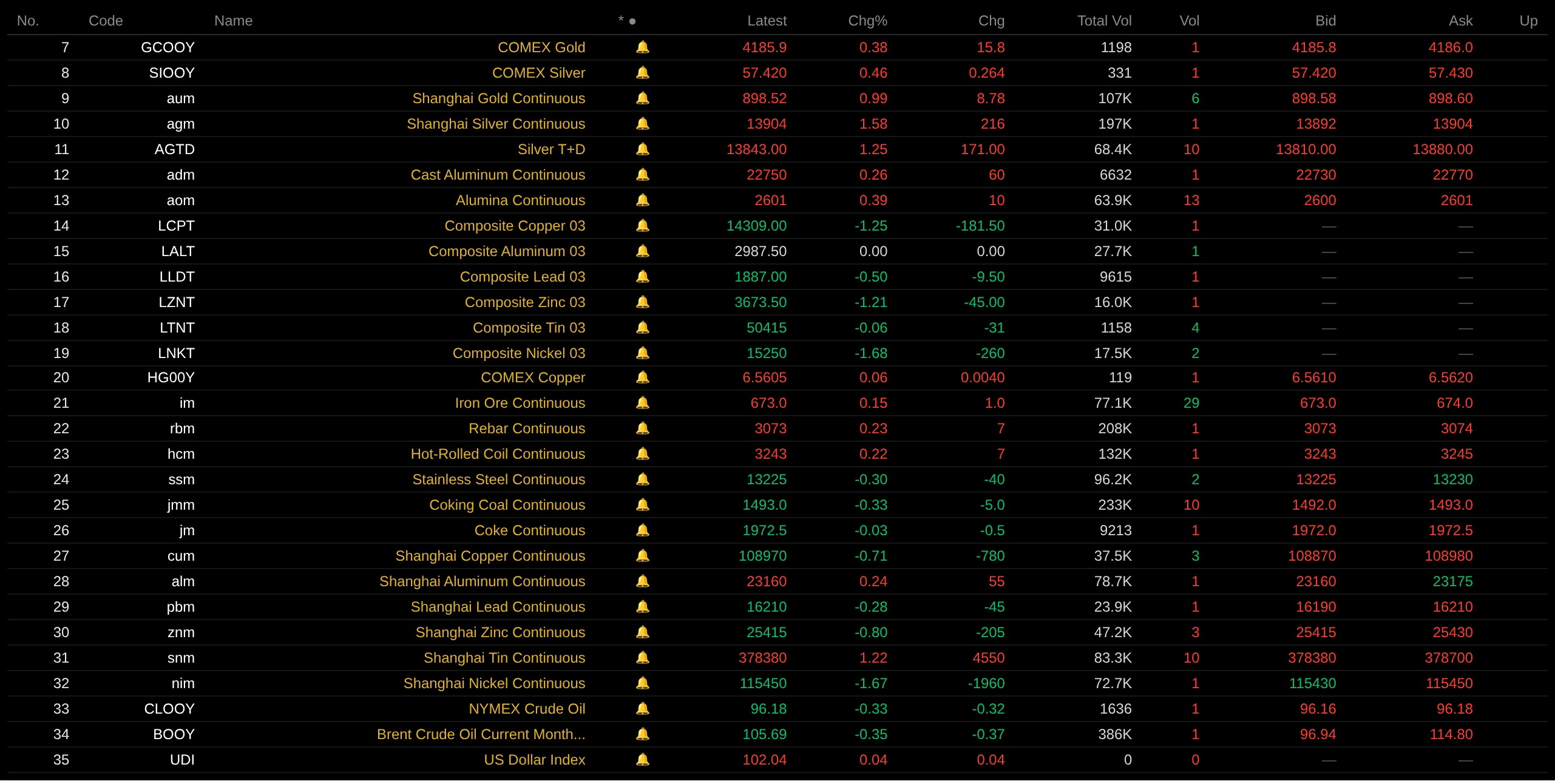
Overnight, base metals on the domestic market fell across the board. SHFE copper fell 0.71%, SHFE aluminum rose 0.24%, and SHFE lead fell 0.28%. SHFE zinc fell 0.8%, and SHFE tin rose 1.22%. SHFE nickel fell 1.67%. In addition, the most-traded alumina futures contract rose 0.39%, and the most-traded casting aluminum contract rose 0.26%.
Overnight, ferrous metals showed mixed performance. Stainless steel fell 0.3%. Iron ore rose 0.15%, and rebar rose 0.23%. Hot-rolled coil rose 0.22%. For coking coal and coke: the most-traded coking coal contract fell 0.33%, and the most-traded coke contract fell 0.03%.
Overnight in the overseas metals market, LME base metals fell nearly across the board. LME copper fell 1.25%, and LME aluminum was flat at $2,987.5/mt. LME lead fell 0.5%. LME zinc fell 1.21%. LME tin fell 0.06%. LME nickel fell 1.68%.
Overnight in the precious metals market: COMEX gold rose 2.06%, and COMEX silver rose 3.09%. Overnight, the most-traded SHFE gold contract rose 0.99%, and the most-traded SHFE silver contract rose 1.58%.
As of 7:09 on October 16, overnight closing prices:
Macro front
Domestic news:
[Lan Fo'an Attends the Third 2026 G20 Finance Ministers and Central Bank Governors Meeting and Holds Multiple Bilateral Meetings] On October 15, 2026, the G20 presidency holder, the US, held the third G20 Finance Ministers and Central Bank Governors Meeting of this year in Bangkok, Thailand. The meeting mainly discussed global macroeconomic conditions, financial sector development, progress on G20 finance track cooperation, and the work outlook. Lan Fo'an said that global economic growth currently faces multiple challenges, and the top priority is to properly address geopolitical conflicts, rising protectionism, and intensifying fragmentation to create a favorable environment for global growth. The G20 should increase certainty through macroeconomic policy coordination, foster new momentum through structural reforms, and enlarge the global economic and trade pie through openness and cooperation, so as to make positive contributions to strong, balanced, sustainable, and inclusive growth of the world economy, and continue to play a leading role in improving global governance and addressing global challenges. G20 discussions on major global economic and financial issues should adhere to the principles of being comprehensive, objective, and balanced. China calls on all parties to uphold the spirit of consensus, fully respect and accommodate each other's legitimate concerns, and jointly support the presidency in hosting a successful G20 Leaders' Summit to achieve balanced and pragmatic outcomes. (Ministry of Finance)
[PBOC Governor Pan Gongsheng Attends G20 Finance Ministers and Central Bank Governors Meeting] Pan Gongsheng pointed out that intensifying geopolitical conflicts remain the greatest uncertainty for the global economy. Sharp fluctuations in government bond markets in some countries and the risk of valuation corrections in AI-related assets have heightened financial vulnerabilities. Modernising financial regulation does not mean loosening regulation, nor should it undermine the stability of the financial system or its ability to withstand risks. All parties should make full use of the G20 finance cooperation platform, strengthen macroeconomic policy coordination, and work together to address global risks and challenges. On global imbalances, all parties should adopt a more comprehensive analytical perspective. We should not look only at the current account; we should also pay attention to financial channels. In particular, as global financial integration deepens, greater attention should be paid to the impact of financial factors such as capital flows on imbalances. Global imbalances cannot be resolved through exchange rate adjustments alone. Exchange rates are affected by many factors, including economic growth, monetary policy, financial markets, geopolitics, and unexpected risk events, and do not have a simple linear relationship with the current account. Deficit and surplus countries should work together to achieve dynamic balance in the global economy. (People's Bank of China)
US dollar:
The US dollar index continued to retreat from its previous 18-month high, falling 0.55% overnight to 101.97.
Kit Juckes, chief FX strategist at Societe Generale, believes the dollar is also being affected by position adjustments. With the dollar having already risen considerably and the market pricing in substantial rate hike expectations, some investors are starting to look for pullback opportunities. (Wall Street CN)
The US producer inflation indicator once again came in well above market expectations, with inflationary pressure continuing to spread to the supply side, further solidifying the Fed's rate hike path. According to data released by the US Bureau of Labor Statistics on Thursday, September PPI rose 6.3% YoY, far exceeding market expectations of 5.4%, the highest level since December 2022; it rose 1.3% MoM, the largest monthly increase since March 2022, also well above the expected 0.6%. The PPI data was released one day after the consumer price index (CPI) report, which also beat expectations, with both reports pointing to stubborn inflationary pressure. Analysts noted that the data will reinforce the stance of Fed officials to continue raising rates in the coming months, especially against the backdrop of persistently climbing energy costs and inflation dominating the November midterm elections. (Wall Street CN)
US September retail sales data looked strong on the surface but concealed underlying concerns - high oil prices boosted the headline reading, but multiple consumer categories contracted over the same period, with the squeeze from inflation spreading to household disposable spending. The US Commerce Department released data on Thursday showing that September retail sales rose 0.8% MoM, above market expectations of 0.3%, with a YoY increase of 6.3%. However, core retail sales excluding autos and gasoline grew only 0.2%, and the "control group" sales, which directly feed into GDP goods consumption calculations, rose just 0.1% MoM, a sharp pullback from August. Meanwhile, data released the same day by the US Bureau of Labor Statistics showed that September producer price gains were the largest in more than four years, further underscoring the persistence of inflationary pressures. (Wall Street CN)
According to CME "Fed Watch": the probability that the US Fed will keep rates unchanged through October is 71.8%, while the probability of a cumulative 25bp hike is 28.2%. The probability that the Fed will keep rates unchanged through December is 7.2%, the probability of a cumulative 25bp hike is 67.4%, and the probability of a cumulative 50bp hike is 25.4%.
Cleveland Fed President Hammack said on Thursday that if the public's inflation expectations deteriorate, the Fed may need to take more aggressive action in response. Hammack said: "My concern is that if an inflationary mindset takes hold, where the public begins to expect price pressures to become increasingly persistent, then monetary policy will find it harder to do its job. If an inflationary mindset has already formed, the Fed may need to act more forcefully."
In other currencies:
ECB Governing Council member Kazaks said that in the face of multiple opposing forces in the global economy, the ECB is in a position to take some time to analyze inflation trends and does not need to take immediate rate action. The Latvian central bank governor said in an interview that continued increases in oil and gas prices are expected to keep consumer price gains elevated, but the sell-off in government bonds in recent weeks could also begin to weigh on economic activity. Kazaks, who is attending the IMF annual meetings in Bangkok, Thailand, said: "My sense is that in the near term, inflationary pressures will still prevail. Therefore, the direction of monetary policy is clear, even if there is no need to rush to adjust rates at this point. We are not behind the curve, and in that sense, we are in a favorable position." Kazaks stressed that upside risks to inflation "remain greater than downside risks to economic growth." However, he noted that threats to economic growth "may exhibit more pronounced nonlinear characteristics." He said: "The trade-offs facing monetary policy will become increasingly tricky. So far, decisions have been relatively easy, but there is a great deal of uncertainty right now, and the predictability of the future is also very low." (Jin10 Data APP)
Data:
Today will see the release of the Eurozone September CPI final annual rate, Eurozone September CPI final monthly rate, Eurozone August seasonally adjusted trade balance, US September import price index monthly rate, US September industrial production monthly rate, and other data. Watch for: 2026 FOMC voting member and Cleveland Fed Chairman Hammack to deliver a speech; Bank of England Governor Bailey to participate in a fireside chat; Fed Chairman Warsh to attend the IMF annual meeting in Bangkok and hold a fireside chat with IMF Managing Director Georgieva; Bank of Canada Governor Macklem to attend the IMF annual meeting and participate in a panel session.
Crude oil:
Overnight, the two major oil futures showed mixed performance, with WTI crude up 2.59% and Brent crude down 0.35%.
WTI crude had two major upward drivers that day: partly due to hurricane-induced production shutdowns in the Gulf of Mexico, US domestic crude inventories unexpectedly fell sharply; reports said the Trump administration is considering easing some sanctions on the "shadow fleet," aiming to increase tanker supply and lower crude transportation costs.Brent was a different story.The settlement price fell 0.13% to $105.92, as news emerged that emergency reserves would be tapped again, partially offsetting supply risks extending from the Strait of Hormuz to the Black Sea. The US had previously persuaded the G7 to release 100 million barrels of crude and diesel reserves, and reached an agreement with Russia on diesel exports. As US crude transportation costs declined, boosting demand, WTI crude and Brent crude have recently diverged.(Wall Street CN)
US crude inventories posted a sharp decline last week, with hurricane-driven production plunges in the Gulf of Mexico the main cause. This better-than-expected inventory report prompted the market to reassess the near-term supply outlook. According to data released Thursday by the US Energy Information Administration (EIA),for the week ended October 9, US commercial crude inventories fell by 8.6 million barrels to 415.6 million barrels, a far larger draw than market expectations.A Reuters survey of analysts had shown the market widely expected inventories to edge down by just 288,000 barrels. After Wednesday's US stock market close, data from the American Petroleum Institute (API) showed that last week, US API crude inventories plunged by 11.123 million barrels.The sharp drawdown in crude inventories was mainly driven by production shutdowns and lower imports amid the hurricane impact. Meanwhile, gasoline inventories unexpectedly climbed, while distillate inventories tightened further. (Wall Street CN)
According to RIA Novosti, Russian Deputy Prime Minister Novak said in an interview with reporters during the "Russian Energy Week" forum that Russian oil companies are ready to begin diesel exports, but all necessary procedures will take two to three weeks. Currently, all parties are negotiating commercial contracts for Russia to supply diesel to the US and global markets. He said: "To achieve supply, it is necessary to sign contracts, load fuel, charter vessels, and arrange shipments. The entire process takes two to three weeks. Therefore, it is now necessary to reach an agreement as soon as possible... Russian enterprises are already prepared for loading and can ship at any time immediately." The Russian Energy Week international forum was held in Moscow from October 14 to 16. (Jin10 Data APP)
![[Mingyi Electronics Launches High-Aspect-Ratio Gantry Line Electroplating Equipment for AI Servers and IC Substrates]](https://imgqn.smm.cn/usercenter/CaDcj20251217171711.jpg)
![[Li Auto's Chip Unit Secures $230M, Eyes $2.4B Valuation with Further Investment]](https://imgqn.smm.cn/usercenter/qopTu20251217171736.jpg)
![Supply-side support lends some strength, SHFE zinc rebounds slightly [SMM zinc futures review]](https://imgqn.smm.cn/usercenter/oTrxc20251217171755.jpg)