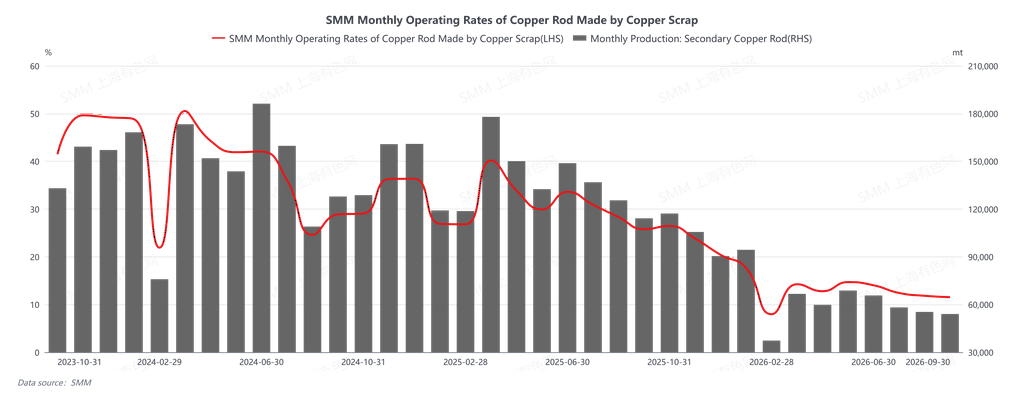
The operating rate of secondary copper rod stood at 11.55% in September 2026, below the expected 13.06%, down 0.28 percentage points MoM and down 14.23 percentage points YoY. Throughout the month, the most-traded SHFE copper contract broke through the 110,000 yuan/mt mark, with the copper price center shifting notably higher from August and swinging wildly. The average price spread between copper cathode rod and secondary copper rod swung sharply within 766-2,114 yuan/mt. Secondary copper rod quotes in Jiangxi against copper futures repeatedly switched between a premium of 153 yuan/mt and a discount of 898 yuan/mt. Average gross profit margins fluctuated within 493-1,113 yuan/mt. Book profits appeared moderate, but actual operating pressure remained high. The month was characterized by high price spread volatility, persistently low operating rates, pulsed transactions, and failed stockpiling.
On the supply side, the copper scrap market remained structurally tight. The underlying constraint was stricter enforcement of reverse invoicing, which led local authorities to tighten control over the reverse invoicing business volume of scrap utilization enterprises. Domestic tax-exclusive supply struggled to circulate at scale due to inconsistent standards, while compliant tax-inclusive raw materials remained persistently scarce, with tax-inclusive invoice tax rates exceeding 13% and domestic social inventory staying low. On the import side, China's copper scrap imports reached 177,400 mt in August, down 19.04% MoM. Overseas payable indicators were near the upper limit acceptable to downstream buyers amid tight supply, providing limited relief from import growth. Supplier selling was highly sensitive to copper prices: when copper prices shot up, suppliers took the opportunity to sell off, creating temporary supply abundance; after inventories were digested and prices pulled back, they shifted to holding back from selling and holding prices firm. Raw material prices exhibited a strange pattern of lagging on the way up and following on the way down—rising only modestly when copper prices climbed, yet falling in tandem when prices retreated from highs. This led to high-cost inventory buildup and difficulty in expanding shipment volumes. Invoice issues stemming from reverse invoicing erupted before the dual holidays, as suppliers were unable to resolve invoicing, leaving scrap utilization enterprises with extremely limited procurement volumes. The supply side fell into a deadlock of having goods but struggling to sell, high-cost inventory buildup, and invoice constraints hampering circulation.
On the demand side, September peak-season stockpiling demand did kick off, with rod enterprise orders and restocking willingness improving from August. The price spread between copper cathode rod and secondary copper rod once widened to 2,200-2,590 yuan/mt, driving hot sales of secondary copper rod, with some enterprises requiring production scheduling for new orders. However, the procurement sentiment index remained at a low 1.68-2.03, with buying limited to essential restocking and bargain hunting, favoring quick payment in exchange for supply priority. Rising copper prices pushed up raw material costs, and elevated tax-inclusive invoice tax rates kept raw material costs high. Rod enterprises faced cost pressure on hand, and once costs hit their limits, they quickly turned cautious, reducing order intake as transactions cooled from hot to cold. When copper prices pulled back to around 107,000 yuan/mt, restocking willingness recovered, but low raw material inventory and firm pricing shifted finished rod quotes against futures from discounts to premiums, compressing the cathode-scrap rod price spread to an uneconomical 300-1,000 yuan/mt range, with weak end-user procurement. As the month-end long holiday approached, copper prices broke above 110,000 yuan/mt again, prompting rod enterprises to purchase cautiously and wait for prices to fall back below 110,000 yuan/mt before acting. Invoice constraints effectively derailed stockpiling, with many enterprises holding pre-holiday raw material inventories insufficient to sustain holiday production. Some had to arrange worker holidays and indicated that insufficient procurement would extend the break. End-user wire and cable enterprises demanded delivery during the National Day holiday, while rod enterprises preferred post-holiday shipments, with the mismatch in upstream and downstream demands suppressing transactions. Third-party surveys showed that over 70% of secondary copper rod enterprises had zero stockpiling before the holiday, and nearly half of capacity was idled. The number of enterprises taking the full 7-day holiday increased notably YoY. This year's National Day period presented a pattern of divergence in primary production and collapse in secondary production, with copper cathode rod enterprises averaging only 4.4 days off, while sampled secondary copper rod producers generally extended shutdowns to 7 days.
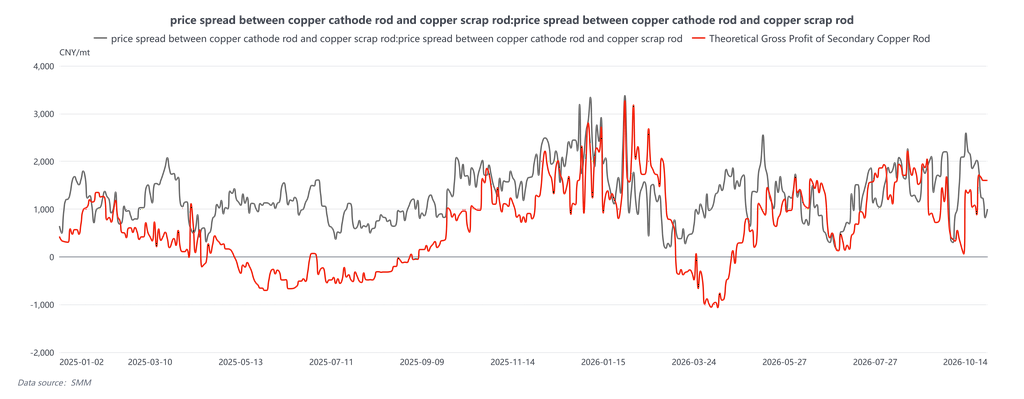
Overall, the core contradiction in September has shifted from "copper price levels" to "the combined suppression of physical demand by high costs, invoice tax rates, and invoice constraints": price spread dividends have been eroded by tax and raw material costs, leaving rod producers with no choice but to push for lower prices and pick up bargains only for rigid demand. Peak-season and pre-holiday stockpiling failed to be effectively released, and the market fell into a weak equilibrium marked by suppliers holding prices firm and holding back from selling, rod producers waiting on the sidelines for lower prices, low operating rates, pulsed transactions, and stalled stockpiling. Looking ahead to October, if copper prices pull back below 110,000 to release restocking demand, reverse invoicing rules become clear, and the invoice shortage eases marginally, liquidity for compliant supply is expected to improve and transactions may rebound marginally. However, before high copper prices and invoice constraints are resolved, the market will continue to see inflated price spreads, wait-and-see sentiment among rod producers, and sluggish transactions. The dilemma of "having orders but no invoices" will be difficult to resolve in the short term, and a genuine recovery in physical consumption still requires copper prices to correct to downstream psychological price levels, or a substantial decline in invoice costs to rebuild a reasonable profit margin for rod producers.