SMM News on October 14:
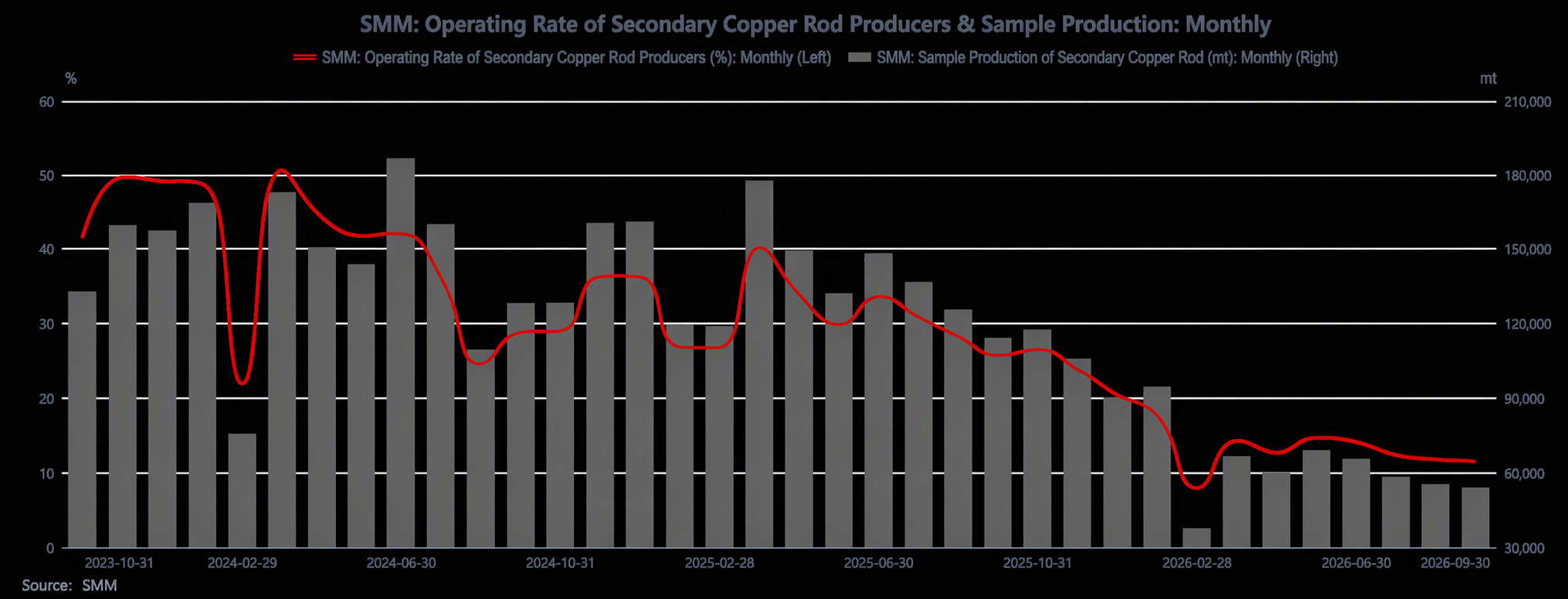
In September 2026, the operating rate of secondary copper rod was 11.55%, below the expected 13.06%, down 0.28 percentage points MoM and down 14.23 percentage points YoY. Throughout the month, the most-traded SHFE copper contract broke above the 110,000 yuan/mt threshold. The center of copper prices moved up markedly from August and swung wildly. The average price difference between copper cathode rod and secondary copper rod fluctuated sharply between 766-2,114 yuan/mt. Quotations for secondary copper rod in Jiangxi against futures repeatedly switched between a premium of 153 yuan/mt and a discount of 898 yuan/mt. The average gross sales margin fluctuated in the 493-1,113 yuan/mt range. While book profits appeared moderate, actual operating pressure stayed high. Overall, the month was characterized by “high-level volatility in the price difference, persistently low operating rates, pulse-like transactions, and failed stockpiling.”
From the supply side, the copper scrap market remained structurally tight. The underlying constraint was tighter enforcement of reverse invoicing, followed by local controls on the volume of “reverse invoicing” business for scrap utilization enterprises. Domestic tax-exclusive supply was difficult to circulate on a large scale due to inconsistent standards, while compliant tax-inclusive raw materials remained in persistent shortage. The invoice tax rate for tax-inclusive materials has exceeded 13%, and China’s social inventory was low. On the import supplement side, China’s copper scrap imports in August were 177,400 mt, down 19.04% MoM. Outside China, the payable indicator was close to the upper limit acceptable to downstream buyers and supply was tight, so incremental imports provided limited relief. Supplier shipments were highly sensitive to copper prices: when copper prices shot up, suppliers took the opportunity to sell, and supply was once ample; after inventory was digested, during the pullback phase they shifted to holding back from selling and holding prices firm. Raw material prices showed the anomalous pattern of “following declines but not rises”—they rose only slightly when copper prices rose, but instead followed declines and adjusted downward when prices retreated from highs—resulting in a buildup of high-priced inventory and difficulty scaling up shipments. Invoice issues brought by reverse invoicing erupted ahead of the Mid-Autumn Festival and National Day holidays. As suppliers were unable to resolve invoicing, scrap utilization enterprises’ procurement volume was extremely limited, and the supply side fell into a stalemate of “goods available but hard to sell, high-priced inventory piling up, and invoices constraining circulation.”
From the demand side, stockpiling demand for the September peak season did start. Rod enterprises’ orders and willingness to restock improved from August, and the price difference between copper cathode rod and secondary copper rod once widened to 2,200-2,590 yuan/mt. Secondary copper rod sales were brisk, and some enterprises needed to arrange production schedules to take orders. However, the procurement sentiment index remained at a low 1.68-2.03, with activity mainly driven by restocking for rigid demand and bargain-hunting on dips, and a preference for securing supply priority through fast payment. A copper price rally pushed up raw material costs, and the persistently high invoice tax rate kept raw material costs elevated. Rod enterprises’ landed costs were under pressure; after hitting the limit, they quickly shifted to a wait-and-see stance, order-taking volumes fell, and transactions turned from hot to cold. When copper prices pulled back to around 107,000, willingness to restock recovered, but low raw material inventory and firm pricing shifted finished rod against futures from a discount to a premium. The price difference between copper cathode rod and secondary copper rod was compressed to a non-economic range of 300-1,000 yuan/mt, and end-user procurement was weak. With the month-end long holiday approaching, copper prices broke above 110,000 again, prompting rod enterprises to purchase cautiously and wait for a pullback below 110,000 before acting. Invoice constraints left stockpiling effectively unfulfilled, and many enterprises' pre-holiday raw material inventories could not even meet holiday production needs, forcing them to arrange worker holidays and indicating that insufficient procurement would extend the break. End-user wire and cable enterprises requested delivery during the National Day holiday, while rod enterprises preferred to ship after the holiday, and the mismatch in upstream and downstream demands suppressed transactions. Third-party surveys showed that before the holiday, over 70% of secondary copper rod enterprises had zero stockpiling, nearly half of capacity was idled, and the number of enterprises taking a full 7-day holiday increased significantly YoY. This year's National Day presented a pattern of "divergence in the primary segment, collapse in the secondary segment," with copper cathode rod enterprises averaging only 4.4 days of holiday while secondary copper rod producers generally extended shutdowns to 7 days.
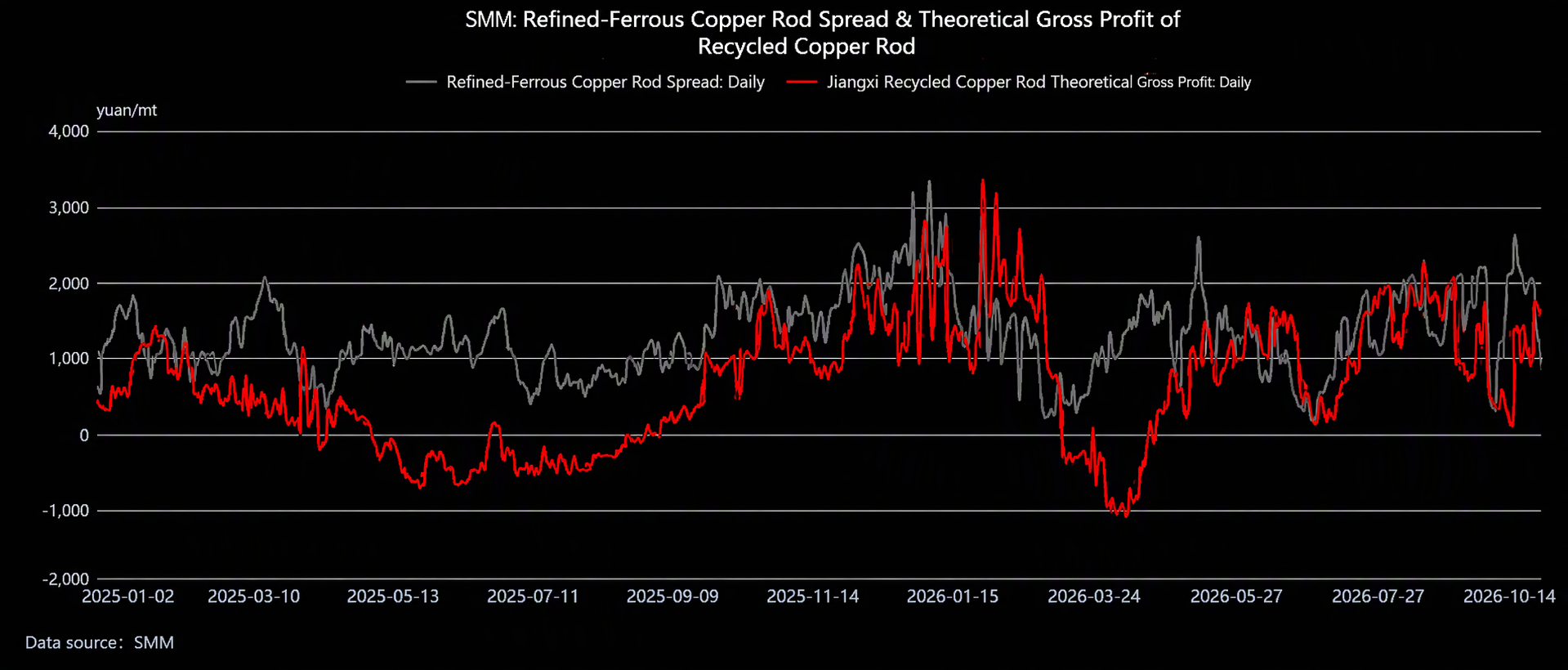
Overall, the core contradiction in September shifted from "copper price levels" to "the combined suppression of physical demand by high-cost pricing, invoice tax rates, and invoice constraints": price spread advantages were eroded by tax and raw material costs, leaving rod enterprises with no choice but to push for lower prices and make rigid-demand bargain purchases. Peak-season and pre-holiday stockpiling failed to be effectively released, and the market fell into a weak equilibrium of "suppliers holding prices firm and holding back from selling, rod enterprises waiting on the sidelines for declines, low operating rates, pulsed transactions, and stalled stockpiling." Looking ahead to October, if copper prices pull back below 110,000 to release restocking demand, reverse invoicing rules are clarified, and the invoice shortage marginally eases, liquidity for compliant cargoes is expected to improve and transactions may rebound marginally. However, before high copper prices and invoice constraints are resolved, the market will continue to exhibit a pattern of "inflated price spreads, rod enterprises on the sidelines, and sluggish transactions," with the "orders without invoices" dilemma unlikely to ease in the short term. A genuine recovery in physical consumption still requires copper prices to pull back to downstream psychological price levels, or a substantial decline in invoice costs to rebuild reasonable profit margins for rod enterprises.