Recently, the world's first ship-to-ship bunkering of green ammonia fuel was completed at an anchorage in Zhoushan, Zhejiang. A total of 1,000 mt of green ammonia from China Energy Engineering Corporation's "Qingqing No. 1" Songyuan Hydrogen Energy Industrial Park project was bunkered via the dedicated liquid ammonia bunkering vessel "Shenghang Yongle" to an ammonia-powered ship under Belgium's CMB.TECH, completing the full chain of "wind and solar power-based green hydrogen production—green ammonia synthesis—storage and transport—ship bunkering" and marking the first sale of China-produced green ammonia for ocean-going shipping.
Phase I of the Songyuan project began production in December 2025 and obtained ISCC EU green certification upon commissioning, qualifying it for access to the EU shipping market. This stands in contrast to the inefficiency of earlier vehicle-end demonstrations. Over the past few years, fuel cell commercial vehicles have been trapped in a negative cycle of "few vehicles—few stations—low willingness," with projects largely sustained by local subsidies and shelved once subsidies were withdrawn. Capital contraction became pronounced in 2026: Aerospace Engineering's subsidiary Aerospace Hydrogen Energy reduced its registered capital, and Xiongtao Co., Ltd. terminated its Shenzhen fuel cell industrial park fundraising project—both signals of capacity bubble clearing in the equipment sector. The core yardstick for capital evaluation of projects has shifted from electrolyzer capacity planning to long-term green electricity agreements and downstream offtake contracts.
The crux lies in storage and transport. Gaseous and liquid hydrogen storage and transport entail high energy consumption and investment, with storage and transport costs accounting for approximately 30%–40% of end-user hydrogen costs, making long-distance cross-regional direct hydrogen delivery economically unviable. Converting surplus wind and solar power into hydrogen on-site and then into carriers such as ammonia that are easier to store and transport has become a viable pathway at this stage. Ammonia storage and transport technology is mature, liquefaction can be achieved at ambient temperature under pressure, existing chemical storage tanks and shipping facilities can be reused, hydrogen storage density is high, and it suits the 10 kt-scale continuous demand of ocean-going shipping. However, controversy remains: ammonia is toxic, and its combustion produces nitrogen oxides that require tail-gas treatment, raising retrofit and operation and maintenance costs; carrier conversion entails energy losses that must be covered by carbon value premiums; and green methanol, liquid hydrogen, and other routes each have their own suitable scenarios—ammonia is not the only answer. Resource and market mismatches persist—wind and solar resources are concentrated in the northeast and northwest, while shipping demand is along the southeast coast. This operation adopted a "northeast ammonia production + road transport + port storage tanks + offshore bunkering" model, but the energy consumption, safety, and logistics costs of road transport of liquid ammonia remain under long-term pressure.
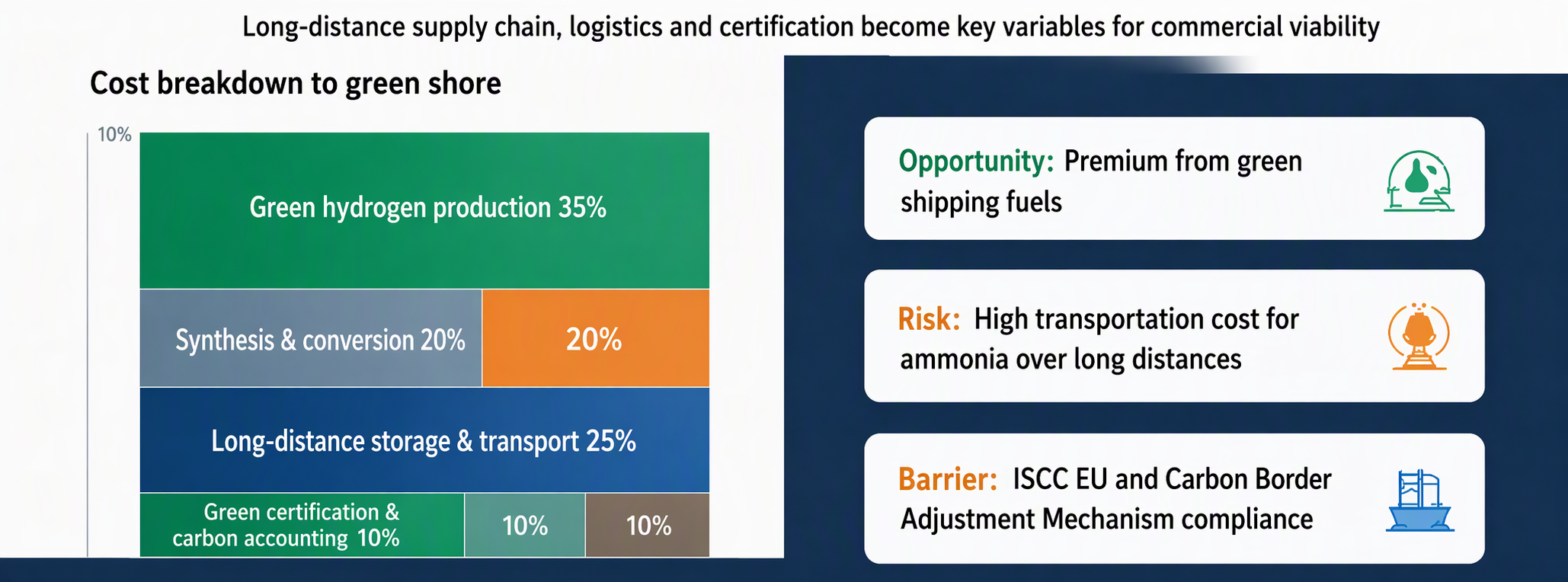
Two major constraints cannot be avoided. The first is green certification barriers. The EU CBAM and green product standards continue to tighten, overseas buyers impose stringent carbon footprint traceability requirements, and China's carbon accounting system is not fully compatible with EU rules. Export enterprises must continuously bear the costs of third-party certification and full life cycle verification, and the green commodity market will evolve into a "label game." The second is greenwashing regulation. In March 2026, the Ministry of Industry and Information Technology (MIIT), the Ministry of Finance, and the National Development and Reform Commission (NDRC) jointly launched a comprehensive hydrogen energy application pilot program, drawing a red line—coal-based ammonia and methanol projects are strictly prohibited from being built under the guise of green ammonia and methanol. Coal-based ammonia capacity is enormous and low-cost, creating incentives to package and pass it off as green ammonia to capture premiums; the mechanism for stably transmitting the carbon reduction benefits of green hydrogen-based ammonia and methanol upstream has yet to be established.
This round of adjustment is essentially the clearing of inefficient projects rather than the collapse of the sector. Fuel cell vehicle demand is fragmented, per-unit investment is high, and the commercialization cycle is long; green ammonia and hydrogen-based metallurgy target steel, chemicals, and shipping, where downstream demand is continuous and stable at the mt scale, making it easier to form a closed loop of "wind and solar power—hydrogen production—products—long-term offtake sales." However, the 2030 targets of 4 million mt of green hydrogen and 10 million mt-scale green ammonia and methanol cannot be supported by wind and solar installations alone. The greatest risks remain idle capacity—"produced but unsellable"—and the disruption of regional power supply and demand and electricity costs by large-scale electrolytic hydrogen production.
The Zhoushan bunkering operation demonstrated the full-chain feasibility of green ammonia as a hydrogen carrier, with cross-regional supply and ocean-going application, opening up space for China-produced green ammonia to go global. However, the commercialization prospects should not be overestimated: safety and tail-gas treatment, long-distance logistics costs, international certification barriers, carbon benefit transmission, and greenwashing risks are all hard constraints before scaling up. Hydrogen energy has moved past comprehensive expansion into a phase of differentiation, where integrated projects, long-term offtake agreements, and credible carbon footprint certification will become the core variables of enterprise competitiveness. Green ammonia is not a panacea, but it is one of the most mature pathways for hydrogen energy to move from the laboratory to the global commodity market at this stage.