Recently, the world’s first ship-to-ship bunkering of green ammonia fuel was completed at the anchorage in Zhoushan, Zhejiang Province. A cargo of 1,000 tonnes of green ammonia sourced from China Energy Engineering’s Qing Hydrogen No.1 Songyuan Hydrogen Energy Industrial Park was bunkered via the dedicated liquid ammonia bunkering vessel Shenghang Yongle to an ammonia-powered ship owned by Belgium’s CMB.TECH. This milestone has unlocked the full industrial chain of “wind & solar power for green hydrogen production – green ammonia synthesis – storage & transportation – ship bunkering”, marking China’s maiden overseas sale of green ammonia for ocean-going shipping.
Phase I of the Songyuan project came online in December 2025. Upon commissioning, it obtained ISCC EU sustainability certification, granting eligibility to access the EU shipping decarbonization market. This stands in stark contrast to the inefficiencies seen in previous fuel cell vehicle demonstrations. Over the past few years, fuel cell commercial vehicles have been trapped in a vicious cycle: low vehicle uptake leads to poor return on investment for hydrogen refueling stations, discouraging infrastructure development; insufficient infrastructure in turn limits vehicle deployment. Most projects relied on local subsidies and were suspended once subsidies tapered off. Capital contraction has been prominent in 2026: Aerospace Hydrogen Energy, a subsidiary of Aerospace Engineering, reduced its registered capital, and Xiongtao Co., Ltd. scrapped the fundraising plan for its Shenzhen hydrogen fuel cell industrial park. These developments signal the bursting of equipment capacity bubbles. Investors now evaluate projects based primarily on long-term green power purchase agreements and downstream offtake contracts, rather than electrolyzer capacity blueprints.
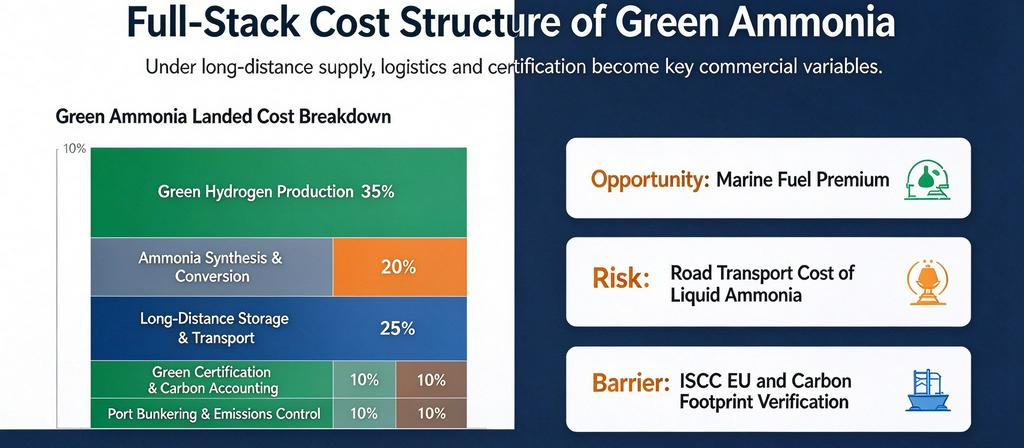
The core bottleneck lies in storage and transportation. Compressed gaseous hydrogen and cryogenic liquid hydrogen both entail high energy consumption and capital expenditure, with storage and transportation accounting for 30%–40% of the end-user cost of green hydrogen. Direct long-distance cross-regional hydrogen delivery is economically unviable. A viable pathway at this stage is to produce green hydrogen locally using surplus wind and solar power, then convert hydrogen into ammonia or other easily transportable carriers. Ammonia benefits from mature storage and transportation technology; it can be liquefied under ambient temperature and moderate pressure, and existing chemical storage tanks and marine vessels can be retrofitted for use. Its high volumetric hydrogen storage capacity makes it well-suited for the steady, large-scale demand of ocean shipping. Nevertheless, controversies persist. Ammonia is toxic, and its combustion generates nitrogen oxides, requiring exhaust treatment systems that raise vessel retrofitting and operational costs. Energy losses occur during hydrogen-to-ammonia conversion, which must be offset by carbon value premiums. Green methanol, liquid hydrogen and other carriers each fit specific scenarios, meaning ammonia is not the sole solution. A mismatch between resource endowment and market demand remains: wind and solar resources are concentrated in Northeast and Northwest China, while shipping demand clusters in southeast coastal ports. The current model of “ammonia production in Northeast China + road transportation + port storage + offshore bunkering” carries persistent energy, safety and logistics costs for liquid ammonia road haulage, which need to be reduced over time.
Two non-negotiable constraints exist. First, barriers to green certification. The EU CBAM and green product standards keep tightening, and overseas buyers impose strict traceability requirements for carbon footprints. China’s domestic carbon accounting framework is not fully compatible with EU rules. Exporters must continuously bear costs for third-party certification and full life-cycle carbon verification, turning the global green commodity market into a “label game”. Second, regulation against greenwashing. In March 2026, MIIT, MOF and NDRC jointly launched the comprehensive hydrogen energy pilot programme and set a clear red line: coal-based ammonia and methanol capacity shall not be built under the guise of green ammonia/methanol projects. Coal-to-ammonia capacity is large and low-cost, creating incentives for producers to disguise coal-derived ammonia as green ammonia to capture green premiums. A mechanism to reliably pass carbon emission reduction benefits from green hydrogen and ammonia projects upstream has yet to be fully established.
The ongoing industry adjustment is a shakeout of low-efficiency projects rather than a collapse of the hydrogen sector. Fuel cell vehicles face fragmented demand, high per-unit capital outlay and a lengthy commercialization timeline. By contrast, green ammonia and hydrogen metallurgy serve steel, chemicals and ocean shipping sectors with continuous, stable tonne-scale downstream demand, making it easier to form closed-loop business models: “wind & solar power – hydrogen production – finished products – long-term offtake sales”. Even so, the industry target of 4 million tonnes of green hydrogen and 10 million tonnes of combined green ammonia and methanol capacity by 2030 cannot be achieved by renewable buildout alone. The greatest risk remains idle capacity, where products can be manufactured but not sold, alongside potential disruptions to regional power supply-demand balances and rising electricity costs triggered by large-scale electrolyser deployment.
The Zhoushan bunkering demonstration proves the technical feasibility of the full value chain for green ammonia as a hydrogen carrier, with cross-regional supply and ocean end-use, opening opportunities for China’s green ammonia exports. Yet near-term commercial potential should not be overestimated: safety and exhaust treatment, long-haul logistics costs, international certification barriers, carbon benefit transmission and greenwashing risks represent hard constraints before large-scale rollout. Hydrogen energy has exited the era of broad-based expansion and entered a phase of differentiated development. Integrated projects, long-term offtake agreements and credible carbon footprint certification will become core determinants of corporate competitiveness. Green ammonia is not a universal decarbonization panacea, but it is one of the most mature pathways for hydrogen to move beyond laboratory trials and enter global commodity markets at present.
![[SMM Analysis] Green Ammonia Goes Global: Hydrogen Narrative Shifts from Vehicles to Bulk Carriers](https://imgqn.smm.cn/usercenter/BmqWy20251217171726.jpg)