Key points: The solid-state battery investment clock has five stages: in the concept stage, watch cash, R&D, and the main business; in the pilot stage, watch equipment tenders, delivery, and yield; in the verification stage, watch lithium sulfide supply and demand (830 mt to 8,000 mt); in the mass production stage, watch costs (400-500 million to 200-300 million yuan/GWh), where involution risk is highest; in the endgame stage, watch patents and share (500 GWh, 400 billion yuan). Keep a close eye on tenders, lithium sulfide, and yield.
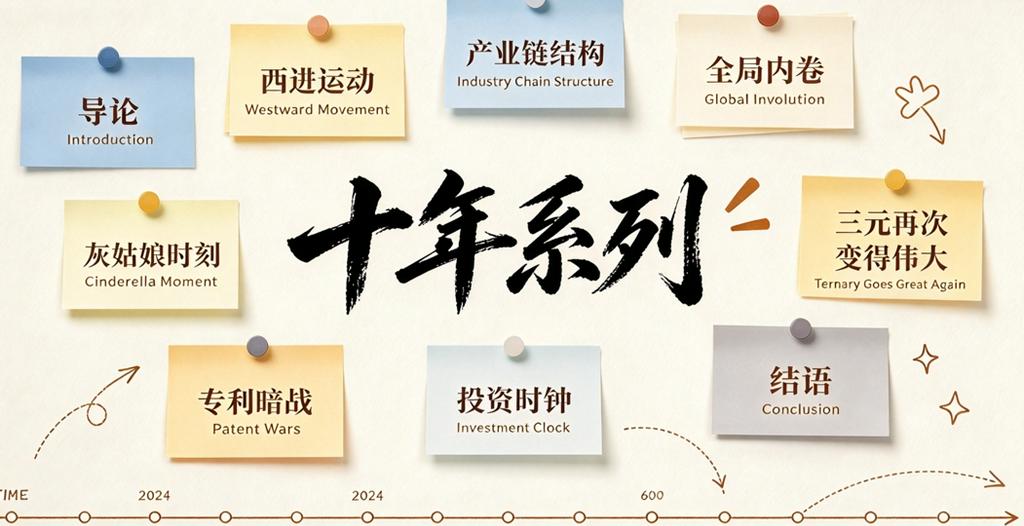
SMM recently reviewed the future of solid-state batteries and compiled it into a ten-year series. Using the current development of the lithium battery industry as a reference, especially the intertwined love-hate relationship between the LFP and ternary routes, an epic chapter has unfolded over the years. In the long river of conventional liquid lithium batteries, solid-liquid hybrid and all-solid-state batteries will take the stage, outlining a new generation of high-specific-energy battery world.
The ten-year series will be divided into nine parts: introduction, westward movement, industry chain structure, industry-wide involution, Cinderella moment, ternary becoming great again, patent shadow war, investment clock, and conclusion.
Introduction: Dreams will surely shine into reality: Why we need to re-understand the industrial logic of solid-state batteries - the gap between ideal and reality, and the result is that dreams shine into reality
Part 1: Will it replicate the westward movement of liquid batteries: The logic of concentration in the west - will solid-state batteries replicate the "westward movement" of liquid lithium batteries?
Part 2: A good opportunity to reverse the distorted power structure of the industry chain: Industry chain power structure - upstream windfall profits, midstream under pressure, downstream delayed payments?
Part 3: Warning of PV-style industry-wide involution: Will solid-state batteries enter PV-style industry-wide involution?
Part 4: Cinderella's comeback in technology routes: The "Cinderella moment" of solid-state batteries - which technology route will follow the comeback path of LFP?
Part 5: Ternary may become great again: Can ternary batteries become "great again" with the help of solid-state batteries?
Part 6: Global competitive landscape - the "patent shadow war" and industrialisation race among China, Japan, and South Korea
Part 7: Entering the field early will let you see yourself ten years later: Investment clock - the "five-stage model" of solid-state battery industrialisation
Conclusion: A brand-new track: Solid-state batteries are not a "simple sequel" to liquid lithium batteries
This is the eighth of nine articles in the ten-year solid-state battery series: See yourself ten years later - the investment clock "five-stage model." The five stages of the solid-state battery investment clock (2024-2035): in the concept stage, watch cash, R&D, and the main business, and guard against concept speculation; in the pilot stage, watch equipment tenders, delivery, and yield, with equipment value 2-3 times that of liquid batteries; in the verification stage, watch lithium sulfide supply and demand, whether 830 mt can be expanded to 8,000 mt, with solid-liquid hybrid leading the way; in the mass production stage, watch costs fall from 400-500 million yuan/GWh to 200-300 million yuan/GWh, where involution risk is highest; in the endgame stage, watch patents and global share, with shipments of 500 GWh and a market of 400 billion yuan. Keep a close eye on equipment tenders, lithium sulfide capacity, and yield breakthroughs. Summary: concept stage watches money, pilot stage watches equipment, verification stage watches materials, mass production stage watches costs, endgame stage watches patents and share. The biggest variable is when technology routes will converge.
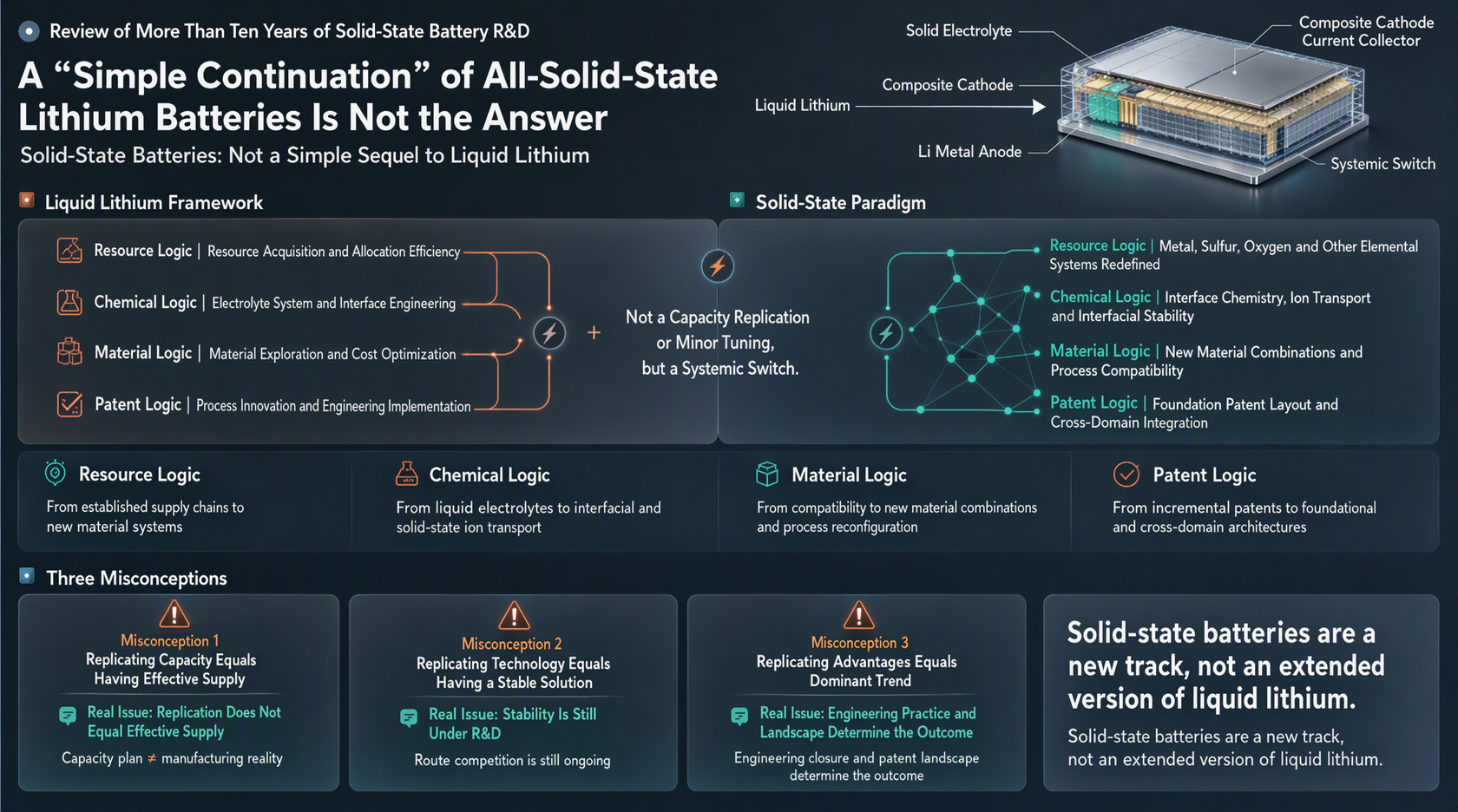
This is the ninth of nine articles in the ten-year solid-state battery series. Solid-state batteries are a brand-new track, not a "simple sequel" to liquid lithium batteries. Five major reasons, six discontinuities.
Review of the previous article: The eighth of nine articles in the ten-year solid-state battery series: See yourself ten years later - the investment clock "five-stage model" . The five stages of the solid-state battery investment clock (2024-2035): in the concept stage, watch cash, R&D, and the main business, and guard against concept speculation; in the pilot stage, watch equipment tenders, delivery, and yield, with equipment value 2-3 times that of liquid batteries; in the verification stage, watch lithium sulfide supply and demand, whether 830 mt can be expanded to 8,000 mt, with solid-liquid hybrid leading the way; in the mass production stage, watch costs fall from 400-500 million yuan/GWh to 200-300 million yuan/GWh, where involution risk is highest; in the endgame stage, watch patents and global share, with shipments of 500 GWh and a market of 400 billion yuan. Keep a close eye on equipment tenders, lithium sulfide capacity, and yield breakthroughs. Summary: concept stage watches money, pilot stage watches equipment, verification stage watches materials, mass production stage watches costs, endgame stage watches patents and share. The biggest variable is when technology routes will converge.
I. Why it is not a "simple sequel": Five major reasons
1. The industrial geography has changed: from “resource-oriented” to “chemical park-oriented”
The industrial geography of liquid lithium batteries has largely developed around resource origins such as lithium, nickel, cobalt, and phosphorus, as well as cathode material clusters. Solid-state batteries, by contrast, are more “chemical park-oriented”: key materials such as lithium sulphide, sulphide electrolytes, and oxide electrolytes demand far more from chemical synthesis capabilities, dry environments, solvent recovery, and safety control than traditional lithium batteries.
This means that competition in solid-state batteries is not just about “who has lithium mines”, but about “who has a chemical foundation, who has engineering capabilities, and who can replicate dry-environment infrastructure”.
2. The power structure of the industry chain has changed: material enterprises have gained a stronger voice
In liquid lithium batteries, leading battery cell makers and resource enterprises hold strong bargaining power. But in solid-state batteries, lithium sulphide accounts for as much as 70%-80% of costs, and technological breakthroughs on the materials side directly determine battery cost, yield, and performance.
As a result, power in the industry chain will tilt towards technology-intensive material enterprises. If battery cell enterprises only focus on “integration” without binding themselves to materials, processes, and patents, they can easily be “choked” by upstream material enterprises. This is a very different power structure from that of liquid lithium batteries.
3. The risk of involution is buffered by “dual protection”: unconverged technology routes + high capital thresholds
Involution in liquid lithium batteries often stems from rapid capacity expansion and quickly spreading price wars. Solid-state batteries are currently protected by two factors: first, technology routes have not yet converged, with oxide, sulphide, polymer, and other routes each having their supporters; second, capital thresholds are extremely high, with equipment investment per GWh at about 500 million to 1 billion yuan, and even 1.5 billion yuan for some technology routes, far higher than for traditional lithium batteries.
But this does not mean there is no risk. Once routes converge, capital will quickly concentrate, and capacity expansion may shift from “not daring to invest” to “rushing to invest”, at which point involution will emerge in an even more intense form.
4. Technology route competition looks more like a “differentiated landscape” than “single substitution”
“Oxide is like LFP, sulphide is like ternary” is an instructive analogy, but it cannot be taken as absolute. It suggests that solid-state batteries may not be dominated by a single route; instead, different routes involve trade-offs in energy density, cost, safety, and cycle life, forming layered competition.
If this judgement holds, then the solid-state battery era will not have just “one CATL”, but may see multiple segment champions emerge across different routes and different application scenarios.
5. Global competition has gained a “patent encirclement” variable
In the liquid lithium battery era, China has clear advantages in engineering, industry chain completeness, and market size. In the solid-state battery era, Japan and South Korea have deep accumulation in sulphide electrolytes and patent layouts, which may form a patent encirclement.
This means that global competition in solid-state batteries is not simply a "capacity race," but a multidimensional battle involving "patents + chemical engineering + equipment + standards." Chinese enterprises need to find independent routes without infringing on patents, or break through via cross-licensing and collaborative development.
II. Overview of Characteristics: The "Six Discontinuities" of Solid-State Batteries
Discontinuity in industry attributes: It is more akin to a new chemical materials industry than to traditional lithium battery manufacturing.
Discontinuity in value distribution: The voice of material suppliers is rising, with lithium sulfide accounting for 70%-80% of costs.
Discontinuity in competitive pace: Before technology routes converge, it is a period of "letting a hundred flowers bloom"; after convergence, it may become "winner takes all."
Discontinuity in the investment clock: It is not smooth capacity expansion, but stepwise investment driven by bottleneck breakthroughs.
Discontinuity in the global landscape: Patent encirclement by Japan and South Korea has escalated competition from a capacity war to a patent war and a standards war.
Discontinuity in the risk structure: The greatest risk is not insufficient demand, but betting on the wrong route, failure in yield ramp-up, and patent restrictions.
III. Several Judgments and Views
First, the investment logic for solid-state batteries should shift from "capacity expansion" to "bottleneck breakthroughs."
830 mt of lithium sulfide, a 60-70% pilot yield rate, equipment investment of 1 billion yuan/GWh, and lithium sulfide accounting for 70%-80% of costs—these are the key anchors. Planned capacity does not equal effective capacity, and announced expansion does not mean yield targets have been met.
Second, the timing of technology route convergence is the biggest watershed.
Before convergence, all positioning carries the nature of a "bet"; after convergence, the industry will rapidly shift from "letting a hundred flowers bloom" to "winner takes all." This moment will determine who becomes the CATL of the solid-state battery era, who becomes the BYD of the solid-state battery era, and who becomes the "LFP" of the solid-state battery era.
Third, the valuation framework for liquid lithium batteries cannot be applied to solid-state batteries.
For liquid lithium batteries, the focus is on capacity, clients, and cost curves; for solid-state batteries, greater attention must be paid to material patents, chemical processes, the ability to replicate dry-room environments, yield ramp-up speed, and route positioning. It is more like a composite competition of "materials science + chemical engineering + precision manufacturing."
Conclusion
Solid-state batteries are not a "simple sequel" to liquid lithium batteries. In terms of industrial geography, they are more oriented toward chemical industrial parks; in terms of power structure along the industry chain, they are more favorable to technology-intensive material enterprises; in terms of involution risk, they are protected by both unconverged technology routes and high capital thresholds; in terms of technology route competition, they are more likely to reproduce a fragmented landscape; and in global competition, they face the unique challenge of patent encirclement by Japan and South Korea.
Understanding these differences is the fundamental premise for judging the industrial trajectory of solid-state batteries over the next decade. The greatest uncertainty lies in when the technology routes will converge. Before convergence, all capacity investment, industry chain deployment, and competitive strategies carry a "betting" nature; after convergence, the industry will rapidly shift from "a hundred flowers blooming" to "winner takes all."
Finally, we recommend SMM's premium conferences. Current progress and some participating enterprises and representatives:
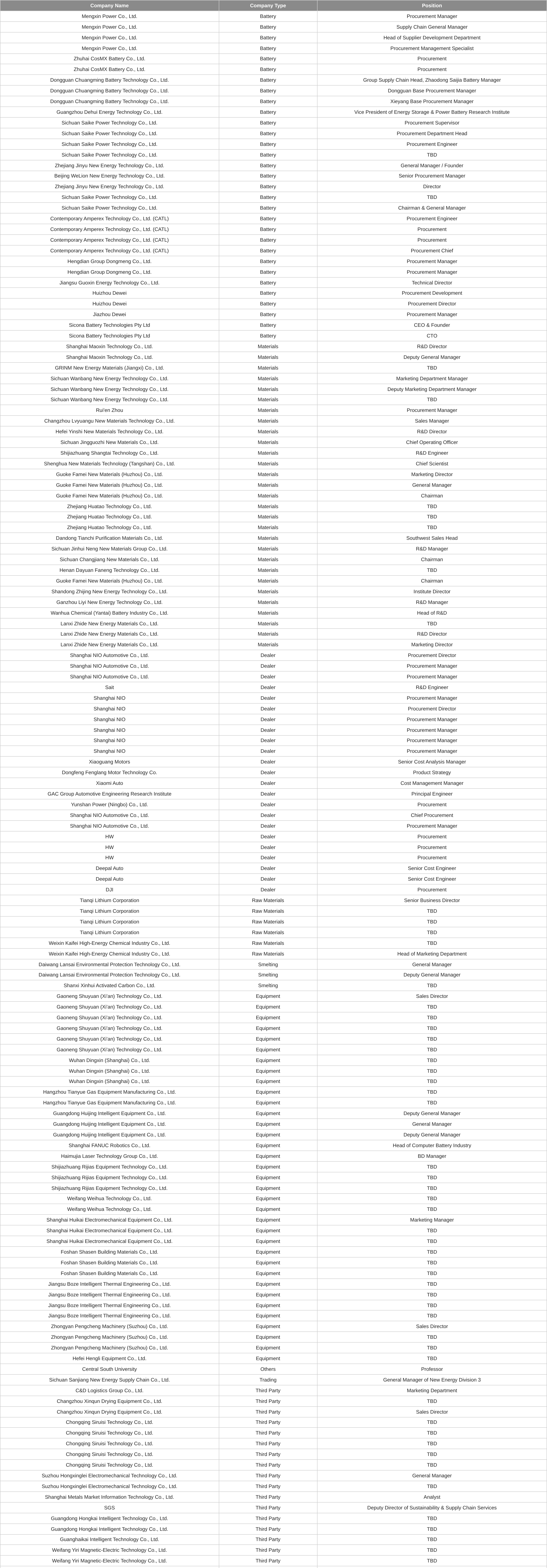
Tel: 021-20707860 (or add WeChat 13585549799), Yang Chaoxing. Thank you!
Related Information
![[Weekly Observation] Cobalt industry chain in the doldrums in first week after holiday; cobalt salt prices continue to grind lower; some enterprises remain in reduced or halted production](https://imgqn.smm.cn/usercenter/GVVKq20251217171728.jpg)
![[SMM News] Sinomine’s Bikita to Lift Annual Spodumene Processing Capacity 50% to 3 million mt by Q2 2027](https://imgqn.smm.cn/usercenter/akEdZ20251217171728.jpg)
![[SMM Flash News] Savannah Resources close to second offtake deal for Portugal's Barroso lithium project](https://imgqn.smm.cn/usercenter/WBREf20251217171728.png)