SMM, October 10:
Metals market:
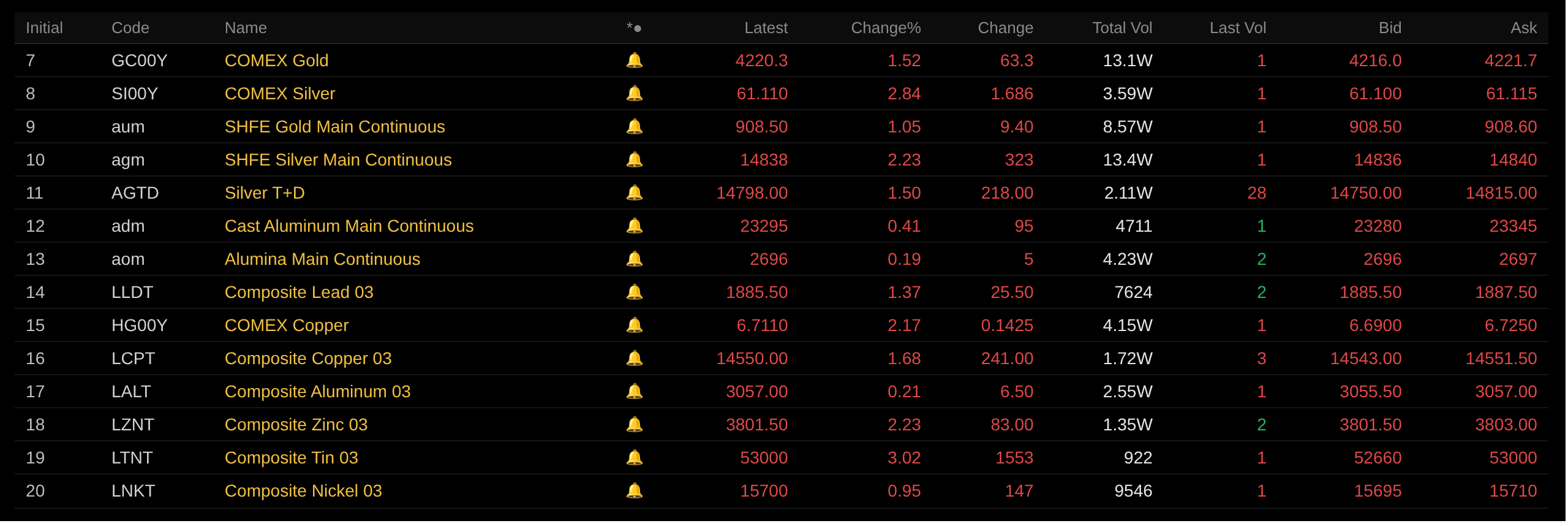
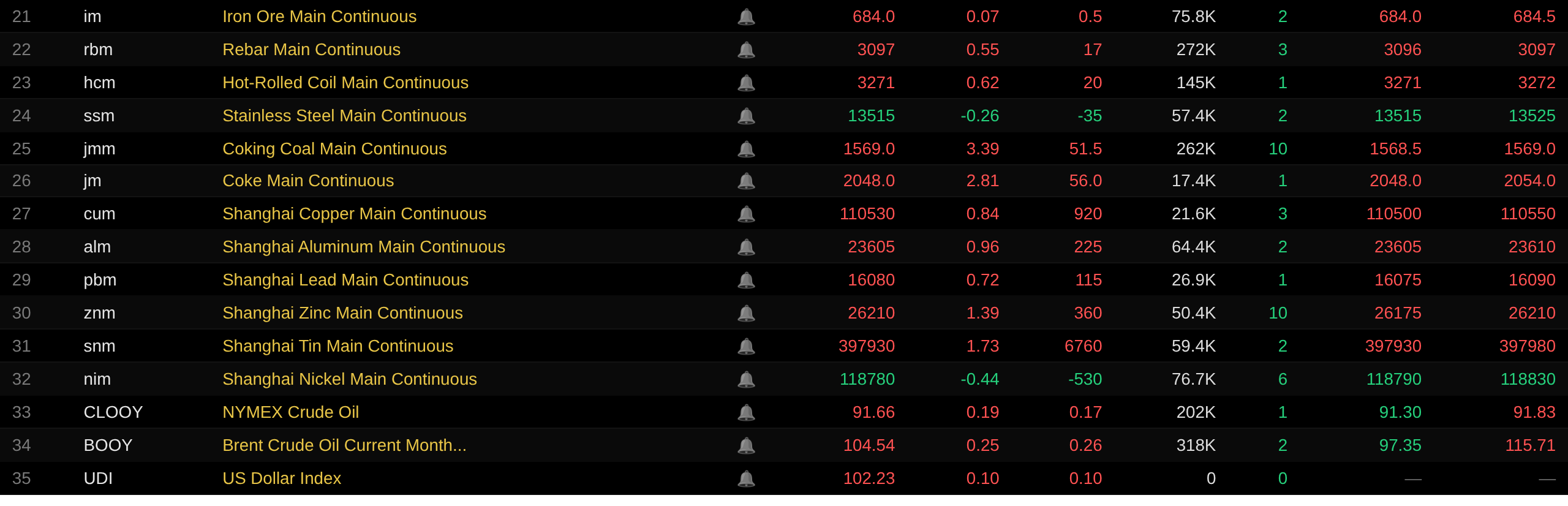
Overnight, base metals on the domestic market nearly all rose. SHFE copper gained 0.84%, SHFE aluminum and SHFE lead rose 0.96% and 0.72%, respectively. SHFE zinc rose 1.39%, and SHFE tin gained 1.73%. SHFE nickel fell 0.44%. In addition, the most-traded alumina futures contract rose 0.19%, and the most-traded cast aluminum contract gained 0.41%.
Overnight, ferrous metals mostly rose. Stainless steel fell 0.26%. Iron ore edged up 0.07%, and rebar gained 0.55%. Hot-rolled coil rose 0.62%. Coking coal and coke: the most-traded coking coal contract rose 3.39%, and the most-traded coke contract gained 2.81%.
Overnight on the overseas market, LME base metals all rose. LME copper gained 1.68%, and LME aluminum rose 0.21%. LME lead gained 1.37%. LME zinc rose 2.32%. LME tin gained 3.02%. LME nickel rose 0.95%.
Overnight in precious metals: COMEX gold rose 1.52%, with COMEX gold posting a weekly gain of 1.39%; COMEX silver gained 2.84%, with COMEX silver closing the week higher, up 1.15% WoW. Overnight, the most-traded SHFE gold contract rose 1.05%, with SHFE gold posting a weekly gain of 0.4%; the most-traded SHFE silver contract gained 2.23%, while SHFE silver fell for a third straight week, down 1.41% WoW.
As of 8:07 on October 10, overnight closing prices:
Macro front
China:
[Accelerate the development of new quality productive forces! The CPC Central Committee and the State Council issue a major document!] To accelerate the development of new quality productive forces, the CPC Central Committee and the State Council issued the Opinions on Developing New Quality Productive Forces. The document lays out 19 key measures across five areas: vigorously advancing technological innovation, promoting the deep integration of technological innovation and industrial innovation, advancing innovation in development models, solidly promoting institutional and mechanism innovation, and deepening innovation in talent work mechanisms. The document makes clear that China will adhere to innovation-driven development, reform as the priority, tailored measures based on local conditions, and establishing the new before abolishing the old; adhere to high technology, high efficiency, and high quality; coordinate the relationship between government and market, quality and business forms, reform and development, and self-reliance and openness; coordinate development and security; take technological innovation as the guide and a substantial increase in total factor productivity as the core hallmark; promote revolutionary technological breakthroughs, innovative allocation of production factors, and deep industrial transformation and upgrading; promote the optimized combination and upgraded leap of workers, means of labor, and objects of labor; advance technological innovation, industrial innovation, development model innovation, institutional and mechanism innovation, and talent work mechanism innovation in all respects; accelerate the formation of production relations better suited to new quality productive forces; foster a favorable development ecosystem conducive to the deep integration of technological innovation and industrial innovation; and better support high-quality development.
[NDRC: AI is the core support for developing new quality productive forces and building a modern industrial system] A responsible official from the National Development and Reform Commission (NDRC) answered reporters' questions on the Opinions on Developing New Quality Productive Forces. AI is the core support for developing new quality productive forces and building a modern industrial system. AI is moving from the laboratory into production and daily life, giving rise to new fields and tracks such as autonomous driving, humanoid robots, autonomous flying drones, brain-computer interfaces, smartphones, smart TVs, smart computers, and smart wearable devices, while also playing an important role in empowering the upgrading of traditional industries. The Opinions prominently emphasize the full implementation of the "AI+" initiative, aiming to promote the deep integration of AI and the real economy, help transform and upgrade traditional industries, cultivate and strengthen emerging industries, and make forward-looking arrangements for future industries; promptly apply innovations in the intelligent sector to specific industries and specific industry chains; drive industries toward high-end and green development through intelligence; and empower the transformation and upgrading of all industries. (Jin10 Data App)
[China-EU Trade and Investment Consultation Joint Statement: Understanding reached on hybrid vehicle trade, further strengthening export control dialogue, willing to facilitate export approval for rare earth permanent magnets] On October 8-9, 2026, China's Commerce Minister Wang Wentao and European Commission Commissioner for Trade and Economic Security Maros Sefcovic held the second regular meeting of the China-EU Trade and Investment Consultation Mechanism (hereinafter referred to as the Mechanism) in Beijing. The two sides reached multiple consensuses on issues including trade and investment balance, export controls, intellectual property protection, and WTO reform. The two sides reached an understanding on hybrid vehicle trade and will continue to advance procedures related to enterprise price commitments and reviews in the EV anti-subsidy case. Regarding medical devices, the EU side welcomed China's measures to expand imports of EU medical devices, including holding procurement matchmaking meetings during the 9th China International Import Expo; China will facilitate export licensing approvals for rare earths and permanent magnets to the EU through a "green channel" mechanism.
[SHFE: Adjust price limit ranges and trading margin ratios for fuel oil and bitumen futures contracts] According to the SHFE, after study and decision, effective from the close of trading and settlement on October 12, 2026 (Monday), the price limit ranges and trading margin ratios will be adjusted as follows: The price limit range for fuel oil futures contracts FU2612 and FU2701 will be 16%, with hedging open interest margin ratio at 17% and general open interest margin ratio at 18%. The price limit range for bitumen futures contracts BU2610, BU2611, BU2612, and BU2701 will be 12%, with hedging open interest margin ratio at 13% and general open interest margin ratio at 14%.
[Consolidating technical foundation: China accelerates international standardization in the low-altitude economy] China is deeply involved in low-altitude economy standardization work at the International Organization for Standardization (ISO) and the International Electrotechnical Commission (IEC), promoting the initiation, development, and release of international standards. Among them, the UAV Perception and Obstacle Avoidance System, jointly led by China, filled a gap in international standards in the relevant field. The Cards and security devices for personal identification - Unmanned Aircraft System (UAS) license and drone/UAS security module - Part 5: Test methods for drone/UAS security module, proposed under China's leadership, was successfully approved as the first international standard proposal in the field of UAS identification. (CCTV News)
[Shanghai International Energy Exchange: Adjust trading limits for crude oil and low-sulfur fuel oil futures contracts] Shanghai International Energy Exchange: After study and decision, effective from the trading session on October 13, 2026 (i.e., the night session of October 12), the trading limits for non-futures company members, overseas special non-brokerage participants, and clients in crude oil and low-sulfur fuel oil futures contracts will be adjusted as follows: The maximum number of intraday opening trades for crude oil futures contracts SC2612 and SC2701 will be 800 lots. The maximum number of intraday opening trades for low-sulfur fuel oil futures contracts LU2611, LU2612, and LU2701 will be 1,500 lots.
US dollar:
Overnight, the US dollar index rose 0.1% to 102.23. Weekly: the US dollar index rose for a fourth straight week, up 0.29% WoW. Market participants are weighing persistent inflation concerns and the future direction of the US Fed's interest rate policy.
US consumer confidence fell further in early October, with consumers' assessment of current economic conditions dropping to a record low, as persistently high inflation weighs on US household finances. The preliminary University of Michigan survey released on Friday showed the October consumer sentiment index fell to 46.3, the lowest since May. The current economic conditions index plunged from 50.9 in September to 44.7, the lowest on record. Meanwhile, the consumer expectations index rose from 46.3 to 47.3, the first increase since July. With gasoline prices staying high, borrowing costs rising, and hiring slowing, US consumer confidence continues to deteriorate. The survey showed consumers expect prices to rise 4.7% over the next year, up from 4.6% in September. Long-term inflation expectations for the next 5 to 10 years rose to an annual average of 3.5%, slightly above September's level. Joanne Hsu, director of the University of Michigan consumer survey, said in a statement that low-income consumers and those with smaller stock portfolios saw a notable decline in confidence this month. (Jin10 Data App)
The US Fed's latest Survey of Consumer Finances shows US household debt stress is intensifying, with more borrowers falling behind on loan payments or needing to devote a larger share of income to debt repayment. The survey showed the median household debt-service-to-income ratio rose to 15.4%, up 2 percentage points from 2022. The US Fed noted this may be related to rising mortgage and consumer loan rates over the same period. Meanwhile, the share of households with heavy debt-service burdens rose from 6.5% in 2022 to 8.6% in 2025, the highest since the survey began in 2013. These households' debt payments account for 40% or more of their income. More notably, from 2022 to 2025, the share of households reporting loan delinquencies surged from about 12% to nearly 20%. These data indicate that as borrowing costs rise, US households not only need to devote more income to debt repayment, but loan delinquencies have also increased markedly, reflecting deteriorating financial conditions for some households. (Jin10 Data App)
In addition, according to a notice published on the White House website on Friday, US President Trump announced the establishment of a special committee to investigate allegations against US Fed Governor Lisa Cook. According to the notice dated October 7, Trump said: "To assist me in fulfilling this responsibility, the committee will investigate the allegations against Governor Cook and report to me whether there is 'good cause' to remove Governor Cook." The investigation will focus on assessing whether Cook meets the legal conditions for removal, and does not currently mean she has been removed. (Jin10 Data App)
Other currencies:
Capital Economics economist Thomas Ryan said that after two consecutive months of sharp declines in Canadian employment and a slight rise in the unemployment rate, only a September inflation print significantly above expectations could bring the option of a rate hike by the Bank of Canada later this month back into discussion. Canada's September employment fell by 68,300, notably worse than the market's general expectation of a slight increase and also below Capital Economics' earlier forecast of flat employment. However, Ryan believes the actual employment situation is not as bad as the headline data suggest. He noted that part of the employment decline reflects a pullback among young workers after unusually strong summer hiring, while the weakness was concentrated mainly in the public sector. Ryan still expects the Bank of Canada to wait until 2027 before beginning to normalize its policy rate. (Jin10 Data App)
Russia's September consumer prices rose 6.35% YoY, above market expectations of 6.3%, and rose 0.35% MoM, with inflation persistently above the central bank's 4% target. Although seasonal price declines in fruits and vegetables dampened some of the increase, weekly price growth jumped from 0.12% to 0.96% after regulated prices such as utilities were raised this month. The chief economist at CentroCredit Bank said he previously expected the Russian central bank to keep its benchmark rate unchanged at 14% through year-end, but another rate hike has now become a realistic possibility. The Russian central bank will hold its rate-setting meeting on October 23. Last month, it paused rate cuts for the first time since June 2025 due to inflation risks from fuel supply disruptions and increased government spending. The central bank had already raised its end-2026 inflation forecast to 6% to 7%, implying inflation will exceed the target for a seventh consecutive year. In addition, Ukraine's continued attacks on Russian refineries are disrupting the fuel market, and the fiscal deficit is expected to reach twice the original plan, further intensifying price pressures. (Jin10 Data App)
Data:
Next week will see the release of Germany's final September CPI MoM, US September NFIB Small Business Optimism Index, US ADP employment change for the week ended September 26, US September existing home sales annualized, China September CPI YoY, US September unadjusted CPI YoY, and US September seasonally adjusted CPI MoM
、US September core CPI MoM after seasonal adjustment、US September core CPI YoY without seasonal adjustment、China September trade balance、Australia September unemployment rate after seasonal adjustment、UK August three-month GDP MoM、UK August manufacturing output MoM、UK August goods trade balance after seasonal adjustment、UK August industrial output MoM、France September final CPI MoM、Eurozone August industrial output MoM、Canada August wholesale sales MoM、US initial jobless claims for the week ending October 10、US September retail sales MoM、US September PPI YoY、US September PPI MoM、US October New York Fed manufacturing index、US October Philadelphia Fed manufacturing index、US August business inventories MoM、China September total electricity consumption YoY、China September total electricity consumption、Eurozone September final CPI YoY、Eurozone September final CPI MoM、Eurozone August trade balance after seasonal adjustment、US September import price index MoM、US September industrial output MoM and other data.
In addition, next week's focus includes: the IMF and World Bank Annual Meetings in Bangkok, through the 18th; 2026 FOMC voting member and Cleveland Fed Chairman Hammack speaks; the Reserve Bank of Australia releases its September monetary policy meeting minutes; Fed Governor Waller speaks at the Bloomberg New Economy Forum in India; Apple holds a smart home product launch event in New York; 2028 FOMC voting member and Boston Fed President Collins speaks; Bank of Canada Governor Macklem participates in a fireside chat at the IIF Annual Membership Meeting in Bangkok; ECB President Lagarde speaks on Europe's digital future; Fed Governor Bowman speaks; the Fed releases the Beige Book; China's refined oil products open a new pricing adjustment window; the National Energy Administration releases total electricity consumption data around the 15th of each month; G20 finance ministers and central bank governors meeting; 2026 FOMC voting member and Cleveland Fed Chairman Hammack speaks; Bank of England Governor Bailey participates in a fireside chat; Fed Chairman Warsh attends the IMF Annual Meetings in Bangkok and holds a fireside chat with IMF Managing Director Georgieva; Bank of Canada Governor Macklem attends the IMF Annual Meetings and participates in a panel session; Bank of England Governor Bailey speaks.
Crude oil:
Overnight, both oil futures edged up, with WTI up 0.19% and Brent up 0.25%. On the weekly chart, WTI futures rose, gaining 0.6% for the week; Brent futures rose for a second straight week, up 2.24% for the week. Concerns over the ongoing conflict in the Middle East and a hurricane approaching the northern Gulf of Mexico, which prompted the US to shut more crude oil capacity, supported oil prices. However, Trump's announcement that Russia would release diesel supplies to the global market limited the gains in oil prices.
US President Trump has issued new, conflicting signals regarding the timetable for military action against Iran. At a White House press briefing on Friday, when asked why he had postponed action against Iran until after the midterm elections rather than acting immediately, Trump said it was “possible” the US would act immediately. Just the day before, on Thursday, Trump had explicitly stated that the US “will not attack Iran before the midterm elections” and described the ongoing negotiations with Iran as “productive.” This abrupt reversal has made it increasingly difficult for outside observers to grasp the direction of White House policy, while also keeping investors on high alert over uncertainty in the Middle East. (Wall Street CN)
Trump said on social media that his call with Putin was very successful, and that Russia would immediately supply more than 300,000 mt of diesel, another 500,000 mt in November, followed by an additional 1 million mt, and a further 3 million mt depending on refinery conditions. Ultima Markets senior analyst Elon Gu believes that if attacks from Iran continue to escalate and the White House reconsiders military action, oil prices could surge rapidly, especially given that tanker traffic through the Strait of Hormuz is already far below pre-war levels. As the best indicator of physical crude oil supply-demand tightness, Dated Brent prices soared this week, once again approaching post-war historical highs. (Wall Street CN)
In addition, according to The Washington Post, the US blockade of Iranian ports has driven Iranian oil exports to extremely low levels, costing Tehran billions of US dollars in monthly revenue. Although the economic pressure has not yet forced Iran to make concessions in negotiations, a senior Trump administration official said the White House still believes time is on America’s side. The official explained that during previous rounds of economic pressure, Iran was able to ease the strain by relying on oil revenue, but the port blockade now in place is eliminating that room for maneuver and steadily strengthening the impact of sanctions. In the Trump administration’s view, blocking Iranian oil exports will continue to erode Tehran’s ability to withstand economic pressure. So far, however, the economic losses have not translated into Iranian concessions on key negotiating terms, and the impasse between the US and Iran remains unbroken. (Jin10 Data APP)
The US Treasury Department’s Office of Foreign Assets Control (OFAC) issued General License No. 135 on October 9 local time, authorizing transactions involving Russian-origin diesel that were previously prohibited under sanctions against Russia, covering sales, delivery, discharge, and import, and explicitly permitting import into the US. The license is valid until 12:01 a.m. Eastern Daylight Time on April 7, 2027 (12:01 p.m. Beijing time on April 7, 2027). However, the license still prohibits the transfer of funds from accounts opened by the Central Bank of Russia, the Russian National Wealth Fund, or the Russian Ministry of Finance at US financial institutions. (Jin10 Data APP)
Russian Deputy Prime Minister Novak stated that Russia will immediately begin lifting diesel export restrictions, ahead of the original plan. According to him, Russia is willing to supply additional diesel to the US and all partners in October, with 300,000 mt in October, rising to 500,000 mt in November and 1 million mt in December. Novak also noted that the Russian market will be fully supplied with diesel as well. The Russian government had previously decided to extend the export ban on related products for diesel, marine fuel, and gasoil producers until October 31. (CCTV)
As Category 3 Hurricane Isaias approaches the US Gulf Coast, local oil producers have suspended approximately 1.46 million bpd of crude oil production, accounting for 72% of the region's total output. The US Bureau of Ocean Energy Management stated that as of 12:00 pm ET on Friday (0:00 Beijing time on October 10), personnel from 129 offshore platforms had been evacuated, and two mobile drilling rigs had been moved out of the storm's path. BP has shut down production at its Thunder Horse and Na Kika platforms and evacuated non-essential personnel from three other platforms. The supply disruption has driven up crude oil prices in the Gulf of Mexico, with Mars crude trading at a premium of about $3/bbl over WTI crude, and Thunder Horse crude maintaining a premium of over $4/bbl for two consecutive trading days. (Jin10 Data APP)
Recommended reading:

![Cost support shifts downward, but finished product supply contraction provides a floor [SMM Steel Industry Chain Weekly Report]](https://imgqn.smm.cn/usercenter/udPED20251217171747.jpg)
![Dollar crude oil weakens, base metals overseas market outperforms domestic market, SHFE tin plunges, LME copper, aluminum, tin, and gold futures lead gains [SMM Midday Review]](https://imgqn.smm.cn/usercenter/BVoXk20251217171736.jpg)