SMM, October 9:
In the metals market:
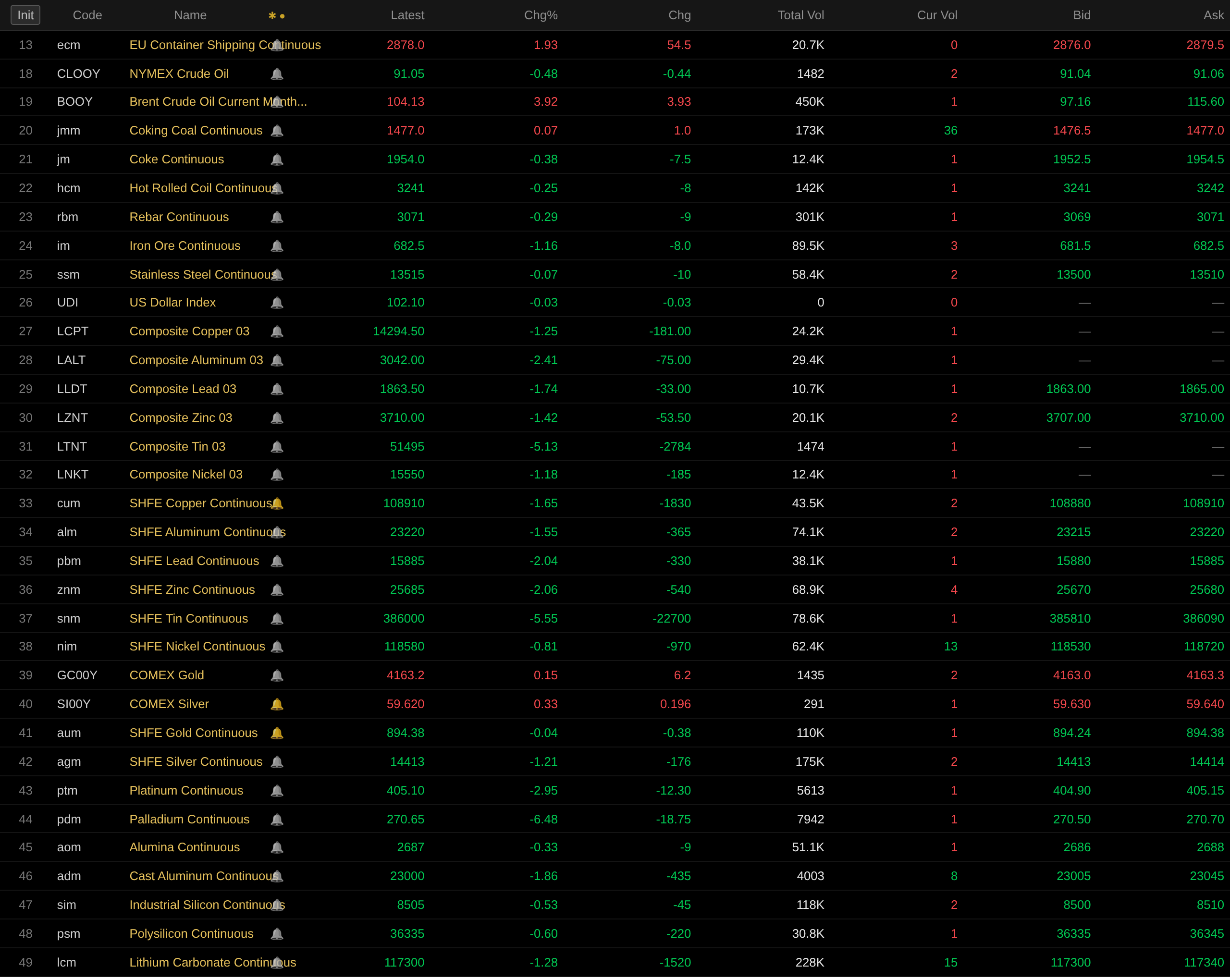
Overnight, base metals on both domestic and overseas markets fell collectively. LME and SHFE tin led the decline with drops exceeding 5%, with LME tin down 5.13% and SHFE tin down 5.55%. LME aluminum, SHFE lead, and SHFE zinc all fell more than 2%, with LME aluminum down 2.41%, SHFE lead down 2.04%, and SHFE zinc down 2.06%. LME copper fell 1.25%, LME lead fell 1.74%, LME zinc fell 1.42%, and LME nickel fell 1.18%. SHFE copper fell 1.65%, and SHFE aluminum fell 1.55%. Other metals saw modest fluctuations. The alumina main contract fell 0.33%, and the foundry aluminum main contract fell 1.86%.
Overnight, ferrous metals broadly declined, with iron ore down 1.16%, and hot-rolled coil and rebar both down around 0.2%. For coking coal and coke, coking coal rose 0.07%, while coke fell 0.38%.
Overnight in precious metals, COMEX gold rose 0.43%, while COMEX silver fell 1.43%. Domestically, SHFE gold fell 0.04%, and SHFE silver fell 1.21%.
As of 6:46 on October 9, overnight closing prices:
Macro front
Domestically:
PBOC: Based on demand from primary dealers in open market operations, the volume of 7-day reverse repo operations on October 8, 2026 was zero. Meanwhile, 606 billion yuan of overnight reverse repo operations were conducted.
[GFEX releases announcement soliciting public comments on lithium hydroxide futures and options contracts and related rules] GFEX released an announcement soliciting public comments on lithium hydroxide futures and options contracts and related rules. The lithium hydroxide futures and options business rules (draft for comments) mention that the trading unit for lithium hydroxide futures contracts is 1 mt per lot. The quotation unit for lithium hydroxide futures contracts is yuan (RMB)/mt. The minimum price fluctuation for lithium hydroxide futures contracts is 20 yuan/mt. The maximum order size for lithium hydroxide futures contracts is 1,000 lots per order, and the minimum is 1 lot per order, which the exchange may adjust based on market conditions with a separate announcement. The daily price limit for lithium hydroxide futures contracts in months before the delivery month is 5% of the previous trading day's settlement price, and 7% in the delivery month.
[Domestic fuel surcharges to rise] According to Flight Master DAST and the latest airline notices, starting October 10, domestic fuel surcharges will be raised: 90 yuan for segments over 800 kilometers, up 20 yuan from August and September; 50 yuan for segments under 800 kilometers, up 10 yuan from August and September. (Jin10 Data APP)
On the US dollar:
As of the overnight close, the US dollar index fell 0.16% to 102.12. The IMF schedule shows that Fed Chairman Warsh will attend the IMF annual meeting in Bangkok and deliver a speech at 11:30 Beijing time on October 16. That day is also the last day before Fed officials enter the quiet period ahead of the October 27-28 FOMC meeting. Markets currently price in an 80% probability that the Fed will pause rate hikes at the October meeting and then hike in December. (Jin10 Data APP)
St. Louis Fed President Musalem said the Fed needs to raise rates again to bring inflation back to the 2% target. He said monetary policy needs to tighten further to achieve the inflation target within a "timely" horizon. Musalem said that if "timely" means about 18 months, rates may need to be raised further at appropriate times over the next 6 to 9 months. He said inflation remains the main problem facing the US economy, but with strong growth and a stable labor market, the Fed may be able to bring down inflation without significantly hurting employment. Asked whether the Fed should hike at the October 27-28 meeting, Musalem said he remains open-minded and has not prejudged the outcome, but the inflation situation requires policymakers to continue considering further tightening. Musalem said that despite the notable rise in US Treasury yields, financial conditions remain accommodative and supportive of economic growth. He said rising yields do not mean investors are losing confidence in the Fed, but rather reflect expectations of higher real rates and intensifying competition for capital in a strong economy. (Jin10 Data APP)
Fed Governor Waller said on Thursday that further rate hikes may still be needed to bring inflation back to the Fed's 2% target, but he stressed that the pace of hikes has some "flexibility," leaving room for a pause at the upcoming October policy meeting. Waller said: "If economic data continue to come in as expected, I expect further rate hikes will be needed to bring inflation back to the 2% target more quickly." "But there is some flexibility in when those hikes are implemented. We don't have to hike at consecutive meetings, but we should complete the necessary hikes within a reasonable timeframe." Waller did not specify how much further the policy rate needs to rise to curb inflation that remains more than 1 percentage point above the Fed's target. However, he said the need for higher rates has become increasingly evident as the US economy strengthens, the energy price shock from the Iran war has yet to fade, and AI infrastructure construction is driving demand for key goods and services, further adding to inflationary pressures. (Jin10 Data APP)
According to CME "FedWatch": The probability of the Fed keeping rates unchanged through October is 82.3%, and the probability of a cumulative 25 basis point hike is 17.7%. The probability of the Fed keeping rates unchanged through December is 18.7%, the probability of a cumulative 25 basis point hike is 67.6%, and the probability of a cumulative 50 basis point hike is 13.7%. (Jin10 Data APP)
On the data front:
Today will see the release of China's September M2 money supply year-over-year (TBD), the preliminary US October one-year inflation expectations, the preliminary US October University of Michigan consumer sentiment index, Switzerland's September consumer confidence index, and Canada's September employment figures. In addition, 2028 FOMC voter and St. Louis Fed President Musalem will deliver a speech.
In crude oil:
Overnight, oil prices on both markets rose together, with WTI up 3.29% and Brent up 3.92%. The market is concerned about the ongoing Middle East war, while Hurricane Isaias approaches the northern US Gulf Coast, expanding offshore oil production shutdowns in the US. (Jin10 Data APP)
=On October 8 local time, the US Treasury Department website released information showing that the US has imposed a new round of sanctions on Iran, targeting 17 vessels transporting Iranian crude oil, petroleum products, and petrochemical products. US Treasury officials also said the US estimates that about 20 million barrels of Iranian crude oil remain stranded on vessels outside the scope of the US blockade of Iranian ports. Officials said Iran has halted loading and unloading of crude oil vessels due to the US blockade and sanctions. Earlier that day, US President Trump said productive talks are underway with Iran and that the US will not attack Iran before the November 3 midterm elections. (CCTV)
US Central Command: In recent months, US forces have supported the transport of more than 1.25 billion barrels of crude oil from Gulf partner countries and through the Strait of Hormuz. By contrast, Iran has failed to ship a single barrel of crude oil due to the US iron-fisted blockade of Iranian ports. (Jin10 Data APP)
CITIC Securities research notes say US-Iran negotiations have yet to achieve a major breakthrough, and security incidents involving tankers in the Strait of Hormuz have increased, with transportation costs climbing. Combined with escalating conflict between Saudi Arabia and the Houthis, risks to regional energy facilities and shipping through the Bab el-Mandeb Strait are rising, and uncertainty over crude oil supply and transportation continues to grow. International oil prices are expected to continue to consolidate at highs for the remainder of 2026, with focus on negotiation progress, resumption of strait transit, and actual supply changes. (Jin10 Data APP)
According to foreign media reports, Saudi Arabia is in talks with clients about offering loading options outside the Strait of Hormuz in next year's long-term crude supply contracts, formally incorporating the temporary transportation arrangements adopted during the Iran war into the contract mechanism. At the same time, Saudi Arabia is seeking to expand its share of the global crude oil market. According to people familiar with the matter, negotiations are still ongoing and must be completed before the end of this year. If approved, the plan would mark a major change in how Saudi Arabia delivers crude oil to clients, as long-term contract supply accounts for the vast majority of the country's crude oil sales. Currently, the transportation model of using vessels for short-haul transits through the Strait of Hormuz and then completing delivery via ship-to-ship transfers outside the strait has become an important mechanism for maintaining market supply. People familiar with the matter said Saudi state oil company Saudi Aramco is also discussing other adjustments, including allowing clients to choose different crude pricing benchmarks, and even having Saudi Aramco deliver crude oil directly to Asian clients.
(Jinshi Data APP)
![LME tin plunged 5.22% to $51,447/mt, while the most-traded SHFE tin SN2610 contract fell 4.50% in the night session, breaking below the 390,000 yuan mark [SMM Tin Morning Meeting Summary]](https://imgqn.smm.cn/usercenter/cUElw20251217171752.jpg)
![Tin prices opened high and consolidated after the holiday, with focus on the US Fed and evolving Middle East situation [SMM Tin Midday Review]](https://imgqn.smm.cn/usercenter/nBLhE20251217171750.jpg)
![Metals show mixed performance, with lithium carbonate leading the gains. SHFE copper and LME zinc post the largest increases, while palladium plunges. SHFE silver and iron ore lead the declines. [SMM Midday Commentary]](https://imgqn.smm.cn/usercenter/YKilH20251217171735.jpg)