I. Power Spot Market Operations
Weekly Overview: From September 21 to 27, weather conditions across China remained highly differentiated. Late-summer heat persisted across Jiangnan and South China, with cooling demand remaining relatively resilient in Guangdong and other southern markets, while more frequent cold-air activity in northern China gradually reduced cooling demand. Despite the continued transition away from peak-summer load, weekly average spot prices increased across all six monitored markets. Shandong’s real-time average rose to RMB 430.49/MWh; Guangdong’s day-ahead and real-time averages increased to RMB 509.58/MWh and RMB 577.52/MWh, respectively; Inner Mongolia’s generation-side real-time average rose to RMB 389.03/MWh; Jiangsu’s day-ahead and intraday averages reached RMB 433.89/MWh and RMB 451.23/MWh; Shanxi’s day-ahead and intraday averages stood at RMB 379.64/MWh and RMB 452.72/MWh; while Shaanxi’s day-ahead and real-time averages rose to RMB 328.70/MWh and RMB 319.79/MWh. On the fuel side, port thermal coal prices remained elevated, while LNG import costs declined during the week and eastern Guangdong LNG prices fell from RMB 6,205/mt to RMB 6,050/mt.
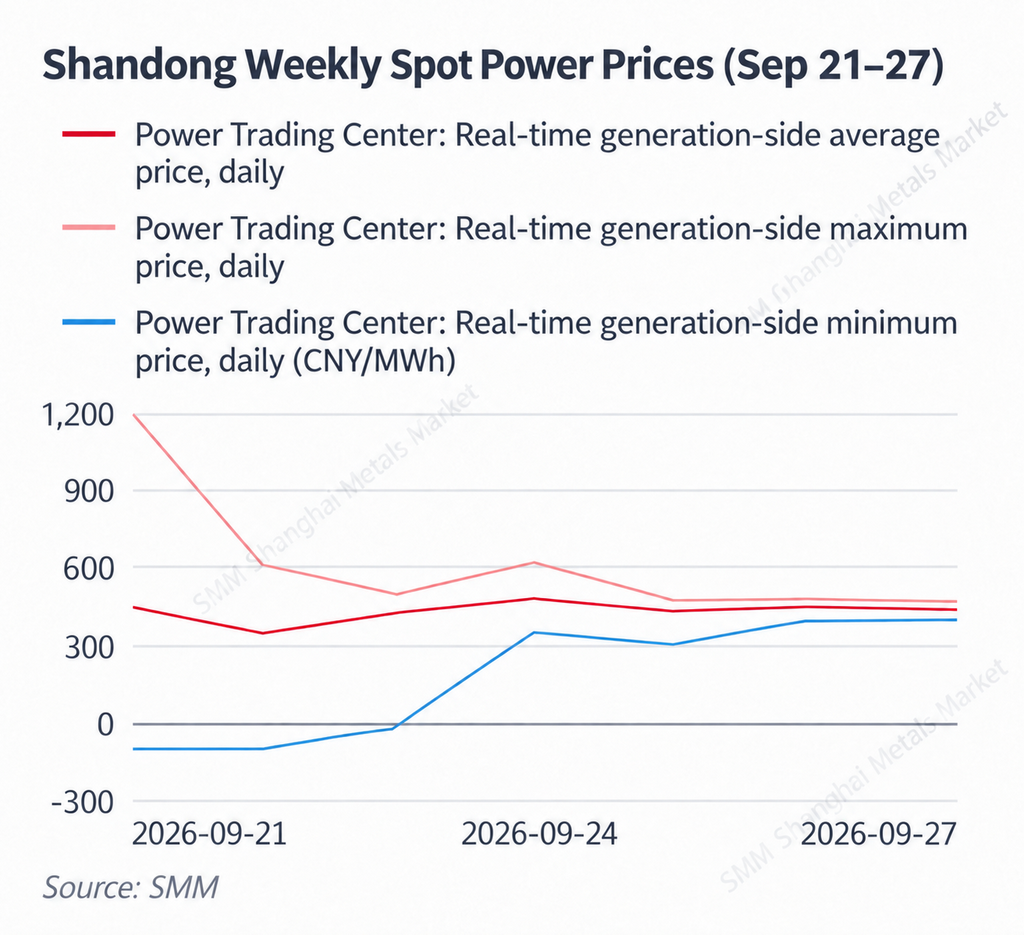
Shandong remained at elevated levels, with negative prices still appearing early in the week before supply-demand conditions tightened markedly later on. Shandong’s real-time generation-side average price fell from RMB 447.39/MWh on September 21 to RMB 348.91/MWh on September 22, before rebounding to RMB 476.84/MWh on September 24. Prices then remained mainly within RMB 432–448/MWh during September 25–27. The weekly average was approximately RMB 430.49/MWh, up around 3.3% from the previous week. Notably, the real-time minimum price hit -RMB 100/MWh on both September 21 and 22, and remained negative at -RMB 32.61/MWh on September 23. From September 24 onward, however, daily minimum prices all rose above RMB 300/MWh, indicating a clear shift from localized oversupply early in the week toward much tighter system conditions later on. As cooling demand continued to fade in northern China, high-temperature load was no longer the main driver of Shandong prices. Renewable output, actual load deviations and coal-fired marginal costs played a more important role, while elevated coal prices limited the downside for thermal generation bids.
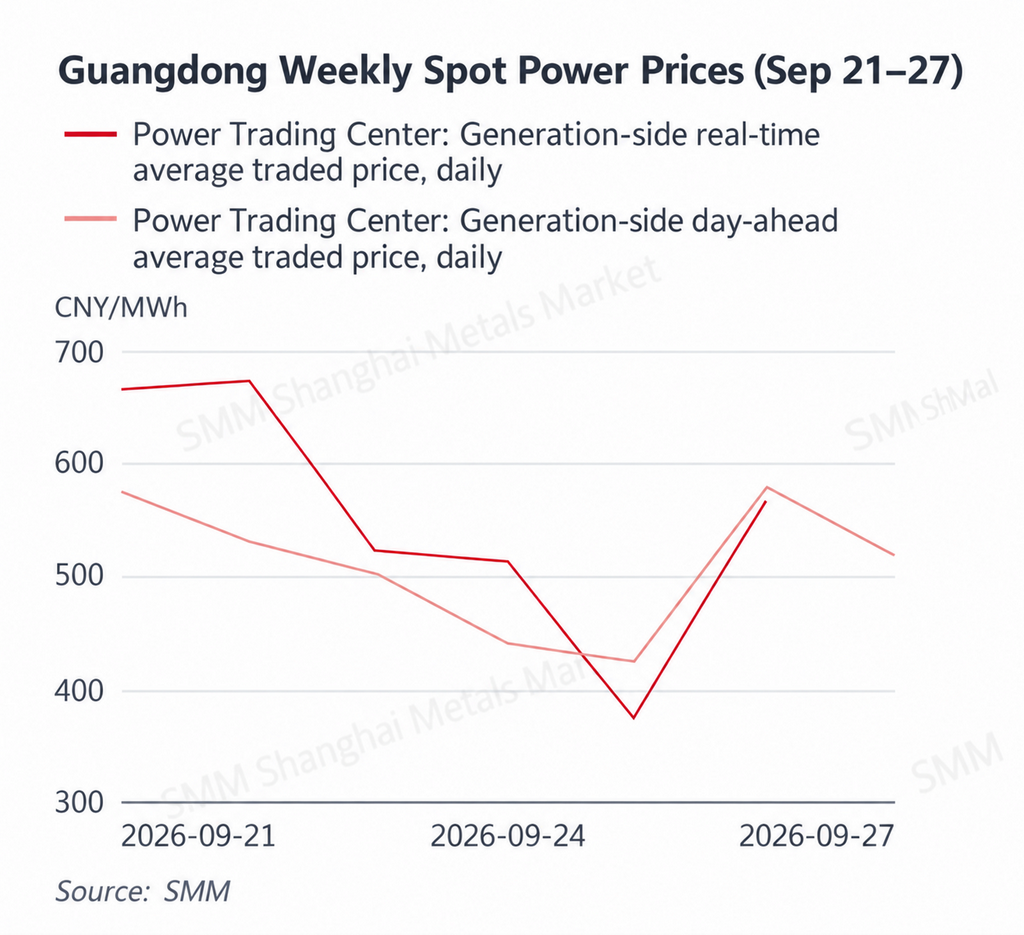
Guangdong retained strong price support from persistent heat, while real-time volatility increased further and prices strengthened again over the weekend. Guangdong’s weekly day-ahead average rose to approximately RMB 509.58/MWh, up around 10.7% week on week, while its real-time average reached approximately RMB 577.52/MWh, up around 13.7%. Real-time prices remained above RMB 666/MWh on September 21 and 22, dropped to RMB 376.28/MWh on September 25, and then rebounded sharply to a weekly high of RMB 727.35/MWh on September 27. Day-ahead prices also remained elevated, reaching RMB 577.02/MWh on September 26. Persistent hot weather continued to support cooling demand in Guangdong. Meanwhile, eastern Guangdong LNG prices fell from RMB 6,205/mt to RMB 6,050/mt, easing marginal gas-fired generation costs compared with the previous week. Therefore, the continued strength in Guangdong spot prices this week was driven more by resilient heat-related demand and tight real-time supply-demand conditions than by further increases in fuel costs.
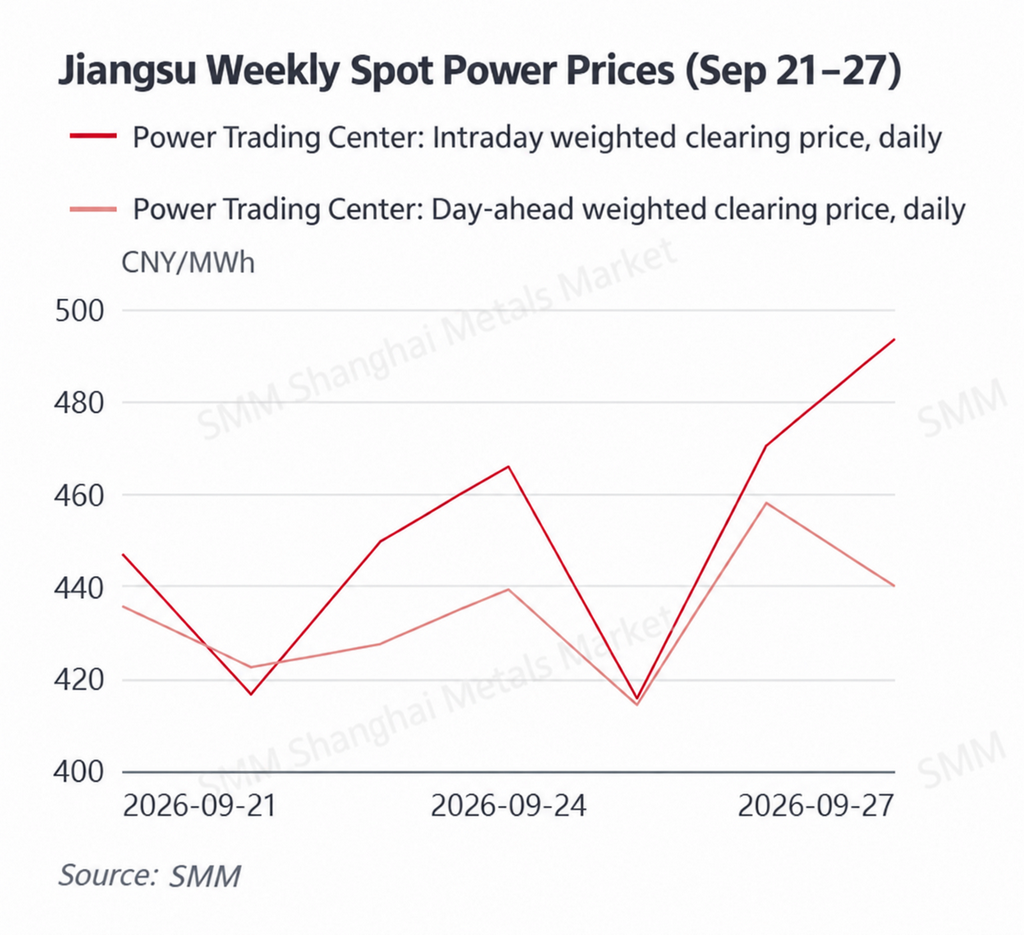
Jiangsu’s day-ahead and intraday markets both strengthened, with intraday pricing continuing to indicate relatively tight real-time operating conditions. Jiangsu’s weekly day-ahead weighted average rose to approximately RMB 433.89/MWh, up around 9.7% from the previous week, while the intraday average climbed to approximately RMB 451.23/MWh, up around 6.2%. Intraday prices mostly ranged between RMB 416/MWh and RMB 471/MWh before rising further to RMB 493.57/MWh on September 27. Day-ahead prices were relatively stable, mainly within RMB 414–458/MWh. Rainfall increased from September 23 onward and maximum temperatures gradually declined, meaning cooling demand did not provide a strong upward driver. Instead, higher prices more likely reflected tighter actual system conditions, resilient industrial demand and continued support from high coal-fired generation costs. The premium of intraday prices over day-ahead prices also suggests that renewable-output deviations and actual load conditions remained important short-term pricing factors.
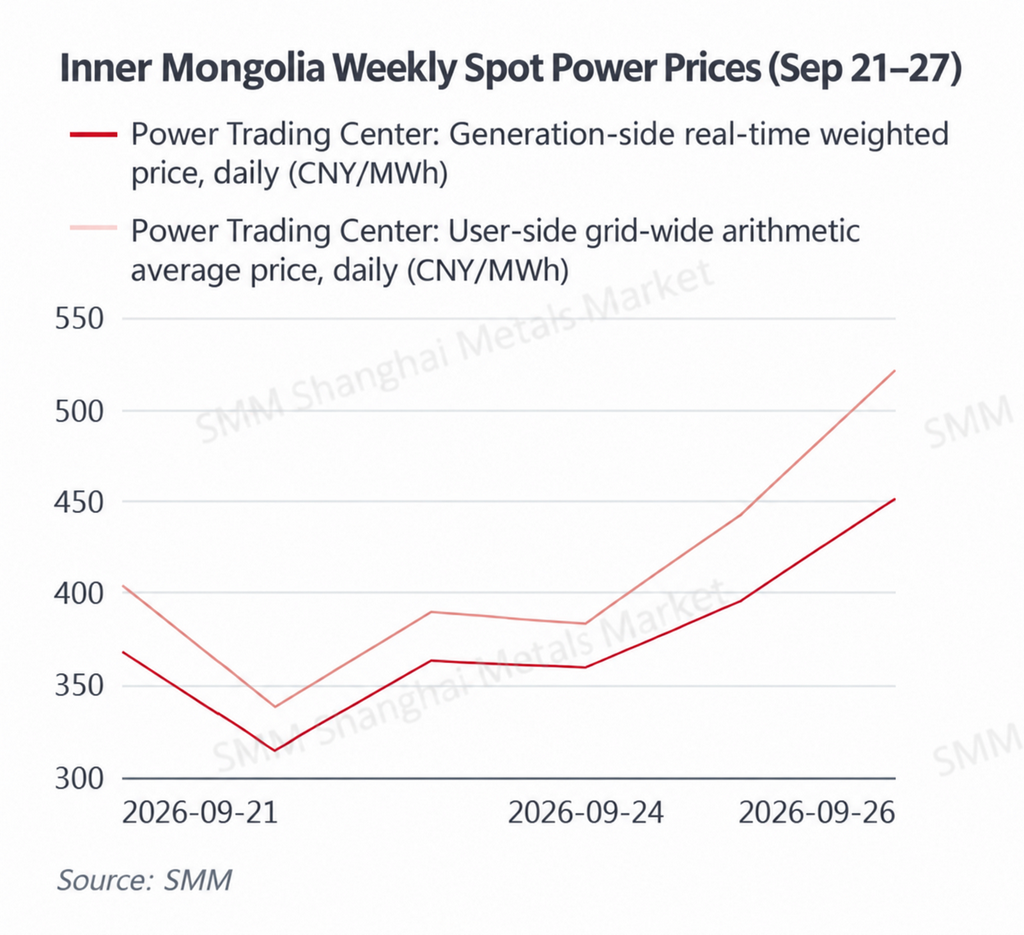
Inner Mongolia moved from weaker levels early in the week to a clear late-week rebound, with renewable output continuing to dominate price volatility. Inner Mongolia’s generation-side real-time weighted average reached approximately RMB 389.03/MWh for the week, up around 12.3% week on week, while the system-wide user-side arithmetic average rose to approximately RMB 425.21/MWh, up around 13.7%. Generation-side prices fell to RMB 314.85/MWh on September 22 before trending higher, reaching RMB 451.10/MWh on September 26 and RMB 472.11/MWh on September 27. The user-side average also climbed to RMB 521.09/MWh on September 26. With a high share of wind and solar generation, Inner Mongolia’s spot prices remain highly sensitive to renewable output and export flows. Strong wind and solar generation can quickly depress prices, while weaker renewable output raises thermal balancing requirements and allows high coal costs to exert a stronger influence on marginal bids. The late-week rally therefore reflected the interaction between renewable-output changes and coal-fired marginal costs.
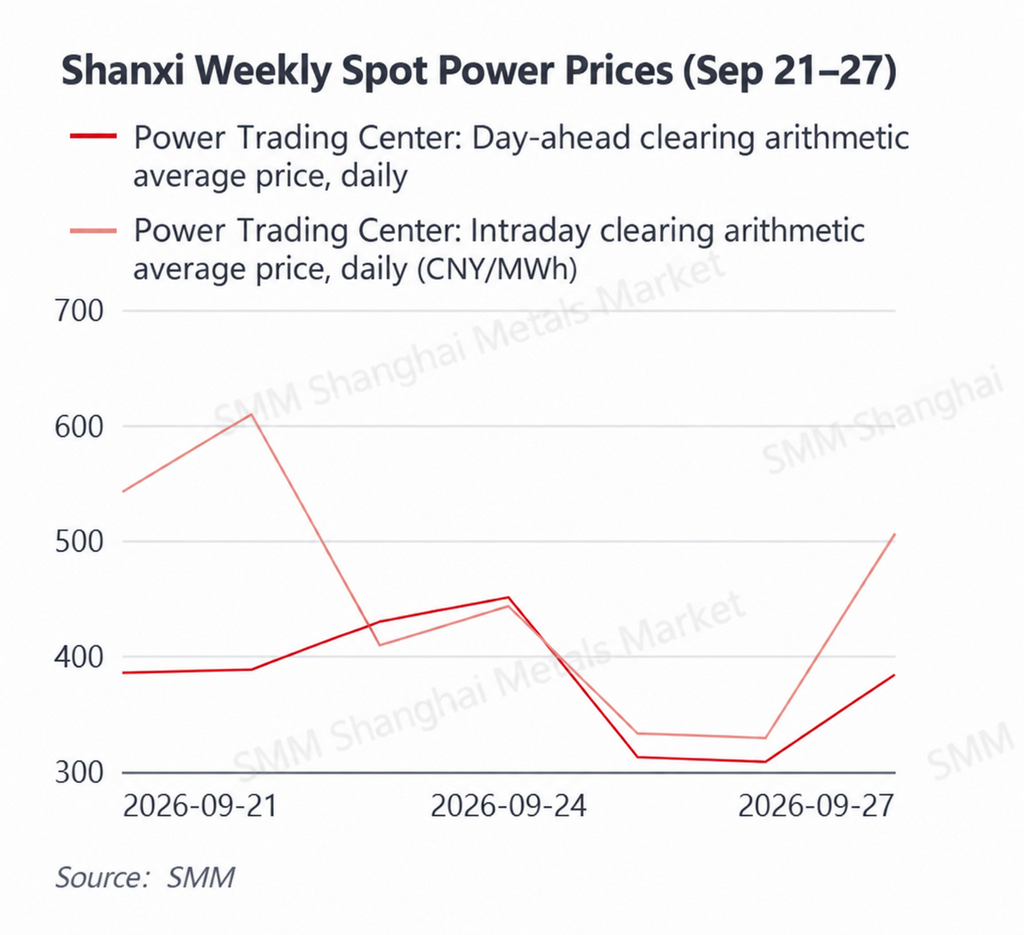
Shanxi’s day-ahead and intraday prices both increased significantly, while intraday pricing continued to show large deviations from day-ahead expectations. Shanxi’s weekly day-ahead arithmetic average rose to approximately RMB 379.64/MWh, up around 18.0% week on week, while the intraday average increased to approximately RMB 452.72/MWh, up around 11.8%. The intraday average was roughly RMB 73/MWh above the day-ahead average. Intraday prices were already elevated at RMB 541.56/MWh and RMB 609.34/MWh on September 21 and 22, eased to around RMB 330/MWh on September 25–26, and then rebounded to RMB 505.71/MWh on September 27. Day-ahead prices peaked at RMB 450.63/MWh on September 24 before falling sharply. The wide day-ahead/intraday spread indicates that actual system conditions continued to deviate materially from day-ahead forecasts. Given Shanxi’s high coal-fired generation share, elevated coal costs can amplify intraday price volatility when actual load, exports or renewable output differ from expectations and coal-fired units become marginal.
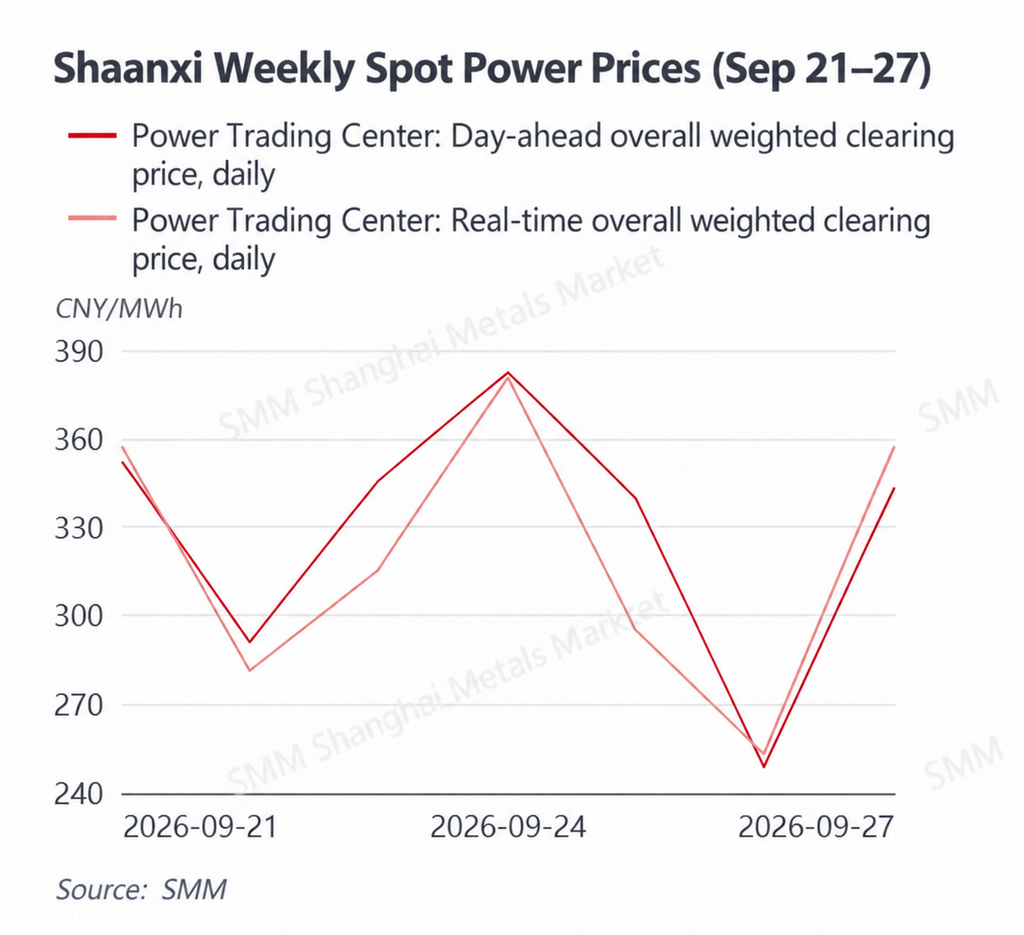
Shaanxi’s price centre continued to move higher, although real-time prices remained slightly below day-ahead levels on a weekly-average basis, indicating relatively balanced actual system conditions. Shaanxi’s weekly day-ahead overall weighted average rose to approximately RMB 328.70/MWh, up around 18.8% from the previous week, while the real-time average increased to approximately RMB 319.79/MWh, up around 8.3%. Day-ahead prices reached a weekly high of RMB 382.51/MWh on September 24, fell to RMB 248.11/MWh on September 26, and then recovered to RMB 343.20/MWh on September 27. Real-time prices followed a broadly similar pattern, peaking at RMB 380.77/MWh on September 24 and bottoming at RMB 252.84/MWh on September 26. Unlike Shanxi, Shaanxi’s weekly real-time average was around RMB 9/MWh lower than its day-ahead average, suggesting that actual operating conditions were not persistently tighter than expected. The weekly increase therefore reflected firmer overall supply-demand conditions and support from coal-fired marginal costs, while actual renewable output continued to determine short-term price direction.
Overall, weekly average prices increased across all six monitored markets, although the underlying drivers were already very different from those seen during peak summer. Guangdong remained supported by high-temperature demand, while prices in Shandong, Jiangsu, Inner Mongolia, Shanxi and Shaanxi were increasingly driven by actual renewable output, real-time load, interprovincial trading and forecast deviations. In particular, intraday prices in Shanxi and Jiangsu remained above day-ahead levels, pointing to tighter-than-expected actual operating conditions. In Shandong, the transition from negative minimum prices early in the week to minimum prices above RMB 300/MWh later on illustrates how quickly system conditions can shift within the same province. On the fuel side, elevated coal prices continued to support coal-fired marginal costs, while the retreat in LNG prices reduced the pace of further increases in gas-fired generation costs in Guangdong.
Primary Energy
September 21–27
Thermal coal: Port prices remained firm at elevated levels while mine-mouth prices diverged, with the market shifting from a one-way rally toward high-level consolidation.
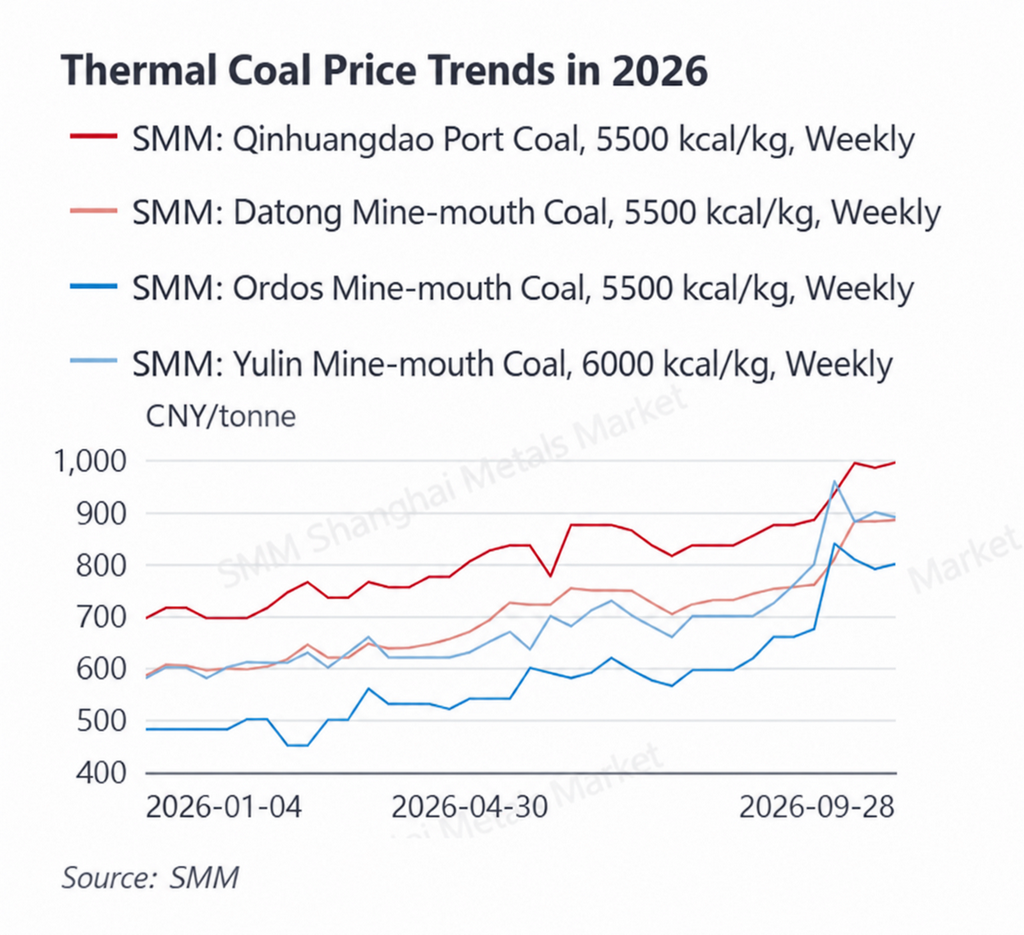
The latest weekly readings show SMM Qinhuangdao Port 5,500 kcal coal at RMB 995/mt on September 28, up from RMB 985/mt on September 18. Over the same period, Datong mine-mouth 5,500 kcal coal edged up from RMB 883/mt to RMB 885/mt, Ordos mine-mouth 5,500 kcal coal rose from RMB 790/mt to RMB 800/mt, while Yulin mine-mouth 6,000 kcal coal fell from RMB 900/mt to RMB 890/mt. Port prices therefore remained firm, but price movements across major producing regions became more differentiated, suggesting that the market was gradually moving from rapid gains toward a high-level consolidation phase.
Supply: Safety supervision remained relatively strict across major coal-producing regions, while production at some mines recovered only gradually, limiting short-term supply growth. Meanwhile, improving economics for shipments from production areas to northern ports supported a recovery in port inflows. With the National Day holiday approaching, production schedules at some mines may face temporary adjustments, while expectations of railway maintenance have also encouraged traders to organize resources in advance. However, the fact that mine-mouth prices no longer rose uniformly suggests that the tightest phase of supply may already be easing.
Demand: Peak-summer demand has largely ended in northern China and power-plant coal burn is entering a seasonal downtrend. However, persistent heat across Jiangnan and South China has slowed the decline in thermal-coal demand at coastal power plants. Pre-holiday inventory replenishment and the gradual start of winter stockpiling in northern China also provided some support. Nevertheless, power-plant inventories remain at generally reasonable levels, and procurement is still focused mainly on term-contract deliveries and essential spot purchases. End-users remain reluctant to chase high spot prices.
Inventories: Northern port inventories remain relatively tight following earlier destocking, while power generators continue to hold adequate inventory buffers. This creates a “tight ports, adequately stocked end-users” structure. In the near term, safety constraints, pre-holiday replenishment and winter stockpiling expectations continue to support prices, but declining temperatures and lower power-sector coal consumption are reducing the momentum for another rapid rally. Thermal coal prices are therefore expected to remain elevated but range-bound.
LNG: Import costs declined during the week and eastern Guangdong prices were adjusted lower, easing some of the earlier cost pressure.
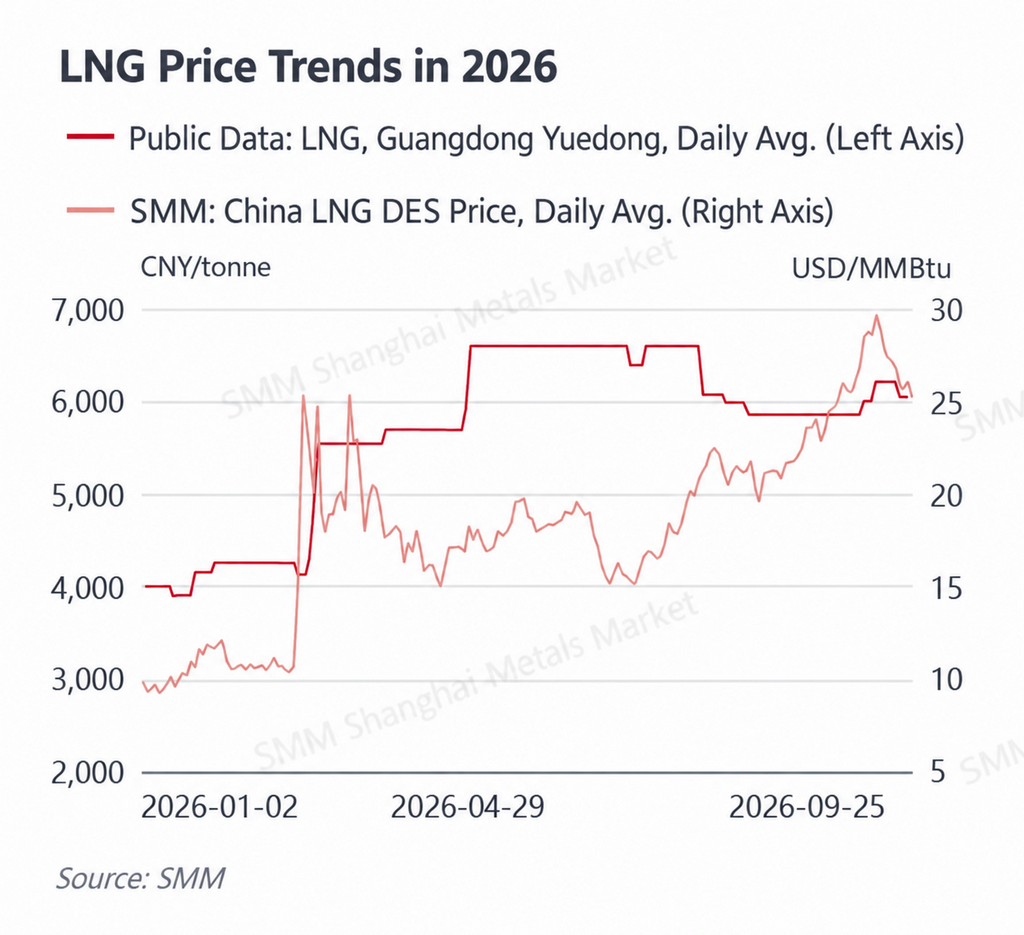
SMM China LNG arrival prices trended lower during the week, falling from USD 26.83/MMBtu on September 21 to USD 25.88/MMBtu on September 22 and USD 25.70/MMBtu on September 23. Prices briefly rebounded to USD 26.11/MMBtu on September 24 before falling again to USD 25.27/MMBtu on September 25, down around 5.8% from the beginning of the week. Eastern Guangdong LNG prices declined from RMB 6,205/mt on September 21 to RMB 6,050/mt on September 22 and remained at that level thereafter.
Supply: The impact of the earlier surge in upstream feedgas costs has not fully disappeared, leaving domestic LNG production costs relatively high. However, as supply gradually recovered and imported spot LNG prices retreated from previous highs, the incentive for suppliers to continue raising prices weakened. Lower imported LNG costs also began to feed through to coastal domestic markets, leading to a modest correction in Guangdong and other regions.
Demand: Natural-gas demand remained structurally differentiated. Persistent heat in Guangdong and other southern regions kept gas-fired power demand relatively resilient, while LNG vehicle demand and some industrial consumption also provided support. However, the heating season has yet to begin in earnest, and downstream buyers remain cautious toward expensive gas. Demand therefore remains insufficient to trigger another rapid LNG rally. With import costs easing, the market has shifted from the previous period of sharp cost-driven increases toward high-level consolidation.
For Guangdong’s power market, the decline in eastern Guangdong LNG prices from RMB 6,205/mt to RMB 6,050/mt should ease the upward pressure on gas-fired marginal generation costs. However, gas prices remain significantly above August levels, meaning gas-fired generation costs still provide support to electricity prices during high-load periods or when renewable output is weak, although their marginal upward impact has weakened compared with the previous two weeks.
Weather Review
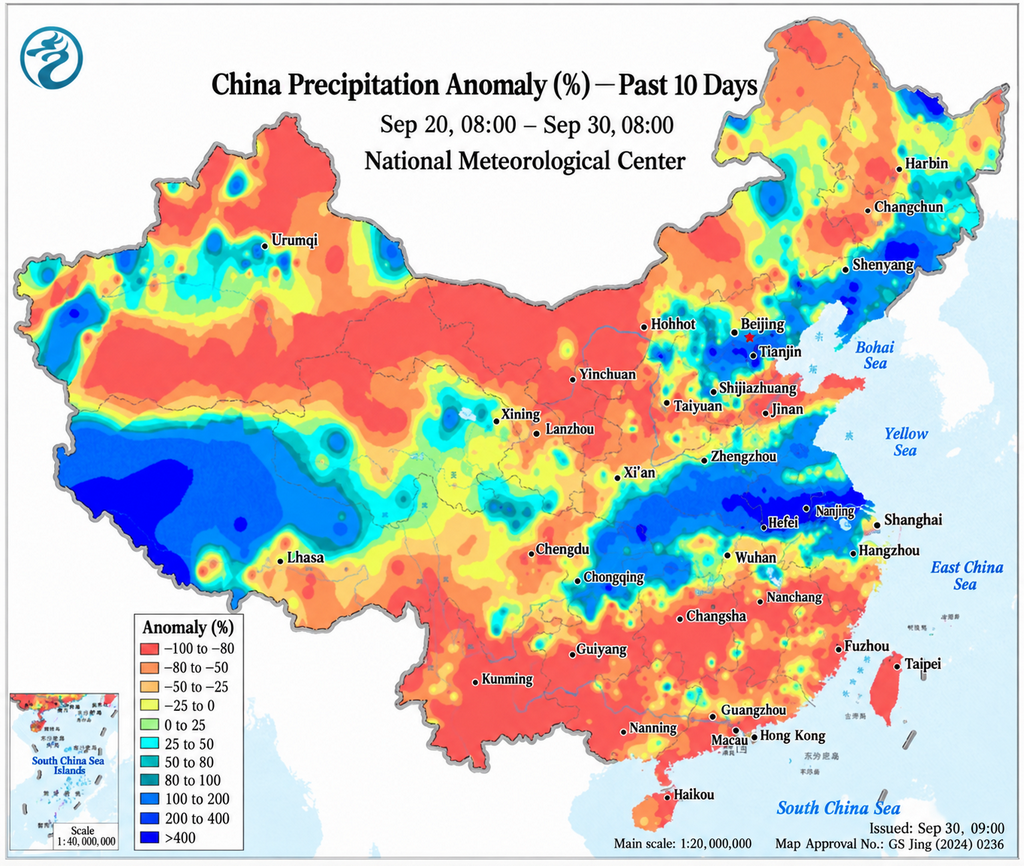
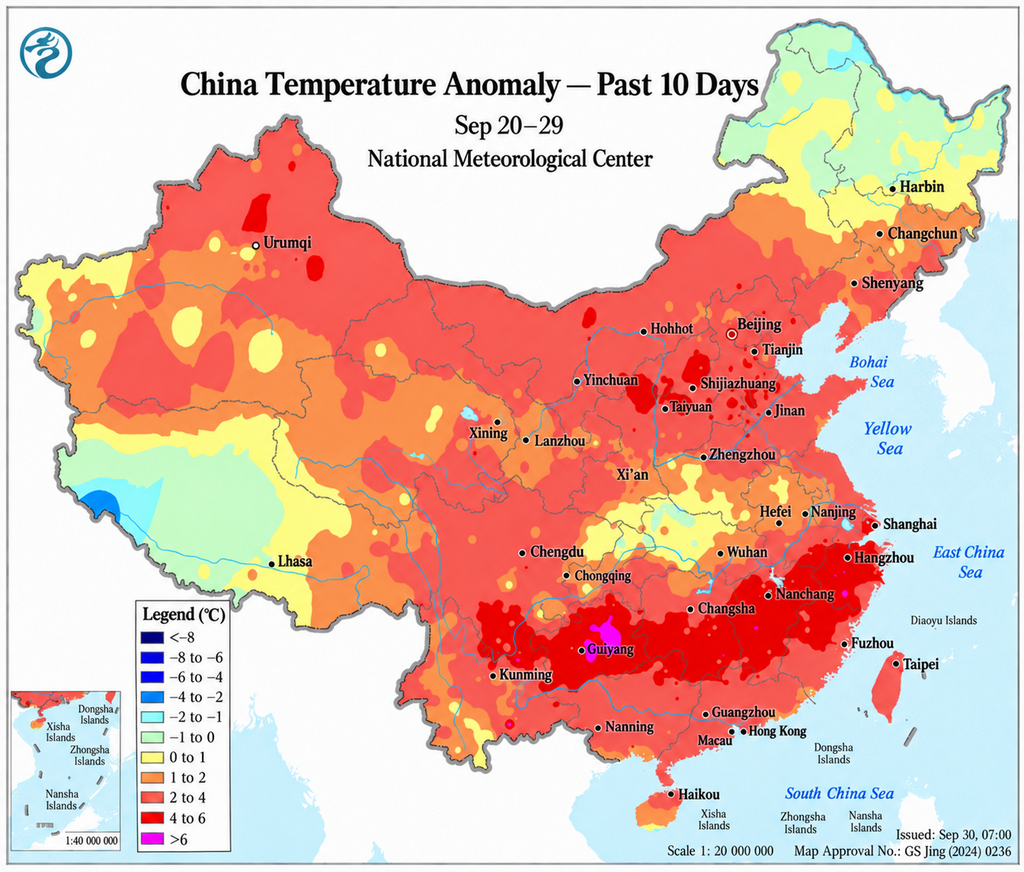
During September 21–27, weather conditions across China remained highly differentiated. The subtropical high continued to influence parts of Jiangnan and South China, keeping late-summer heat in place. Maximum temperatures in Guangdong, Fujian and surrounding areas generally exceeded 33°C, with some areas still recording temperatures above 35°C. In contrast, cold-air activity became more frequent in northern China, widening day-night temperature ranges and further reducing cooling demand.
Rainfall was concentrated from western China toward the Huang-Huai and Jianghuai regions, with relatively heavy precipitation in northeastern Sichuan, northern Chongqing and southern Shaanxi. Rainfall increased in Jiangsu from September 23 onward, accompanied by lower daytime temperatures. Shandong remained mostly sunny during the first half of the week before cloud cover increased and cooler air gradually arrived later on. Guangdong remained generally hot and humid, and intermittent showers had only a limited impact on cooling demand.
From a power-market perspective, weather effects have clearly shifted away from the broad summer pattern of nationwide heat-driven load growth toward greater regional differentiation. Guangdong continued to receive support from high-temperature demand, while northern markets became less sensitive to temperature alone. Wind and solar generation, cloud cover, rainfall and short-term load forecast errors are now playing larger roles in spot-price formation. As cold-air activity strengthens in October, cooling demand is expected to fall further, increasing the importance of actual renewable output in determining short-term spot prices.
II. Key Developments in China’s Power Market
On September 21, the Fujian Provincial Development and Reform Commission and the Fujian Regulatory Office of the National Energy Administration issued the Notice on the Formal Operation of the Fujian Power Spot Market (Min Fa Gai Dian Li [2026] No. 406). The document states that the Fujian power spot market will enter formal operation from September 30, 2026. The market had previously undergone more than 18 months of continuous settlement trial operation and had been tested under summer and winter peak-demand periods, flood seasons, extreme weather and major holidays. The transition to formal operation further expands the number of provincial-level spot markets operating on a permanent basis in China.
On September 21, the Liaoning Provincial Development and Reform Commission issued the Notice on Matters Related to the 2027 Auction for Incremental Renewable Energy Projects (Liao Fa Gai Jia Ge [2026] No. 521). The total electricity volume covered by the mechanism auction is 5.308 billion kWh, including 3.956 billion kWh for wind power and 1.352 billion kWh for solar power. The bidding range for both wind and solar is RMB 0.18–0.30/kWh, the minimum bid-sufficiency ratio is 140%, and the mechanism-price implementation period is 12 years. For centralized projects, the declared mechanism electricity volume may not exceed 60% of total on-grid generation, while the cap for distributed projects is 80%. As mechanism-price auctions become more regular, renewable-project revenues will increasingly depend on a combination of market prices and mechanism-price settlement.
On September 22, the National Energy Administration announced that electricity traded through China’s power markets rose 19.2% year on year during January–August 2026. Power exchanges nationwide completed 5.18 trillion kWh of traded electricity during the period. Of this, interprovincial and interregional transactions totalled 1.1536 trillion kWh, up 12.1% year on year, while spot-market transactions reached 562.7 billion kWh. The continued expansion of traded volumes highlights the growing role of spot markets and cross-regional resource allocation within China’s unified national power market.
On September 23, the National Energy Administration released the Announcement on Newly Registered Renewable Power Projects Nationwide in August 2026 (Excluding Residential PV). A total of 4,007 renewable generation projects were newly registered during the month, including 29 wind projects, 23 centralized solar projects, 3,949 commercial and industrial distributed PV projects and six biomass projects. Commercial and industrial distributed PV accounted for the overwhelming majority of new registrations, with Guangdong adding 704 projects, Jiangsu 566 and Zhejiang 553, indicating that distributed renewable development remains particularly active in eastern load-centre provinces.
Overall, this week’s policy developments continued to focus on the formalization of provincial spot markets, renewable-energy mechanism-price auctions, expansion of interprovincial and spot-market trading, and continued growth in distributed renewable capacity. As spot-market coverage expands and renewable generation becomes more fully exposed to market pricing, generators, electricity retailers and energy-storage operators will face increasing requirements for price forecasting, deviation management and coordinated participation across multiple market segments.
![[SMM Analysis] Coal Prices Hold Firm at High Levels as LNG Costs Rise, Spot Power Prices Diverge Across Provinces](https://imgqn.smm.cn/usercenter/wDeWQ20251217171734.jpeg)

![[SMM Flash] Kenya Power announces power grid maintenance arrangements for three counties, with some areas plan to experience power outages lasting up to 8.5 hours](https://imgqn.smm.cn/usercenter/JNxfy20251217171742.jpg)