I. Power Spot Market Operations
Weekly Overview: From September 14 to 20, temperatures across China remained generally above seasonal norms, with lingering late-summer heat particularly evident in South China. Maximum temperatures in parts of Guangdong reached 35–36°C, while Shandong, Jiangsu and other eastern regions also remained relatively warm during the afternoons. From September 19 onward, a weak cold front began affecting Northwest China, northern parts of North China and Northeast China, bringing localized temperature declines of 4–6°C. Against this increasingly differentiated load pattern, primary-energy costs remained elevated. As of September 18, CCTD Qinhuangdao 5,500 kcal and 5,000 kcal thermal coal prices held at RMB 754/mt and RMB 684/mt, respectively, while the 4,500 kcal grade edged down to RMB 616/mt. Eastern Guangdong LNG prices rose to RMB 6,205/mt. Meanwhile, the SMM China LNG arrival price reached USD 29.74/MMBtu on September 14 before retreating to USD 27.19/MMBtu on September 18. Under the combined influence of high-temperature demand, renewable output and fuel costs, provincial spot markets showed increasingly divergent trends during the week, with price centres moving higher in Shandong, Guangdong and Jiangsu, but lower in Inner Mongolia and Shaanxi. Shanxi, meanwhile, recorded weaker day-ahead prices but a marked rise in intraday prices toward the end of the week.
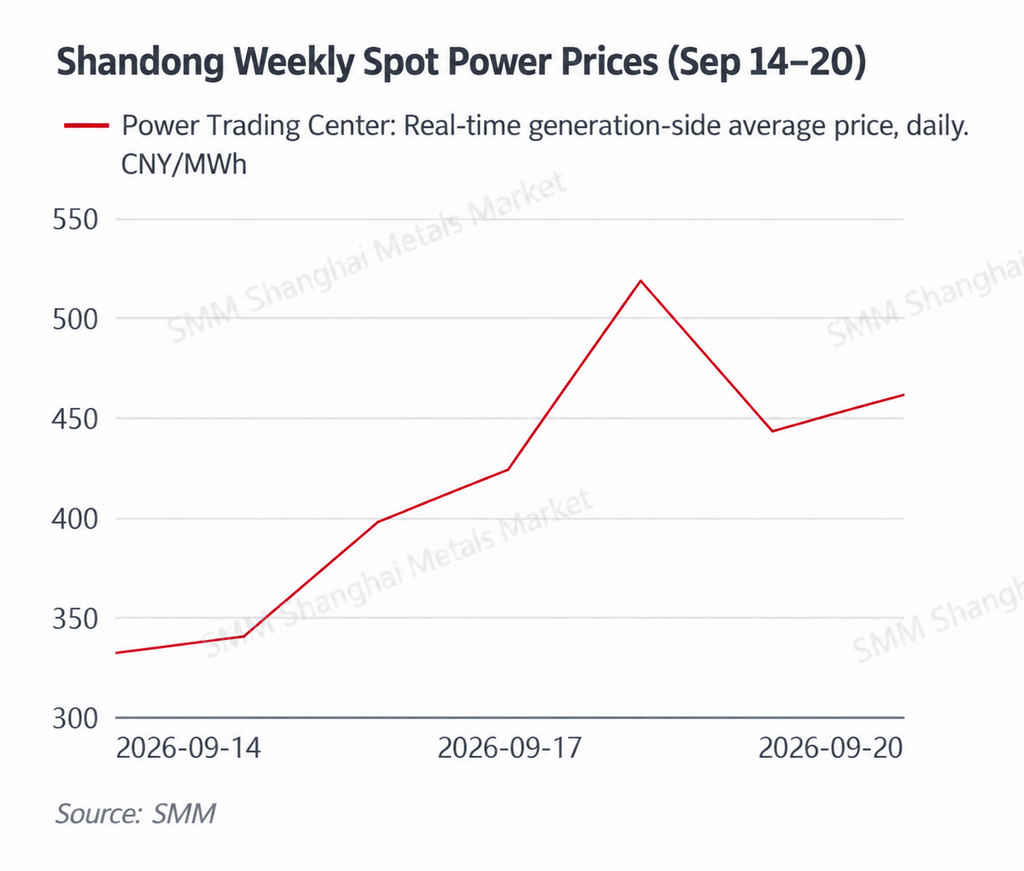
Shandong’s price centre moved higher as resilient heat-related demand and coal-fired generation costs jointly strengthened support. Shandong’s real-time generation-side average price rose from RMB 332.04/MWh on September 14 to RMB 397.17/MWh on September 16 and RMB 423.71/MWh on September 17, before climbing further to RMB 518.58/MWh on September 18. Although prices eased somewhat over the weekend, they remained elevated at RMB 443.02/MWh and RMB 461.59/MWh on September 19 and 20. The weekly real-time average reached approximately RMB 416.62/MWh, up around 18.3% from RMB 352.08/MWh in the previous week. Maximum temperatures across Shandong were mainly around 30–33°C, and persistently warm conditions kept cooling demand more resilient than during the previous week’s cold spell. At the same time, CCTD Qinhuangdao 5,500 kcal coal remained at RMB 754/mt, leaving coal-fired marginal costs with limited room to decline. The combination of firmer demand and elevated fuel costs therefore pushed the provincial spot-price centre higher.
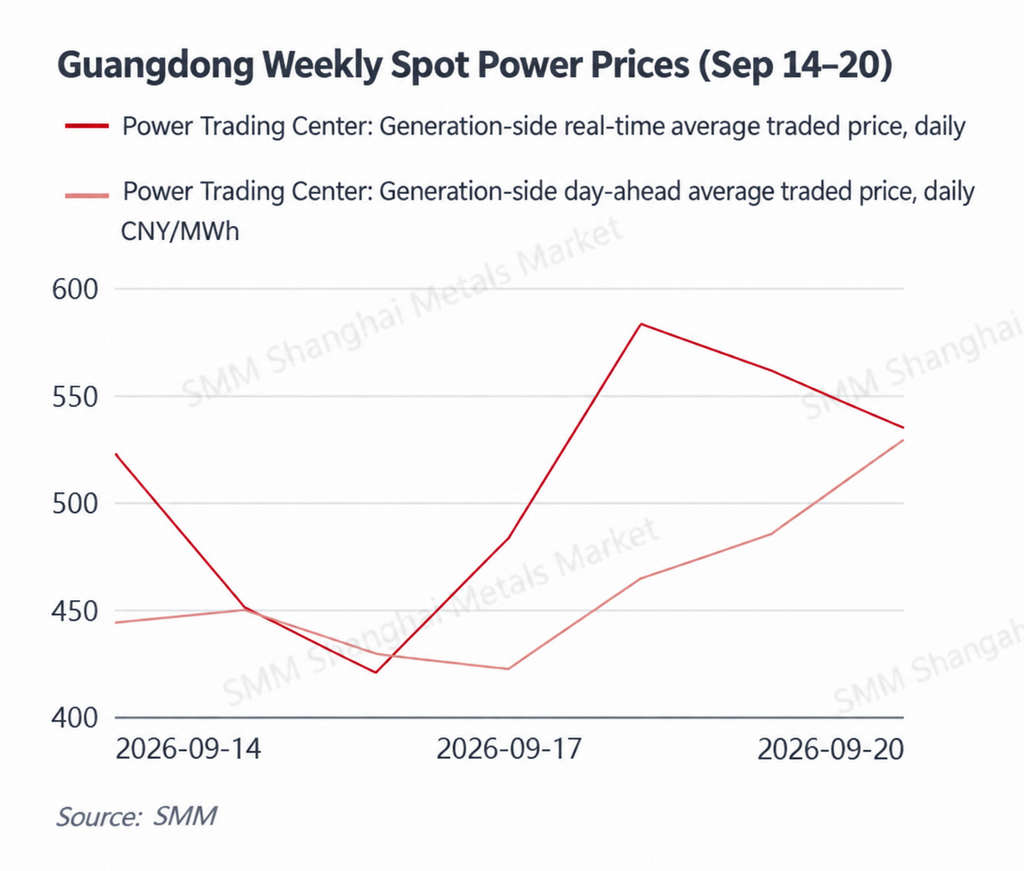
Guangdong spot prices remained elevated, supported by persistent heat and higher gas-fired generation costs, with prices strengthening again late in the week. Guangdong’s day-ahead generation-side average price started at RMB 443.67/MWh, briefly fell to RMB 422.18/MWh on September 17, and then rose steadily to RMB 529.19/MWh on September 20. The weekly average was approximately RMB 460.35/MWh, up around 10.4% week on week. Real-time prices were even more volatile, reaching RMB 522.60/MWh on September 14, RMB 583.15/MWh on September 18 and RMB 561.36/MWh on September 19, with a weekly average of approximately RMB 508.12/MWh, up about 12.5% from the previous week. Temperatures in many parts of Guangdong remained near 35°C, sustaining air-conditioning demand. Meanwhile, eastern Guangdong LNG prices rose further from RMB 6,005/mt to RMB 6,205/mt, lifting the marginal cost of gas-fired generation. Although imported LNG prices retreated from their early-week peak, domestic gas-cost pass-through typically occurs with a lag, leaving gas-fired generation costs relatively high. The combination of persistent heat and elevated gas costs kept Guangdong spot prices at high levels.
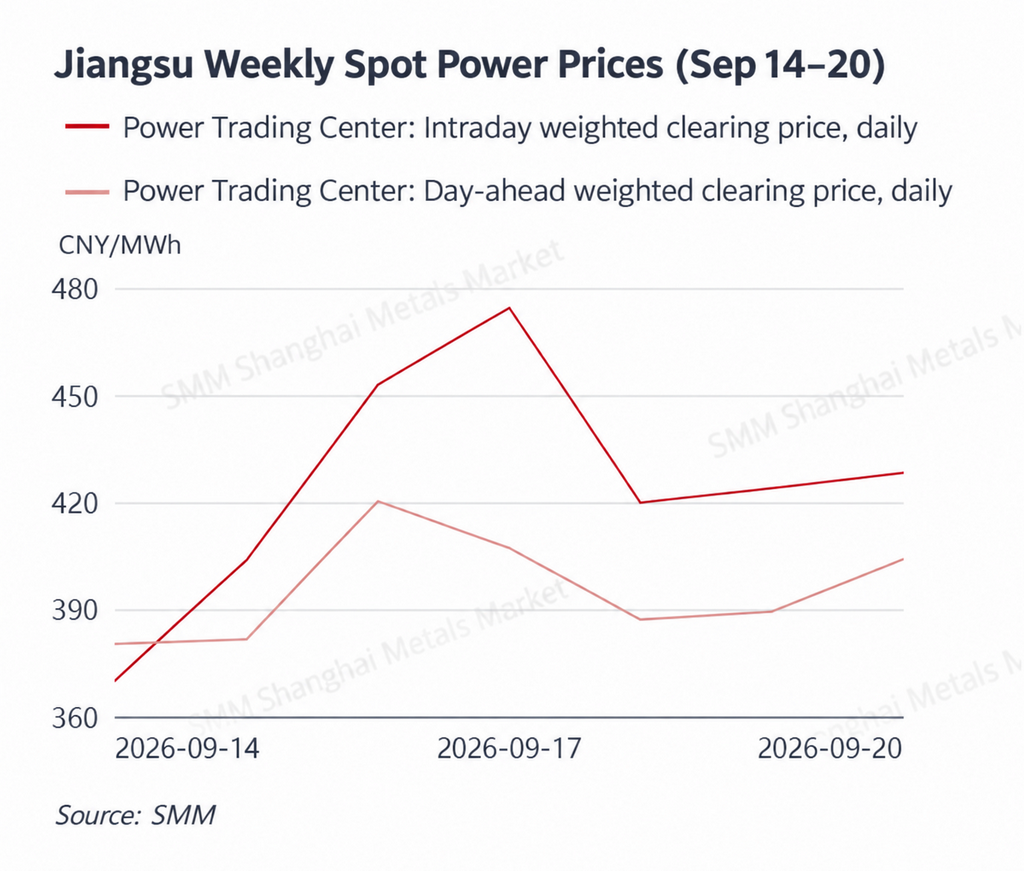
Jiangsu’s day-ahead and intraday prices both strengthened, with intraday prices outperforming as resilient load met firm coal-fired generation costs. Jiangsu’s day-ahead weighted clearing price mainly ranged between RMB 380/MWh and RMB 420/MWh, averaging approximately RMB 395.55/MWh for the week, around 7.0% higher than the previous week. Intraday prices rose from RMB 369.74/MWh on September 14 to RMB 474.48/MWh on September 17 and remained above RMB 420/MWh thereafter, bringing the weekly intraday average to approximately RMB 424.70/MWh, up around 15.3% week on week. Maximum temperatures remained around 29–31°C, meaning the transition out of summer heat was relatively gradual and commercial and industrial load retained a degree of resilience. At the same time, high coal prices kept coal-fired marginal costs firm. The relatively large premium of intraday over day-ahead prices also suggests that actual system conditions were tighter than anticipated in day-ahead forecasts, with renewable-output deviations and real-time load changes exerting a stronger influence on intraday pricing.
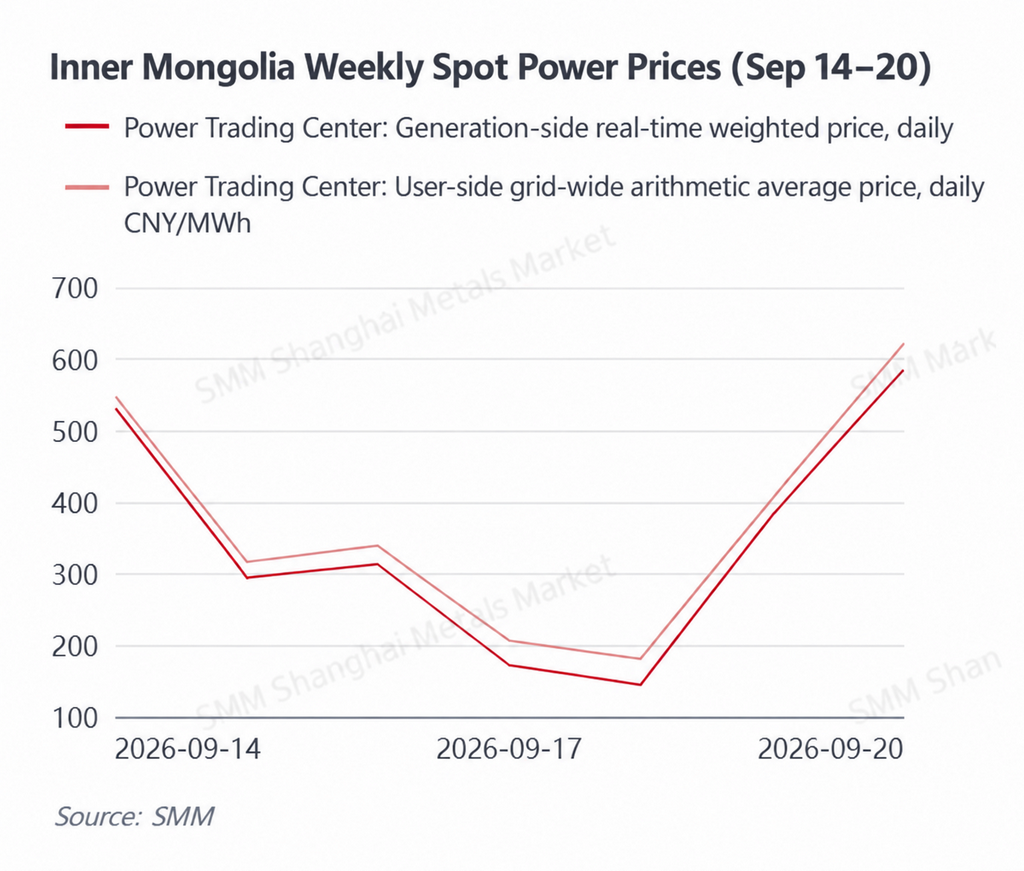
Inner Mongolia recorded wide price swings, with changes in renewable output continuing to dominate short-term market movements. The generation-side real-time weighted average price ranged from just RMB 145.22/MWh to RMB 586.10/MWh during the week. Prices reached RMB 531.59/MWh on September 14 before declining sharply through September 15–18, bottoming at RMB 145.22/MWh on September 18, and then rebounding to RMB 586.10/MWh on September 20. The weekly average was approximately RMB 346.36/MWh, down around 18.4% from the previous week. The system-wide user-side arithmetic average also declined to approximately RMB 374.09/MWh. With a high share of wind and solar generation, Inner Mongolia’s spot market remains highly sensitive to renewable output. Strong wind and solar generation can rapidly depress prices, whereas weaker renewable output increases the need for thermal balancing generation, allowing higher coal-fired marginal costs to amplify upward price movements. Thus, although the weekly average declined, daily price volatility remained pronounced.
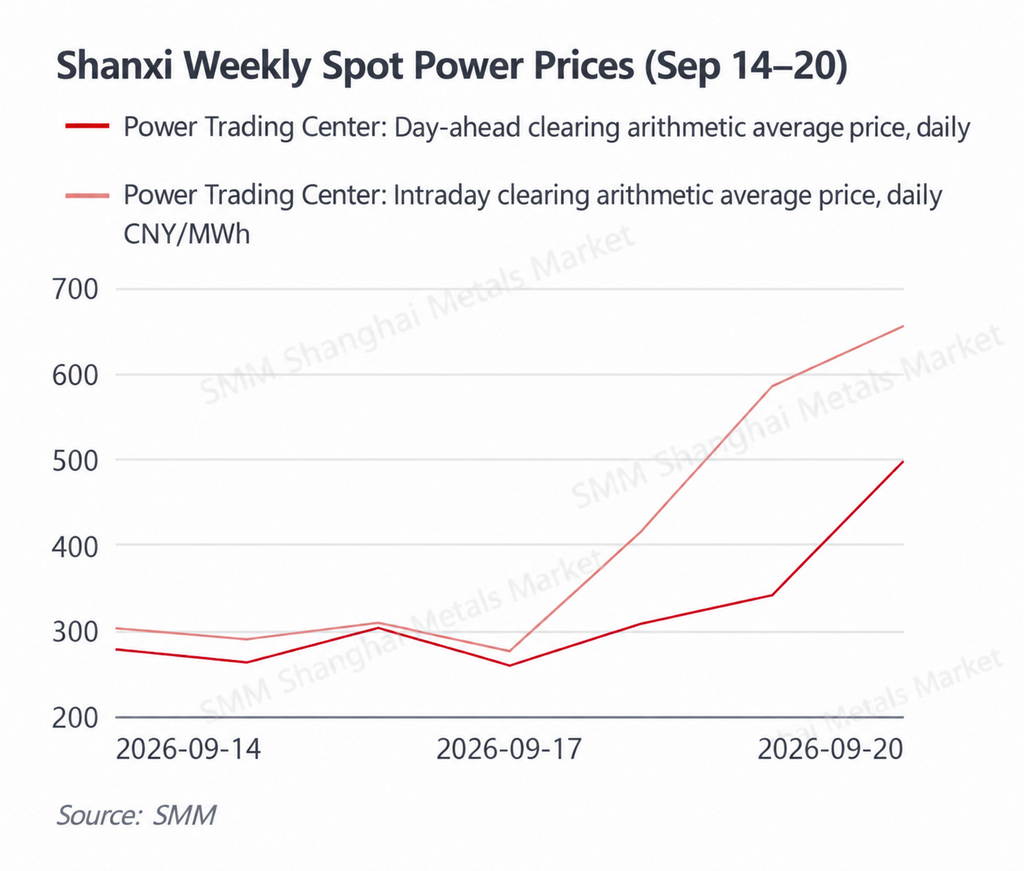
Shanxi showed weaker day-ahead prices but a sharp late-week increase in intraday prices, indicating a substantial widening in real-time supply-demand deviations. Shanxi’s day-ahead arithmetic average clearing price remained mostly around RMB 260–310/MWh in the first half of the week, rose to RMB 341.27/MWh on September 19, and jumped to RMB 497.68/MWh on September 20. The weekly average was approximately RMB 321.70/MWh, down around 6.3% from the previous week. Intraday prices, however, strengthened much more sharply. They remained around RMB 276–309/MWh during September 14–17, then rose to RMB 416.01/MWh on September 18, RMB 585.20/MWh on September 19 and RMB 655.58/MWh on September 20, producing a weekly average of approximately RMB 405.06/MWh, up around 15.3% week on week. The rapid widening of the day-ahead/intraday spread late in the week suggests that actual system conditions became materially tighter than expected in day-ahead schedules. With coal-fired generation accounting for a large share of Shanxi’s generation mix, elevated coal prices can further amplify intraday price spikes when load, exports or alternative generation deviate from expectations.
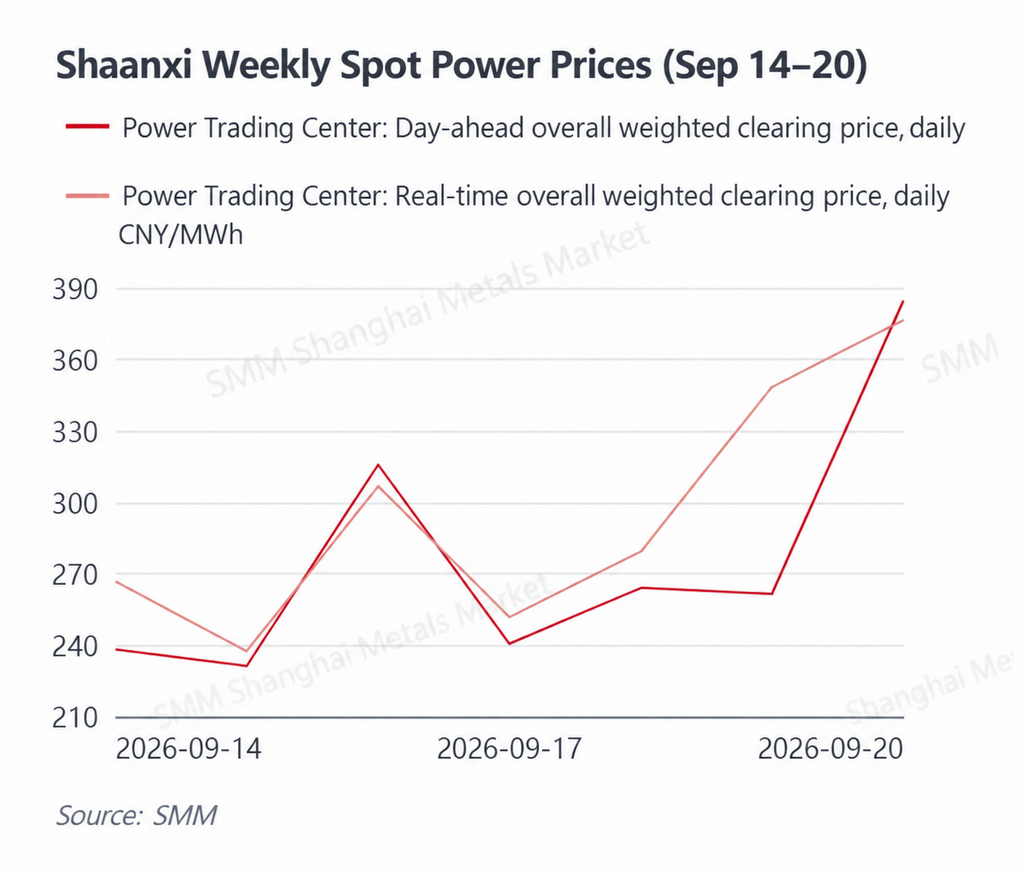
Shaanxi remained relatively weak overall, with some recovery over the weekend but not enough to reverse the weekly decline. Shaanxi’s day-ahead overall weighted average clearing price remained mostly within RMB 232–316/MWh before rising to RMB 384.54/MWh on September 20. The weekly average was approximately RMB 276.70/MWh, down around 12.0% week on week. The real-time overall weighted average was approximately RMB 295.37/MWh, down around 17.6% from the previous week. Real-time prices fell to RMB 237.57/MWh on September 15 before gradually recovering to RMB 376.50/MWh on September 20. Given Shaanxi’s relatively high renewable penetration, fluctuations in wind and solar generation and changes in interprovincial trading remained key short-term pricing variables. Elevated coal costs alone were insufficient to lift prices when renewable output was strong and system conditions were loose, with prices only recovering visibly once supply-demand conditions tightened toward the end of the week.
Overall, provincial spot markets showed clear divergence this week. Shandong, Guangdong and Jiangsu saw their weekly price centres rise as resilient heat-related demand combined with elevated fuel costs. Inner Mongolia and Shaanxi recorded lower weekly averages as renewable output and relatively loose supply-demand conditions weighed on prices. Shanxi showed a distinct structural divergence between weaker day-ahead pricing and sharply stronger intraday prices. As peak-summer demand gradually fades, electricity pricing is becoming less dependent on temperature alone, while renewable output, forecast deviations, interprovincial flows and coal and gas costs are playing increasingly important roles in short-term price formation.
Primary Energy
September 14–20
Thermal coal: CCTD prices stabilised at elevated levels as seasonal demand weakness competed with pre-holiday restocking expectations.
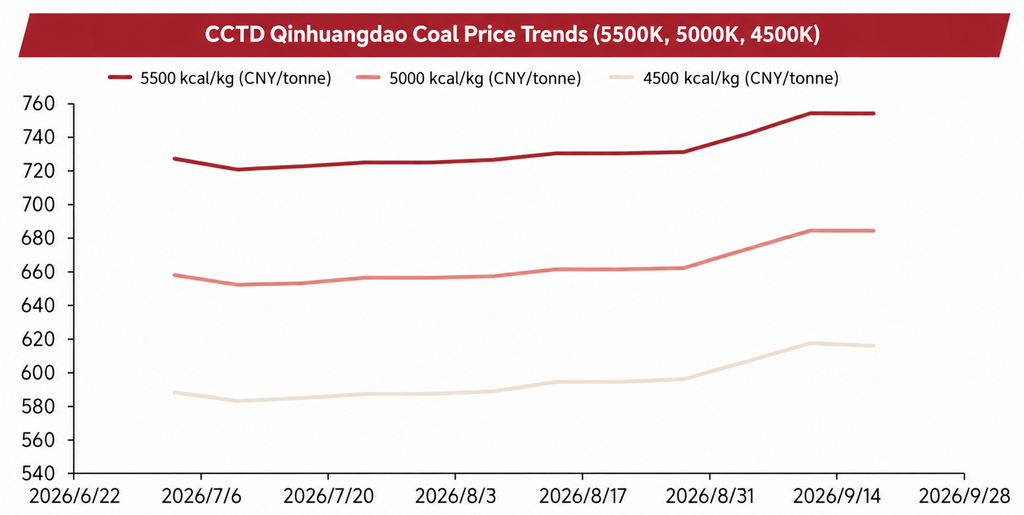
As of September 18, CCTD Qinhuangdao 5,500 kcal thermal coal stood at RMB 754/mt, unchanged from the previous week. The 5,000 kcal grade also held steady at RMB 684/mt, while the 4,500 kcal grade edged down by RMB 1/mt to RMB 616/mt. Following the earlier rally, port coal prices moved into a high-level consolidation phase, with the market shifting from a relatively one-directional increase toward a more balanced tug-of-war between supply and demand.
Supply: Safety supervision in major coal-producing regions remained relatively strict, and output at some mines had yet to return fully to normal levels, continuing to limit short-term supply elasticity. At the same time, improving transport conditions supported higher inflows into northern ports. With the National Day and Mid-Autumn Festival holidays approaching, some mines that had largely completed monthly production targets could reduce output temporarily, while expectations of maintenance on the Daqin railway have encouraged some shipments to be brought forward. As a result, the near-term supply environment is unlikely to loosen rapidly.
Demand: Peak-summer power demand is drawing to a close, and northern electricity load has begun to decline. However, persistent heat across parts of East and South China has kept coastal power-plant coal burn relatively resilient. Ahead of the holiday period, some power generators have also increased replenishment, while winter stockpiling demand in northern regions is gradually emerging. Nevertheless, power-plant inventories remain generally adequate, and procurement continues to focus on term-contract deliveries and essential spot purchases. Acceptance of high spot prices remains limited. Non-power-sector demand has improved modestly in some industries, but has not yet developed into a sustained source of incremental demand.
Inventories: Port inventories remain relatively low following earlier destocking, while power-plant coal stocks still provide a comfortable buffer. The market therefore continues to display a “tight port resources, adequate end-user inventories” structure. Safety constraints, pre-holiday replenishment and expectations for winter stockpiling provide support to prices, but seasonal demand weakness limits further upside. Thermal coal prices are therefore expected to remain broadly range-bound at elevated levels in the near term, with attention focused on production recovery, port inflows and the timing of large-scale winter restocking.
LNG: Domestic prices continued to rise while imported costs retreated from an early-week peak, leaving gas-fired generation costs in Guangdong well supported.
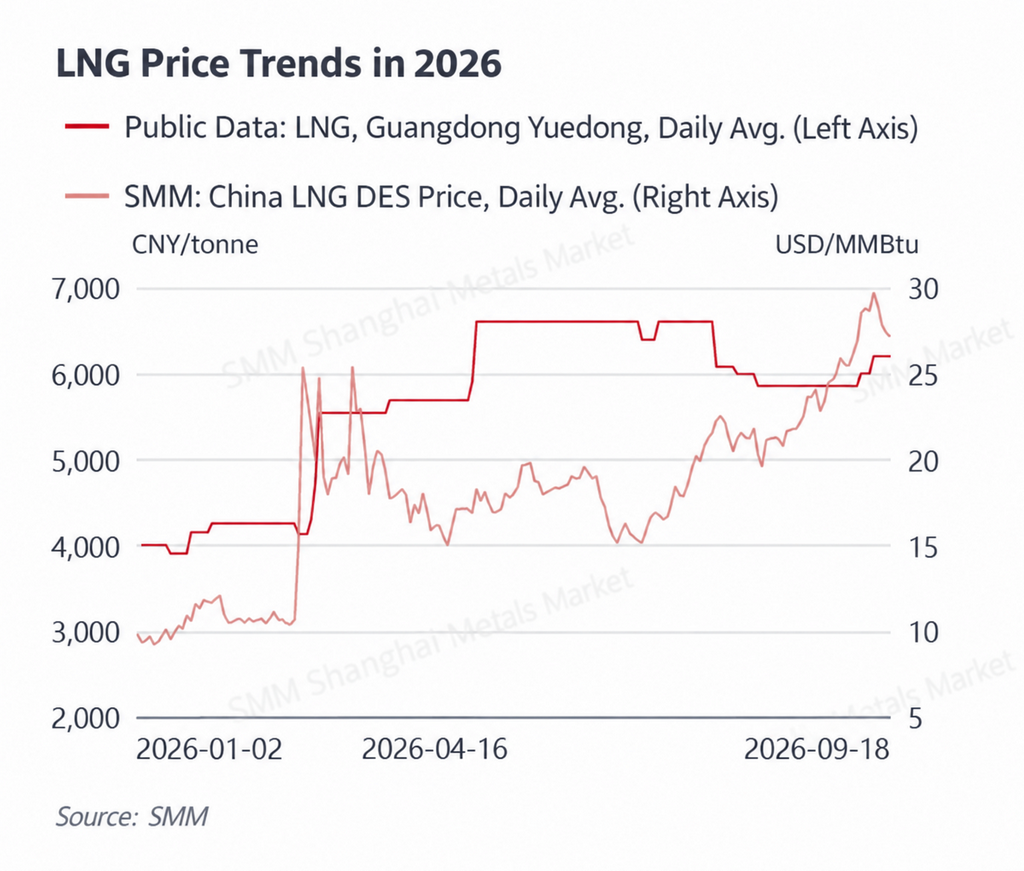
As of September 18, average LNG prices in eastern Guangdong remained at RMB 6,205/mt, up RMB 200/mt from RMB 6,005/mt in the previous week. SMM China LNG arrival prices, meanwhile, showed a clear spike-and-retreat pattern. Prices reached USD 29.74/MMBtu on September 14 before falling to USD 28.94/MMBtu on September 15, USD 27.81/MMBtu on September 16, USD 27.38/MMBtu on September 17 and USD 27.19/MMBtu on September 18. Despite the correction from the weekly high, imported LNG costs remained elevated.
Supply: Earlier increases in domestic feedgas costs lifted production costs for LNG plants in major producing regions such as Northwest China. Maintenance at some facilities further constrained short-term supply flexibility and reduced producers’ willingness to discount cargoes. Imported LNG costs have eased after the previous sharp rally, but the earlier increase continues to feed through to coastal domestic markets, keeping LNG prices in Guangdong and other coastal regions relatively firm.
Demand: LNG demand has not experienced a broad-based recovery. Industrial users remain cautious toward higher prices, but improved economics for LNG-fuelled vehicles and expectations of autumn and winter inventory building provide some incremental support. In Guangdong, persistent hot weather has also maintained a degree of gas-fired power demand. With eastern Guangdong LNG prices at RMB 6,205/mt, the marginal generation cost of gas-fired units has risen further, providing stronger cost support to spot electricity prices during high-load periods. Domestic LNG prices are expected to remain elevated in the near term, with the pace of temperature declines, recovery of liquefaction-plant supply and winter inventory building remaining key variables.
Weather Review
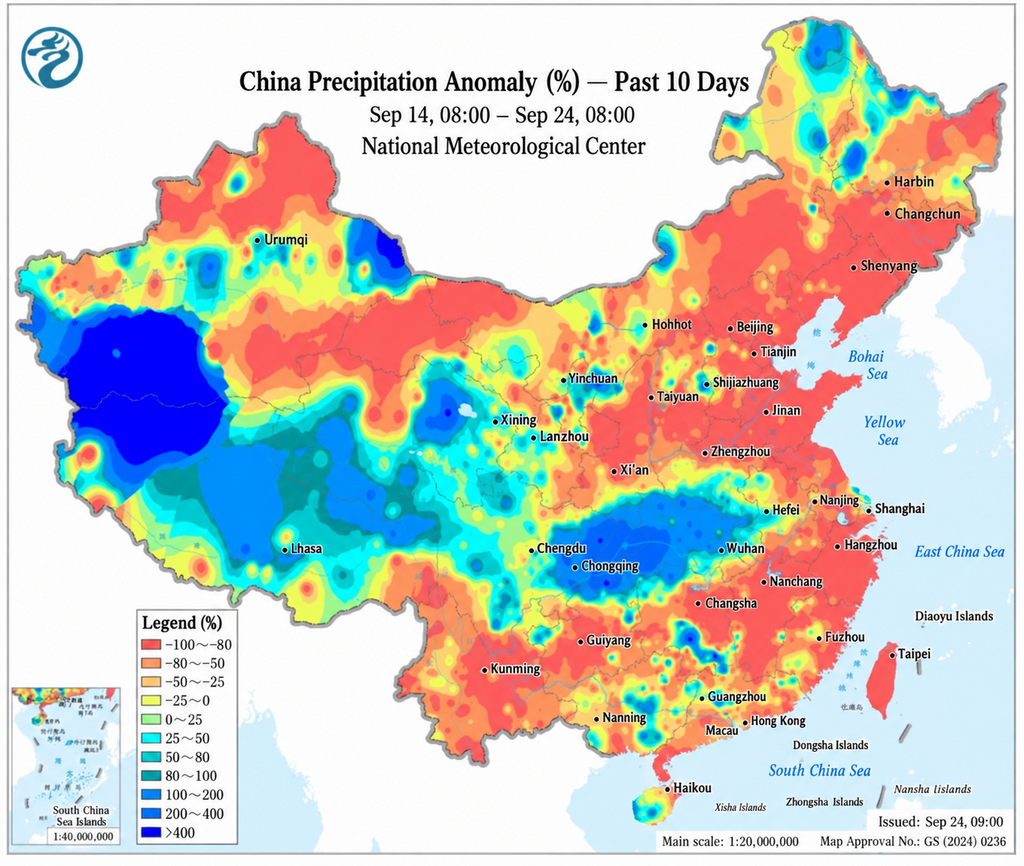
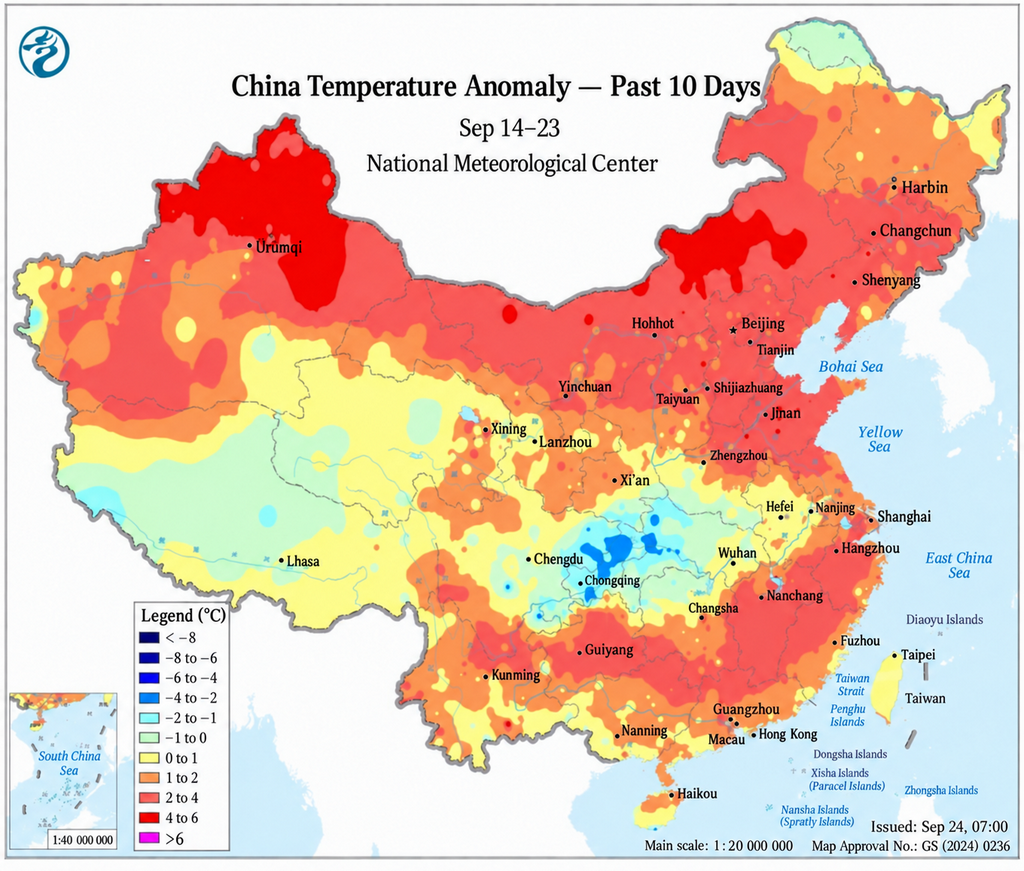
During September 14–20, temperatures across China were generally above seasonal norms, with the late-summer heat pattern remaining relatively pronounced. Cold-air activity was initially weak, while most of central and eastern China experienced predominantly sunny and warm conditions. South China remained particularly hot, with maximum temperatures in parts of central and northern Guangdong reaching 35–36°C. Some areas of Shandong reached around 33°C, while Jiangsu mainly recorded maximum temperatures of 29–31°C.
From September 19 onward, a weak cold-air mass began moving eastward from Northwest China, bringing temperature declines of around 4–6°C to parts of Northwest China, northern North China and Northeast China and gradually weakening northern power demand. Rainfall remained relatively frequent across Southwest China and parts of western China, though accumulated precipitation was generally limited. Typhoon Dujuan, the 25th named storm of the season, formed over the northwestern Pacific on September 16 but remained far offshore and had limited direct impact on China’s coastal power markets.
Overall, weather impacts remained highly regional. Persistent warmth across East and South China helped maintain cooling demand in Shandong, Guangdong and Jiangsu, while cooler conditions in northern regions weakened load later in the week. As cold-air activity becomes more frequent in late September, direct temperature-driven support for electricity prices is expected to weaken, while wind and solar output and short-term load forecast deviations are likely to become increasingly important.
II. Key Developments in China’s Power Market
On September 15, the East China Energy Regulatory Bureau, the Anhui Provincial Development and Reform Commission and the Anhui Provincial Energy Administration jointly issued the Implementation Rules for the Anhui Power Frequency Regulation Ancillary Services Market (Trial) (East China Energy Regulation Market [2026] No. 87). The rules further broaden participation by flexible resources, adopt a frequency-regulation mileage bidding range of RMB 1–6/MW, and establish a cost-allocation mechanism under which commercial and industrial users currently bear 90% of applicable frequency-regulation ancillary-service costs. Following the formal launch of Anhui’s power spot market, the revised frequency-regulation framework further expands the potential for energy storage and other flexible resources to combine spot-market and ancillary-service revenues.
On September 16, the Liaoning Provincial Department of Industry and Information Technology released the Liaoning Power Market Operation Rules (Version 5.0, Draft for Comments). The revision was prepared on the basis of Liaoning’s continuous spot-market settlement trials and updates the previous Version 4.0 rules. The draft further develops the market framework as Liaoning moves toward a more comprehensive spot-market system.
On September 17, the Shanghai Power Exchange circulated the East China Energy Regulatory Bureau’s draft Implementation Rules for the Shanghai Power Frequency Regulation Ancillary Services Market (Trial) for public comment. The proposed market would use frequency-regulation mileage as the trading product under a single-price, performance-based mechanism, with a bidding range of RMB 3–15/MW and a “day-ahead bidding, intraday clearing, real-time dispatch” structure. New energy-storage facilities and other flexible resources would also be eligible to participate subject to the proposed requirements. For Shanghai, a major load-centre grid, the mechanism would create an additional market-based channel for monetising short-duration flexibility.
On September 17, the Shanxi Energy Regulatory Office reported enforcement action against 29 market participants for coordinated bidding violations. Using its digital regulatory platform, the regulator identified eight suspected coordinated-bidding cases involving one wholesale user, six electricity retailers and 22 generators. Rectification notices were issued to all 29 companies, while two generators that had repeated similar violations were formally placed under investigation for potential administrative penalties. The case highlights the shift toward more frequent data-driven monitoring of trading behaviour as spot-market operations mature.
On September 18, the National Development and Reform Commission, the National Energy Administration and the National Mine Safety Administration jointly deployed measures to support safe and stable coal production and supply. Coal-producing regions and enterprises were instructed to accelerate the resumption and normalisation of production while maintaining safety standards, strengthen fulfilment of medium- and long-term thermal-coal contracts, make appropriate use of imported coal and advance replacement production capacity. The measures improve the outlook for coal supply, although actual output recovery will take time, meaning the cost support provided by coal prices to thermal generation is unlikely to disappear immediately.
![[SMM Analysis] Southern Heat Persists as High Coal Prices Provide Cost Support, Spot Power Prices Move Higher](https://imgqn.smm.cn/usercenter/LVqfJ20251217171736.jpg)

![[SMM Flash] Kenya Power announces power grid maintenance arrangements for three counties, with some areas plan to experience power outages lasting up to 8.5 hours](https://imgqn.smm.cn/usercenter/JNxfy20251217171742.jpg)