SMM, September 29:
In the metals market:
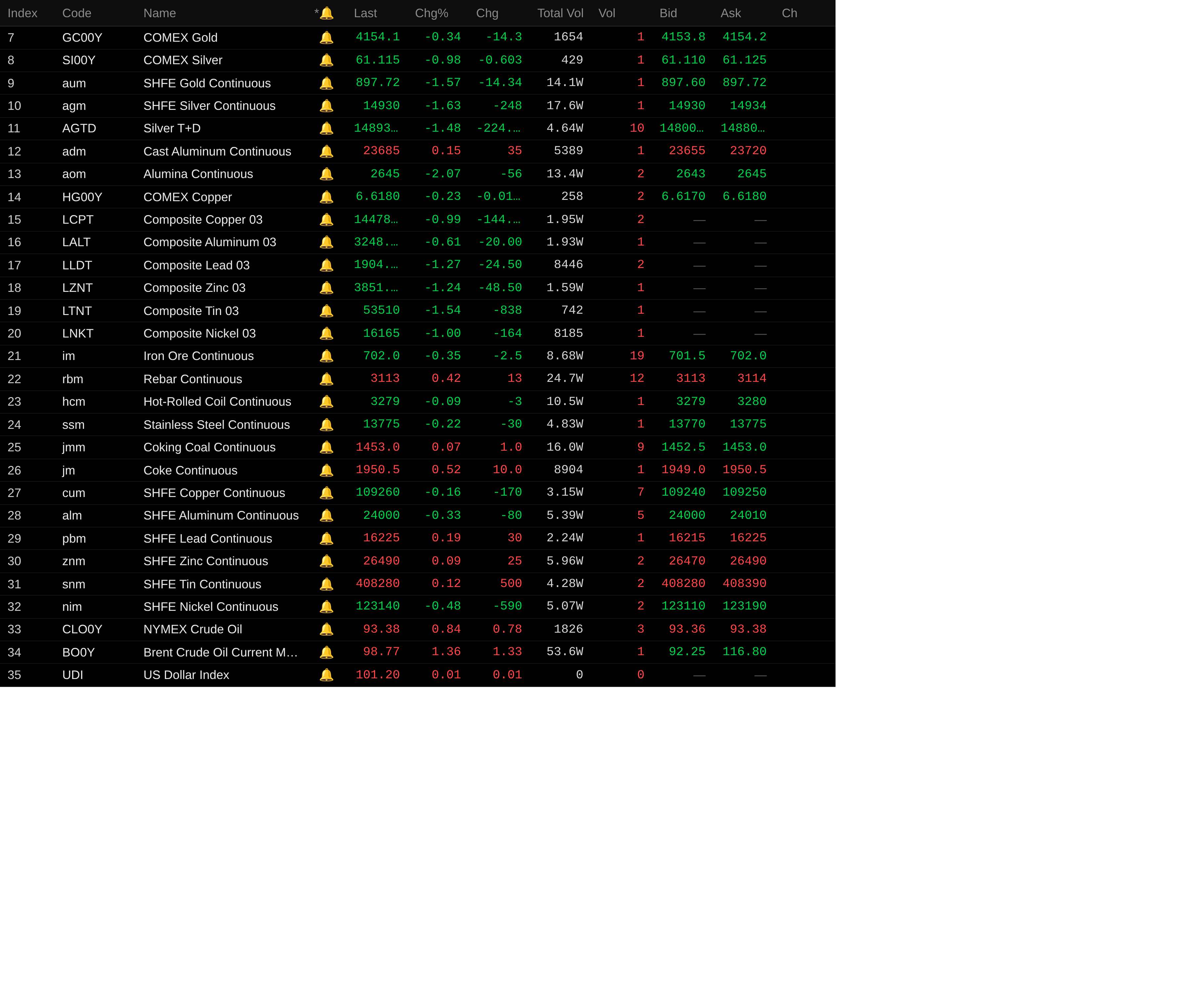
Overnight, base metals on the domestic market showed mixed performance. SHFE copper fell 0.16%, SHFE aluminum fell 0.33%, and SHFE lead rose 0.19%. SHFE zinc edged up 0.09%, and SHFE tin rose 0.12%. SHFE nickel fell 0.48%. In addition, the most-traded alumina futures contract fell 2.07%, while the most-traded cast aluminum contract rose 0.15%.
Overnight, ferrous metals showed mixed performance. Stainless steel fell 0.22%. Iron ore fell 0.35%, and rebar rose 0.42%. Hot-rolled coil edged down. In coking coal and coke: the most-traded coking coal contract rose 0.07%, and the most-traded coke contract rose 0.52%.
Overnight in the overseas metals market, LME base metals fell across the board. LME copper fell 0.99%, and LME aluminum fell 0.61%. LME lead fell 1.27%. LME zinc fell 1.24%. LME tin fell 1.54%. LME nickel fell 1%.
Overnight in the precious metals market: COMEX gold fell 4%, hitting an intraday low of $4,143.1/oz; COMEX silver fell 5.82%. Overnight, the most-traded SHFE gold contract fell 1.57%, and the most-traded SHFE silver contract fell 1.63%.
As of 7:07 on September 29, overnight closing prices:
Macro front
Domestic news:
[State Council Executive Meeting: Study the introduction of policy measures to stabilize the real estate market and boost employment and income] Premier Li Qiang chaired a State Council executive meeting on September 28 to study efforts to enhance the effectiveness of macro policies and promote effective investment, hear a report on progress in the treatment of new pollutants, and review and approve the Regulations on the Administration of Registration of Public Institutions (Draft). The meeting noted that in response to current problems in economic operations, it is necessary to strengthen countercyclical macro policy adjustments, promote sustained improvement in the economy, and strive to achieve the annual economic and social development targets. Efforts should be intensified to ensure the implementation of various policies. Existing policies should be made more effective in implementation, the issuance and use of various bonds should be accelerated, and major engineering projects specified in the 15th Five-Year Plan and the "Six Networks" implementation plan should be started as early as possible. Renovation and upgrading of aging reservoirs and grain depots should be advanced, and subsidized loan policies for expanding investment and boosting consumption should be implemented more vigorously. A batch of practical and effective incremental policies should be introduced, fiscal expenditure arrangements should be optimized, the unused local government debt limits should be put to good use, monetary policy tools should be applied comprehensively and adjusted in a timely manner, relending quotas for technological innovation and equipment upgrades and for supporting agriculture and small businesses should be increased, and policy measures to stabilize the real estate market and boost employment and income should be studied and introduced. Efforts should be coordinated across all levels to stabilize investment, ensure high-quality project preparation, stimulate the vitality of private investment, strengthen the guarantee of production factors for investment projects, and improve the efficiency of investment approval. Work should continue on researching and building up policy measures to boost domestic demand, devising more workable levers with strong driving effects, improving relevant supporting measures, and encouraging regions with the necessary conditions to take the lead in piloting new approaches. (CCTV News)
[MIIT and six other departments jointly issue the 15th Five-Year Plan for the Development of the New-Type Battery Industry: By 2030, all-solid-state batteries will initially achieve large-scale application] On September 28, the 15th Five-Year Plan for the Development of the New-Type Battery Industry, jointly formulated by seven departments including the Ministry of Industry and Information Technology, the National Development and Reform Commission, and the Ministry of Transport, was officially released (hereinafter referred to as the "Plan"). New-type batteries are high-efficiency electrical energy storage and conversion devices or systems centered on innovation in new mechanisms, new materials, new structures, and new processes. Represented by lithium batteries, sodium-ion batteries, and flow batteries, they are characterized by rapid technological iteration, a wide range of applications, and strong spillover and driving effects. The Plan sets the goal that by 2030, the scale of China's new-type battery industry will achieve steady growth; innovation capabilities across the entire chain will continue to strengthen, major breakthroughs will be made in advanced materials, significant progress will be achieved in R&D on new-system batteries, all-solid-state batteries will initially achieve large-scale application, the cycle life of long-life lithium batteries will reach 15,000 cycles, and the product defect rate of top-tier players will reach the PPB (parts per billion) level; the ecosystem for full-scenario applications will be built at an accelerated pace, and battery technology will be integrated and innovatively developed with clean energy and end-user energy consumption at a faster pace; and the integrated advancement of international trade and investment will be further promoted to serve global green and low-carbon development.
[Shanghai issues local implementation opinions on reforming the commercial housing sales system: Strengthen pre-sale management and orderly implement completed-home sales] Shanghai has issued local implementation opinions on reforming the commercial housing sales system. The Implementation Opinions stipulate that starting from August 28, 2026, commercial housing projects on newly announced land transfers will give priority to completed-home sales; for projects subject to completed-home sales, relevant information on completed-home sales shall be disclosed to the public in the land transfer announcement. After obtaining the initial registration of the housing, real estate development enterprises shall apply to the housing administration department of the district where the project is located for completed-home sales filing. The Implementation Opinions explicitly promote a deposit system for completed-home sales. Real estate development enterprises may, after obtaining the construction project construction permit, sign a home purchase deposit contract with buyers, and the deposit shall generally not exceed 3% of the total purchase price. If a real estate development enterprise breaches the contract and fails to deliver the housing on schedule, the buyer has the right to request termination of the deposit contract in accordance with the contract, and the real estate development enterprise shall return the deposit in accordance with the law and bear liability for breach of contract.
[SHFE approves Jinchuan Group Co., Ltd. to add the "JNMC" brand Grade A copper (permanent cathode-K) registered origin]The SHFE announced that it recently received the relevant application materials submitted by Jinchuan Group Co., Ltd. In accordance with the "Shanghai Futures Exchange Nonferrous Metals Deliverable Commodities Management Regulations" and other relevant provisions, after review and decision: Jinchuan Group Yongchang Copper Co., Ltd., a subsidiary of Jinchuan Group Co., Ltd., is approved to register its "JNMC" brand Grade A copper (permanent cathode-K) with the exchange, with a registered capacity of 400,000 mt, at the standard price. From the date of this announcement, the above products may be used for delivery against copper cathode futures contracts on the exchange. (Jin10 Data APP)
US dollar:
The US dollar index rose 0.16% overnight to 101.19.
Fed Governor Lisa Cook said US inflation will continue to face pressure in the coming months, mainly from AI-related demand growth, rising oil prices, and supply chain disruptions caused by Middle East conflicts,but she did not explicitly indicate that further interest rate hikes are needed.Cook said the labour market is currently "capable of withstanding higher interest rates," and the magnitude and frequency of future monetary policy adjustments will depend on how the economy responds to policy actions, as well as inflation and employment data in the coming months. She said that as of August, the US 12-month headline inflation rate was about 3.8%, still well above the Fed's 2% target. Cook noted that demand from AI infrastructure buildout will continue to add inflationary pressure in the near term, and although AI-driven productivity gains may have some disinflationary effect in the medium term, this year it will not be fast enough to offset current inflationary pressures. She said there is no clear evidence yet that AI is reshaping the labour market, but the Fed is closely monitoring the risk that it could lead to a phased rise in unemployment. Cook also said that if the job market is hit by AI in the future, the Fed's room to respond would be limited, because cutting interest rates to support employment could further push up inflation.
According to CME "FedWatch": the probability of the Fed keeping rates unchanged at 3.75%-4.00% at the October meeting is 29.1%, and the probability of a 25bp hike is 70.9%. The probability of the Fed keeping rates unchanged at 3.75%-4.00% by December is 5.0%, the probability of a cumulative 25bp hike is 36.3%, and the probability of a cumulative 50bp hike is 58.7%. (Jin10 Data APP)
ING analyst Francesco Pesole said in a report that unless Friday's US nonfarm payrolls report comes in far stronger than expected, the US dollar may struggle to sustain its recent strong upward momentum."Although it may be too early to call a decline in oil prices, news of a US-Iran agreement on the Strait of Hormuz could prevent further gains in the dollar. He said this could help stabilise the government bond market and risk sentiment. In addition, according to ING's short-term valuation model, the dollar currently looks overvalued. He said the US dollar index DXY rose 0.1% to 101.101, but a pullback to around 100.50 would be more consistent with fundamentals. ING expects this week's jobs data to keep the market guessing whether the US Fed will raise rates again in October.
On the data front:
Today will bring the Reserve Bank of Australia's rate decision for the period to 29 September, Switzerland's September KOF economic leading indicator, UK August mortgage approvals, eurozone September industrial sentiment, eurozone September economic sentiment, Canada July monthly GDP, US July FHFA house price index m/m, US July S&P/CS 20-city unadjusted house price index y/y, US August JOLTS job openings, and US September Conference Board consumer confidence.
Also in focus: US Fed Governor Lisa Cook speaks; 2027 FOMC voter and Richmond Fed President Barkin speaks; the Reserve Bank of Australia announces its rate decision; RBA Governor Bullock holds a monetary policy press conference; US President Trump, House Speaker Johnson and CEOs of several technology companies hold a meeting on artificial intelligence.
In crude oil:
Both oil futures rose overnight, with WTI up 0.95% and Brent up 1.36%.
As the US-Iran standoff continues to escalate, oil prices swung wildly, and intraday fluctuations say far more about the market's fragility than closing prices do. Brent and WTI repeatedly whipsawed between multiple "breaking news" items: the resumption of exports through Saudi Arabia's east-west pipeline pushed prices lower, reports of an explosion in a Saudi city pushed prices higher, then reports that "Iran agreed to suspend uranium enrichment" pushed prices lower again, while news of "major differences in US-Iran negotiations" sparked a rebound in prices. (Wall Street Journal)
Saudi Arabia's east-west crude pipeline has been repaired and exports have resumed after a drone attack, and the restart of this key energy corridor is reshaping the global crude supply landscape while putting pressure on the recent rally in oil prices. On Tuesday, the Wall Street Journal reported, citing people familiar with the matter, that state oil company Saudi Aramco began loading crude through the east-west pipeline at the Red Sea port of Yanbu on Sunday, with current pipeline throughput of about 3.5 million barrels per day. Meanwhile, Saudi Arabia's crude oil loadings at the Strait of Hormuz had already climbed significantly, and the prospect of both export routes operating simultaneously drew close market attention. After the announcement, the international benchmark Brent crude price narrowed its gains on Monday. (Wall Street CN)