Silicon steel industry supply-demand divergence intensifies; exports offset domestic capacity pressure
In recent years, China's overall silicon steel capacity has continued to expand rapidly, with prominent structural contradictions in the industry. Overcapacity in low and mid-end ordinary grades of non-oriented silicon steel has become increasingly evident. Limited growth in domestic demand from traditional home appliances and general industrial motors, with demand boost relying solely on high-grade products such as new energy vehicles, makes it difficult to fully absorb new production. Domestic supply remains ample, and supply-demand pressure is relatively high. Grain-oriented silicon steel is generally in a tight balance, with low and mid-end products gradually saturating, while supply gaps remain for high magnetic induction, ultra-low loss high-end grades. Leveraging China's complete steel industry chain support, stable product quality, and large-scale cost advantages, the global price-performance competitiveness of domestic silicon steel has steadily strengthened. With manufacturing shifts to Southeast Asia, Latin America, and South Asia, coupled with rigid incremental demand from the popularization of high-efficiency motors and energy-saving transformers outside China, exports have become an important channel for the industry to absorb surplus capacity. Low and mid-end non-oriented and ordinary grain-oriented silicon steel are routinely diverted through exports. Going forward, the industry will further phase out inefficient capacity, optimize product structure, and achieve high-quality development through coordinated domestic and international markets.
Non-oriented silicon steel imports: sources concentrated in Japan and Taiwan, China; domestic self-sufficiency improving
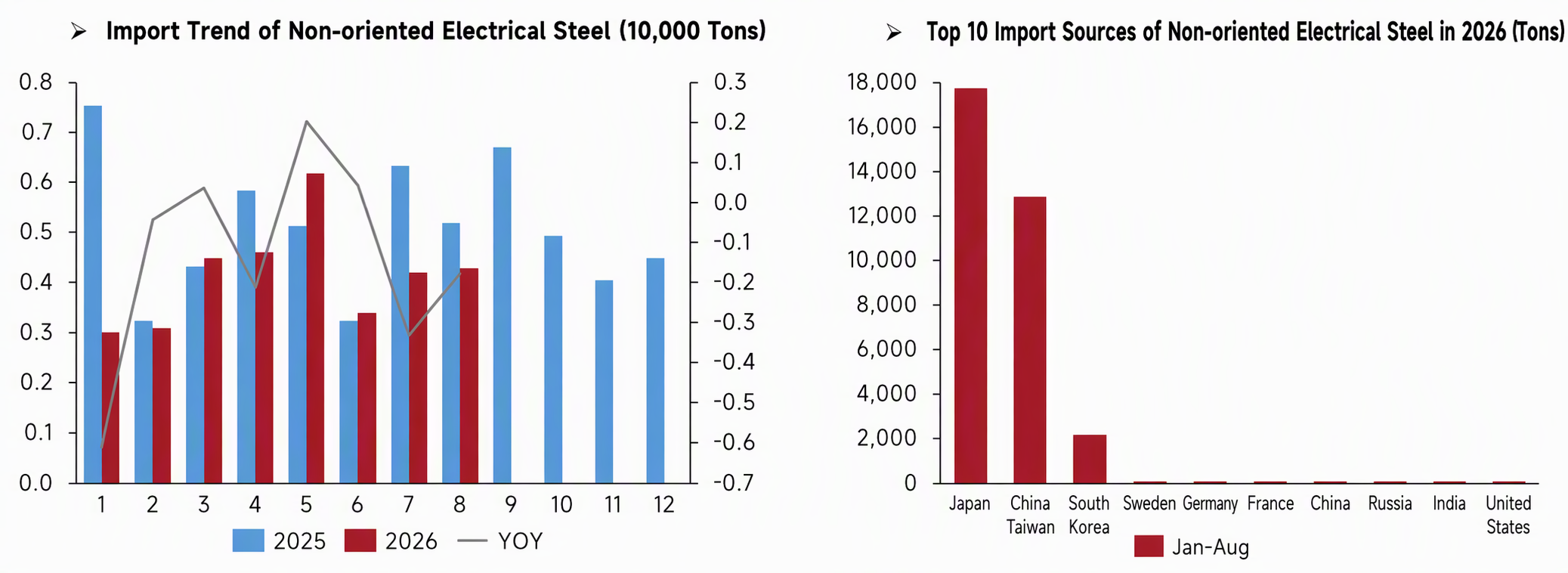
Looking at the monthly trend of non-oriented silicon steel imports, imports in August 2025 were approximately 5,200 mt, falling to 4,300 mt in August 2026, with YoY growth turning negative and imports for the month declining significantly YoY. Import sources in January-August 2026 were highly concentrated, with Japan far ahead in import volume, Taiwan, China ranking second, and South Korea third. Import volumes from other sources including Sweden, Germany, France, Russia, India, and the US all remained at low levels, with import supply highly dependent on Japan and Taiwan, China. The contraction in August imports directly reflects the continued progress of domestic substitution for non-oriented silicon steel. As domestic capacity continues to be released and technology for high-grade products keeps making breakthroughs, domestic self-sufficiency is improving, and dependence on overseas products is gradually weakening.
 Source: General Administration of Customs
Non-oriented silicon steel exports: overseas demand fluctuates; exports edge down MoM
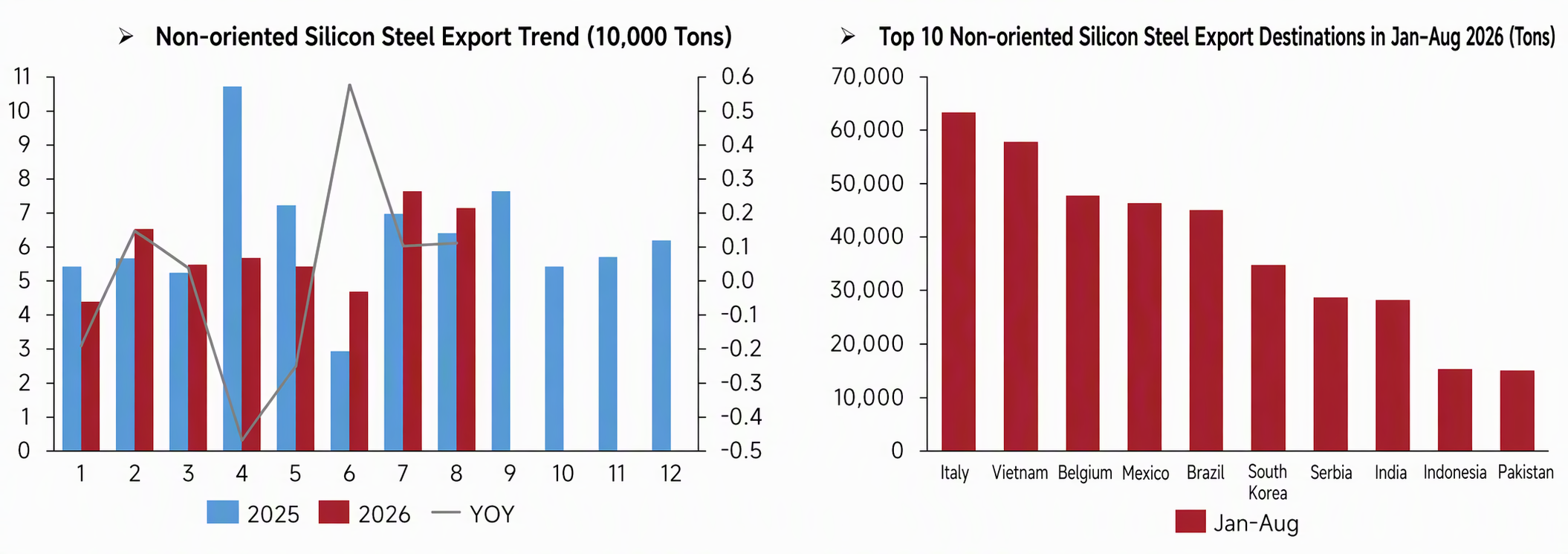
Looking at the monthly trend of non-oriented silicon steel exports, exports in August 2026 were approximately 71,300 mt, down from 76,700 mt in July 2026, but maintaining positive YoY growth. Export destinations in January-August 2026 were relatively dispersed, with Italy ranking first in export volume, followed closely by Vietnam, and then Belgium, Mexico, Brazil, and South Korea, mainly targeting manufacturing clusters in Europe, Southeast Asia, and Latin America. Exports edged down MoM in August but remained at a high absolute output level, continuing the pattern of diverting domestic surplus capacity outward. The relocation of overseas motor manufacturing drives rigid demand, supporting China's non-oriented silicon steel exports. However, affected by fluctuations in overseas demand, monthly exports have seen some consolidation, making exports an important channel for balancing the pressure of loose domestic supply.
 Source: General Administration of Customs
Grain-oriented silicon steel imports: Sources concentrated in Japan and Taiwan, China, with a few countries and regions accounting for the main supply
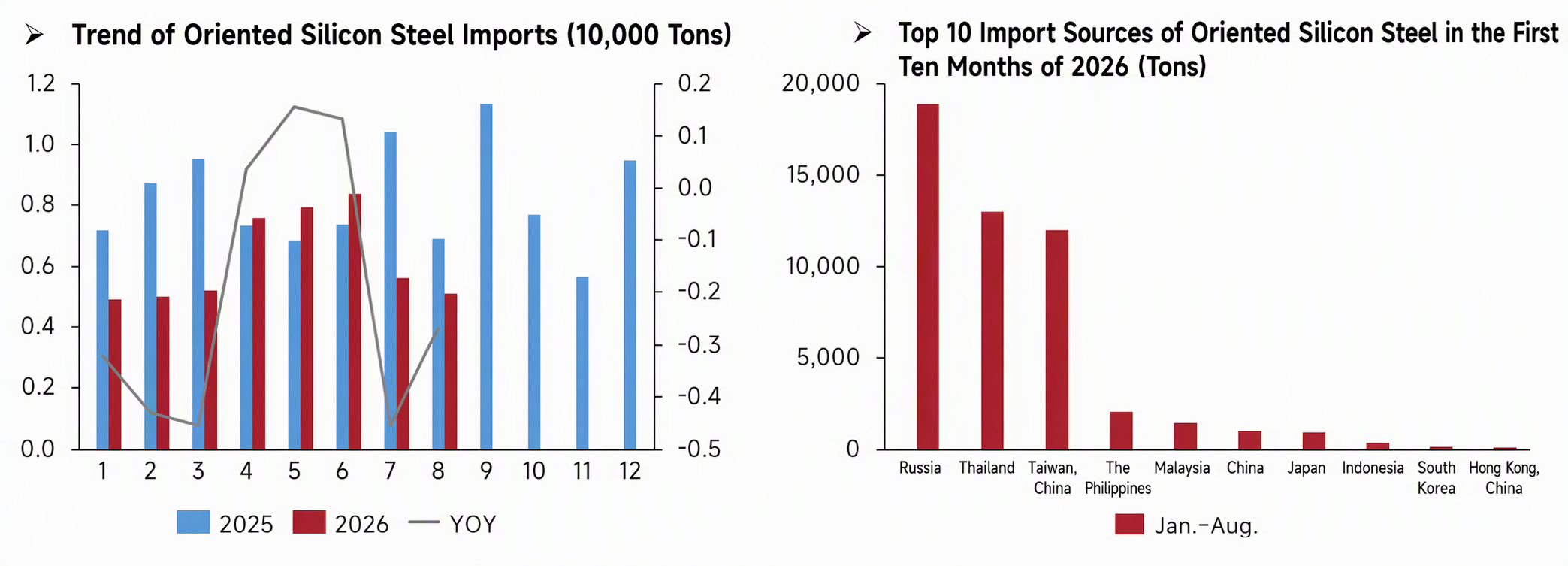
Looking at the monthly trend of grain-oriented silicon steel imports, imports in August 2026 were approximately 5,100 mt, down from 6,900 mt in August 2025, with YoY growth in negative territory, and the monthly import scale also in contraction territory MoM. From January to August 2026, grain-oriented silicon steel import sources were concentrated in Russia, Thailand, and Taiwan, China, with these three accounting for a significantly larger import volume, while imports from the Philippines, Malaysia, Japan, and other regions remained at low levels. The pullback in August imports reflects the continued progress of domestic grain-oriented silicon steel localisation, with the supply capacity of local high-permeability products steadily improving and dependence on external imports declining. However, rigid import demand remains for some ultra-low-loss high-end grades, and imports have not been completely eliminated.
 Source: General Administration of Customs
Grain-oriented silicon steel exports: Non-oriented silicon steel has broad overseas demand coverage, with significant regional diversification
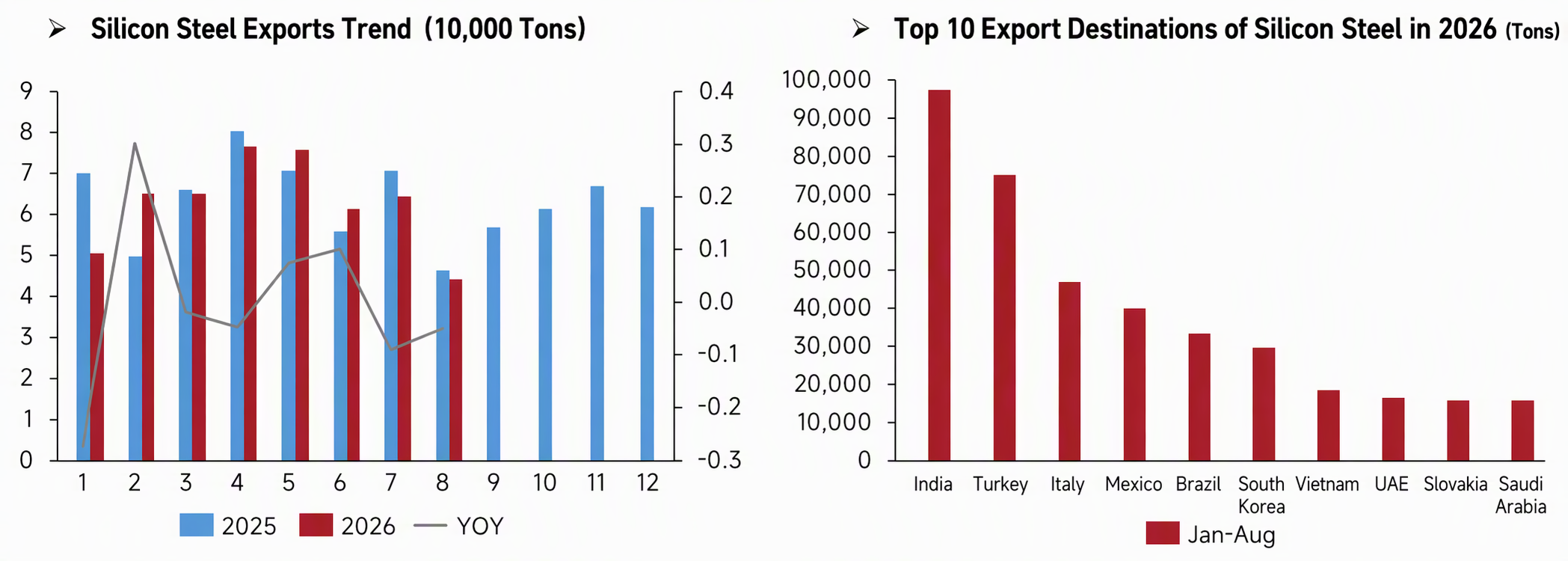
Looking at the monthly trend of grain-oriented silicon steel exports, exports in August 2026 were approximately 44,300 mt, lower than the 46,500 mt in August 2025, with a slight YoY decline, while the monthly export scale pulled back significantly MoM. From January to August 2026, grain-oriented silicon steel export destinations were relatively diversified, with India far ahead in export volume, Turkey in second place, followed by Italy, Mexico, Brazil, and South Korea, with demand mainly coming from overseas power infrastructure markets. Although August exports weakened both MoM and YoY, with the release of domestic grain-oriented silicon steel capacity, the cost-performance advantage of domestic products has become prominent, and they continue to participate in the global transformer materials market competition, with overseas power grid investment providing support for exports.
 Source: General Administration of Customs
Summary
In August 2026, silicon steel imports and exports showed a pattern of contracting imports and consolidating exports, with the domestic substitution process continuing to show progress. On the import side, both non-oriented and grain-oriented silicon steel imports saw YoY declines in August; non-oriented silicon steel imports were highly dependent on Japan and Taiwan, China; grain-oriented silicon steel came mainly from Russia, Thailand, and Taiwan, China, with local product self-sufficiency improving, but some high-end grades still maintaining rigid import demand. On the export side, non-oriented silicon steel exports pulled back MoM in August while remaining positive YoY, with export destinations covering Europe, Southeast Asia, and Latin America, playing a role in diverting surplus domestic capacity; grain-oriented silicon steel exports weakened both YoY and MoM in August, with diversified export markets, India and Turkey as the main destinations, and overseas power infrastructure providing demand support. Overall, China's self-sufficiency in silicon steel has been steadily improving, with import dependence continuing to decline. Exports have seen greater monthly fluctuations due to external demand disruptions, making exports an important channel for alleviating domestic supply pressure.
Data Source Statement:
Except for publicly available information, all other data in this report are derived from public sources (including but not limited to industry news, seminars, exhibitions, corporate financial reports, broker reports, National Bureau of Statistics (NBS) data, customs import and export data, and various data published by major associations and institutions), market communication, and SMM's internal database models. These have been comprehensively analyzed and reasonably inferred by the research team and are for reference only, not constituting decision-making advice.
Shanghai Metals Market reserves the final right to interpret the terms of this statement and the right to adjust and modify the content of the statement based on actual circumstances.
![[Indian recyclers seek government intervention over EU metal waste export ban proposal]](https://imgqn.smm.cn/usercenter/SduBz20251217171716.jpg)
![[US steel and aluminium tariffs create 'manufactured scarcity' as prices top double the world average]](https://imgqn.smm.cn/usercenter/rKOND20251217171716.jpg)
![[SMM Analysis] Ship Recycling Credit Note: What It Means for India's Steel and Shipbreaking Market](https://imgqn.smm.cn/usercenter/MtMyi20251217171748.jpg)