Strategic attributes of magnesium metal continue to stand out as global primary magnesium supply-demand dynamics and trade patterns undergo restructuring
With the rapid development of global lightweighting, new energy, and high-end equipment industries, the strategic resource attributes of magnesium metal continue to rise, with its essential role in automotive weight reduction, aerospace, high-end alloy modification, and critical material support steadily strengthening. For a long time, global primary magnesium supply has been highly concentrated in China, while overseas production has been constrained by resource, energy, environmental protection, and industry chain support shortcomings, leaving primary magnesium capacity small in scale and weak in flexibility. The global magnesium industry is currently showing pronounced structural divergence: overseas players are focusing on filling gaps in local primary magnesium capacity and advancing supply chain de-Sinicization. Meanwhile, China, leveraging its entire industry chain advantages, is upgrading from primary raw material exports to magnesium alloys and high-end die-cast end-use products. The global primary magnesium supply-demand pattern and trade flows are poised for long-term reshaping.
Overseas demand continues to expand, with high-end manufacturing rigid demand underpinning high import dependence
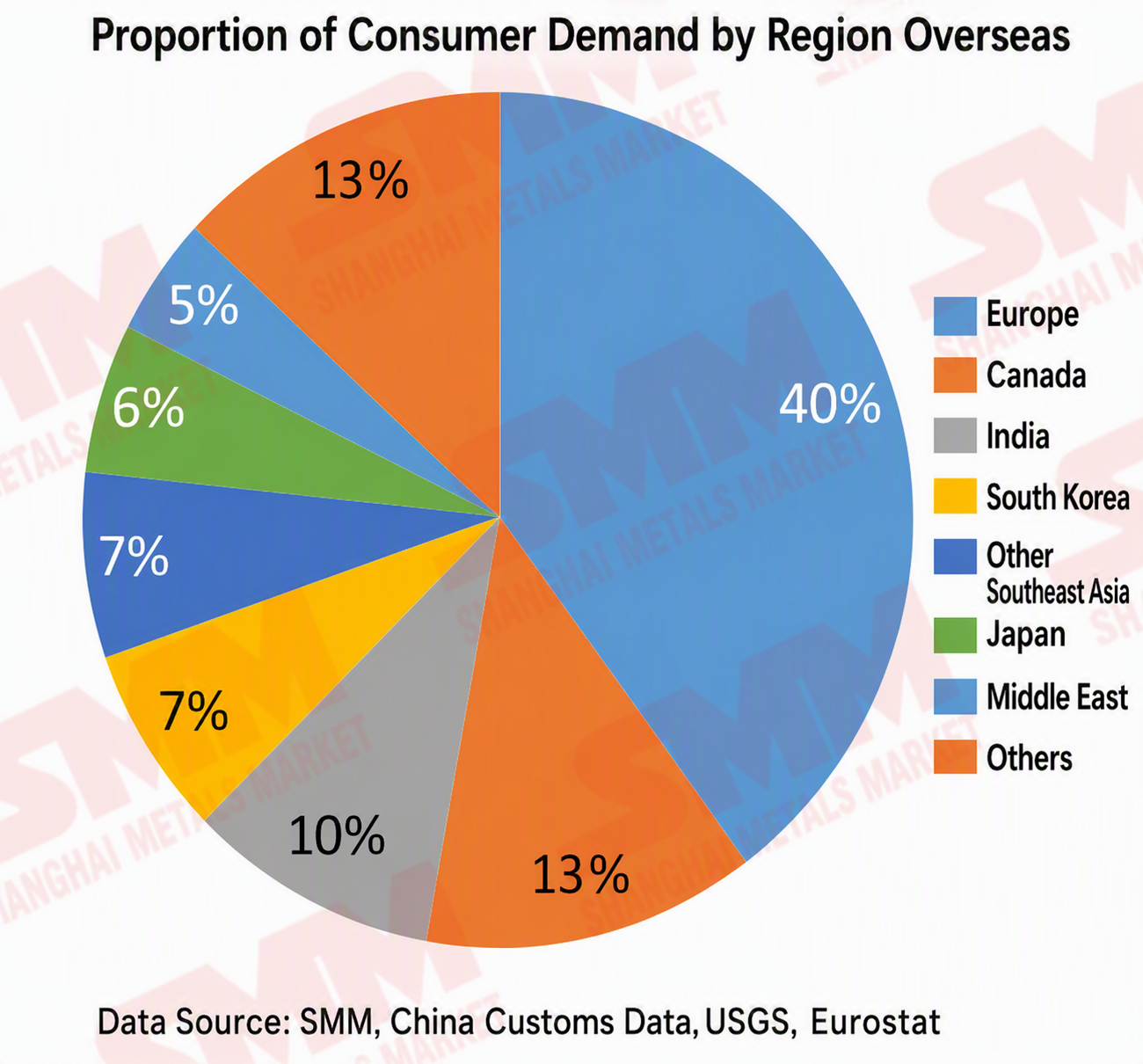
Global magnesium consumption growth is driven jointly by multiple overseas regions. Lightweighting demand in Europe, the US, Japan, South Korea, and emerging markets is steadily releasing, but overseas local primary magnesium capacity is essentially absent, maintaining a long-term pattern of "growing demand, undersupply, and import dependence on China."
Europe is a core global magnesium consumer market. According to Eurostat trade statistics, EU magnesium consumption in 2025 was approximately 110,000 mt. Driven by stringent carbon emission regulations, Europe's NEV lightweighting demand continues to grow rigidly, with magnesium alloy penetration rate steadily rising. However, the EU has no local primary magnesium smelting capacity, with 97% of primary magnesium supply dependent on Chinese imports, highlighting significant single-supply-chain risk. In North America, primary magnesium capacity has fully exited. Large-scale integrated die-casting for NEVs and national defense procurement have become core demand growth drivers, pushing regional magnesium consumption steadily upward. Meanwhile, the US and Canada have designated magnesium as a critical strategic mineral and continue to advance local supply chain support policies, but near-term capacity remains absent and difficult to fill. Demand in Japan, South Korea, India, and Turkey is also growing steadily. Japan and South Korea rely heavily on Chinese imports for magnesium raw materials, with demand concentrated in automotive lightweighting, aerospace, and 3C electronics. India and Turkey, supported by their domestic automotive industries, are seeing continued release of demand for magnesium die-casting, alloy modification, and steel desulfurization. The overall overseas rigid demand base is solid, and the import dependence pattern is unlikely to reverse in the short term.
Overseas magnesium-producing countries have stable but weak capacity, with pronounced regional supply-demand divergence
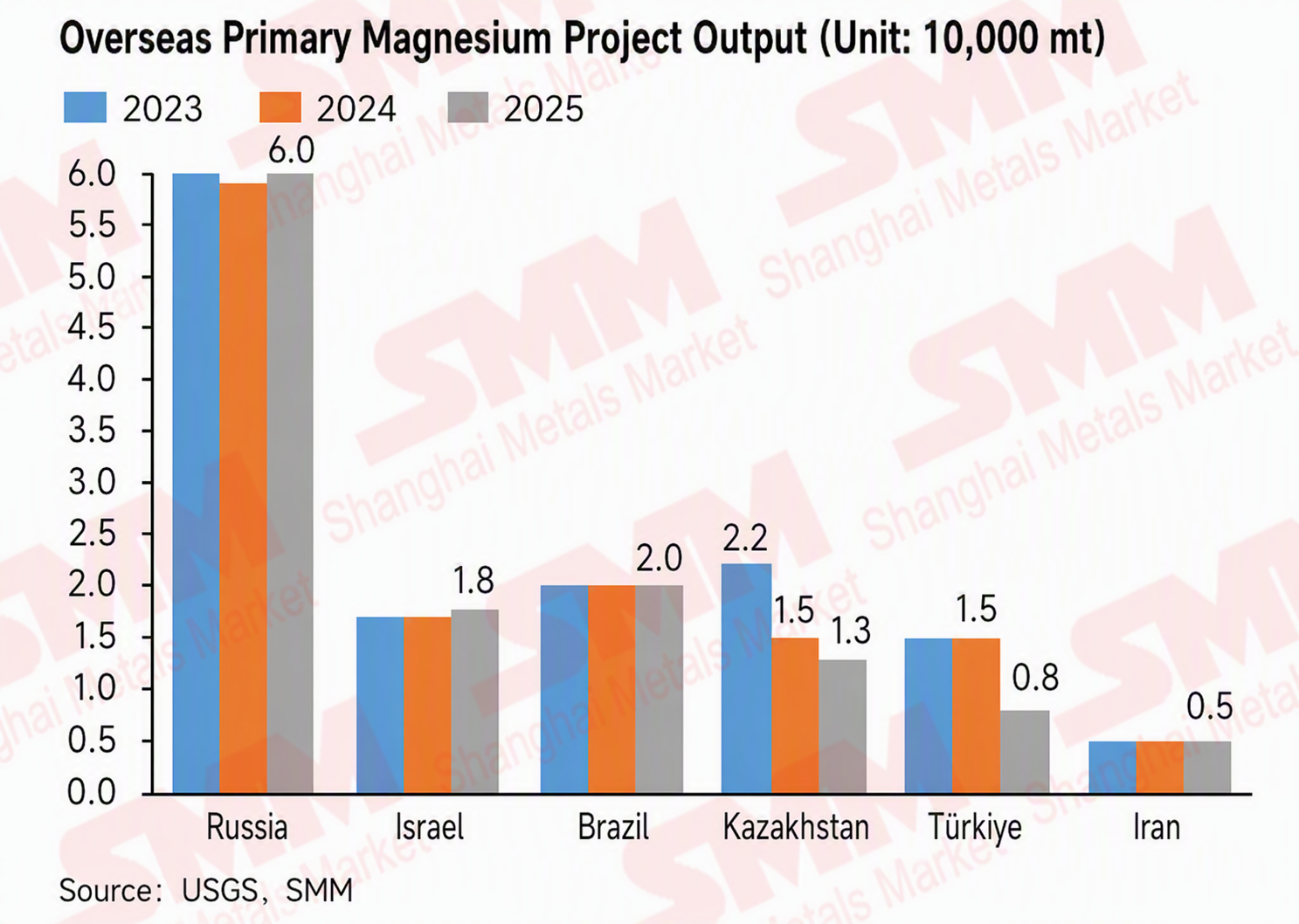
According to SMM data, global primary magnesium production in 2025 totaled approximately 1.09 million mt, of which China produced 1.02 million mt, accounting for 93%; overseas production totaled only about 70,000 mt, accounting for less than 7%. Global primary magnesium supply is highly concentrated in China, while overseas supply is extremely small in scale, highly fragmented, and lacking in flexibility. Overseas operating capacity is concentrated in a few countries including Russia, Israel, Brazil, Turkey, Kazakhstan, and Iran, characterized overall by small scale, weak support, poor flexibility, and limited growth. This pattern is unlikely to be materially shaken in the medium term.
According to USGS data, total primary magnesium production outside China in 2025 was approximately 130,000 mt, but the commercial magnesium available for export was far smaller. Russia's total primary magnesium production in 2025 was approximately 60,000 mt (including internal transfers), of which Solikamsk Magnesium Works produced approximately 15,000 mt of commercial magnesium, accounting for 60% of Russia's commercial magnesium production, with a global market share of 1.4%; VSMPO-AVISMA Corporation's magnesium is primarily for internal use in titanium sponge production, with exports of approximately 6,000 mt. The combined actual commercial magnesium available for export from the two is only about 21,000 mt. Israel's ICL Dead Sea Magnesium Ltd produced 17,800 mt of magnesium metal in 2025, with a designed capacity of 33,000 mt/year and a capacity utilization rate of approximately 54%. Its products are mainly exported to high-end markets in Europe and the US, and it is Israel's only primary magnesium producer. Brazil's Rima Industrial produced approximately 20,000 mt and is the only primary magnesium producer in the Southern Hemisphere, planning to increase production by 20% in 2026 and expand exports to the US, Japan, and South Korea. Turkey's Eczacibasi Esan plant has a designed capacity of 15,000 mt/year, but its capacity utilization rate has long been low, with actual production estimated at 5,000-8,000 mt, mainly exported to the European market. Kazakhstan's Ust-Kamenogorsk Titanium Magnesium Plant (UKTMP) produced approximately 13,000 mt of magnesium, as a co-product of titanium sponge production, with output declining in tandem with titanium production. Iran's Shemsh Felez Royal produced approximately 5,000 mt, essentially meeting domestic basic industrial rigid demand. US domestic primary magnesium capacity has effectively exited. USGS confirmed that US primary magnesium production was zero from 2023 to 2025, and the sole producer US Magnesium fully shut down after bankruptcy in 2025. The EU has no large-scale smelting capacity, and projects such as Romania's Verde Magnesium remain in early stages.
Overall, China's primary magnesium production accounts for over 90% of the global total, while overseas production accounts for less than 10%, and the actual commercial magnesium available for export is even smaller than the total production figures suggest, reflecting high dependence on Chinese supply. This pattern is unlikely to be materially shaken in the medium term.
Multiple countries are laying out new low-carbon magnesium projects to enhance supply chain self-sufficiency
Against the backdrop of global critical raw material security and supply chain de-risking, Europe, the US, and resource-rich countries are intensively planning new low-carbon primary magnesium projects in an attempt to break dependence on China and rebuild local supply systems. Currently, magnesium smelting projects are being planned in Australia, the US, Canada, Romania, Iceland, Saudi Arabia, and other locations, with new processes and low-carbon capacity becoming the core direction of overseas deployment. Specific overseas projects under construction are as follows:
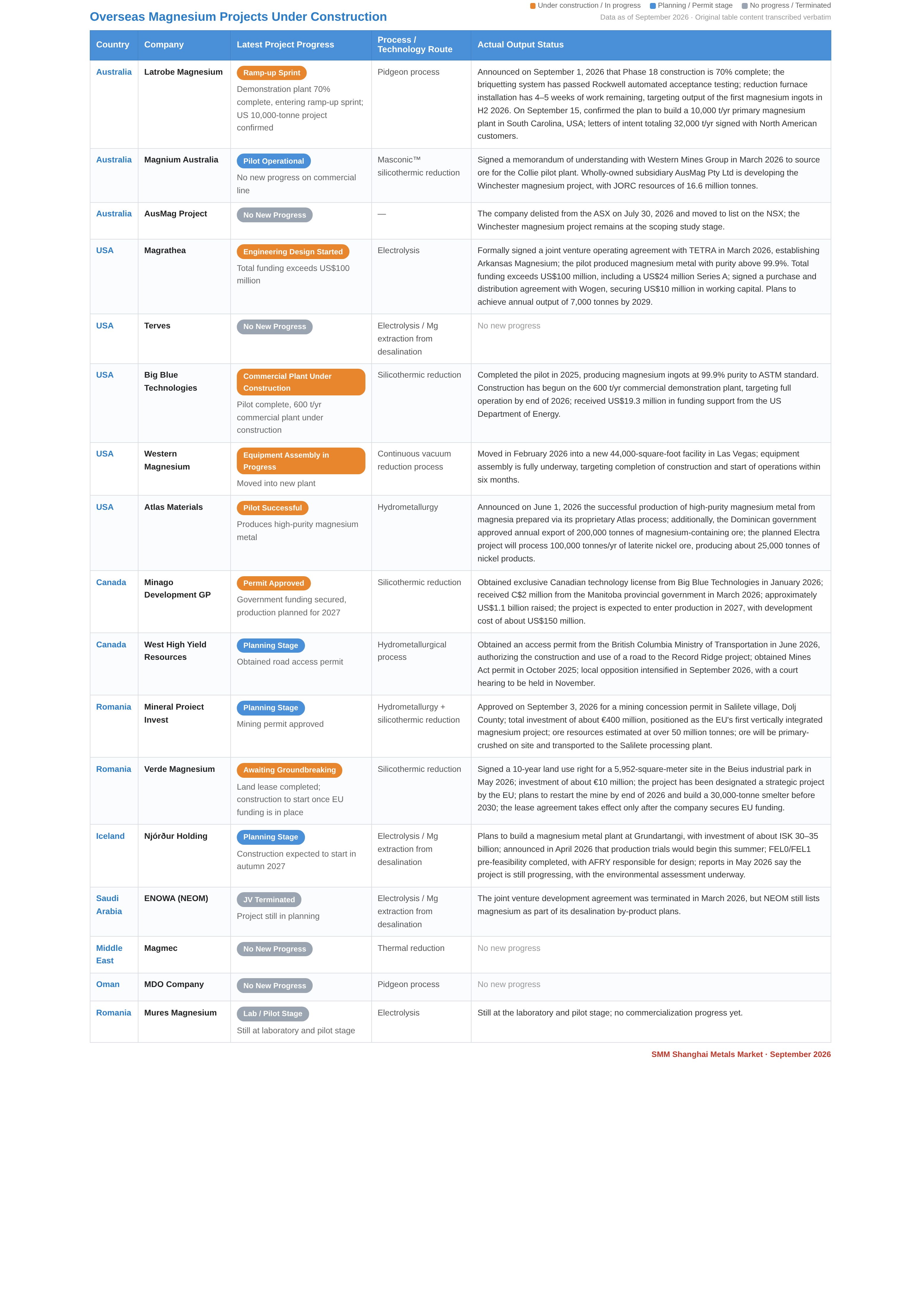
In terms of implementation progress, overseas projects show pronounced divergence, with a few entering late-stage pilot or demonstration construction phases, while most remain in planning or stalled status. By continent, the breakdown is as follows:
Oceania:Latrobe Magnesium's demonstration plant is 70% complete, briquetting equipment has passed acceptance, and reduction furnace installation is progressing steadily, targeting first metal production in H2 2026, but the 10,000-mt commercial line still requires financing approval. Magnium Australia, AusMag, and other projects have made no substantive progress.
North America:Big Blue Technologies completed over 50 pilot tests in 2025, producing 99.9% purity magnesium ingots, and has begun construction of a 600 mt/year commercial plant, supported by $19.3 million from the US Department of Energy (DOE). Magrathea has raised over $100 million in cumulative financing and formed a joint venture with TETRA to advance the design of its Phase 1 commercial plant in Arkansas, targeting annual production of 7,000 mt by 2029. Atlas Materials announced successful pilot production of high-purity magnesium metal in June 2026. West Magnesium has relocated to a new plant in Las Vegas, with equipment assembly underway. Canada's Minago received $3.4 million in government investment, obtained a revised environmental permit, and signed an exclusive Canadian process license with Big Blue. Terves has made no substantive progress.
Europe:Romania's Verde Magnesium has signed a 10-year land lease agreement, but startup requires EU funding to be secured. Mures Magnesium has made no substantive progress.
Asia:Magmec (Saudi Arabia) and MDO (Oman) have made no substantive progress.
South America:No new primary magnesium projects, with only Brazil's Rima Industrial in production.
Overall, overseas new capacity generally faces challenges including insufficient process validation, lengthy financing approval cycles, and lagging pilot progress. Effective new capacity additions in 2026-2028 will be limited in the short term, making it difficult to quickly close the supply-demand gap. In the long term, as new processes iterate and policy subsidies materialize, overseas low-carbon magnesium capacity may form marginal growth, gradually reshaping the global supply structure.
Global magnesium trade patterns undergo a qualitative shift: China upgrades from raw material exports to high-end finished product exports
Taking a comprehensive view of global supply-demand dynamics and capacity iteration trends, overseas players are addressing the issue of "primary magnesium raw material self-sufficiency," while China is upgrading its "entire industry chain value dominance." The logic of global magnesium trade will be progressively restructured.
Export structure divergence proves that overseas dependence on Chinese magnesium is deepening, not weakening. According to customs data, China's magnesium ingot exports in 2025 were 251,300 mt, down 5.54% YoY; magnesium alloy exports were 99,600 mt, up 4.51% YoY, the only category with positive growth. This divergence is most pronounced in the European market: according to SMM analysis, China's magnesium ingot exports to Europe fell 16.38% YoY in H1 2025, while magnesium alloy exports to the Netherlands rose 0.75% over the same period. European clients are not reducing magnesium purchases; rather, they are shifting procurement focus from primary magnesium ingots to magnesium alloys—because the EU no longer has primary magnesium smelting capacity, and the alloying process required for automotive lightweighting cannot bypass Chinese supply. From January to June 2026, magnesium ingot exports were 136,500 mt, up 11.89% YoY; magnesium alloy exports were 52,700 mt, up 7.55% YoY; magnesium powder exports were 36,400 mt, down 3.45% YoY; and wrought magnesium exports rose 91.67% YoY. The pattern of low-end categories continuing to contract while high-value-added categories see both volume and price increases is further established.
In the long term, China's deep-processing advantages are difficult to shake. Baowu Magnesium has built a complete industry chain of "dolomite mining—primary magnesium smelting—magnesium alloy melting—deep processing—recycling," with products exported to Europe, North America, and Southeast Asia. Overseas projects under construction remain at the primary magnesium stage: Latrobe Magnesium's demonstration plant is 70% complete, but its 10,000-mt commercial plant will not come online until H2 2028; Big Blue Technologies has only 600 mt/year capacity, scheduled to begin operations at the end of 2026. Overseas players generally face lengthy financing cycles and a lack of deep-processing support, with limited effective new capacity in 2026-2028. Overseas efforts fill the "raw material gap," while China occupies the "industry chain chokepoint."
This means the competitive focus of global magnesium trade has shifted from "who has resources" to "who has capability." Even if overseas new capacity comes online as scheduled, it can only provide limited supplementation at the primary magnesium stage, while China's industry chain advantages in alloying, die-casting, and end-use components at mid-to-high-end stages are difficult to replicate in the short term. China's magnesium industry is upgrading from the "ballast" of global supply to the "chain leader" of the global industry chain.
![Tug-of-war between sellers and buyers continues, magnesium prices in the doldrums today [SMM magnesium ingot spot express]](https://imgqn.smm.cn/usercenter/ZsMtd20251217171723.jpeg)
![Tug-of-war Between Supply and Demand Continues, Magnesium Ingot Market Under Pressure as Peak Season Falls Through [SMM Magnesium Ingot Spot Express]](https://imgqn.smm.cn/usercenter/tfLay20251217171725.jpg)