Canada has removed a significant trade restriction on direct shipments of certain solar products from China. On 17 September, the Canadian International Trade Tribunal terminated an expiry review covering certain photovoltaic modules and laminates from China and rescinded its existing order. The Canada Border Services Agency will therefore no longer impose anti-dumping and countervailing duties on the goods concerned. The change could improve the price competitiveness of supply from Chinese factories and prompt buyers to reassess their sourcing options.
In SMM's view, the immediate effect is more likely to be a shift in sourcing than a sudden expansion in end-market demand. Canada's imports of the solar products covered by the data are estimated at 0.5621 GW in the first half of 2026. China supplied an estimated 0.0564 GW, or 10.04%, while Malaysia and Indonesia together accounted for roughly two-thirds. Whether direct shipments from China expand will depend on suppliers' ability to turn their cost advantage into project orders.
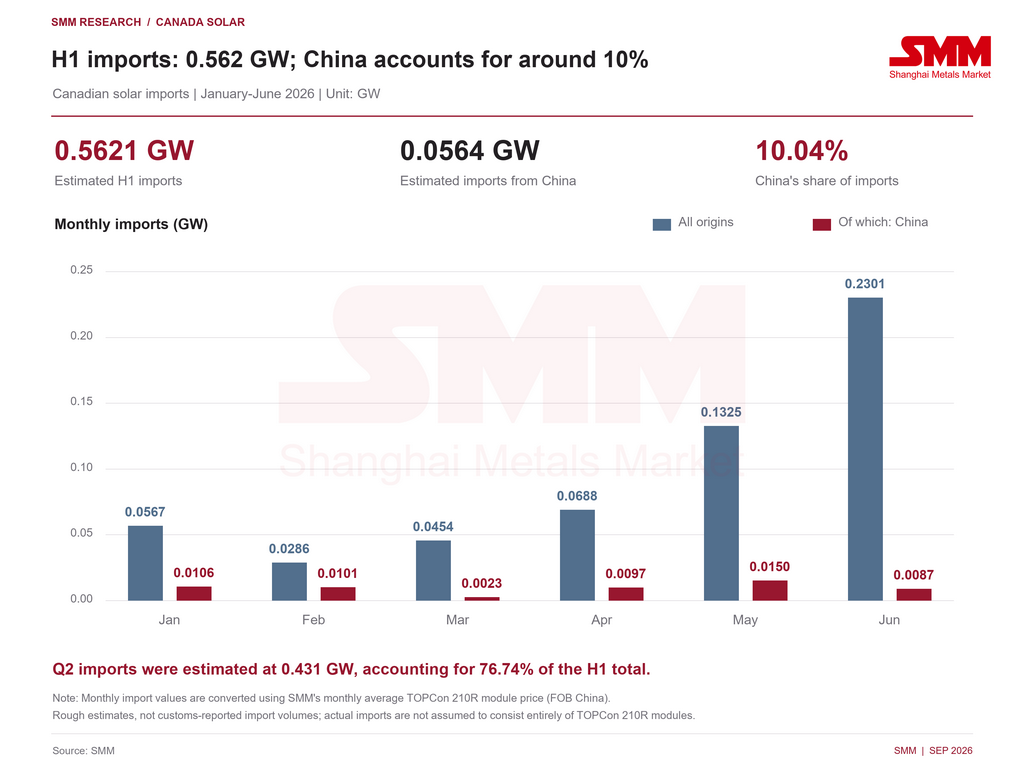
First-half imports estimated at 0.5621 GW, with deliveries concentrated in Q2
Based on data compiled by SMM, Canada's imports are roughly estimated at 0.5621 GW in January-June 2026, with a total import value of US$62.30 million. Import volumes are estimated by dividing each month's import value by SMM's monthly average TOPCon 210R module price (FOB China), then summing the monthly results. This price is used solely as a common estimation benchmark; it does not mean that all products exported to Canada were TOPCon 210R modules.
Estimated imports increased from 0.1308 GW in the first quarter to 0.4313 GW in the second, which accounted for 76.74% of the first-half total. Deliveries were therefore concentrated in Q2 rather than spread evenly across the period. For suppliers, project delivery schedules and inventory-building cycles may matter more to order planning than any single month's price movement.
Imports from China were estimated at 0.0564 GW, equivalent to 10.04% of the first-half total. This relatively modest share leaves room to compete for additional orders following the policy change. However, estimated first-half imports of less than 1 GW also underline the need to match commercial resources to the size of the market, rather than treating the removal of trade restrictions as an automatic surge in demand.
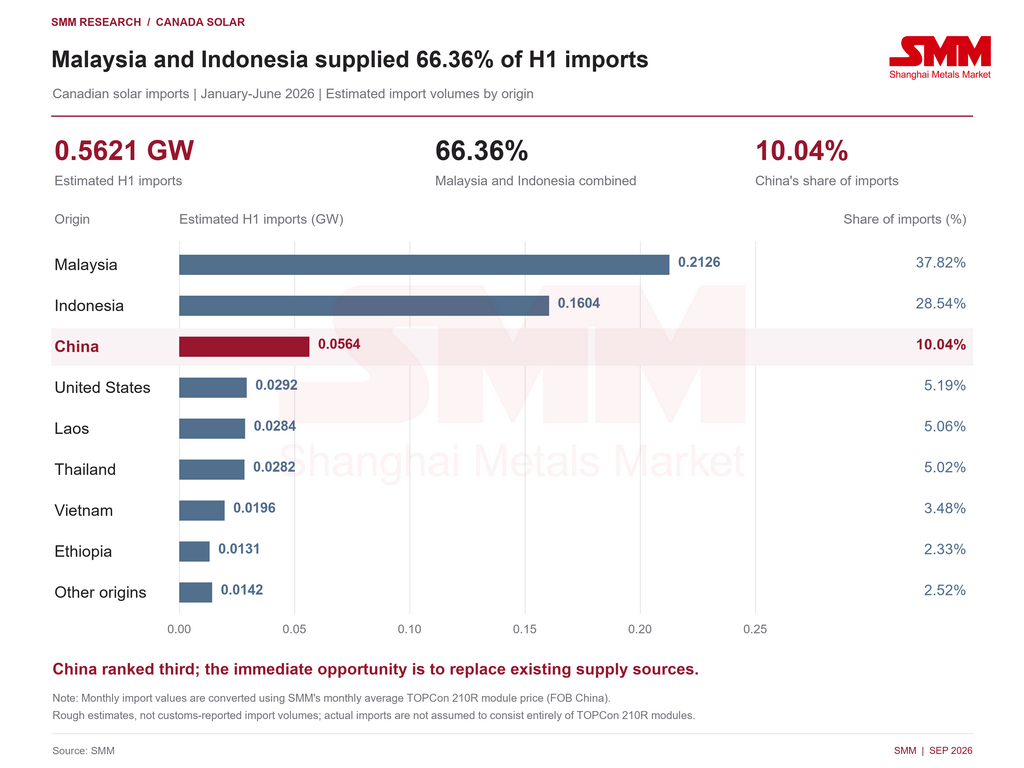
Malaysia and Indonesia account for 66.36%; China's first opportunity is to displace existing supply
Using the same import-volume estimation method, first-half imports from Malaysia and Indonesia were approximately 0.2126 GW and 0.1604 GW, respectively. Their shares were 37.82% and 28.54%, or 66.36% combined. China ranked third, with the United States, Laos, Thailand and Vietnam also supplying the market.
Chinese factories are entering a market with established supplier relationships, product specifications and delivery arrangements. The removal of the duties gives buyers a reason to compare the landed cost of direct shipments from China with supply from other origins. Projects that have not yet secured equipment, or that can change their manufacturing source, may offer greater scope for substitution.
For manufacturers operating factories both in China and overseas, some Canadian orders could be reallocated between production sites. Where Chinese factories offer a more competitive combination of efficiency, manufacturing cost and delivery terms, customers may reconsider orders previously assigned to overseas facilities. However, origin shares are not the same as company or brand shares: supply from the origins listed cannot all be attributed to Chinese-owned manufacturers. Nor does moving an order between factories create additional global demand.
Incumbent suppliers may respond through pricing, payment terms, delivery commitments and after-sales support. Competition will therefore depend not only on how far Chinese suppliers can lower their offers, but also on how existing suppliers respond and whether buyers are willing to bear the cost of changing products or vendors.
Lower trade costs help, but orders still depend on project execution
Removing the duties could improve the economics of sourcing Chinese modules. Canadian project demand nevertheless remains subject to financing, permitting, grid connections and procurement approvals. More competitive pricing may help Chinese products make procurement shortlists, but it cannot by itself change construction schedules.
Canada's Clean Technology Investment Tax Credit supports eligible capital investment in solar equipment. Subject to the relevant eligibility, prevailing-wage and apprenticeship requirements, the regular credit rate is 30% through the end of 2033, falling to 15% in 2034. Duty removal and the investment tax credit could together improve project returns, but they operate on different costs: the former reduces import-related trade costs, while the latter applies to qualifying capital expenditure. The credit should not be interpreted as a direct 30% reduction in module prices.
Hydro-Québec's solar procurement illustrates the time needed to convert development interest into equipment demand. Its tender for up to 0.300 GW attracted 60 bids totalling 0.481 GW. Results are expected in the first quarter of 2027, with electricity deliveries due to begin no later than 1 December 2029. The volume bid signals developer interest, but procurement, construction and delivery must still progress in stages; it is not an immediate module order book.
Local-content policy also warrants attention. Canada has consulted on introducing domestic-content requirements for its Clean Technology and Clean Electricity investment tax credits. Any subsequent procurement rules could influence equipment sourcing for some projects. The consultation itself, however, should not be treated as an implemented market-access requirement.
SMM View: Sourcing substitution comes first; project growth determines the longer-term opportunity
In the near term, Chinese suppliers are best placed to target projects that have not completed equipment procurement, can renegotiate pricing or can switch manufacturing sites. For orders already contracted, tied to a specified origin or requiring recertification, a change in duty treatment will not immediately shift procurement. Opportunities are more likely to emerge first through enquiries, product qualification and subsequent order batches.
Over the medium term, the scope for additional Canadian demand will depend on project awards, financial close, grid-connection arrangements and actual construction starts. If projects continue to advance, competitively priced Chinese modules could benefit from both market growth and sourcing substitution. If demand develops more slowly, the main effect may instead be to redistribute a limited pool of orders between origins, intensifying price competition.
China's roughly one-tenth share of estimated first-half supply leaves room to expand its market presence. At the same time, an estimated import market of 0.5621 GW calls for a measured assessment of the opportunity. Removing the duties addresses one trade-cost constraint; sustained exports will still depend on product acceptance, delivery capabilities and genuine project demand. SMM will continue to track Canadian solar trade policy, project procurement and shipments from China.
Source: SMM.
Note: Import volumes are rough estimates calculated by dividing each month's import value by SMM's monthly average TOPCon 210R module price (FOB China, US$/W), summing the monthly results and converting watts to GW. The same benchmark is applied across all origins. These are not customs-reported import volumes and do not imply that all products exported to Canada were TOPCon 210R modules. Reporting period: January-June 2026.
Written by:
Ryan Tey Tze Yang | SMM PV Analyst
+60 127179370 | ryan.tey@metal.com

![[SMM Brief] PV module bidding capacity from 9.14-9.20 was 5,444.44 MW, with an average winning bid price of 0.73 yuan/W](https://imgqn.smm.cn/usercenter/LlMgj20251217171739.jpg)
![[PV module shows strong willingness to stop falling]](https://imgqn.smm.cn/usercenter/HfeeS20251217171739.jpg)