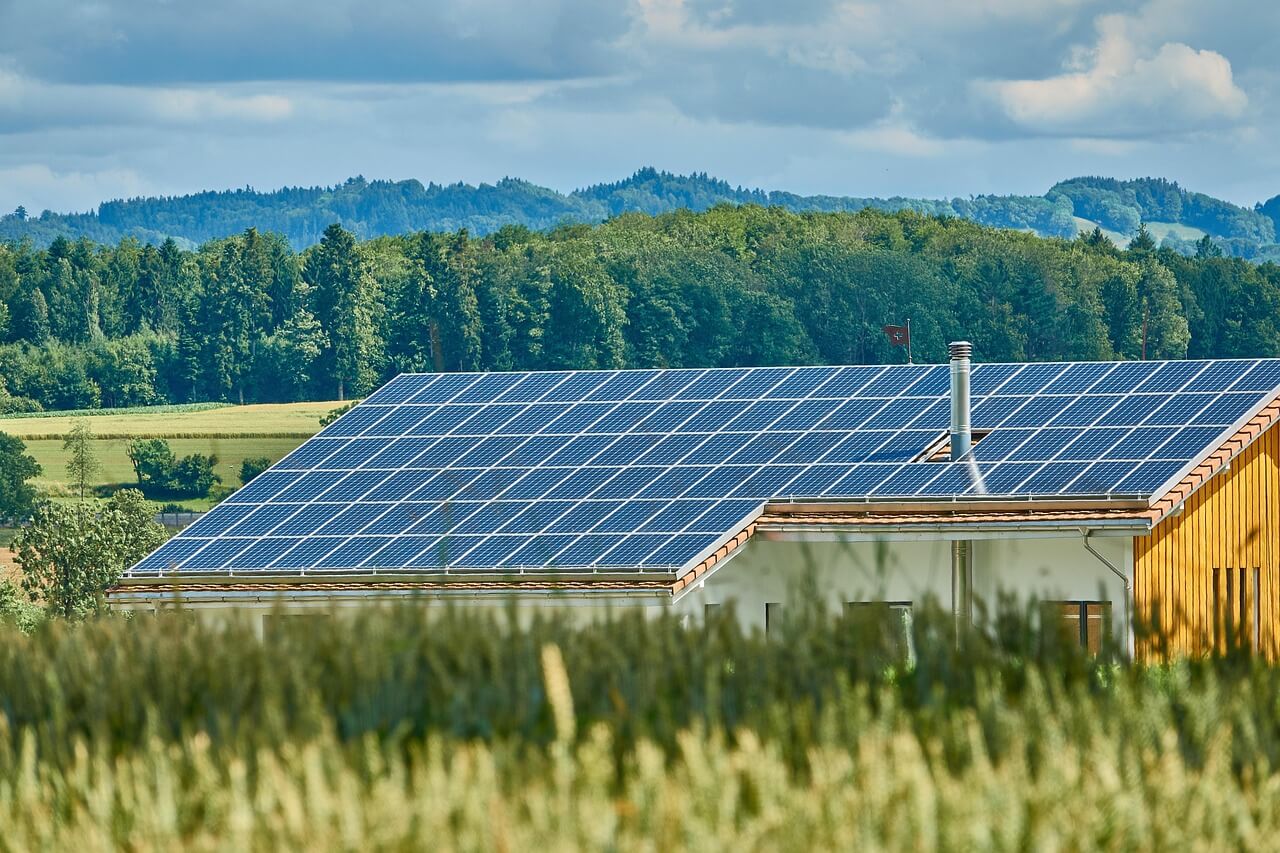
China overview: exports edge higher in August, but year-to-date volumes contract
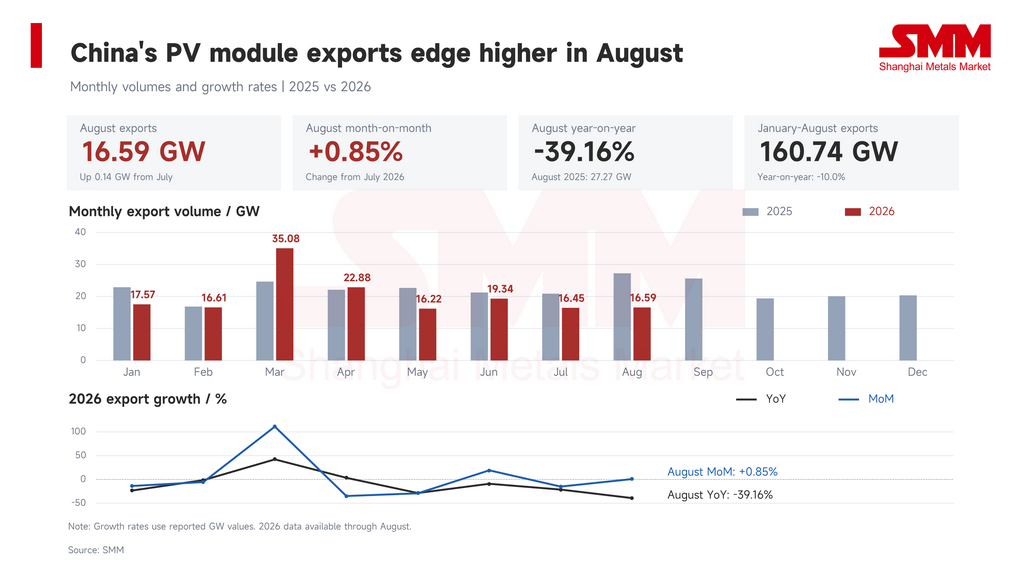
China exported approximately 16.59 GW of photovoltaic (PV) modules in August 2026, according to SMM data. Shipments rose 0.85%, or 0.14 GW, from July but fell 39.16%, or 10.68 GW, from August 2025. Exports in January–August totalled approximately 160.74 GW, down 17.89 GW, or 10.0%, from 178.63 GW a year earlier.
The modest August increase reversed July's 14.94% month-on-month decline, although shipments remained within the roughly 16–20 GW range seen since May. The steeper year-on-year contraction partly reflects the high comparison base of 27.27 GW in August 2025, while also highlighting that current export volumes remain well below last year's level.
Destination markets continued to diverge. Shipments to parts of Europe, South Africa and Nigeria declined, while Pakistan, Brazil, Colombia and some Middle Eastern markets increased purchases.
Regional mix: Europe remains the leading export market
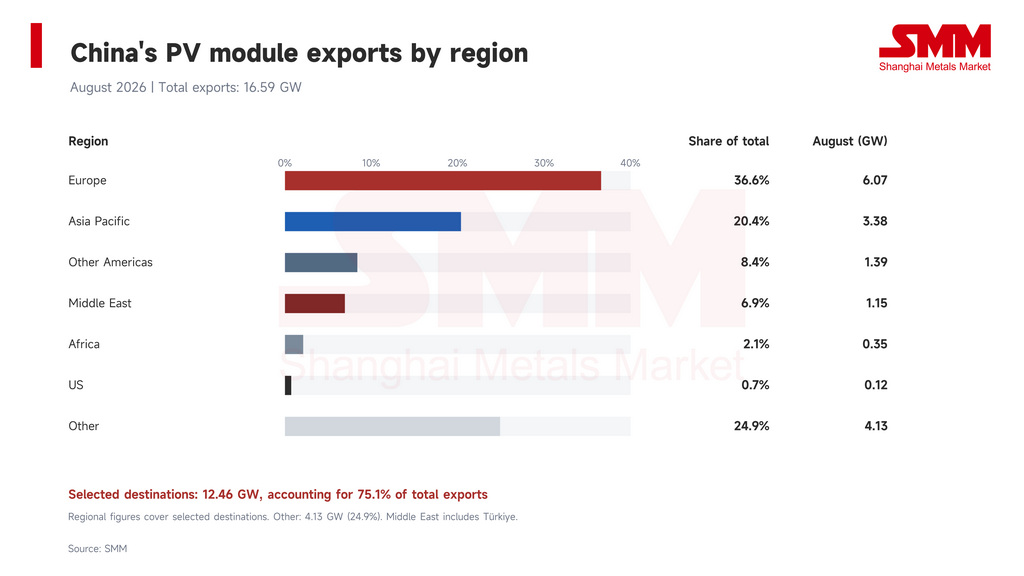
Exports to the 11 European destinations covered by the data totalled 6.07 GW in August, accounting for 36.6% of China's total module exports. Shipments to 10 Asia-Pacific destinations totalled 3.38 GW, or 20.4%; three Middle Eastern destinations accounted for 1.15 GW, or 6.9%; and two African destinations accounted for 0.35 GW, or 2.1%. Direct exports to the US totalled 0.12 GW, representing 0.7%. Exports to Brazil, Colombia and Chile together reached 1.39 GW, or 8.4%. These markets accounted for 75.1% of China's total module exports.
Market performance and key drivers
Europe: summer holidays and slower procurement weigh on shipments
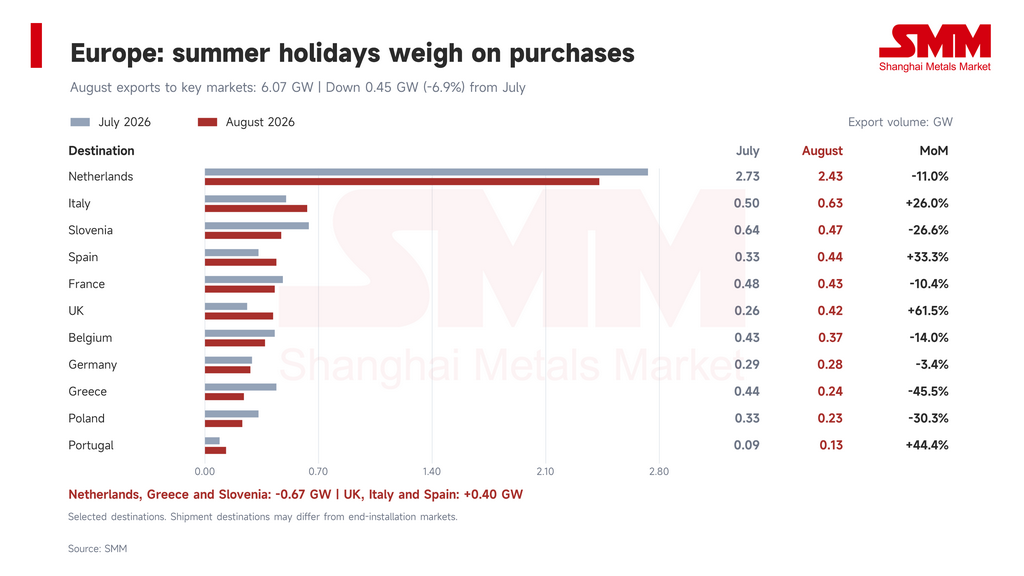
Exports to the 11 European markets covered totalled 6.07 GW in August, down approximately 6.9%, or 0.45 GW, month on month. Shipments to the Netherlands fell 11.0%, from 2.73 GW to 2.43 GW, a reduction of 0.30 GW. Greece declined from 0.44 GW to 0.24 GW, while Slovenia fell from 0.64 GW to 0.47 GW. Together, these three markets accounted for 0.67 GW of lost volume and were the main contributors to the net decline across the European destinations covered.
Some markets continued to grow. Exports to the UK rose from 0.26 GW to 0.42 GW, Italy increased from 0.50 GW to 0.63 GW, and Spain climbed from 0.33 GW to 0.44 GW. Their combined increase of 0.40 GW partly offset declines elsewhere. France, Belgium, Germany and Poland all recorded lower shipments.
SMM's market monitoring indicates that Europe's summer holiday season slowed procurement and project execution in August. Trade was dominated by small orders and deliveries against existing contracts. Rising production costs in China prompted module suppliers to raise overseas offers, but European buying did not strengthen in tandem, limiting distributor restocking. This is consistent with the overall decline across the European markets covered. Growth in the UK, Italy and Spain nevertheless suggests differences in project delivery and procurement schedules.
Asia Pacific: Pakistan leads a partial recovery
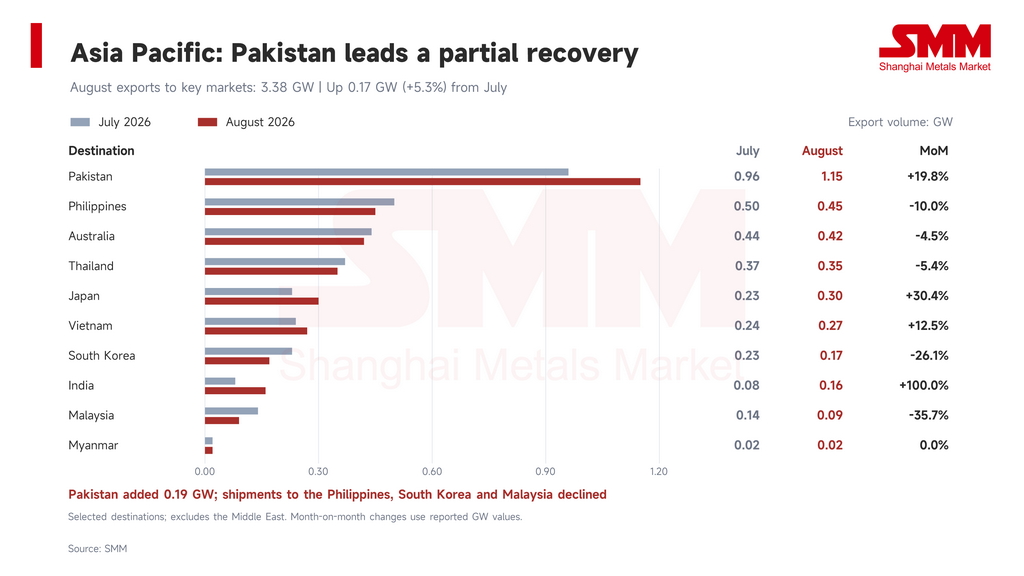
Exports to the 10 Asia-Pacific markets covered reached 3.38 GW in August, up approximately 5.3%, or 0.17 GW, from July. Pakistan was the largest contributor to growth, with shipments rising 19.8%, or 0.19 GW, from 0.96 GW to 1.15 GW. India increased from 0.08 GW to 0.16 GW, Japan rose from 0.23 GW to 0.30 GW, and Vietnam climbed from 0.24 GW to 0.27 GW.
The Philippines, Australia, South Korea, Thailand and Malaysia continued to decline. Shipments to the Philippines fell from 0.50 GW to 0.45 GW, South Korea dropped from 0.23 GW to 0.17 GW, and Malaysia declined from 0.14 GW to 0.09 GW. These reductions partly offset Pakistan's increase, leaving the regional recovery concentrated in a few markets.
Pakistan's rebound partly reflects July's low procurement base. Shipments had reached 2.15 GW in June before falling sharply in July; even after recovering to 1.15 GW in August, they remained approximately 46.5% below June's level. SMM's assessment of high local electricity tariffs, demand for distributed solar self-consumption and price sensitivity suggests that the increase may partly reflect short-term catch-up purchasing. It does not yet establish that channel inventories have been fully absorbed. Shipments to India doubled from July, but the absolute increase was only 0.08 GW. Demand for finished modules largely came from orders outside the scope of the Approved List of Models and Manufacturers (ALMM) restrictions and from off-grid installations.
Middle East and Africa: combined shipments reach 1.50 GW as markets diverge
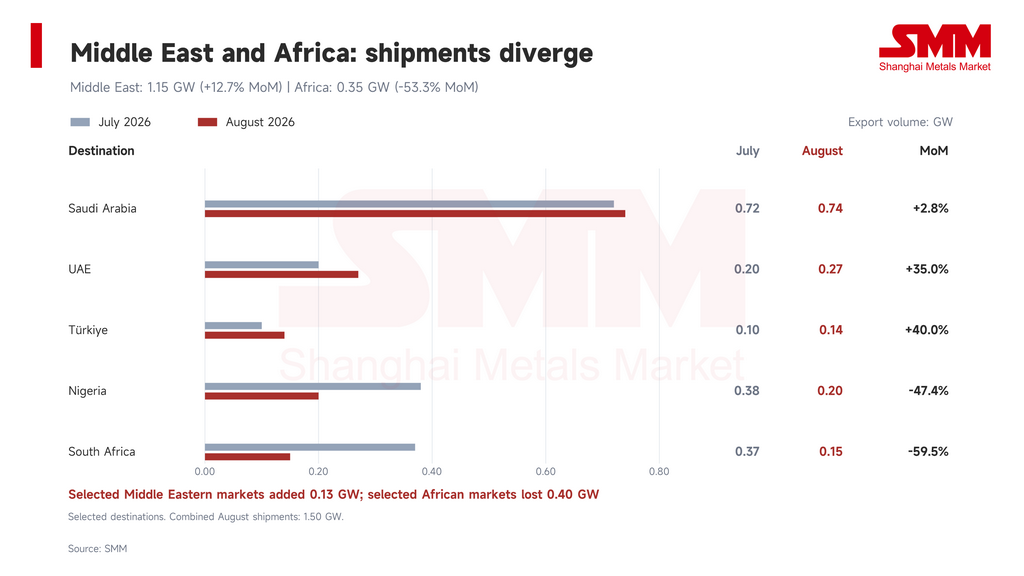
Exports to Saudi Arabia, the UAE and Türkiye totalled 1.15 GW in August, up approximately 12.7%, or 0.13 GW, MoM. Saudi Arabia remained relatively stable, rising 2.8% from 0.72 GW to 0.74 GW. The UAE increased 35.0%, from 0.20 GW to 0.27 GW, contributing 0.07 GW of additional volume. Türkiye rose 40.0%, from 0.10 GW to 0.14 GW.
Large-scale solar projects continue to underpin Middle Eastern module demand, although monthly exports also depend on equipment delivery schedules, vessel loading and customs clearance. The UAE's rebound is consistent with a recovery from July's lower shipment base, while Saudi Arabia maintained comparatively steady purchasing. SMM sees project execution and shipping schedules as potential drivers of the increase. Available project information does not yet link the additional 0.13 GW to specific developments or confirm a broad-based acceleration in regional demand.
Meanwhile, combined exports to South Africa and Nigeria fell approximately 53.3%, or 0.40 GW, to 0.35 GW. South Africa declined 59.5%, from 0.37 GW to 0.15 GW, a reduction of 0.22 GW. Nigeria fell 47.4%, from 0.38 GW to 0.20 GW, down 0.18 GW.
Improved electricity supply reliability in South Africa may have reduced the urgency of solar purchases intended to mitigate power cuts, shifting procurement decisions towards project-level electricity savings and delivery requirements.
Americas: Latin American restocking rises, but shipment volumes remain limited
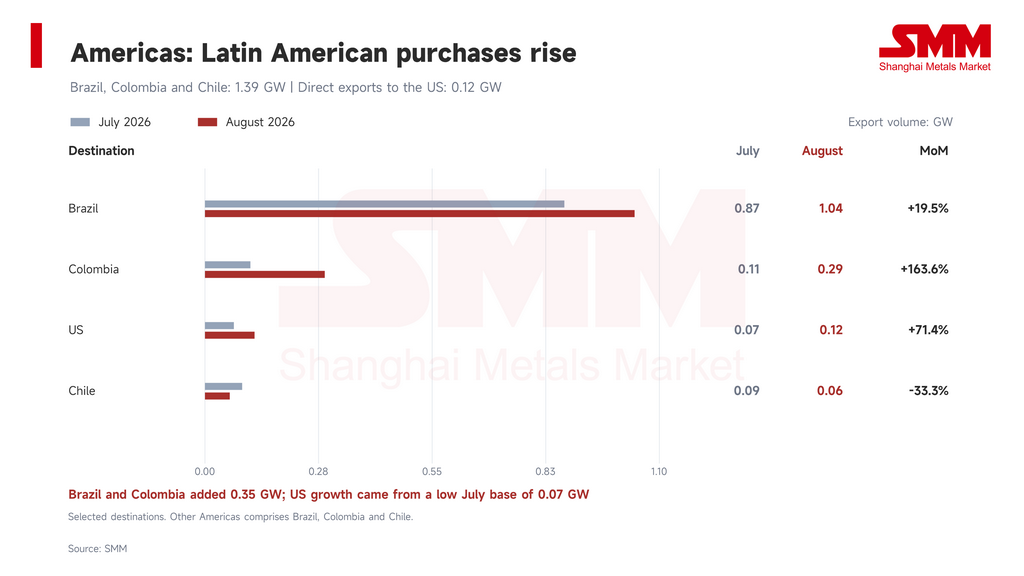
China's direct module exports to the US reached approximately 0.12 GW in August, up 0.05 GW, or 71.4%, from July. The US still accounted for only 0.7% of China's total exports. The strong percentage increase came from a small base and was insufficient to drive a substantial recovery in overall module shipments.
US import measures covering polysilicon and downstream products, announced in August, include additional tariffs scheduled to take effect on 4 December. Expectations of higher import costs may have brought forward some purchasing and deliveries. However, pre-emptive stockbuilding was concentrated in upstream materials, with only a limited increase in direct module exports.
Exports to Brazil, Colombia and Chile together rose approximately 29.9%, or 0.32 GW, to 1.39 GW. Brazil increased 19.5%, from 0.87 GW to 1.04 GW, adding 0.17 GW. Colombia rose 163.6%, from 0.11 GW to 0.29 GW, adding 0.18 GW. Chile declined from 0.09 GW to 0.06 GW, a reduction of 0.03 GW.
Brazil added approximately 891 MW of utility-scale solar capacity in August, pointing to continued project execution and supporting demand for equipment and distributor purchases. New solar projects also secured permits in Colombia, indicating further progress in the development pipeline. SMM sees deliveries to projects under construction and periodic restocking as possible drivers of purchasing growth in both markets. The durability of this recovery remains to be seen.
SMM view
China's module exports edged higher in August, but gains and losses across key destinations largely offset one another, while year-to-date volumes remained below last year's level. In Europe, the focus is on whether post-holiday orders translate into shipments. In Asia Pacific, the key questions are whether Pakistan's procurement recovery can be sustained and whether other markets stabilise. Project equipment deliveries remain central to the outlook for the Middle East and Latin America. Direct exports to the US remain small, while the declines in South Africa and Nigeria need to be assessed against local electricity supply, distribution channels and project conditions.
Source: SMM
Written by:
Ryan Tey Tze Yang | SMM PV Analyst
+60 127179370 | ryan.tey@metal.com
![[PV module shows strong willingness to stop falling]](https://imgqn.smm.cn/usercenter/HfeeS20251217171739.jpg)
![[SMM PV News] First National Standard for Perovskite PV Sector Released](https://imgqn.smm.cn/usercenter/AuVub20251217171738.jpg)
![[SMM PV Newsletter] Includes 150 MW of PV! Public announcement of a 450 MW generation-grid-load-storage integrated project in Inner Mongolia](https://imgqn.smm.cn/usercenter/VEROo20251217171737.jpg)