US restrictions on global solar supply are expanding beyond origin-specific tariffs to cover upstream material prices, supply-chain traceability, equipment authorisation and tax credit eligibility. On 11 September, the US Department of Commerce issued final antidumping and countervailing duty (AD/CVD) determinations on crystalline silicon photovoltaic cells and modules from India, Indonesia and Laos. Separate AD/CVD orders are already in force for Cambodia, Malaysia, Thailand and Vietnam. With Section 232 measures on polysilicon and its derivatives scheduled to take effect on 4 December, relocating production alone offers diminishing scope to maintain low-cost exports to the US.
In SMM's assessment, the central issue is not which country will capture displaced US orders. The US is simultaneously resetting import cost thresholds, supply-chain compliance requirements and eligibility for project incentives. The effects run in both directions: stronger protection for US manufacturing, but tighter constraints on imported inputs, equipment selection and project delivery that could raise deployment costs. Global manufacturing investment is therefore shifting from a search for low-tariff locations towards an assessment of end-to-end compliance costs and project returns.
AD/CVD and Section 301: Different barriers across Asia's major supply bases
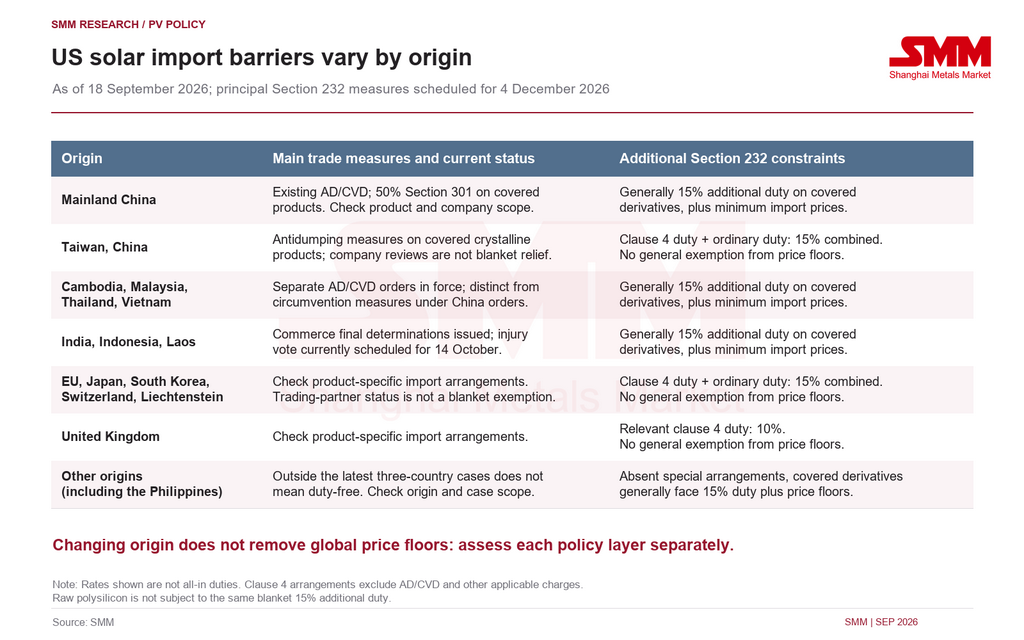
US solar import restrictions do not form a single country-by-country tariff schedule. They comprise overlapping cases, product scopes and company-specific rates.
Crystalline silicon cells and modules from mainland China remain subject to existing AD/CVD measures, while Section 301 tariffs cover both downstream products and upstream materials. The Section 301 rate on solar cells, whether or not assembled into modules, has risen to 50%; the relevant rates on wafers and polysilicon increased to 50% on 1 January 2025. These are individual additional tariff layers, not the final combined duty burden on all Chinese solar products. Certain crystalline silicon solar products from Taiwan, China are also subject to a separate antidumping measure, with applicability requiring case- and company-specific checks.
Cambodia, Malaysia, Thailand and Vietnam face a different combination of restrictions. Circumvention findings involving specified processing of Chinese inputs are distinct from the four countries' standalone AD/CVD cases. The earlier temporary duty suspension ended in 2024, and the separate AD/CVD orders took effect in 2025. Establishing a factory in one of these countries does not, by itself, place its products outside existing trade restrictions.
The latest cases involving India, Indonesia and Laos extend that coverage. India's final dumping margin is 123.04%, with a subsidy rate of 126.09%. Indonesia's dumping margin is 94.36%, while subsidy rates vary significantly by company. Laos has a dumping margin of 65.43%, with exporter-producer combinations also requiring individual checks. Dumping margins, subsidy rates and actual cash deposit rates are not necessarily identical and should not simply be added together as a universal import duty rate.
The US International Trade Commission currently plans to hold its final injury vote on the three countries' products on 14 October. Definitive duty orders remain conditional on affirmative injury determinations. However, cash deposit requirements and other arrangements already apply during the investigations; the pending injury decision should not be interpreted as an unrestricted import window.
The Section 201 solar safeguard expired on 6 February 2026. Relevant International Emergency Economic Powers Act (IEEPA) tariff layers in older country-level reciprocal tariff tables should not simply be carried forward as current rates. Separately, the forced-labour-related Section 301 action implemented against 60 economies from 24 July is a tariff measure distinct from the Uyghur Forced Labor Prevention Act (UFLPA) import compliance regime. Its applicability and exclusions require separate checks, while measures still under investigation should not be treated as duties already in force. The burden on an individual shipment must be assessed by origin, tariff classification, company and entry date, rather than by adding together historical tariff schedules.
Section 232 extends import price barriers across the value chain
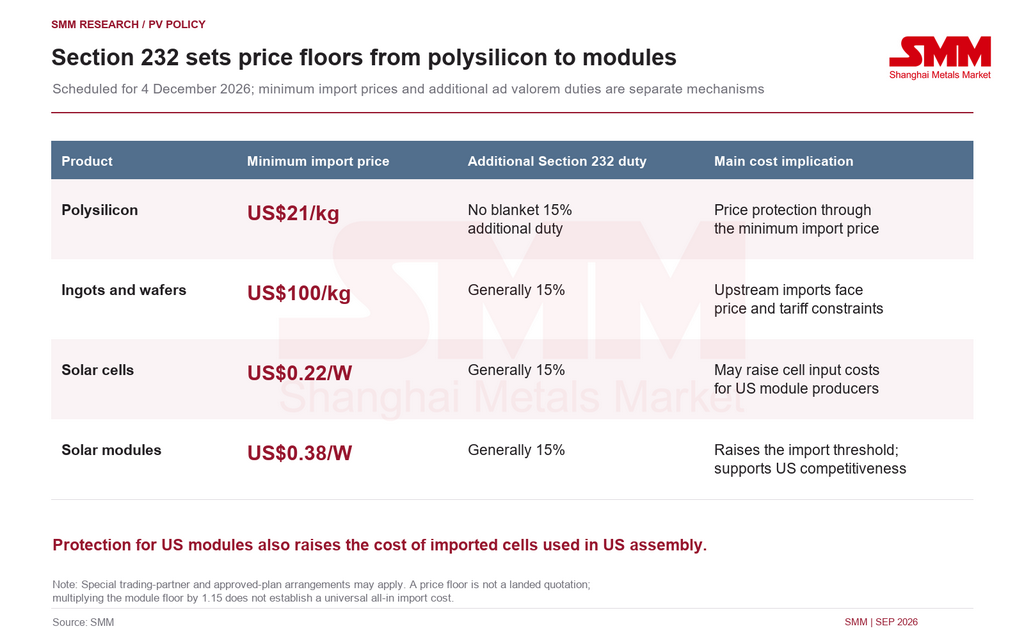
AD/CVD measures primarily determine which suppliers can access the US at commercially viable costs. Section 232 goes further by setting thresholds for the prices at which products can enter the market.
Under the announced arrangements, minimum import prices from 4 December 2026 will be US$21/kg for polysilicon, US$100/kg for silicon ingots and wafers, US$0.22/W for cells and US$0.38/W for modules. Covered ingots and derivative products generally also face an additional 15% ad valorem duty. Raw polysilicon should not be assigned the same blanket 15% rate.
The mechanism is not limited to China or the Asian origins already covered by AD/CVD cases. The EU, Japan, South Korea and other trading partners cannot assume exemption from Section 232 merely because they are outside those cases. The proclamation provides special duty calculations for certain partners. For relevant products from the EU, Japan, South Korea, Taiwan, China, Switzerland and Liechtenstein, the duty under clause 4 of the Section 232 proclamation and the ordinary customs duty are subject to a combined 15% arrangement. The relevant clause 4 duty for the UK is 10%. These figures are not all-in rates encompassing AD/CVD, minimum-import-price-related duties and other applicable charges, nor do they provide a general exemption from the price floors.
The minimum import price mechanism relies on declarations, supporting documentation and specified duties. It is not a universal landed quotation. Multiplying the US$0.38/W module floor by 1.15 will not establish the full cost of every shipment. Approved US onshoring investment plans may receive conditional relief within a defined scope, but building a US factory does not automatically exempt all of a company's imports from all duties.
For global manufacturers, avoiding one origin-specific AD/CVD rate therefore solves only part of the problem. Moving to a country outside the relevant cases still requires a fresh assessment of Section 232 price constraints, logistics, financing and compliance costs. Nor should the period before 4 December be treated as an unlimited opportunity to rush shipments: the arrangements also provide for monitoring of stockpiling and abnormal import activity.
Paying tariffs does not secure customs clearance, tax credits or equipment approval
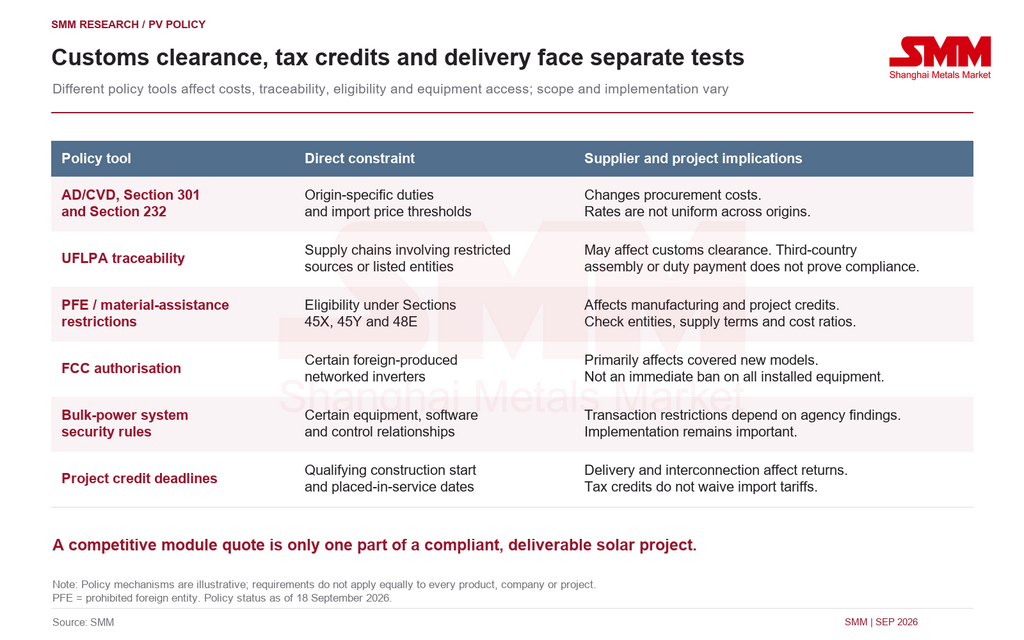
Price is only one of the constraints on solar supply. Different US rules determine whether goods can clear customs, whether manufacturers and projects qualify for tax benefits, whether new equipment models can be sold, and whether projects can be delivered on time. These should not all be characterised as additional tariffs.
The first constraint is material traceability. UFLPA compliance can extend upstream to polysilicon and other inputs. Assembly in a third country does not automatically remove risks associated with restricted sources or listed entities. Genuine origin qualification and complete material records are increasingly important, and paying import duties does not replace the evidence required for customs clearance.
The second is tax credit eligibility. Prohibited foreign entity (PFE) and material-assistance restrictions under Sections 45X, 45Y and 48E increase scrutiny of corporate control, supply arrangements and material cost ratios. They do not mean that US assembly automatically qualifies for credits, or that every Chinese component is prohibited. The domestic content bonus and foreign-entity restrictions involve separate eligibility tests.
The third concerns inverters and grid equipment. Federal Communications Commission (FCC) authorisation restrictions on certain foreign-produced networked inverters primarily affect covered new models, and the scope has subsequently been revised. They do not amount to an immediate ban on all foreign inverters or installed equipment. Bulk-power system security rules also extend scrutiny to certain equipment, software, firmware and control relationships, with transaction restrictions dependent on agency determinations and implementation.
Sustained access to the US market therefore depends on more than the ability to import modules. Suppliers must also establish traceability for cells and polysilicon, preserve relevant tax credit eligibility, and ensure that inverters and other equipment can meet delivery requirements.
Protection for US modules does not remove wafer and cell cost pressures
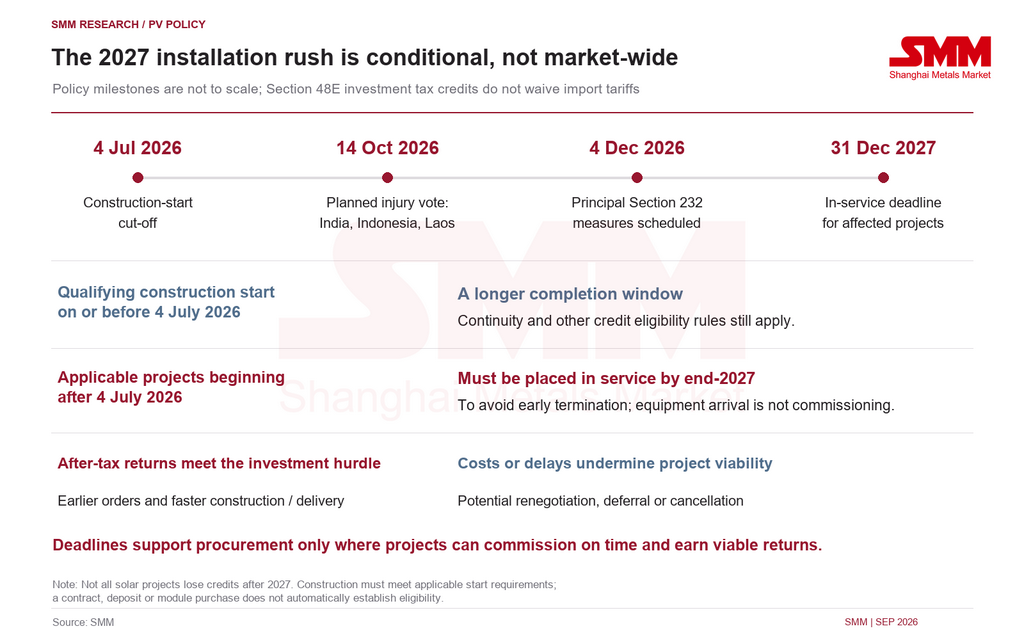
US module nameplate capacity has expanded towards a scale capable of serving annual US demand. Nameplate capacity, however, is not the same as effective supply. Deliveries remain constrained by utilisation, product specifications, certification, bankability and access to upstream materials.
The more pronounced gaps in the US manufacturing chain remain in wafers and cells. SMM's earlier assessment put US cell imports at approximately 21.82 GW in 2025, illustrating the role of imported cells in supporting module manufacturing growth. Wafer and cell production also require capital, process expertise, technical staff and ramp-up time, making it difficult for upstream expansion to keep pace with module assembly.
Section 232 consequently transmits costs in two directions. A higher price threshold for imported modules improves the position of US manufacturers competing for orders. Yet imported cells also face minimum import prices and applicable duties, exposing US module plants that rely on those cells to higher input costs.
Section 45X manufacturing credits provide some support. Typical statutory credits for qualifying modules, cells and polysilicon are US$0.07/W, US$0.04/W and US$3/kg, respectively, subject to production, sales and entity requirements. These credits are neither an automatic procurement discount for developers nor a direct offset against the duties on each import transaction.
SMM expects the benefits to vary across US manufacturers. Companies with reliable, compliant upstream supply, higher utilisation and established customer acceptance are better placed to secure orders. Plants with module nameplate capacity but unresolved cell supply or eligibility arrangements may still face rising costs and delivery pressure. The key indicators are additions to compliant wafer and cell supply and the ramp-up of US upstream plants, not module capacity announcements alone.
45X survives, but eligibility restrictions and demand timing remain risks
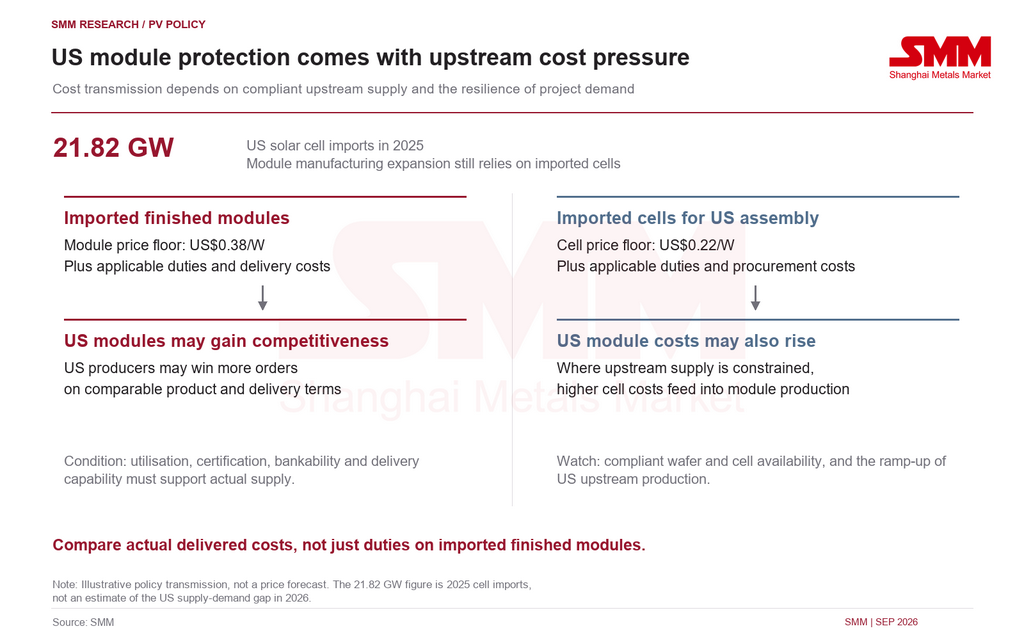
The One Big Beautiful Bill Act did not abolish the Section 45X solar manufacturing production tax credit across the board. Under the current schedule, qualifying modules, cells, wafers and solar-grade polysilicon sold through the end of 2029 can still receive the full statutory credit. The credit falls to 75% of its original amount in 2030, 50% in 2031 and 25% in 2032, before reaching zero from 2033. These percentages refer to the statutory credit amount, not a subsidy as a share of capital investment.
An unexpired support period does not guarantee continued eligibility. PFE and material-assistance restrictions introduced by the Act may affect a company's qualification before the scheduled phase-out begins. Non-compliant entity status, control relationships or material procurement arrangements could remove access to relevant 45X credits before 2030, even where a factory has already been built in the US. Investment models must therefore test ongoing compliance and the effects of losing credits on costs, cash flow and debt service, rather than relying solely on the statutory phase-out dates.
A further risk is the mismatch between manufacturing expansion and project demand. In 2028-29, qualifying solar manufacturing products will remain eligible for full 45X support. However, applicable projects that did not meet the July 2026 construction-start deadline and are not placed in service by the end of 2027 will face the early-termination provisions for Sections 45Y and 48E. If manufacturing capacity comes online as some project purchases have already been brought forward, or are delayed by weaker returns, capacity growth could outpace new orders. Projects that qualified under the earlier construction-start rules retain a longer window; this does not imply a market-wide halt in US solar demand from 2028.
In SMM's assessment, trade protection and manufacturing incentives improve the competitive position of US production but cannot guarantee sustained profitability for every plant. Higher input costs, restricted credit eligibility or low utilisation may still compress margins, even with less import competition. Assessments of US manufacturing investments should examine the statutory credit period, actual company eligibility and the alignment between capacity ramp-up and project procurement.
The 2027 installation rush depends on both deadlines and returns
Stronger manufacturing protection does not automatically expand end-market demand. Projects face changing credit deadlines, equipment inflation, financing constraints and grid-connection delays. Policy effects on supply and demand do not necessarily reinforce one another.
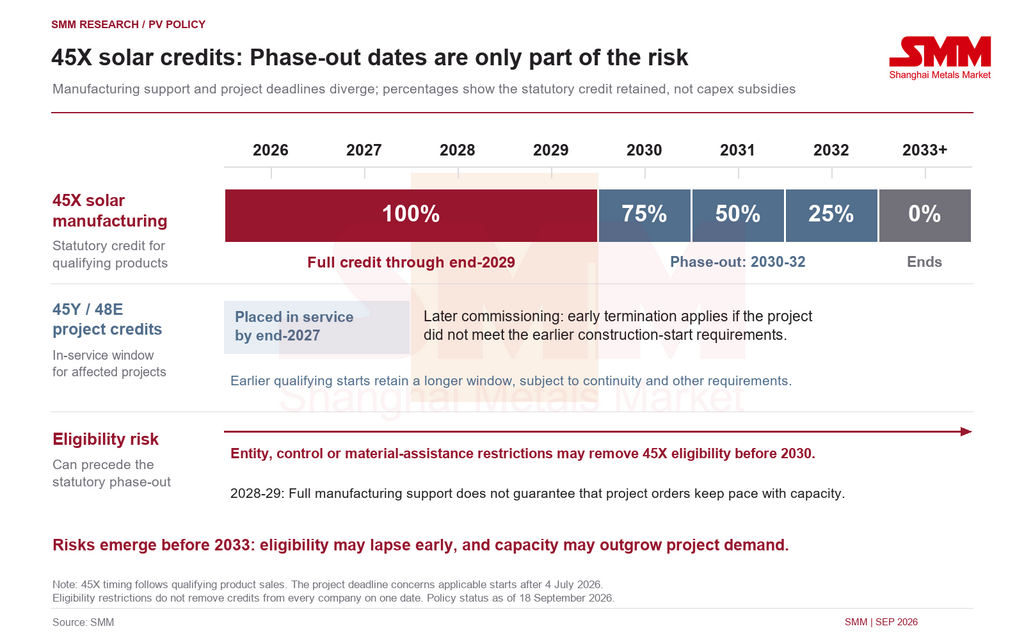
Under the current arrangements, applicable solar projects that begin construction after 4 July 2026 must be placed in service by 31 December 2027 to avoid the relevant early-termination provisions for Sections 45Y and 48E. Projects that met the construction-start requirements by the earlier deadline have a longer window, subject to continuity and other requirements. Signing a contract, paying a deposit or buying modules does not automatically establish a qualifying start of construction.
Some projects therefore have an incentive to accelerate procurement, construction and delivery in 2027, but not all US projects should be included in the same installation rush. The end of the Section 25D credit for homeowner-owned systems also means that residential demand cannot simply be assessed using the procurement logic of utility-scale projects. Eligibility for other credits under third-party ownership requires a separate assessment. Federal-land permitting and regional interconnection timelines may affect delivery, without implying a general halt to US solar construction.
Section 48E is an investment tax credit, not a tariff waiver. Developers must assess whether project cash flows can cover equipment, financing, construction and delay risks after accounting for applicable credits and the domestic content bonus. Where after-tax returns still meet investment hurdles, deadlines can encourage earlier order commitments. Where higher costs erode returns or timely commissioning is unlikely, projects may instead be renegotiated, delayed or cancelled.
Non-US markets may not absorb all diverted supply
Supply-chain adjustment will involve more than moving from one low-cost country to another. Origins such as the Philippines, which are outside the current three-country AD/CVD cases, may attract some genuine manufacturing investment and compliant orders. However, integrated supply chains, traceable production and customer qualification take time to establish. Shipment origin is not necessarily manufacturing origin, and third-country assembly using cells covered by existing measures may remain subject to those measures. A new qualifying origin does not automatically provide relief from Section 232, while rapid export growth could prompt further trade investigations.
Existing factories in Southeast Asia and elsewhere must also reassess their competitiveness if they turn to non-US markets. In most markets without equivalent restrictions, Chinese modules retain advantages in supply-chain depth, product choice and price. Cells and modules originally intended for the US could add supply and depress transaction prices if redirected towards Europe, the Middle East, South Asia, Africa and South America. Absorption will depend on demand, certification, local-content requirements and delivery conditions.
Some factories outside China can compete through specific shipping routes, regional customer relationships, local delivery and responsiveness to small orders. These advantages must be assessed market by market; overseas production does not automatically offer shorter transport distances. Future investment decisions must weigh the cost and potential premium of serving a compliant US market against pricing competition elsewhere. The risks associated with export bases dedicated to the US are increasing.
SMM outlook: Upstream supply, delivered costs and project returns will shape the market
First, AD/CVD measures already cover many of Asia's major low-cost crystalline silicon manufacturing bases. Section 232 and minimum import prices will extend those constraints, further narrowing the commercial scope for low-cost US supply based solely on third-country processing or transshipment. Sustainable suppliers will need genuine, clearly documented origin, full supply-chain traceability and manageable applicable duties, or compliant manufacturing in the US. Assessing US supply requires more than module nameplate figures: effective, compliant wafer and cell supply is critical. If end-market demand remains resilient, upstream shortages and price sensitivity could exceed those at the module stage. Meanwhile, diverted US-bound products may intensify competition in other regions.
Second, the central variable for modules remains the actual procurement cost. If imported modules cost more than US-produced alternatives after applicable AD/CVD, Section 232 price mechanisms, logistics and financing, US manufacturers will be better positioned to serve local demand. However, their continued reliance on imported cells leaves them exposed to upstream price floors. Comparisons must therefore include US manufacturers' cell procurement costs, their ability to realise tax credits and final delivered prices, rather than import tariff rates alone.
Third, a temporary installation rush is possible in 2027, primarily among projects that missed the July 2026 construction-start deadline and need to be placed in service by the end of 2027 to preserve relevant credit eligibility. Earlier qualifying projects retain a longer window. Section 48E and applicable domestic content bonuses can support returns but do not waive tariffs. Attractive after-tax returns could sustain accelerated procurement; equipment inflation, financing costs and delay risks beyond a project's tolerance could instead lead to deferral or cancellation.
The timing mismatch between manufacturing support and project demand also warrants attention. The statutory 45X solar manufacturing phase-out begins in 2030, but entity or supply-chain restrictions could remove eligibility earlier. Continuing manufacturing support in 2028-29 does not guarantee a corresponding expansion in project purchases. If US capacity ramps up faster than orders, utilisation and margins could fall. Trade protection should not be treated as a guarantee of long-term profitability.
Overall, the US is strengthening manufacturing protection while tightening import and project compliance requirements. Policy can change the source of supply, but it cannot remove cost and demand constraints. Competitiveness will increasingly depend on compliant upstream supply, actual delivered costs and project execution, rather than simply locating production in a country not yet covered by AD/CVD.
Source: SMM. Policy status as of 18 September 2026. Product coverage, company-specific rates and implementation dates remain subject to subsequent developments.
Written by:
Ryan Tey Tze Yang | SMM PV Analyst
+60 127179370 | ryan.tey@metal.com
![[SMM Analysis] China Solar Settlement Prices Diverged in H1 2026 as Timing and Seasonality Reshaped Revenue](https://imgqn.smm.cn/usercenter/kuMAH20251217171739.jpg)
![High-Power Demand Improves, but Weak Orders Keep Global PV Module Prices Rangebound [SMM Analysis]](https://imgqn.smm.cn/production/admin/votes/imageswRRpR20260918163233.png)