China's solar generators faced increasingly differentiated settlement outcomes in the first half of 2026. For spot-market solar units, Shandong recorded an average settlement price of $12.01/MWh (81.12 yuan/MWh), while Shanxi averaged $16.82/MWh (113.59 yuan/MWh). Pressure on unit revenue is making plant efficiency, contract coverage and trading execution more important to project performance.
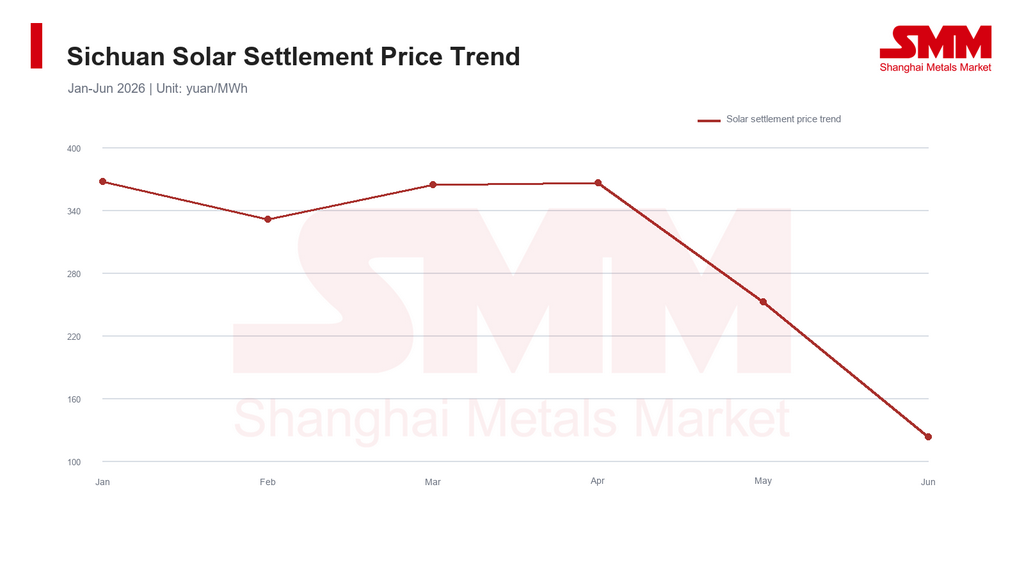
Seasonality also affected revenue. Sichuan's solar settlement price averaged $45.03/MWh (304.04 yuan/MWh) for the first half, but fell to approximately $18.22/MWh (123 yuan/MWh) in June. The half-year average therefore masked a sharp change in the monthly revenue environment.
Across the 21 regional markets, the price distribution was sharply tiered. Shandong, Xinjiang, Shaanxi, Gansu and Shanxi occupied the lower end, while parts of central, eastern and southwestern China settled at materially higher levels. The spread is increasing project exposure to regional supply-demand balances, generation timing and trading execution.
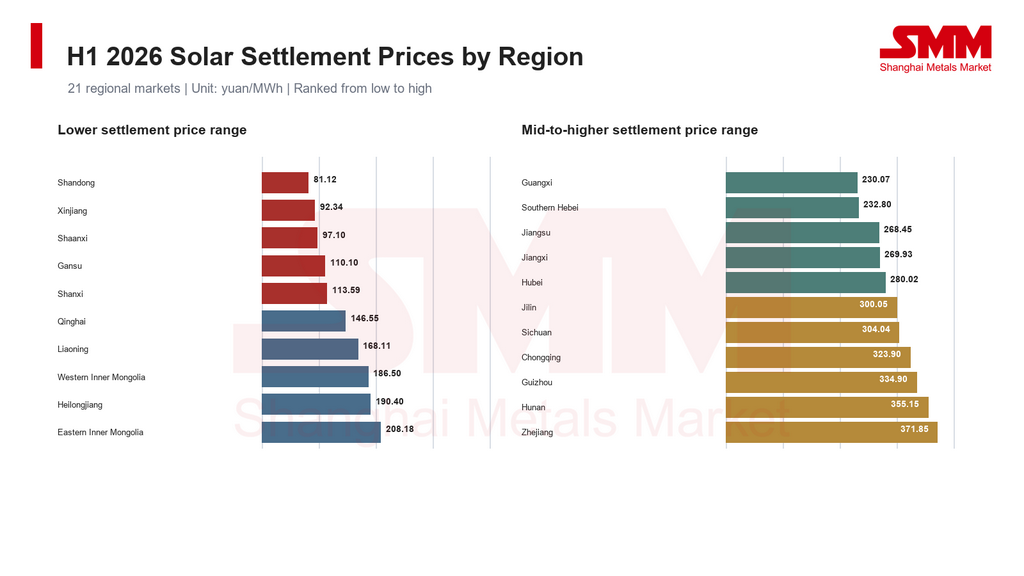
Shandong and Shanxi spot-market solar prices stayed below 0.12 yuan/kWh
Shandong settled 16.929 TWh of spot-market solar generation at an average of $12.01/MWh (81.12 yuan/MWh) in January-June 2026. Shanxi settled 18.626 TWh at $16.82/MWh (113.59 yuan/MWh). The difference was $4.81/MWh (32.47 yuan/MWh), equivalent to about 0.0325 yuan/kWh.
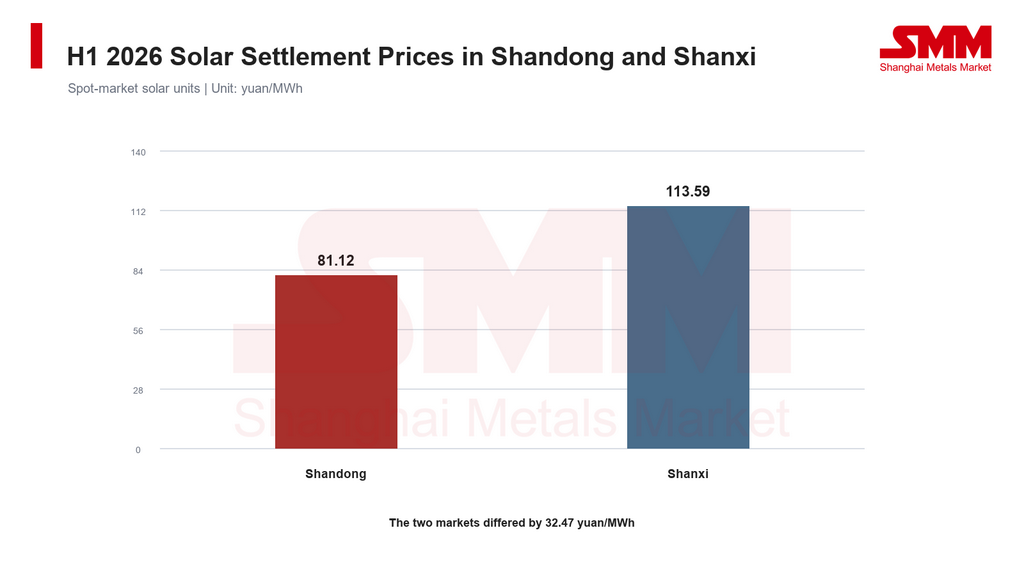
Small changes in the unit price can materially affect projects with a high share of market-based sales. For every 100 GWh of settled generation, a change of 0.01 yuan/kWh alters settlement revenue by 1 million yuan. The calculation highlights the sensitivity of project revenue to small price movements.
Solar generation is concentrated during daylight hours. When midday solar output grows faster than demand and system flexibility, the additional supply can depress prices during solar production hours. Growth in installed capacity and generation therefore does not necessarily improve revenue per unit of electricity.
SMM believes plants operating in low-price markets need closer coordination between output forecasting, market bidding and contract coverage. Annual budgets should account for the share of generation exposed to low-price hours and the impact of imbalance settlement, in addition to expected generation volume.
Wind-solar settlement gaps differed sharply across regional markets
Shandong's average wind settlement price was $38.44/MWh (259.52 yuan/MWh), exceeding solar by $26.42/MWh (178.40 yuan/MWh). Shanxi wind averaged $38.95/MWh (263.01 yuan/MWh), $22.13/MWh (149.42 yuan/MWh) above solar. These gaps show why a market-wide average price alone cannot describe renewable generation revenue.
Jilin showed the opposite result. Solar averaged $44.44/MWh (300.05 yuan/MWh), compared with $28.32/MWh (191.23 yuan/MWh) for wind. In Heilongjiang, wind and solar were almost level at $28.39/MWh (191.71 yuan/MWh) and $28.20/MWh (190.40 yuan/MWh), respectively.
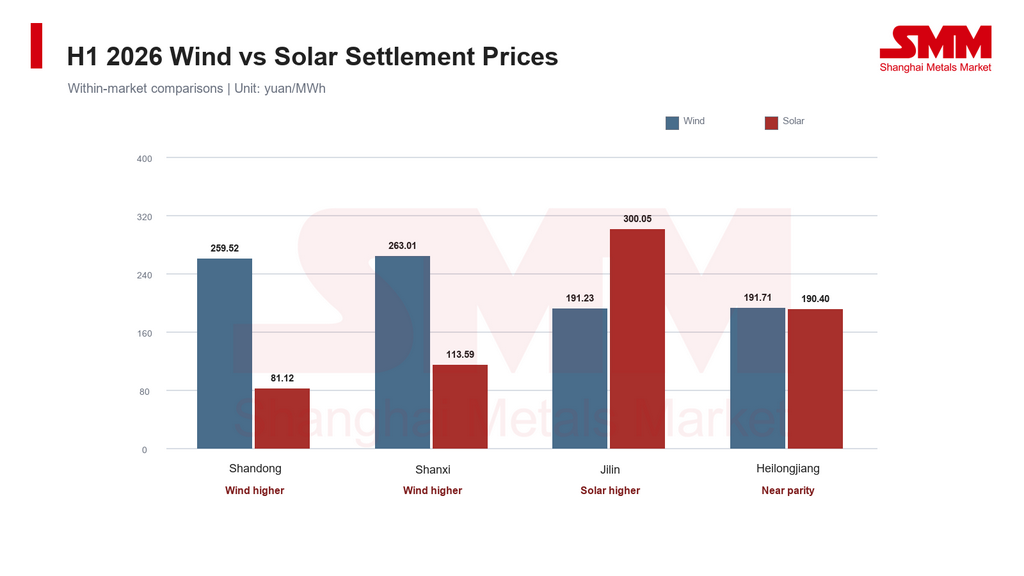
Each comparison is made within the same regional market. Differences in generation profiles and contract positions affect settlement outcomes, and wind does not consistently settle above solar in every market.
One useful measure of time-of-day value is the solar capture price: the spot price weighted by solar generation in each settlement interval. It measures how closely actual solar output aligns with the price curve. Long-term contracts and imbalance settlement must then be considered to explain the final settlement result.
If the highest prices occur in the evening, when conventional solar output is limited, those prices do not automatically translate into higher solar revenue. Improving the alignment between actual output and executable sales arrangements matters more than waiting for the market-wide average price to rise.
Sichuan's wet-season decline exposed the limits of a half-year average
Sichuan recorded 9.804 TWh of solar generation in the first half, with an average settlement price of $45.03/MWh (304.04 yuan/MWh). The monthly curve remained relatively high from January through April, then declined visibly in May and fell further in June. The transition into the wet season shifted the price centre lower and exposed operating pressure that the half-year average did not capture.
Over the same period, Sichuan's hydro settlement price fell from $57.68/MWh (389.46 yuan/MWh) in January to $23.88/MWh (161.25 yuan/MWh) in June. Hydro generation reached 23.293 TWh in June, accounting for approximately 78.5% of the province's total generation of 29.679 TWh. Rising hydro output coincided with lower solar prices, highlighting the effect of seasonal supply changes on the power market.
Solar projects in hydro-heavy regions should therefore incorporate inflow conditions and the transition between dry and wet seasons into their operating plans. High-price months may support a strong half-year average without guaranteeing comparable selling conditions in the rest of the period.
Companies can use separate dry-season and wet-season price scenarios in monthly budgets and assess cash flow alongside their contract positions. This provides a more useful view of seasonal revenue risk than a single annual price assumption.
Trading optimisation and solar-plus-storage require project-level modelling
Lower solar settlement prices are increasing the incentive to optimise sales strategies. Utility-scale projects need to coordinate medium- and long-term contracts, output forecasting and spot-market participation. Commercial and industrial distributed solar projects must also consider daytime customer load, self-consumption ratios and power-purchase contract performance.
Storage can shift the timing of electricity sales, but its value depends on the executable charge-discharge price spread. The difference between average wind and solar settlement prices is not a storage arbitrage margin.
Project models should include round-trip efficiency, available cycles, degradation, capital and operating costs, and the foregone revenue of solar electricity used for charging. Solar-plus-storage creates durable economic value only when incremental revenue covers these incremental costs.
In volatile markets, developers should compare storage, contract changes and higher on-site consumption within the same evaluation framework. The best option will depend on the project's actual load profile, grid-connection conditions and eligible market products.
Output timing and seasonal conditions will remain key in H2 2026
SMM believes the first-half results show that solar operations are shifting from volume-only management toward coordinated management of volume and price. The share of generation exposed to low-price hours, contract execution and monthly cash flow should become standard operating metrics.
In the short term, seasonal demand, hydro inflows and renewable output will continue to shape regional price curves. Over the medium term, new flexibility resources, interprovincial trading conditions and electricity demand growth will influence midday supply-demand balances and the market value of solar generation.
New projects should test multiple price and offtake scenarios during feasibility studies. Existing projects should adjust trading and operating strategies using actual settlement results. Stronger time-of-day sales capabilities, combined with efficient plant operations, can help stabilise performance through price volatility.
![Tariffs Mount, Market Access Tightens: Can US Solar Keep Growing? [SMM Analysis]](https://imgqn.smm.cn/usercenter/CpbPE20251217171736.jpg)

![High-Power Demand Improves, but Weak Orders Keep Global PV Module Prices Rangebound [SMM Analysis]](https://imgqn.smm.cn/production/admin/votes/imageswRRpR20260918163233.png)