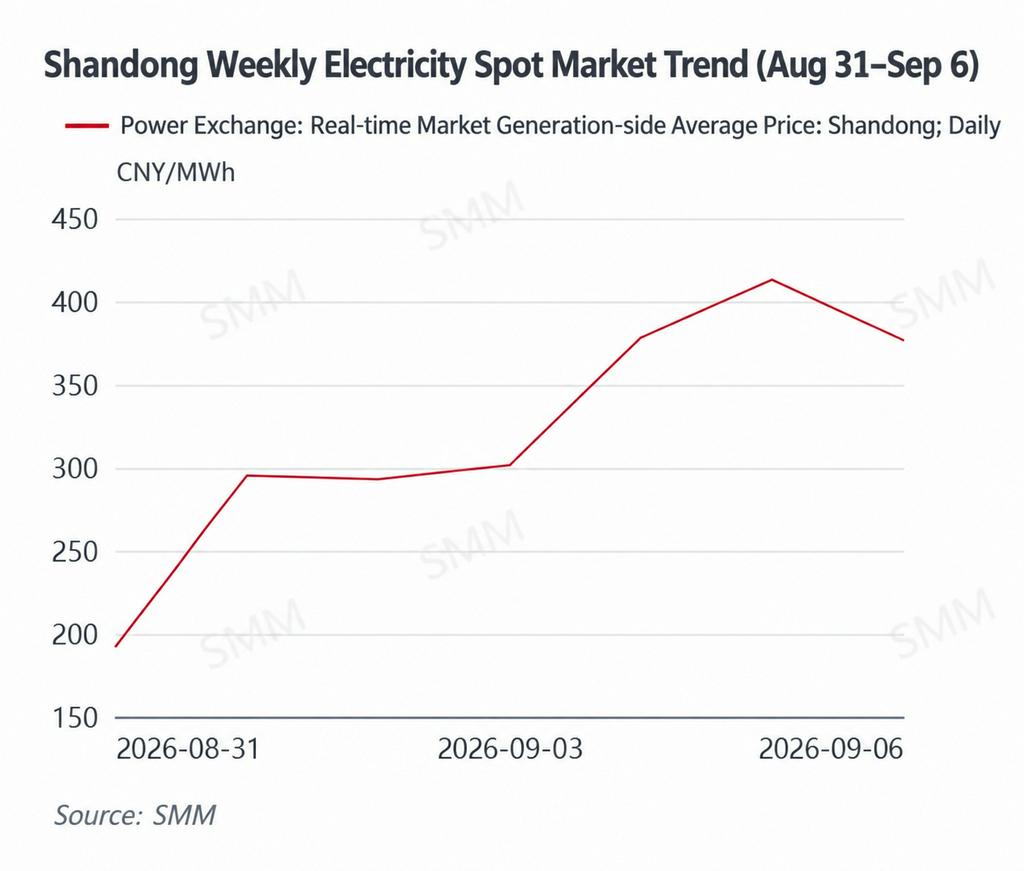
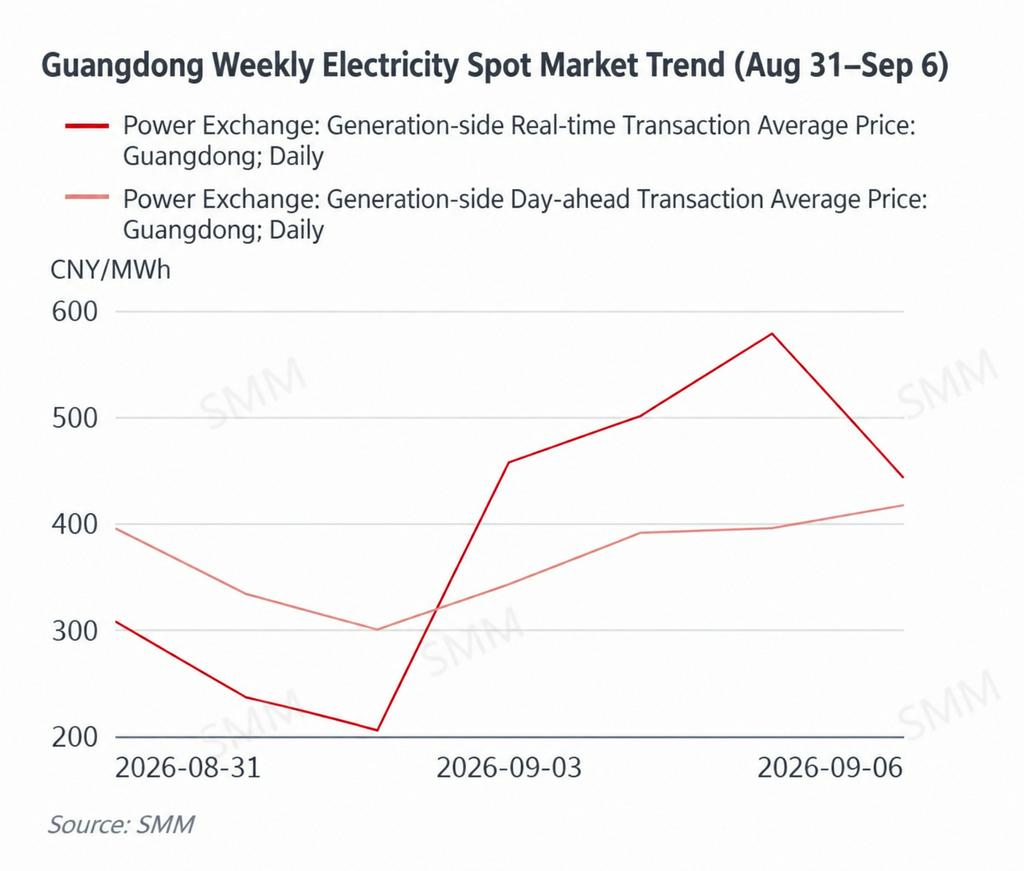
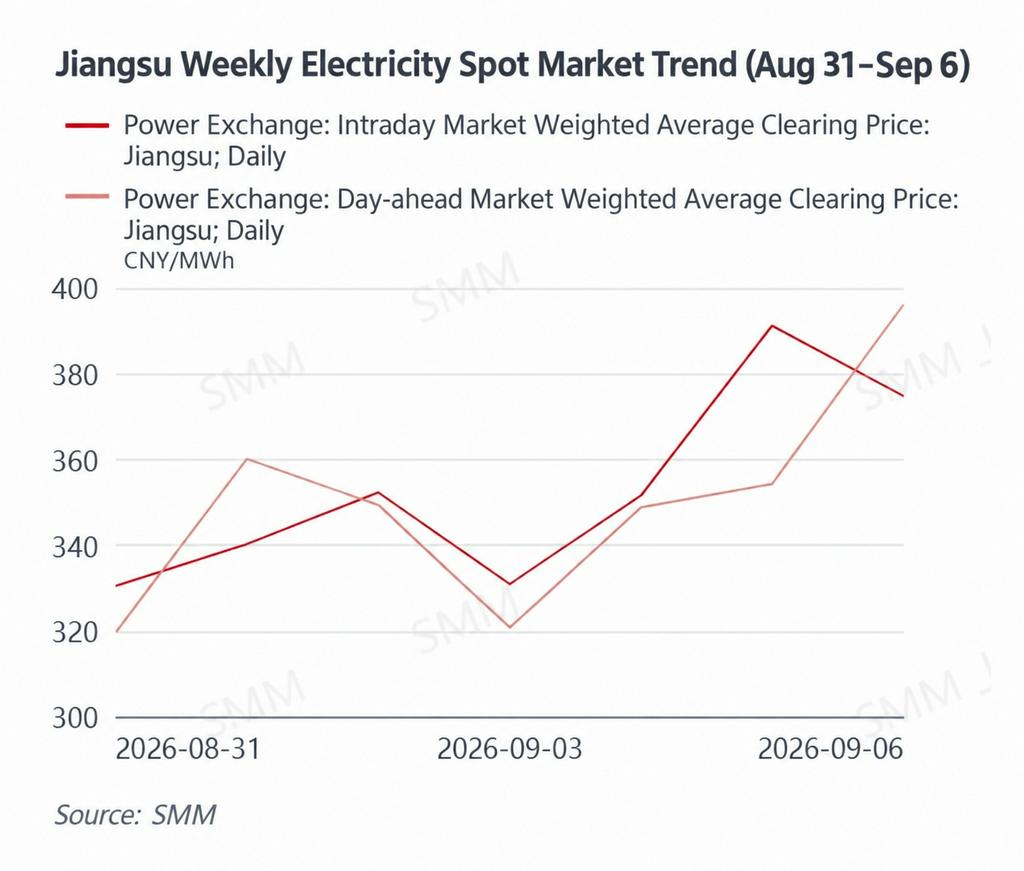
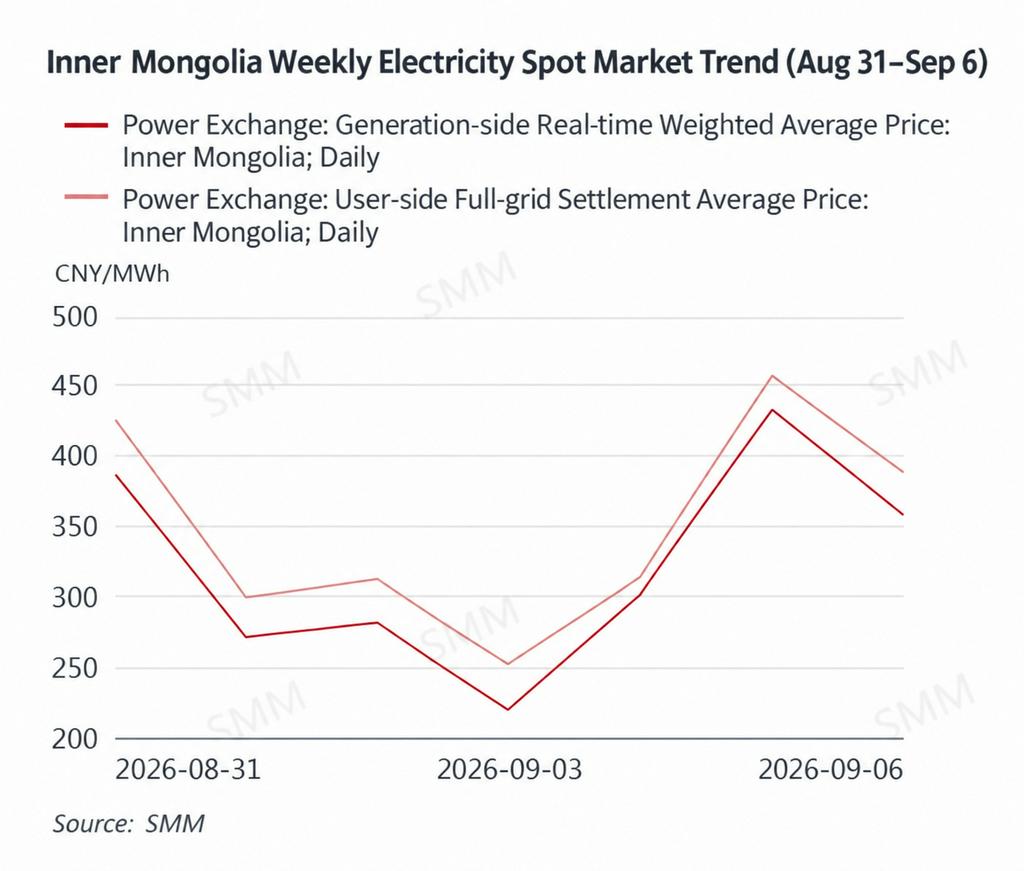
During August 31-September 6, weather conditions across China underwent a clear transition, with temperatures gradually falling in northern regions while East and South China remained exposed to typhoon-related rainfall. Typhoon No. 18 “Saudel” became the most notable weather event of the week. After weakening and being declassified on August 30, its residual circulation moved into the South China Sea, re-intensified into a named typhoon on September 1, and made its third landfall near Gulei, Zhangpu County, Fujian on September 3, marking a rare episode involving two separate classifications and three landfalls. Against this backdrop, changes in weather, renewable generation and primary-energy costs drove wide swings in provincial spot power prices. Shandong's real-time average rebounded from a low of RMB 192/MWh to RMB 376/MWh by the weekend; Guangdong's real-time price surged from a low of RMB 206/MWh to RMB 578/MWh; Jiangsu's day-ahead and intraday prices strengthened in the latter half of the week; western Inner Mongolia saw real-time generation-side prices fluctuate between RMB 220-432/MWh; Shanxi's day-ahead price climbed to RMB 427/MWh on September 5 before retreating; while Shaanxi's day-ahead market remained subdued even as its real-time price rose to RMB 407/MWh over the weekend. On the fuel side, CCTD Qinhuangdao 5,500 kcal/kg thermal coal reached RMB 741/mt as of September 4, with supply constraints, higher transport costs and falling port inventories strengthening support for coal-fired generation costs. Available SMM China LNG arrival prices ranged from $24.61-25.91/MMBtu, while the eastern Guangdong LNG price remained unchanged at RMB 5,860/mt. As September begins and heat-driven demand fades, renewable output, primary-energy costs and deviations between day-ahead forecasts and real-time system conditions are becoming increasingly important drivers of power prices.
Shandong prices fell first and then rebounded, as strong renewable generation depressed early-week prices while higher coal-fired generation costs limited further downside. The province's real-time generation-side average started at RMB 191.87/MWh on August 31, recovered to RMB 295.10-301.31/MWh during September 1-3, then strengthened sharply to RMB 412.94/MWh on September 5 before ending the week at RMB 376.43/MWh. The weekly average was approximately RMB 321.24/MWh. Cooling demand weakened substantially from August's heatwave levels, while relatively clear weather supported solar generation and loosened midday supply-demand balances, contributing to the low prices early in the week. Meanwhile, CCTD Qinhuangdao 5,500 kcal/kg thermal coal rose to RMB 741/mt, lifting the cost base of coal-fired units and providing support to their offer floors. As a result, despite weaker heat-driven load, prices did not remain depressed, and changes in renewable generation and system demand drove a rapid recovery later in the week.
Guangdong posted a deep V-shaped reversal, as Saudel-related rainfall initially suppressed load before real-time prices surged as weather conditions improved. The day-ahead average fell from RMB 394.81/MWh to RMB 299.82/MWh on September 2 before recovering to RMB 415.08/MWh on September 6. Real-time prices were even more volatile, declining from RMB 306.81/MWh to RMB 205.59/MWh on September 2 before surging to RMB 578.06/MWh on September 5 and remaining elevated at RMB 443.57/MWh on September 6. During September 1-3, Saudel and its outer circulation brought substantial rainfall to eastern Guangdong, temporarily reducing air-conditioning demand. As rainfall weakened from September 5, temperatures and electricity demand recovered, quickly tightening real-time balances. Higher thermal coal prices provided some support to coal-fired units, but the eastern Guangdong LNG price remained stable at RMB 5,860/mt, indicating that the recent rise in international LNG prices had yet to be transmitted materially into domestic gas costs. Guangdong's sharp power-price swings therefore remained primarily driven by weather, real-time load and generation availability rather than fuel costs alone.
Jiangsu prices strengthened after a volatile start, as higher coal-fired generation costs provided support despite fading summer demand, while supply-demand conditions tightened later in the week. The day-ahead weighted average rose from RMB 319.71/MWh to RMB 396.10/MWh on September 6, averaging around RMB 349.91/MWh for the week. Intraday prices increased from RMB 330.54/MWh, reached RMB 391.22/MWh on September 5 and remained at RMB 374.84/MWh on September 6, with a weekly average of approximately RMB 353.11/MWh. Rainfall and cooling caused by typhoon circulation and cold air weakened air-conditioning demand at the beginning of the week. As rainfall subsided, resilient industrial electricity consumption and changes in renewable generation tightened the market again. At the same time, rising thermal coal prices lifted the cost floor for coal-fired marginal generation. The combination of lower weather-driven demand and higher generation costs meant that Jiangsu prices did not fall in tandem with temperatures and instead strengthened during the latter half of the week.
Inner Mongolia remained highly volatile, with wind and solar generation still the primary driver while stronger coal prices amplified price sensitivity when renewable output weakened. The generation-side real-time weighted average fell from RMB 385.83/MWh to a weekly low of RMB 220.04/MWh on September 3, then rebounded rapidly to RMB 432.29/MWh on September 5 before easing to RMB 358.12/MWh on September 6. The user-side systemwide arithmetic average moved in tandem, declining from RMB 424.26/MWh to RMB 253.17/MWh before recovering to RMB 455.99/MWh. Weekly averages were approximately RMB 321.48/MWh on the generation side and RMB 349.31/MWh on the user side. Given western Inner Mongolia's large wind and solar fleet, real-time prices remain primarily driven by renewable generation and outbound transmission demand. However, when renewable output falls and additional coal-fired units are called upon, higher coal costs raise marginal generation costs. The rebound from around RMB 220/MWh to above RMB 430/MWh therefore illustrates the combined impact of renewable volatility and stronger coal-fired cost support.
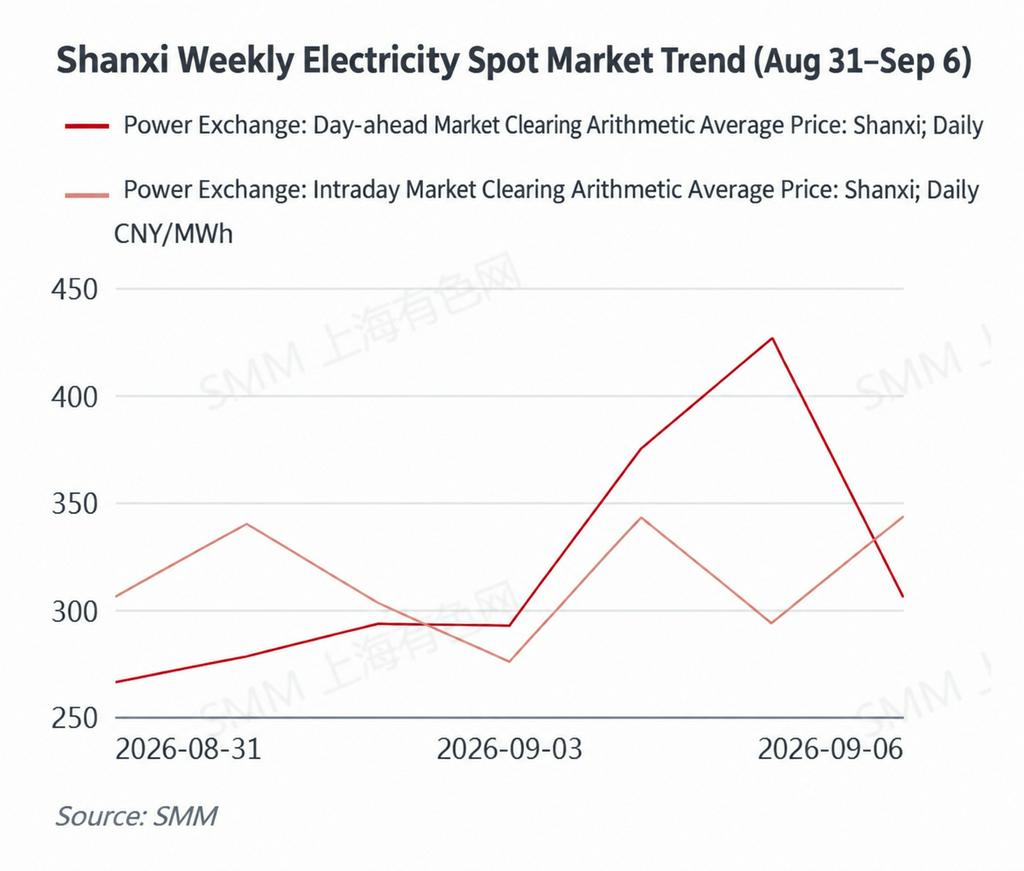
Shanxi surged before retreating, with firmer coal prices supporting the market floor while tighter day-ahead expectations were not fully realised in real-time trading. The day-ahead arithmetic average rose from RMB 266.17/MWh to RMB 374.80/MWh on September 4 and further to RMB 426.54/MWh on September 5, before falling back to RMB 305.91/MWh on September 6. The weekly average was approximately RMB 319.65/MWh. Intraday prices mainly traded between RMB 276-343/MWh, averaging around RMB 314.99/MWh. Shanxi remains heavily reliant on coal-fired generation, so rising thermal coal prices strengthen the cost floor for marginal generation and limit downside room in spot prices. However, on September 5 the day-ahead average exceeded the intraday average by more than RMB 130/MWh, indicating that expectations for tighter renewable output, load or interprovincial exports were not fully realised in actual system operations. Coal costs therefore provide more support to the lower bound of prices, while the short-term upside remains largely determined by real-time supply-demand conditions.
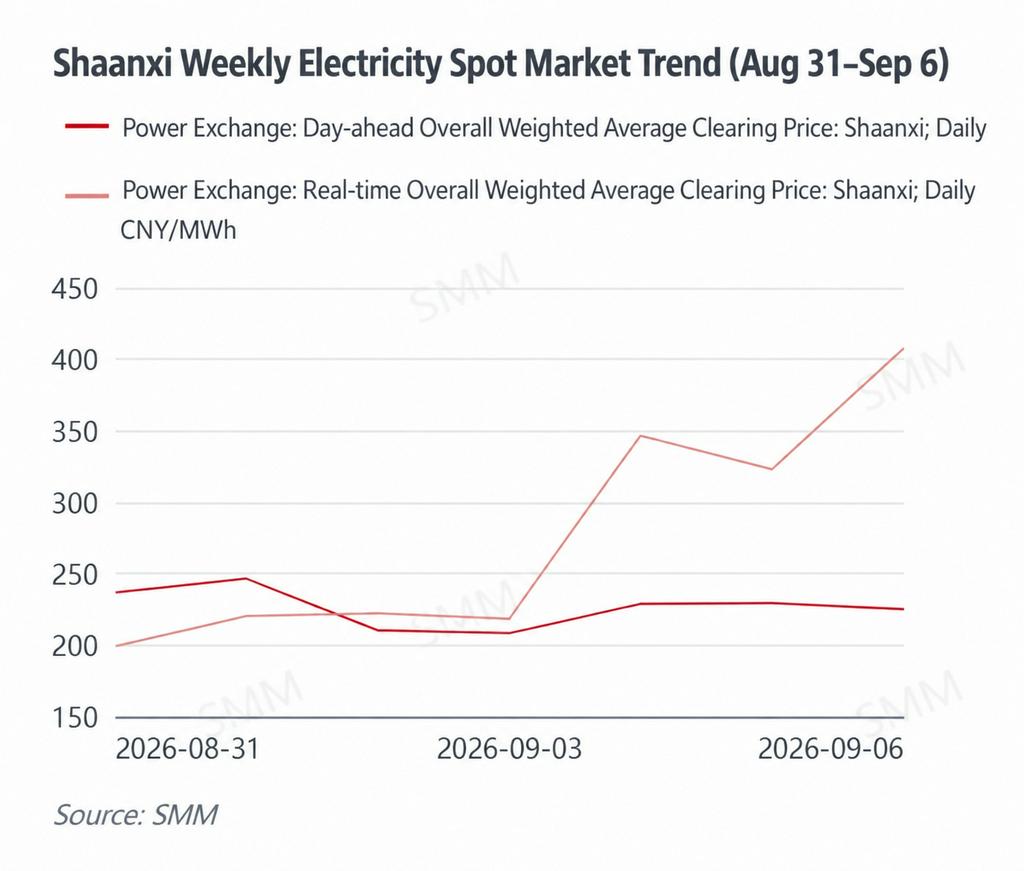
Shaanxi's day-ahead market remained subdued while real-time prices strengthened sharply later in the week, as higher fuel costs amplified the impact of renewable forecasting deviations. Day-ahead weighted averages mainly traded between RMB 208-246/MWh, averaging approximately RMB 226.61/MWh for the week. Real-time prices rose from RMB 199.42/MWh on August 31 to RMB 346.76/MWh on September 4 and further to RMB 407.46/MWh on September 6, resulting in a weekly average of around RMB 276.90/MWh. Ample renewable supply kept day-ahead prices low early in the week, while actual system conditions tightened materially relative to day-ahead forecasts later in the period. At the same time, higher thermal coal prices increased the marginal cost of coal-fired generation. During hours when renewable output underperformed and coal-fired units were dispatched more heavily, the higher fuel-cost base became more visible. The week's price movement was therefore not simply a result of rising coal prices; rather, renewable forecast deviations increased the need for marginal thermal generation, with higher fuel costs amplifying real-time price movements.
Overall, spot markets across multiple provinces experienced wide price fluctuations this week. Heat-driven demand is gradually becoming less dominant, while the influence of renewable generation, primary-energy costs and real-time supply-demand deviations is increasing. Shandong started the week at low levels amid strong solar output and weaker load, but rising coal-fired generation costs limited further downside. Guangdong recorded a deep V-shaped reversal under Saudel-related rainfall, while stable eastern Guangdong LNG prices meant that load and real-time system conditions remained the dominant drivers. Jiangsu strengthened later in the week despite cooler weather, highlighting the growing importance of coal-fired generation costs and changing system balances. Western Inner Mongolia, Shanxi and Shaanxi all showed varying degrees of interaction between renewable-generation volatility and thermal-generation costs. As temperatures continue to fall in September, coal costs, wind and solar output, interprovincial trading and deviations between day-ahead forecasts and real-time conditions will become increasingly important variables to monitor.
Primary Energy
August 31-September 6
Thermal coal: Supply constraints and port destocking reinforce each other, keeping prices firm.
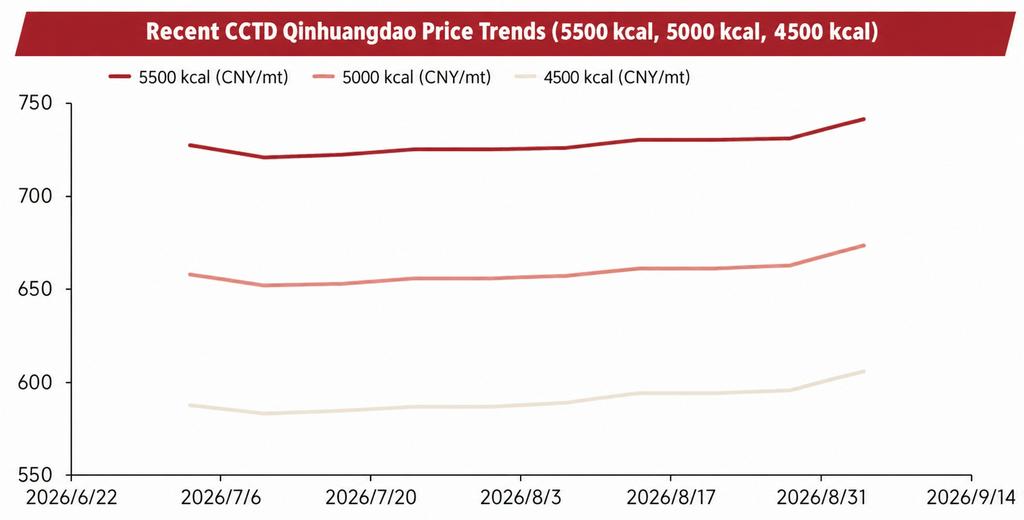
Thermal coal prices continued to rise this week. As of September 4, CCTD Qinhuangdao 5,500 kcal/kg coal stood at RMB 741/mt, up RMB 10/mt from August 28; 5,000 kcal/kg coal reached RMB 673/mt, up RMB 11/mt week on week; and 4,500 kcal/kg coal rose RMB 10/mt to RMB 606/mt. Despite the gradual decline in power-sector coal demand after peak summer, prices continued to strengthen, indicating that the market's main driver is shifting from peak-season demand toward tighter supply. Stricter safety inspections in major producing regions, temporary mine maintenance, higher transport costs and declining inventories at northern ports are jointly reinforcing price support.
Demand: With northern temperatures falling after the end of the hottest summer period, coastal power-plant coal burn is gradually moving down from its peak. However, intermittent high temperatures remain in parts of southern China, keeping thermal-power demand from falling too quickly. Metallurgical, chemical and other non-power sectors also maintain a degree of spot procurement. Nevertheless, power-plant inventory coverage has improved, long-term contract coal remains the main supply source, and spot purchases are largely limited to immediate requirements. End-users therefore remain cautious toward rapidly rising market prices, meaning demand is not the sole driver of the current rally.
Supply: Supply constraints have become an increasingly important driver of stronger coal prices. Safety supervision remains stringent across Shanxi, Shaanxi and Inner Mongolia, while maintenance and weather disruptions have constrained short-term mine production and outbound shipments. As mine-mouth prices rise, transport costs to northern ports have also increased, compressing trading margins on some routes and reducing merchants' willingness to move cargo to ports. Meanwhile, changes in overseas supply and freight costs have narrowed the price advantage of imported coal, limiting its ability to provide significant low-cost incremental supply and further supporting the domestic price floor.
Inventories: Inventories at northern ports continued to decline, tightening the availability of spot cargoes. With weaker inflows from producing regions while downstream buyers maintained a degree of lifting demand, inventories across major Bohai Rim ports remained under pressure. Although end-user inventories still provide a sufficient buffer, continued port destocking has strengthened sellers' willingness to hold firm on offers. Looking ahead, the seasonal decline in September power demand may limit the pace of further price increases. However, if production recovery remains slow and port inflows stay weak, thermal coal prices are likely to retain firm cost support in the near term.
LNG: China arrival prices remain elevated, while eastern Guangdong prices have yet to follow higher.
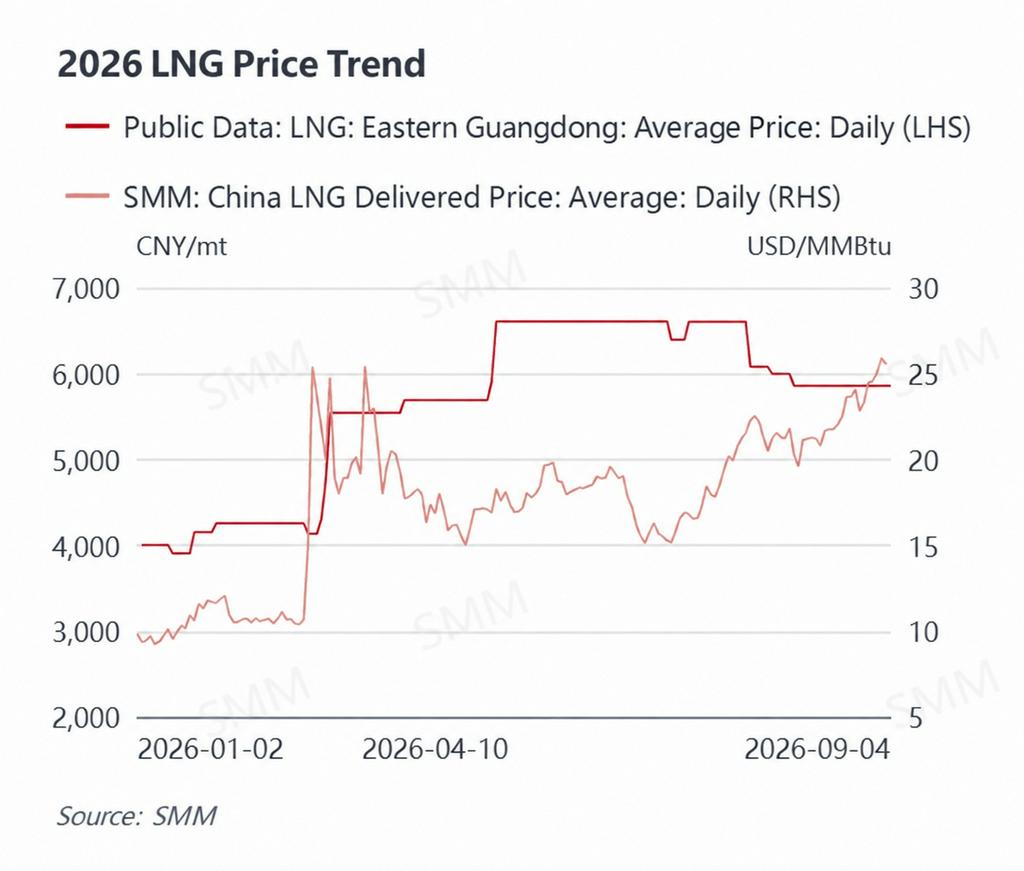
SMM China LNG arrival prices remained elevated this week. Prices stood at $24.61/MMBtu on August 31, rose to $25.06/MMBtu on September 1 and further to $25.91/MMBtu on September 2, before edging down to $25.54/MMBtu on September 3. The price centre remained higher than in late August. In contrast, the eastern Guangdong LNG average stayed unchanged at RMB 5,860/mt, indicating that higher international spot prices have not yet been materially transmitted to domestic end-user prices. International gas markets remain supported by supply risks and expectations for winter restocking, while China's domestic market remains in the traditional off-season. Long-term LNG contracts and pipeline gas are also buffering demand for spot imports. Fuel costs for gas-fired generation in Guangdong therefore remain broadly stable for now, although prolonged strength in overseas LNG prices could eventually raise import costs and lift the marginal cost of gas-fired power generation.
Weather Review
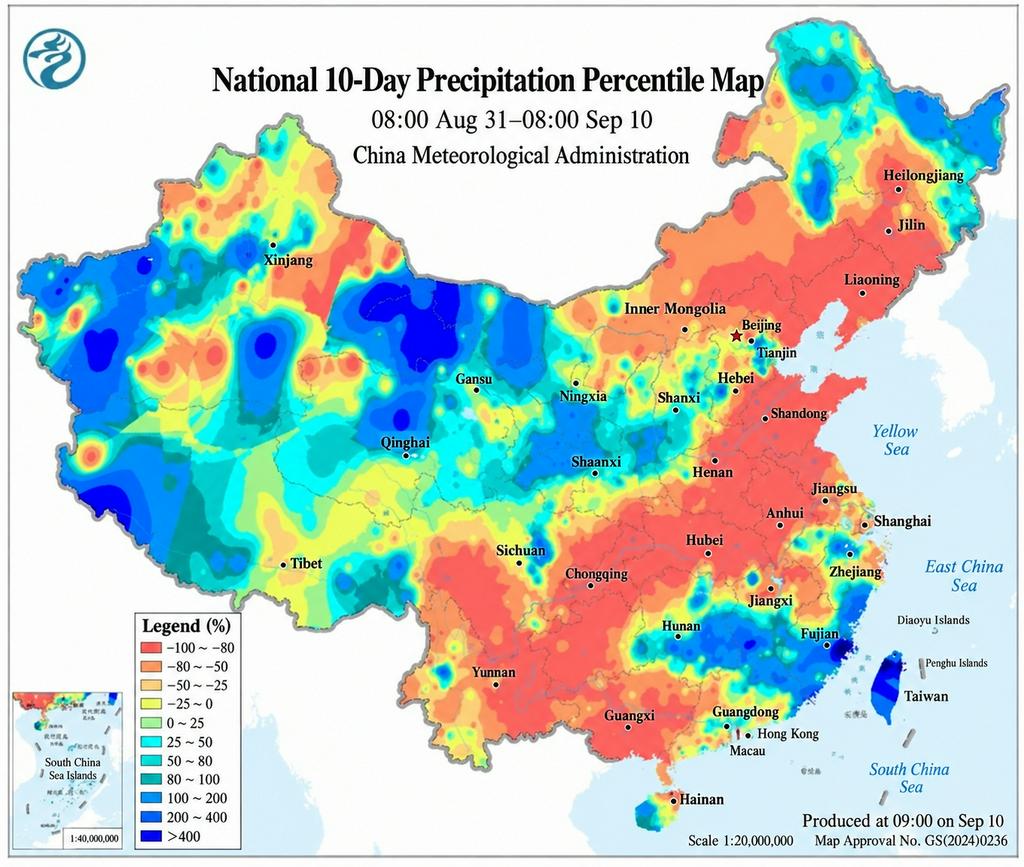
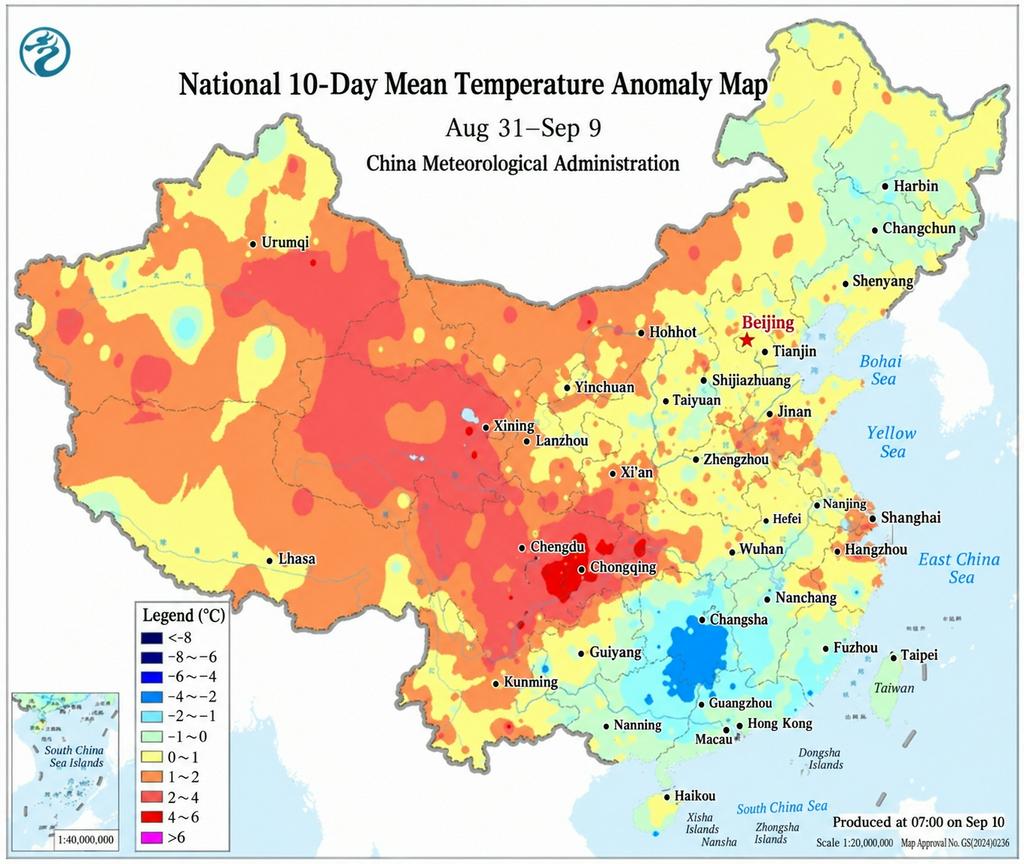
During August 31-September 6, China's weather pattern shifted from peak-summer heat toward cooler conditions in the north and typhoon-related rainfall in the south. Typhoon No. 18 “Saudel” weakened and was declassified on August 30, but its residual circulation subsequently moved into the South China Sea and re-intensified into a named typhoon on September 1. At 06:30 on September 3, it made its third landfall near Gulei, Zhangpu County, Fujian, before moving westward and gradually weakening. Over its full life cycle, Saudel experienced three landfalls, two classifications and two declassifications, an unusually complex evolution.
Saudel's residual circulation, monsoonal moisture and cold air brought persistent heavy rainfall to parts of East and South China, including Fujian, Guangdong, Zhejiang and southern Jiangsu, with some areas experiencing torrential rain. Shandong's maximum temperatures were generally around 30-33°C during the week, marking a clear retreat in heat-driven load. Guangdong gradually warmed again after the typhoon's influence weakened later in the week, while Jiangsu experienced more rainfall early in the period before conditions improved. Looking ahead, strengthening cold-air activity is expected to further reduce the contribution of temperature to nationwide power demand. However, autumn typhoons and severe convective weather may continue to amplify short-term spot-price volatility by simultaneously affecting both electricity load and renewable generation.
II. Domestic Power Market News
On August 31, the General Department of the National Energy Administration released the Notice on Soliciting Public Comments on the Revised Measures for Information Disclosure by Power Supply Enterprises. The revision further improves the existing Measures for Information Disclosure by Power Supply Enterprises (Guonengfa Jianguan Gui [2021] No. 56), with the consultation period lasting 30 days from publication. The revision focuses on improving the standardisation and transparency of information disclosure by power suppliers. As the number of market-based users, retailers and new market participants continues to increase, better disclosure should reduce information asymmetry and strengthen users' access to information on electricity supply services and related charges.
On August 31, the Central China Regulatory Bureau of the National Energy Administration released an update on the first month of interprovincial power mutual-aid trading among the four eastern provinces of Central China. Henan, Hubei, Hunan and Jiangxi launched continuous settlement trial operations for mutual-aid trading on July 1. During July, 653 market participants completed transactions, with trading volume exceeding 500 million kWh and maximum interprovincial mutual-aid power reaching 3.533 GW. Twenty-nine energy-storage stations and one virtual power plant were cleared in the market, while 327 renewable generators increased outbound generation by nearly 100 million kWh that otherwise could have been curtailed. Short-term interprovincial markets are therefore expanding from conventional generation-based balancing toward participation by renewables, storage and virtual power plants.
On September 4, the National Development and Reform Commission released the Announcement on Soliciting Public Comments on the Draft Measures for the Administration of Electricity Retailers. The draft further improves the existing framework for electricity-retailer administration, with greater emphasis on registration, performance guarantees, information disclosure and operational risk management. As spot-price volatility increases, retailers' competitiveness will increasingly depend on medium- and long-term contract management, load forecasting and management of spot-market exposure rather than simple wholesale-retail price spreads.
On September 4, the State Council published the revised Regulation on Emergency Response, Investigation and Handling of Electric Power Safety Accidents. The revised regulation further standardises emergency response and accident investigation procedures while strengthening safety responsibilities for relevant market participants. As renewable generation, new energy storage and other grid-connected resources expand rapidly, clearer safety responsibilities will help reinforce coordination between market-based operation and power-system security.
On September 4, the National Energy Administration released the Announcement on Newly Registered Renewable Power Generation Projects Nationwide in July 2026 (Excluding Residential Distributed PV). A total of 4,276 renewable projects were newly registered in July, including 38 wind projects, 4,236 solar projects and two biomass projects. Industrial and commercial distributed PV accounted for 4,207 projects. Continued expansion of distributed renewable generation will increase midday renewable-integration and short-term balancing pressure on distribution grids, further raising the importance of energy storage, demand response and retail-side load management.