H1 Review: From Surplus Comfort to Tight Balance, With Energy Storage Being the Swing Factor
China's lithium carbonate market spent the first half of 2026 oscillating in a wide band, with the monthly average price trading in a broad band of roughly 149,600 to 177,000 RMB per metric ton. The rally wasn't a simple supply-crunch story. Maintenance shutdowns at salt lakes and refineries, plus mine-side disruptions, clipped supply at the margin — but it was the relentless expansion of EV and energy-storage battery demand that pulled the market from comfortable surplus into tight balance.
On the demand side, EV batteries remain the bedrock of lithium consumption, but energy storage was the more important marginal driver in H1. Global NEV sales reached about 10.25 million units in the first half, up 14% year on year; China domestic sales came in around 7.4 million, up 7%. China's power-battery output hit roughly 790 GWh over the same period, up 43%, with LFP's share of power cells climbing to 76% from 66% a year earlier. Meanwhile, global energy-storage cell shipments totaled 486 GWh in H1 — 263 GWh in Q2 alone, up 17.9% quarter on quarter — with monthly shipments rising from 71 GWh in January to 86 GWh in June.
EV growth layered on top of surging storage demand kept LFP production schedules running hot, and that demand propagated straight up the chain to lithium carbonate. Inventories, meanwhile, shifted from the steady destocking trend of 2025 to structural swings driven by heightened price sensitivity — the battle between upstream and downstream over inventory and purchasing rhythm intensified noticeably.
Right Now: Supply Has Recovered. So Has Demand. The Near-Term Gap Is Still Open.
The market's logic has changed heading into Q3. Earlier maintenance and supply disruptions are fading, and the industry's real conern is no longer "is there supply" — it's whether the pace of supply recovery can outrun the pace of demand growth.
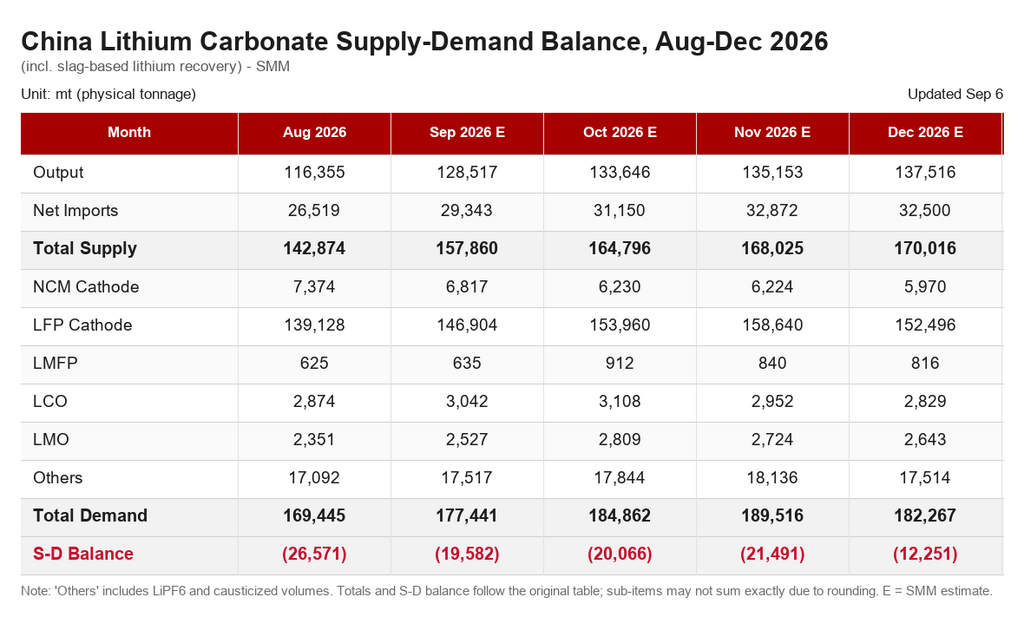
The supply-side recovery is quite clear. SMM data shows domestic lithium carbonate output of about 116,400 mt in August, up 7% month on month. As maintenance wraps up across spodumene, lepidolite and salt-lake operations, September output is expected to climb a further 11% to 128,500 mt. Imports are adding to the flow: July imports hit 26,800 mt, up 30% month on month and 93% year on year, and September net imports are projected at roughly 29,300 mt. That puts total September supply at 157,900 mt, up from 142,900 mt in August.
However, demand hasn't rolled over despite elevated lithium prices.
At the end market, NEV sales rebounded month on month in August after a July dip, and September brings the traditional peak season plus a wave of new-model deliveries. Power-battery demand should keep improving. This leg of auto demand, though, looks more like seasonal repair than a return to a high-growth cycle. Storage, by contrast, remains remarkably resilient: SMM expects September storage-cell output of 94.47 GWh, with grid- and generation-side plus C&I storage still the main sources of demand.
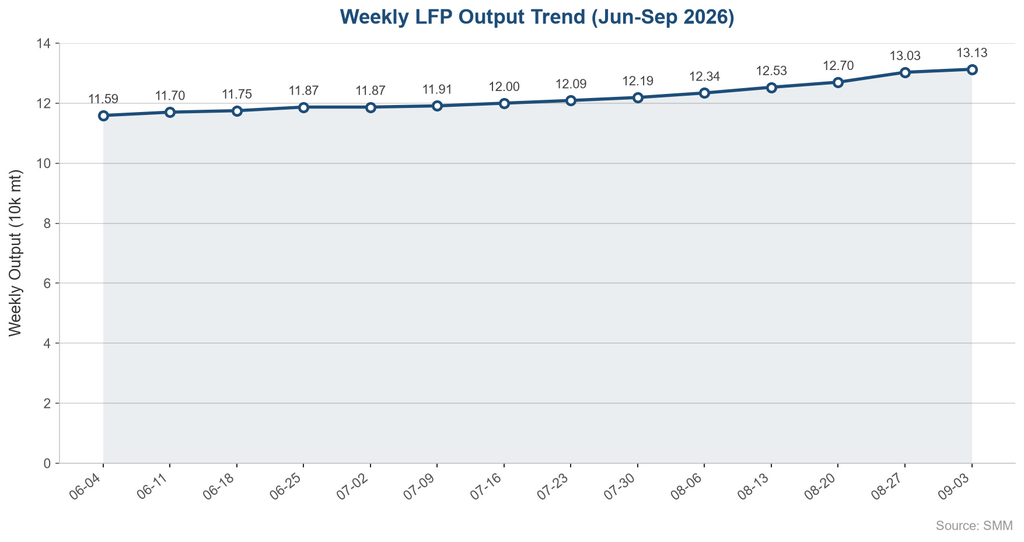
End demand is feeding through to cells and cathodes. China's domestic cell output kept climbing in August, led by LFP power cells. On the cathode side, LFP output rose 7.8% month on month in August and is expected to top 610,000 mt in September. The takeaway: today's LFP strength isn't an auto-only story. It's peak-season EV repair plus a still-booming storage sector — with storage supplying the bigger marginal push.
That explains the state of the lithium carbonate spot market. August prices moved sideways with a slightly lower center of gravity — the monthly average slipped about 2% — but there was no trending decline. Upstream sellers, with some lines still under maintenance and limited spot tonnage circulating, are holding back offers. Downstream buyers have turned sharply more price-sensitive: buying appetite is strong below 150,000 RMB/mt.
H2 Outlook: From End Market to Lithium Salt, the Increment Still Runs Through LFP
Estimating the second half of the year requires looking at end demand, not just lithium-salt output.
On the EV side, China's NEV market is expected to follow a "Q3 stabilization, Q4 peak-season" recovery pattern. Domestically, pressure should ease as the payback effect from 2025's pulled-forward demand gradually digests. Overseas, growth in emerging markets across Southeast Asia, Latin America and the Middle East — plus dealer restocking — should keep exports running strong. H2 power-battery installations are expected to come in well above H1: passenger vehicles provide the base, commercial vehicles the upside.
Storage remains the bigger incremental engine. Global storage-cell demand is expected to keep growing briskly in H2, anchored by grid/generation-side and C&I applications — while 500Ah+ large-capacity cells are completing customer qualification and moving into delieveries with scale.
That demand will keep propagating up the "end market → battery → cathode → lithium carbonate" chain. On SMM's current forecasts, monthly lithium carbonate demand for LFP cathode production rises from 139,100 mt in August to 146,900 mt in September and 154,000 mt in October, reaching roughly 158,600 mt in November. This single application now accounts for more than 80% of total lithium carbonate demand — it is the variable that decides the H2 balance.
Supply will grow in parallel. SMM sees domestic output rising from 116,400 mt in August to 137,500 mt by December, with net imports climbing from around 26,500 mt to roughly 32,500 mt — taking total supply from 142,900 mt to 170,000 mt. But on current end-market and production scheduling assumptions, October–December demand is projected at 184,900 mt, 189,500 mt and 182,300 mt respectively — implying deficits of roughly 20,100 mt, 21,500 mt and 12,300 mt.
The H2 story is already clear: It is not about whether lithium carbonate supply is growing, but whether LFP demand, pulled by both EVs and energy storage, can keep outpacing the supply recovery. On SMM's numbers, China's lithium carbonate market will run a deficit every month from August through December, and inventories will continue to fall.
Risk disclosure: Forecasts in this article are based on SMM's current assessment of supply, demand and inventories, and are subject to revision as actual market conditions evolve. This article does not constitute investment advice. Markets involve risk; decisions require caution.
![August hydromet plant scrap procurement volume down 6% MoM; losses coupled with tight supply [SMM Analysis]](https://imgqn.smm.cn/usercenter/ezoBg20251217171730.jpg)
![[SMM Analysis] September Peak Season Stockpiling Meets Rising Costs, Anode Prices Enter an Uptrend Channel](https://imgqn.smm.cn/usercenter/KySZv20251217171726.jpg)