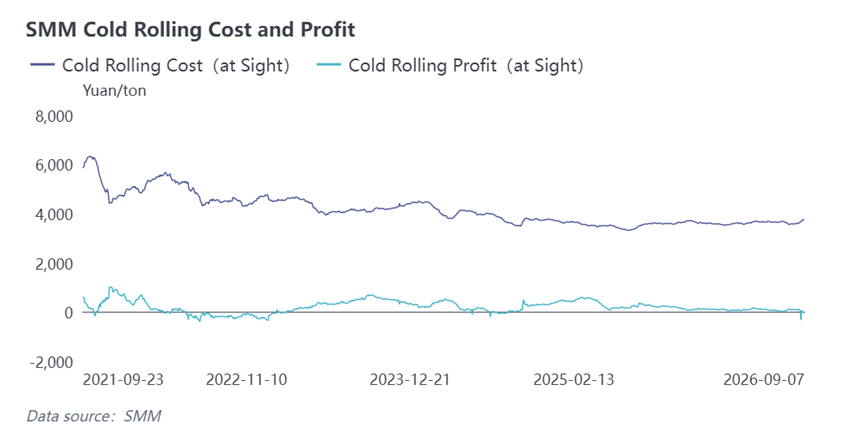
Based on SMM cold rolling spot cost-profit data, since 2021 the cost center of the cold rolling industry has continued to shift downward, and the room for industry profit fluctuations has kept shrinking, with the sector overall entering a long cycle of thin-margin operations. From 2023 to 2025, the industry still had periodic profit windows, with profits seeing phased recovery along with seasonal and raw material fluctuations. In 2026, however, the core contradiction in the cold rolling segment is concentrated in the cost side, where prices are consolidating at lows and edging up, while the demand side is constraining profit realization.
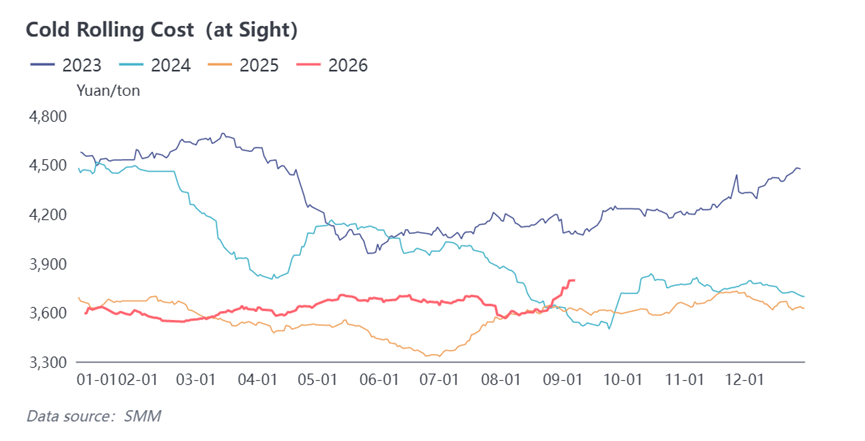
In 2026, the overall operating range of cold rolling spot costs is roughly 3,600-3,850 yuan/mt. Compared with the cost highs of 4,000-4,700 yuan/mt frequently seen in 2023, the cost pressure from raw materials this year has clearly eased. The cost trend during the year shows a pattern of drifting higher, with a relatively low base at the start of the year. Mid-year, costs edged up slightly as war-related factors and high domestic supply pushed up upstream raw material prices, but overall costs remained in the lower percentile of the past four years, with no sharp spike. From a cost perspective, cold rolling profits at steel mills should have been in a fairly favorable range this year.
However, the dividend of lower costs has not been effectively converted into tangible processing profits for cold rolling enterprises. Looking back at the 2026 profit curve, for most of the year, cold rolling spot profits hovered narrowly around the breakeven line, with very limited profit thickness, making it difficult to see the substantial profits of several hundred yuan seen in previous years. Mid-year, profits quickly broke below the zero axis, resulting in phased losses. Even though there was some rebound later, it only returned to marginal profit levels, with the recovery notably weaker than the same periods in 2024 and 2025.
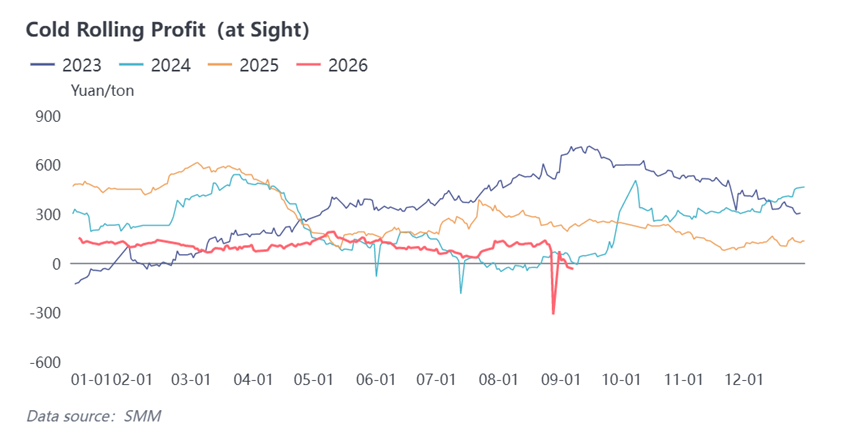
Comparing historical years, in 2023, driven by a phased downstream recovery, cold rolling enjoyed a relatively long profit window. In 2024-2025, a clear wave of profit recovery would also appear as the downstream peak season arrived. In contrast, in 2026, even though raw material costs were not high, actual demand release from core downstream consumer industries such as automobiles and home appliances remained mild, finished product market transactions were weak, and cold rolling prices lacked sufficient upward transmission capacity. Changes in raw material costs can improve the cost floor, but end-use demand determines finished product selling prices. The potential gains from low-cost operations have been continuously eroded by sluggish demand and low finished product quotes.
From the current standpoint, the cold-rolling industry can hardly achieve sustained profit improvement by relying solely on lower raw material costs. The year 2026 has already fully confirmed this: cost conditions are moderate, but with weak demand, steel mills can only maintain thin profits or even suffer periodic losses. For cold-rolling profits to improve substantially going forward, the key still lies in a genuine recovery in downstream end-use demand, which would drive cold-rolled product prices higher and open up room for processing margins to recover.
![[ Mineral Resources' Onslow Iron Sustains 35 Million Tonne Capacity ]](https://imgqn.smm.cn/usercenter/hyiDc20251217171715.jpg)
![[ Canada Imposes 50% Retaliatory Tariffs on US Steel and Aluminum ]](https://imgqn.smm.cn/usercenter/mpffV20251217171715.jpg)
![[SMM Steel] Billet prices in Indonesia remain stable, but shipments are experiencing delays](https://imgqn.smm.cn/usercenter/VhIgs20251217171719.jpg)